WELL SOMETIMES.
BY SPENCER WOOD & ALEX HAMILTON
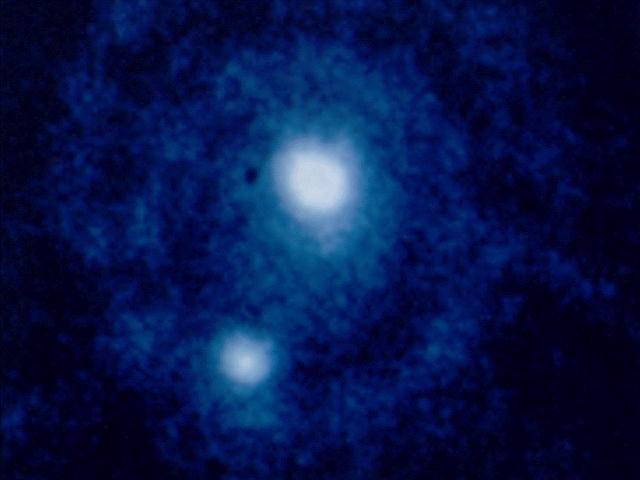
Photo of Pluto and its moon (false color)
Pluto from the Hubbell Telescope
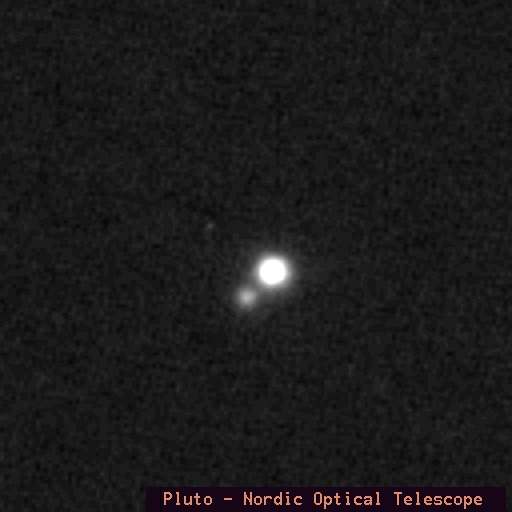
Pluto from the Nordic Optical Telescope
On February 18, 1930
a 24 year old self-taught astronomer sat concentrating through
the eyepiece of the
Blink-Comparator at the Lowell Observatory. Clyde Tombaugh
was searching for something
special, a dim little needle-in-the-haystack that had
eluded the keen eye
of the very founder of the observatory, the esteemed Percival
Lowell. To find it would
make history. It would also prove Lowell's calculations that
predicted a ninth planet
perturbing the orbits of Uranus and Neptune. Clyde Tombaugh was
pursuing the elusive
Planet X.
Back and forth he flipped
the shutter of the Blink-Comparator, a machine that presented his eye
with two photographs
of the identical field of stars taken several weeks apart. Clyde had been
at this nearly a year,
seeing nothing moving in the eyepiece. Suddenly, there it was, just as
Lowell had predicted
and searched for in vain for eight years himself. A faint speck jumped
between the stars. Only
a moving planet would do this, and this one was right where it should
be...or so it seemed.
On March 13, 1930, the
birthday of Percival Lowell, the Lowell Observatory announced the
discovery of Planet
X. Some, including his widow, thought the proof of the decades old
prediction justified
naming the planet after Lowell. But planets were traditionally named for
characters in
Greek and Roman mythology. So Planet X became Pluto, the name suggested
by
Venetia Burney,
a school girl in Oxford, England. Pluto, god of the underworld, with an
orbit
that takes 248
years to complete. It was a name that everyone could agree on, especially
since
the initials for
Pluto are PL, the same as Percival Lowell.
This would be the happy
end of the story, except for an increasing number of oddities that have
been accumulating over
the last sixty plus years. For one thing, we now know there never was
a Planet X. The calculations
were wrong.

Artists Rendition of Pluto
More Pluto
How's that? The slight
shift in the orbit of Uranus that astronomers couldn't fully
explain, even with the
discovery of Neptune in 1846, disappeared when careful
measurements were made
by the interplanetary spacecraft sent to the outer planets.
Almost as strange, astronomers
first assessed Pluto to be much larger and massive
than later observations
justified. It turns out that those observations proved that Pluto
is smaller than our
own moon and has a mass just two tenths of one percent of the
Earth. That's just a
fraction of what would be needed to account for the presumed
motion of Uranus that
started astronomers looking for a ninth planet in the first place.
What's more, Pluto's
orbit around the Sun is tilted compared to the other planets.
Mercury, Venus, Earth,
Mars, Jupiter, Saturn, Uranus and Neptune line up within a
degree or two of a flat
plane through the sun. Their orbits are nearly circular. Pluto's
path is tilted 17 degrees
to that plane and is so elliptical that for the 20 years from
1979 to 1999 Pluto has
actually been the 8th planet of the Solar System, closer to the
Sun than Neptune.
Some astronomers are
starting to take a skeptical view of little Pluto, wondering if
what Clyde Tombaugh
really discovered was a large comet instead of a small planet.
The composition of Pluto
is a core of rock and ice with a surface of methane ice and a
slight atmosphere of
nitrogen, methane and carbon monoxide. If Pluto's orbit was
even more elliptical,
it would enter the inner solar system and shoot out a comet-like
tail as the water and
gasses boil off from the heat of the sun.
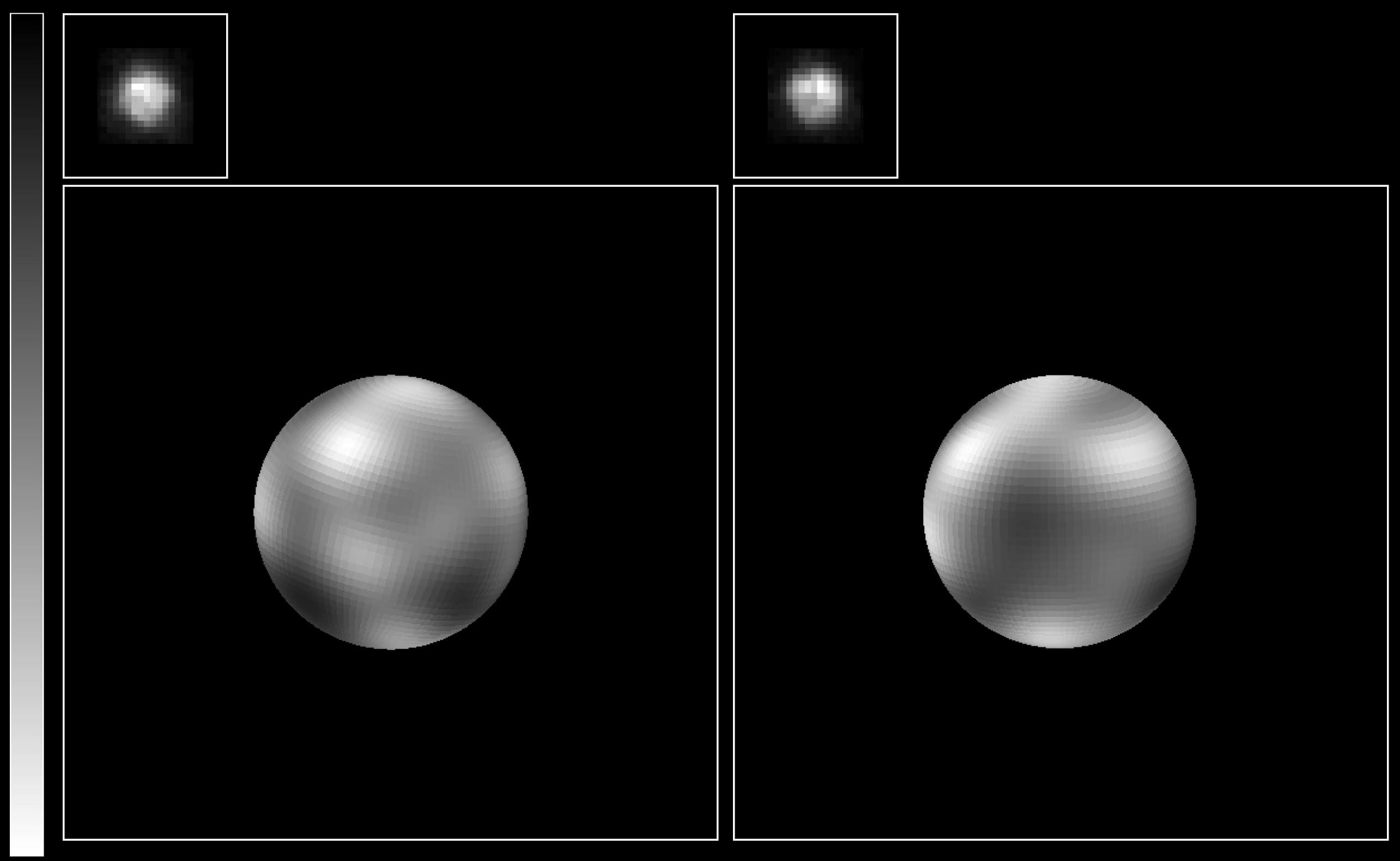
comparitive picturs of pluto
Then there is the matter of Pluto's moon, Charon. Charon is about half the size of Pluto itself and named, appropriately, after the mythological character who ferried the dead across the River Styx and into the underworld of Pluto. Pluto and Charon are almost a double planet system. They dance around each other, all the while showing exactly the same faces. Charon hangs motionless in the Pluto sky, and vice-versa.
There is a move afoot in astronomy to "demote" Pluto to a "minor planet" and consider it something of a large asteroid that was misclassified in the excitement of being found just where a planet was mistakenly expected. But...not so fast. The whole definition of what is a planet is somewhat murky to begin with. What scientists agree on is that a planet must orbit the Sun and be large enough that its own gravity pulls it into a spherical shape. Pluto easily meets that criteria. Besides, there is no definition as to composition. Jupiter, Saturn, Neptune and Uranus are gas giants. Mercury, Venus, Earth and Mars are rocky. Why not an icy-rocky planet?

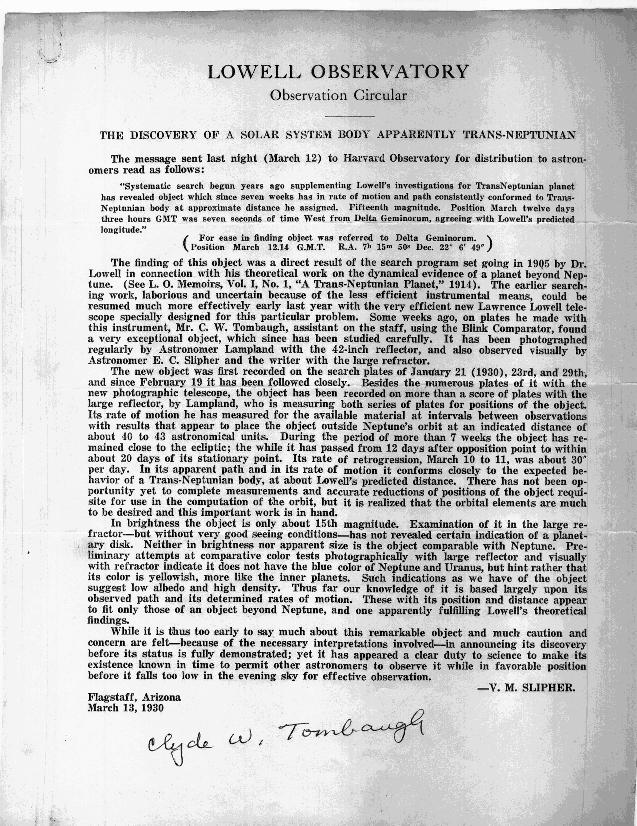
Document of Plutos discovory
For More Information about Pluto, Click Here.