Danny Johnson
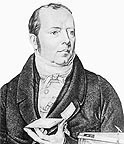


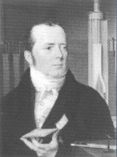
Hans Christian Oersted was born in 1777 and died in 1851. He grew up
in a very poor town called Rudkjöbing, which is on Danish land called
Langeland. They didn't have a lot of money and had to make do with what
they had (1).
He and a younger brother taught
themselves all they knew which took them all the way to the University
of Copenhagen in 1794. Hans was a Danish physicist who studied with his
brother and was very proud of him, and the experiments that they did together.
They went into the science profession and because there was a lot of Germans
around they learned a little of German philosophy. In 1806 when he
was 29 he became Professor of Physics and he continued to study at the
University of Copenhagen. Hans became interested in the powers of nature
and started to learn about how you could separate the makings of elements.
He studied for a long time to find the connection between electricity and
magnetism. There was nothing that confirmed the connection or even suggested
there was one.(2)(3)(4) 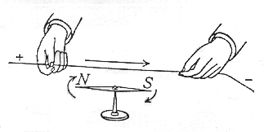
Then in 1820 he found it; he brought a compass
close to a wire carrying an electric current. The needle turned in a direction
and started to bend. Unlike other forces in nature; the force between the
electric wire the needle turned out to have nothing to do with the center
of the compass. After trying the experiment several times he demonstrated
this phenomenon to friends and students. He inspired lots of research by
some of his followers. Talking on the telegraph became possible
when the invention of electric impulses could be used to send signals
along a wire. That was based on what Oersted found out in 1819: An electric
current through wire makes a magnetic needle deflect. (6) (2),(3),(4)
Also, his literary and political interests
made him a a role model in Danish intellectual life. He also wrote a book
on how magnetism works with electricity, and developed a wire that produces
a strong magnetic field by electric waves. (2), (3)
 At that time the didn’t know allot abut aluminum because they had not been
able to separate them from other elements. So Hans preformed an experiment
that and was able to separate aluminum from other elements, But he tried
couldn’t repeat the experiment again. So other scientist kept on
trying to remove the to separate aluminum from other elements, then in
1845 a small amount of aluminum was removed. He also instructing other
experiments as well as separating elements, they separated aluminum, separated
pipeline, and chloride with potassium. (4),(5),(6)
At that time the didn’t know allot abut aluminum because they had not been
able to separate them from other elements. So Hans preformed an experiment
that and was able to separate aluminum from other elements, But he tried
couldn’t repeat the experiment again. So other scientist kept on
trying to remove the to separate aluminum from other elements, then in
1845 a small amount of aluminum was removed. He also instructing other
experiments as well as separating elements, they separated aluminum, separated
pipeline, and chloride with potassium. (4),(5),(6)
There are a lot of things that we wouldn’t know or it would have taken longer to find out.Taking the telegraph became becouse of the invention of electric impulses and they could be used to send signals along a wire. That was based on Oersted's findings in 1819. A electric current threw wire makes a magnetic needle deflect. (6)
Hans Christian Oersted did a lot of fascinating
things in his time and it taught us a lot of new things in science and
we would not have as much information about aluminum. There also wouldn't
be as much information on how electricity and magnetism are related.
Bibliography
1. Department of English. 4 May 2001
<http://www.english.upenn.edu/~jlynch/FrankenDemo/People/oersted.html>.
2. Hans Chrishian Oersted. 2 May 2001
<http://www.mac-med.com/M&C%20FILES/04maccs.html>.
3. http://www-istp.gsfc.nasa.gov/Education/whmfield.html
4. Hans Chrishian Oersted. 2 May 2001
<http://www.mac-med.com/M&C%20FILES/04maccs.html>.
5. Scientific discoverys. 9 May 2001 <http://www.angelfire.com/ks/oersted/sciencediscover.html>.
6. Hans Cristian Oersted. 4 May 2001
<http://www.comptons.com/encyclopedia/ARTICLES/0700/07041280_Q.html>.