Neptune
Neptune was held in higher regard as Neptune Equester, the god of horse-racing and horses. One of temples was located near the Circus Flaminius, one of the larger trace-tracks. Another sanctuary was in the Campus Martius (25 BC) were the Neptunalia was celebrated on July 23. The trident is Neptune's attribute.
Neptune is the eighth planet from the Sun and the fourth largest planet. Neptune is smaller in diameter but larger in mass than Uranus.
After the discovery of Uranus,
it was noticed that its orbit was not as it should be in accordance with
Newton's laws. It was
therefore predicted that another more distant
planet must be perturbing Uranus' orbit. Neptune was first observed by
Galle and d'Arrest on 1846 Sept 23 very near to the locations independently
predicted byAdams and Le Verrier from calculations based on the observed
positions of Jupiter, Saturn and Uranus. An international dispute arose
between the English and French (though not, apparently between Adams and
Le Verrier personally) over priority and the right to name the new planet;
they are now jointly credited with Neptune's discovery. Subsequent observations
have shown that the orbits calculated by Adams and
Le Verrier diverge from Neptune's actual orbit
fairly quickly. Had the search for the planet taken place a few years earlier
or
later it would not have been found anywhere near
the location.
Neptune has been visited by
only one spacecraft, Voyager 2, on Aug 25, 1989. Much of we know
about Neptune comes
from this single probe.
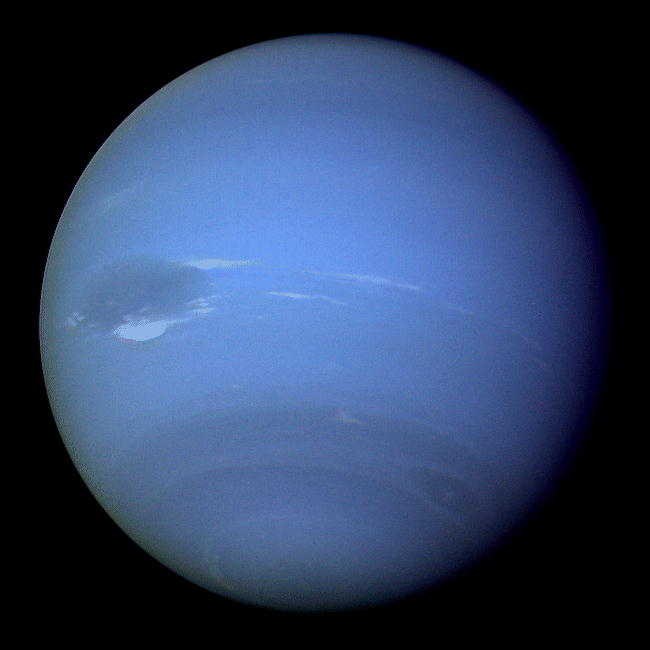
Neptune's blue color is largely the result of absorption of red light by methane in the atmosphere. Like Jupiter and Saturn, Neptune has an internal heat source -- it radiates more than twice as much energy as it receives from the Sun.
However, HST observations of Neptune
in 1994 show that the Great Dark Spot has disappeared! It has either dissipated
or is being masked by other aspects of the atmosphere. A few months later
HST discovered a new dark spot in Neptune'snorthern hemisphere. This indicates
that Neptune's atmosphere changes rapidly, perhaps due to slight changes
in the temperature differences between the tops and bottoms of the clouds.
Neptunes
Interior
For more pictures of Neptune, click here
For more web sites relating to Neptune, click
here