by:
Zack Lenz and Preston Kopp
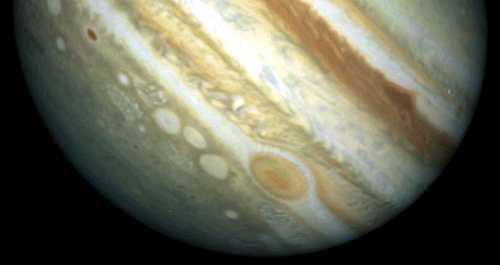
Jupiter as seen from Voyager 1
|
Orbit :
|
778,330,000 km (5.20AU) from Sun
|
|
diameter:
|
142,984 km (equatorial)
|
|
mass:
|
1.900e27 kg
|
Jupiter is the fifth planet from the Sun and by far the largest. Jupiter is more than twice as massive as all the
other planets combined (318 times Earth).Jupiter was the King of the Gods, the ruler of Olympus and the patron of the Roman state. Zeus
was the son of Cronus (Saturn).Jupiter was first visited by Pioneer 10 in 1973 and later by Pioneer 11, Voyager 1, Voyager 2 and Ulysses and Galileo which droped a probe into the atmosphere. The probe was crushed, but the data
from the Galileo probe indicate that the winds are even faster than expected (more than 400 mph) and extend down into as far as the probe was able to observe.
Jupiter and the other gas planets have high velocity winds which are confined in wide bands of latitude.
The winds blow in opposite directions in adjacent bands. Slight chemical and temperature differences
between these bands are responsible for the colored bands that dominate the planet's appearance. The light
colored bands are called zones; the dark ones belts. The bands have been known for some time on Jupiter,
but the complex vortices in the boundary regions between the bands were first seen by Voyager. ; they may extend down thousands of kilometers into the interior. Jupiter's atmosphere was also found to be quite turbulent. This indicates that Jupiter's winds are driven in large part by its internal heat rather than from solar input as on Earth.Jupiter radiates more energy into space than it receives from the Sun. The interior of Jupiter is hot: the core is probably about 20,000 K. The heat is generated by the Kelvin-Helmholtz mechanism, the slow gravitational compression of the planet. This interior heat probably causes convection deep within Jupiter's liquid layers and is probably responsible for the complex motions we see in the cloud tops. Saturn and Neptune are similar to Jupiter in this respect, but oddly, Uranus is not.
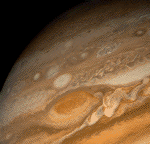
The Great Red Spot and other storms on Jupiter
The Great Red Spot (GRS) has been seen from Earth for more than 300 years (its discovery is
usually attributed to Cassini, or Robert Hooke in the 17th century). The GRS is an oval about 12,000 by
25,000 km, big enough to hold two Earths. Other smaller but similar spots have been known for decades. Infrared observations and the direction of its rotation indicate that the GRS is a high-pressure region whose cloud tops are significantly higher and colder than the surrounding regions.
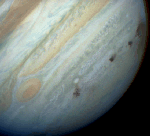
Comet hitting Jupiter
In July 1994, Comet Shoemaker-Levy 9 collided with Jupiter with spectacular results (above). The
effects were clearly visible even with amateur telescopes. The debris from the collision was visible for
nearly a year afterward with HST.When it is in the nighttime sky, Jupiter is often the brightest object in the sky (it is second only to Venus, which is seldom visible in a dark sky). The four Galilean moons are easily visible with binoculars; a few bands and the Great Red Spot can be seen with a small astronomical telescope.
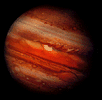
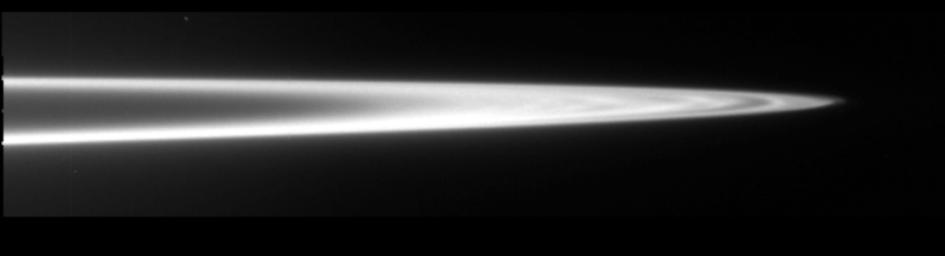
Jupiter has four rings composed of
rock fragments and ice.
Jupiter has rings like Saturn's, but much fainter and smaller. They
were totally unexpected
and were only discovered when two of the Voyager 1 scientists insisted
that after traveling 1 billion
km it was at least worth a quick look to see if any rings might be
present. Everyone else thought that
the chance of finding anything was nil, but there they were. It was
a major coup. They have since
been imaged in the infra-red from ground-based telescopes and by Galileo.
Particles in Jupiter's rings probably don't stay there for long.
The Galileo spacecraft found clear evidence that the rings are continuously
resupplied by dust formed by micrometeor impacts on the four inner moons,
which are very energetic because of Jupiter's large gravitational field.
The inner halo ring is broadened by interactions with Jupiter's magnetic
field.