-
-
ANIMAL CELLS
-
NUCLEUS
-
MITOCHONDRIA
-
ENDOPLASMIC RETICULUM
-
GOLGI APPARATUS
-
LYSOSOME
-
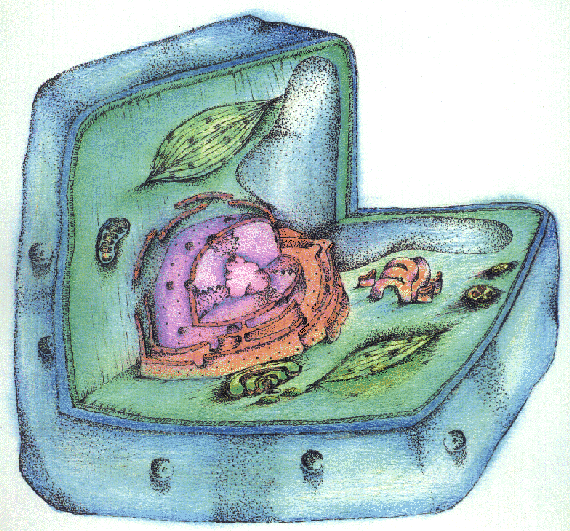
PLANT CELL
-
Plant cells include all of the organelles
above but because they produce their own food they're more complex and
need more organelles.
-
-
CHLOROPLASTS
-
VACUOLE
-
CELL WALL
-
-
-
-
NUCLEUS
-
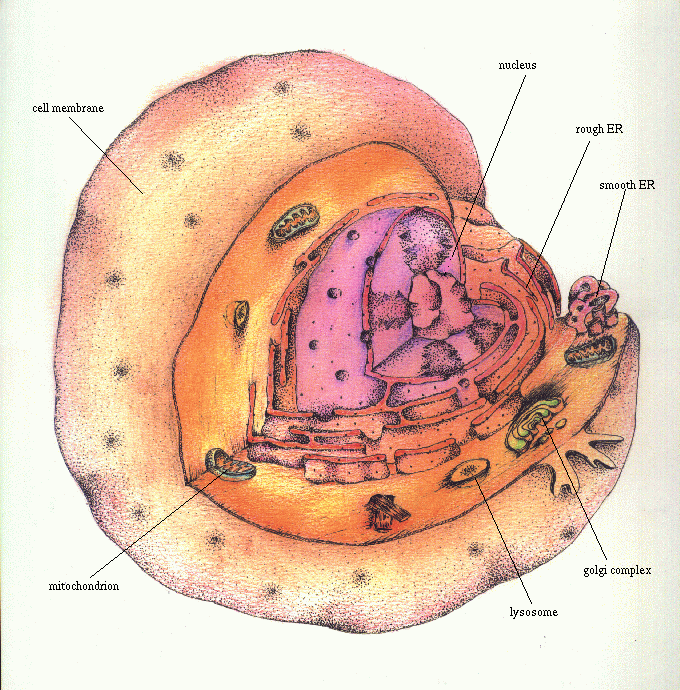
Also known as the control center of the cell, the nucleus contains all
of the "instructions" to the cell. It is the site were nucleic
acids are synthesized and and directs all activities to the cell.
It is surrounded by a double membrane known as the nuclear
envelope. Substances such as proteins
and nucleic acids enter the nucleus through holes in the envelope called
nuclear
pores. Inside the nuclear envelope is
a material called nucleoplasm. This material contains a combination
of deoxyribosnucleic acid (DNA) and proteins known as chromatin.
When a cell goes through mitosis, a strand of this chromatin coils up and
forms a chromosome.
Most nuclei contain a dark spot called a nucleolus
and
is the site of ribosome
formation. A ribosome is a small structure found on the rough endoplasmic
reticulum and floating freely in the cytoplasm. A nucleolus is shown
in the picture below.
-

-
MITOCHONDRIA
-
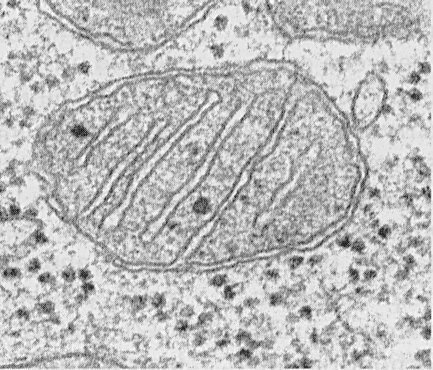
The mitochondrion
is where adenosine triphosphate
(ATP) is formed, therefore this organelle is commonly known as the "powerhouse"
of the cell. ATP provides the chemical energy that drives the chemical
reactions of the cell. Cells such as muscle cells or liver cells
have a lot of mitochondria because they need a lot of energy. A mitochondria
has two membranes, a smooth outer membrane that serves as the boundary
between the mitochondrion and the cytoplasm. The inner membrane has
many long folds, called cristae, that enlarge the internal surface area,
providing more space for the reaction of cell respiration that take place
there. Mitochondria are the sites of aerobic
respiration. Many biologists believe
that the mitochondrion was a descendant of some bacteria that was endocytosed
by a larger cell billions of years ago. Evidence of mitochondrion
DNA and the similarity of bacteria ribosomes and the ribosomes found in
the mitochondria support this theory. The electron microscope of
a mitochondria is found below.
-
-
-
ENDOPLASMIC
RETICULUM (ER)
-
The endoplasmic
reticulum is the "highway" to the cell. It is simply a membrane system
of folded sacs and tunnels. There are two types of ER, one is the
rough
endoplasmic reticulum, the other is the smooth
endoplasmic reticulum. The difference
between them is that rough ER has ribosomes attached to it while the smooth
ER does not. A picture of rough endoplasmic reticulum is shown below,
notice the ribosomes on the surface (the black dots).
-
-
GOLGI APPARATUS
-
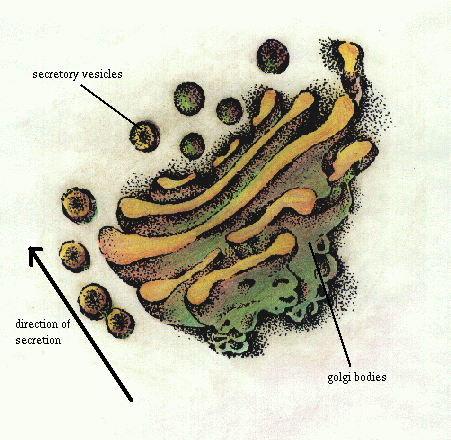
The
Golgi apparatus is the processing, package, and secreting organelle of
the cell. This organelle simpifies molecules and packages them into
small membrane bound sacs called vesicles.
It consists of a stack of membranes or sacs filled with fuid and dissolved
or suspended substances. The Golgi apparatus works as an assembly
line in a factory. After protein is synthesized on a ribosome, the
protein passes into the interior of the ER membrane to an area of smooth
ER. There the protein is enclosed in a vesicle that buds off from
smooth ER. The vesicle then moves and fuses with a Golgi sac.
The contents are then modified as they pass through the Golgi apparatus.
At the last Golgi sac, the new vesicle moves to the cell membrane and discharges
it's contents outside the cell. Below is a picture of the Golgi apparatus.
-
-
LYSOSOMES
-
The
lysosome is an organelle that contains digestive enzymes. They are
small, spherical organelles that are surrounded by a single membrane.
These organelles digest food particles, disease-causing bacteria captured
by the white blood cells, and worn-out and broken parts of cells.
These organelles are extremely important in early development, on the other
hand, lysosomes can destroy important structures in the cell such as DNA
or RNA this explains the reason for the nuclear pores and the membrane.
Notice in the picture below the dark spots, these are lysosomes.
-

-
-
-
-
-
-
-
CHLOROPLASTS
-
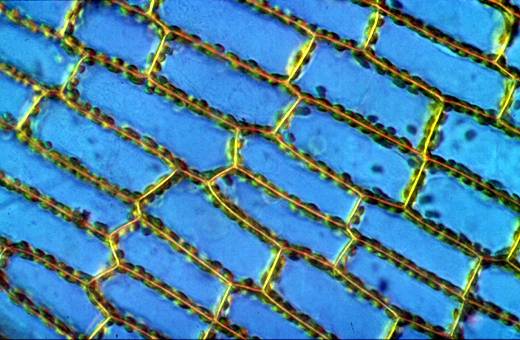
Chloroplasts
are the site of photosynthesis. These organelles are usually oval
and have two outer membranes. These two layers surround a semi-fluid
interior called the stroma. Within the stroma, another system of
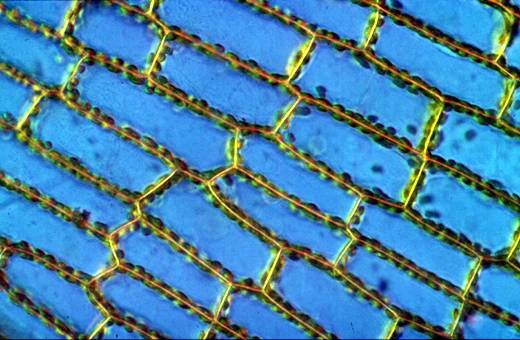
interconnecting disk-shaped compartments are formed these disks are known
as grana. Below is a picture of chloroplast in an onion cell.
-
-
VACUOLE
-
The vacuole in
a plant cell takes up around 90% of the cell's volume. This organelle
is a place for storage and commonly holds water for the cell. The
vacuole must stay full to keep the plant upright. The pressure put
on the cell wall by the vacuole is what keeps the cell rigid and standing
against gravity. Can you find the vacuole in the picture below?
-

-
-
CELL WALL
-
The
cell wall is the rigid covering of a plant cell. It is primarily
made of long chains of cellulose embedded in hardening compounds such as
pectin and lignin. Pores in the cell wall allow ions and molecules
to pass to and from the cell membrane (this structure will be discussed
later but CLICK
HERE to go to the page).
There are two types of cell walls, primary and secondary. The primary
cell wall is formed during cell growth. The secondary wall is formed
after the cell has stopped growing. These two wall together help
strenghten the cell.