GiantRocks
ofSpace
By:
Tammy
Cheney
and
Lynsi
Moore

Moving Asteroids
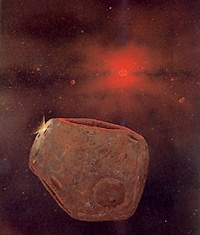
Planetismal
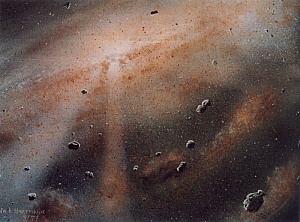
Moving Asteroids in
space
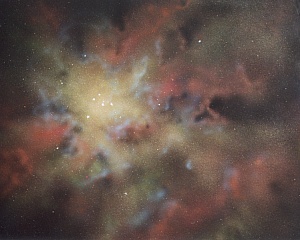
Stars from in regions
of dense nebulae, consisting of gas and dust.
Copyright: William
K. Hartman

Crater caused by an
asteroid
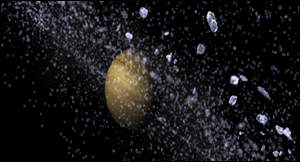
Asteriods floating
in space
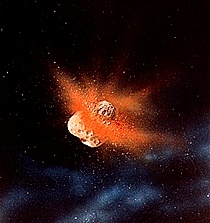
Impacted asteroid
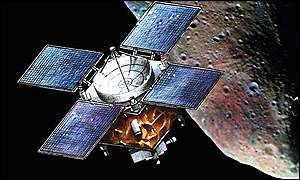
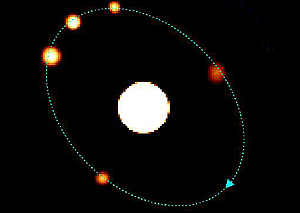
Satellite orbiting
the asteroid eros
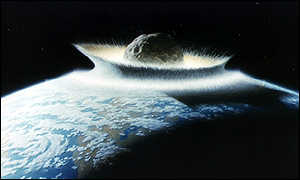
Asteroid hitting the
earth
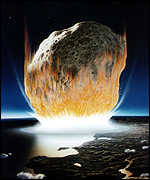
Burning asteroid
Asteroids are large
pieces of rocky iron material. They mostly orbit the sun between Mars and
Jupiter called the asteroid belt. We think that they are pieces of planets
that never formed because of the big pull from Jupiter's gravity. With
telescopes, astronomers can see thousands of objects in space. The Galileo
Spacecraft took pictures of two of these asteroids. We are now studying
asteroids using radar from Earth and The Space Telescope ( Hubble Space
Telescope) The asteroid is called Gaspra. On its travel to Jupiter, The
Galileo spacecraft passed Gaspra. This was the first close look at an asteroid.
This is shaped like a potato. The craters on it even small objects like
asteriods bump into other objects in space. Ida, another strangley shaped
object, shows many of its craters on its surface. We can now look at some
of the bigger asteriods with space telescopes. Not all asteriods stay in
orbit near Mars and Jupiter. Some come closer to Earth. When they do, astronomers
can take pictures using radar.
There are many theories on where asteroids come from. One theory suggests
that they are the remains of a planet that was destroyed in a massive collision
long ago. More likely, asteroids are material that never formed into a
planet. In fact, if all asteroids were put together, they would be less
than 1,500 kilometers (932 miles) across which is less than half
the diameter of the Moon.
Thousands of asteroids
have been identified from the Earth. By estimation, there are around 100,000
asteroids that are bright enough to eventually be photographed through
Earth based telescopes. Asteroids that are near Earth are called meteoroids.
When a meteoroid strikes our atmosphere, it forms a streak of light called
a meteor. If the meteoroid does not burn up completely, what's left strikes
Earth's surface and is called a meteorite. The best place to look for meteorites
is at the ice cap of Antarctica.
Of all the meteorites
examined, 92.8 % are composed of silicate (stone), and 5.7 % are
composed of iron and nickel; the rest is a mixture of the three materials.
Stony meteorites are the hardest to identify because they are closely related
to terrestrial rocks.
Since asteroids are
material from the early solar system, scientists are interested in their
composition. Spacecraft that has flown through the asteroid belt have found
that the belt is really empty and that asteroids are separated by huge
distances.
The impact of a large
asteroid can be very catastrophic. For example, some astronomers believe
that the object that smashed into the Yukatan Peninsula 65 million years
ago was the event that wiped out the dinosaurs. The Gulf of Mexico marks
the crater that was left behind. The asteroid that would have hit there
would have been between 10-20 miles across. The hole it created was approximately
20 miles deep. It was instantly converted into a white hot vapor.
A large asteroid hitting
the earth would create debris that would crash down into neighboring areas.
It would throw dust into Earth's atmosphere, circling the globe, dimming
the sunlight, ruining agriculture year round, and end civilization as we
know it.
At this point in time
NORAD has a small amount of people monitoring the sky for asteroids. An
asteroid would enter quickly. Asteroids must be monitored.
Space Guard is an
international network of telescopes where people work together to track
asteroids and keep them from hitting the Earth. Blowing up an asteroid
is not the answer. Large pieces still would impact on the earth and do
lots of damage also.
The Earth is always
encountering inner planetary debris in various sizes. Although the rarity
increases with size, we know that there are asteroids big enough to cause
a catastrophe if they collided with the Earth. Because of the influence
of the major planets, the asteroid orbits tend to "wander", and whether
(or when) a particular object might impact the Earth may require accurate
knowledge of the orbit. Such as can be provided by radar observations.
The solar system has
a large number of rocky and metallic objects that orbit the Sun but are
too small to be considered planets. These objects are known as asteroids
or minor planets. Most asteroids, but not all, are found in a band or belt
between the orbits of Mars and Jupiter. Some have orbits that cross Earth's
path. There is evidence that Earth has been hit by asteroids in the past.
One of the least eroded and best preserved examples are the Barringer Meteor
Crater near Winslow, Arizona.
Nasa
Nine
Planets
Planetscapes