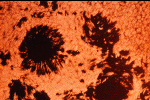
This is a photograph of sun spots on the sun.
Sun spots are "cool" regions, only 3800 K (they look dark only by comparison
with the surrounding regions). Sunspots can be very large, as much as 50,000
km in diameter. Sunspots are caused by complicated and not very well understood
interactions with the Sun's magnetic field.
Nuclear fusion is a reaction in the sun.
Each second about 700,000,000 tons of hydrogen are converted to about 695,000,000
tons of helium and 5,000,000 tons (=3.86e33 ergs) of energy in the form
of gamma rays. As it travels out toward the surface, the energy is continuously
absorbed and re-emitted at lower and lower temperatures so that by the
time it reaches the surface, it is primarily visible light. For the last
20% of the way to the surface the energy is carried more by convection
than by radiation.
The surface of the sun is called the photosphere
and is at a temperature of about 5800 K. The area above the photosphere
is the cromosphere. The highly rarefied region above the chromosphere ia
called the corona. It extends millions of kilometers into space but is
visible only during eclipses . Temperatures in the corona are over 1,000,000K.
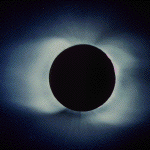
Picture of an eclipse
Hope you liked our website check out other information at many sun related sites