Mercury
The Planet of Extremes
By
Logan
Estes
Bobby
Wilson
Mercury
Mercury
The Planet of Extremes
By
Logan
Estes
Bobby
Wilson
Mercury
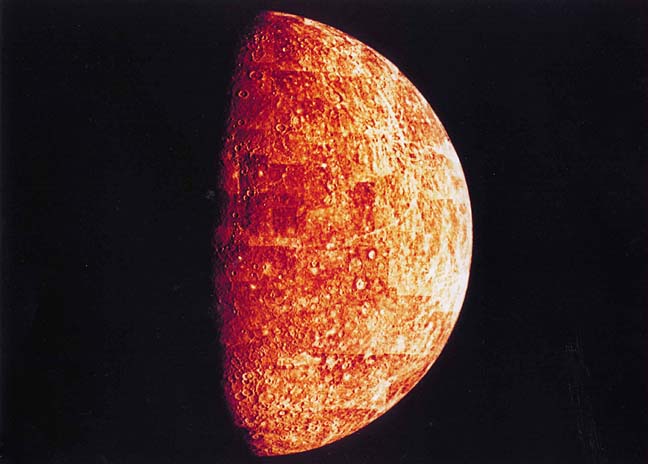
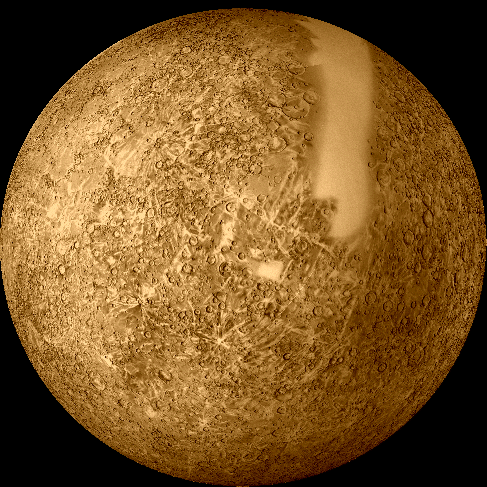
Mercury has been visited by only one spacecraft, Mariner 10. It flew by three times in 1974 and 1975. Only 45% of the surface was mapped (and, unfortunately, it is too close to the Sun to be safely imaged by HST).
Mercury
is in many ways similar to the Moon: its surface is heavily cratered and
very old; it has no
plate
tectonics. On the other hand, Mercury is much denser than the Moon (5.43
gm/cm3 vs 3.34).
Mercury
is the second densest major body in the solar system, after Earth. Actually
Earth's density is
due
in part to gravitational compression; if not for this, Mercury would be
denser than Earth.
In
addition to the heavily cratered terrain, Mercury also hasMercury, the
second smallest planet and the closest one to the Sun, may appear to some
as a drab, colorless, heavily-cratered world. Not so. New analysis of data
returned by the Mariner 10 mission in 1974 and 1975 reveals a surface with
lava flows and deposits from explosive volcanic eruptions, variations in
composition across its surface and into its crust, and a different chemical
composition from the other inner planets. These discoveries were made by
Mark Robinson at the United States Geological Survey in Flagstaff, Arizona
(he is now at Northwestern University) and Paul Lucey of the University
of Hawai'i. Using improvements in computer and age-processing technologies,
and a better understanding of how light reflects off planetary surfaces
than was available in the mid-1970s Robinson and Lucey manipulated the
original data and produced a color image of Mercury that depicts compositional
differences across its stark surface (Robinson, Mark S. and Lucey, Paul
G., 1997, Recalibrated Mariner 10 Color Mosaics:regions of relatively smooth
plains. Some may be the result of ancient volcanic activity but some may
be the result of the deposition of ejecta from cratering impacts.
Mercury
would seem to be one of the least likely places in the solar system to
find ice. The closest planet to the Sun has temperatures which can reach
over 700 K. The local day on the surface of Mercury is 176 earth-days,
so the surface is slowly rotating under a relentless assault from the Sun.
Nonetheless, Earth-based radar imaging of Mercury has revealed areas of
high radar reflectivity near the north and south poles, which could be
indicative of the presence of ice in these regions (
1-3).
There appear to be dozens of these areas with generally circular shapes.
Presumably, the ice is located within permanently shadowed craters near
the poles, where it may be cold enough for ice to exist over long periods
of time. The discovery of ice on the Earth's moon can only serve to strengthen
the arguments for ice on Mercury.
Amazingly One of the largest
features on Mercury's surface is the Caloris Basin; it is
about 1300 km in diameter.
It is thought to be similar to the large basins (maria)
on the Moon. Like the lunar
basins, it was probably caused by a very large impact
early in the history of
the solar system. That impact was probably also responsible for the
odd terrain on the exact opposite side of the planet (left) , Radar observations
of Mercury's north pole (a region not mapped by Mariner 10) show evidence
of water ice in the protected shadows of some craters. Mercury is often
visible with binoculars or even the unaided eye, but it is always very
near the Sun and difficult to see in the twilight sky. There are several
Web sites that show the current position o f Mercury (and the other planets)
in the sky. More detailed and customized charts can be created with a planetarium
program such as Starry Night.
Mercury's orbit is highly eccentric; at perihelion it is only 46 million km from the Sun but at aphelion it is 70 million. The perihelion of its orbit precesses around the Sun at a very slow rate. 19th century astronomers made very careful observations of Mercury's orbital parameters but could not adequately explain them using Newtonian mechanics. The tiny differences between the observed and predicted values were a minor but nagging problem for many decades. It was thought that another planet (sometimes called Vulcan) might exist in an orbit near Mercury's to account for the discrepancy. The real answer turned out to be much more dramatic: Einstein's General Theory of Relativity! Its correct prediction of the motions of Mercury was an important factor in the early acceptance of the theory.
I think the chances are pretty good, but I have not heard of any specific mission in the 'works' let alone being funded. There have been some proposals for returning to Mercury to do detailed mapping of its surface, especially the polar regions where water ice has been detected by radio astronomers.
Johann Hieronymus Schroeter
was the first to observe the planet Mercury and record detailed
drawings of Mercury's surface
features. Schroeter lived from 1745 to 1816. Unfortunately, his
sketches were not very accurate.
Mercury would seem to be
one of the least likely places in the solar system to find ice. The closest
planet to the Sun has temperatures which can reach over 700 K. The local
day on the surface of Mercury is 176 earth-days, so the surface is slowly
rotating under a relentless assault from the Sun. Nonetheless, Earth-based
radar imaging of Mercury has revealed areas of high radar reflectivity
near the north and south poles, which could be indicative of the presence
of ice in these regions (1-3). There appear to be dozens of these areas
with generally circular shapes. Presumably, the ice is located within
permanently shadowed craters
near the poles, where it may be cold enough for ice to exist over long
periods of time. The discovery of ice on the Earth's moon can only serve
to strengthen the arguments for ice on mercury.
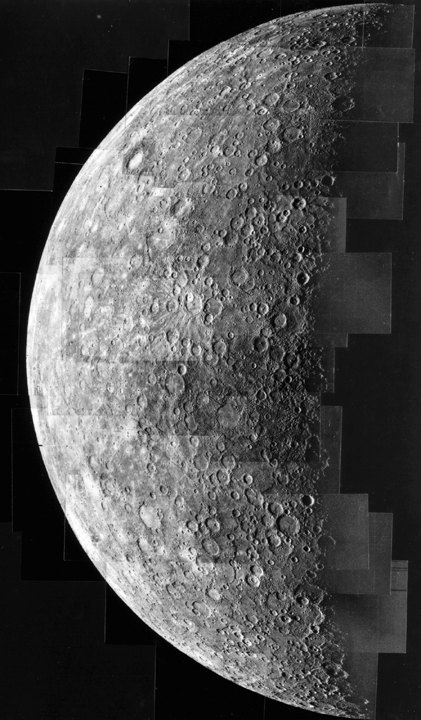
h.If an explorer were to
step onto the surface of Mercury, he would discover a world resembling
lunar terrain. Mercury's rolling, dust-covered hills have been eroded from
the constant bombardment of meteorites. Fault-cliffs rise for several kilometers
in height and extend for hundreds of kilometers. Craters dot the surface.
The explorer would notice that the Sun appears two and a half times larger
than on Earth; however, the sky always black because Mercury has virtually
no atmosphere to cause scattering of light. As the explorer gazes out into
space, he might see two bright stars. One appearing as cream colored Venus
and the other as blue colored Earth