USS Seahorse
February 7, 1944
c/o Fleet Post Office
San Francisco, California
FROM: The Commanding Officer
TO: ComSubPac
VIA: ComSubRon 4
SUBJECT: USS Seahorse – Report of War Patrol number ONE
ENCLOSURE: (a) Subject Report, (b) Charts & Diagrams
RMKS/1. Enclosure (a), report covering the First war patrol of this vessel conducted in the East China Sea during the period January 2, 1944 to February 6, 1944. Enclosure (b), charts and sketches of approximate positions for significant events during this patrol.
(signature)
CDR Hawk
USS Seahorse (SS–304) • Report of First War Patrol
1. Prologue to
Arrived Midway to top off fuel January 2nd.
2. Narrative
January 2nd: 17:20 Departed Midway with a mixed load of 11 Mk-14 and 13 Mk-18 torpedoes.
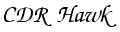
January 14th: Arrived assigned patrol area. Commenced patrolling area east and northeast of Okinawa.
January 15th: 18:52 SJ radar contact bearing 270°T, range 16 miles. 19:10 Estimated 6-8 ships heading NNE at 12 knots. 19:14 Initiated Normal Approach Course. Range 13 miles. Moderate seas, partly cloudy skies. Moonrise at 21:47. 19:47 Convoy solution corrected to 11.7 kts at 018°T, range 24,000 yds. Convoy either made a course change or seas kept our speed below that required for an intercept. Lost contact with convoy at 23:00 after pursuing it for four hours. Changed course to circle around north end of Okinawa into the East China Sea.
January 16th: Encountered what was thought to be an enemy patrol. Contact on SJ radar at 06:46 bearing 219°T, range 17 miles. At 07:32 spotted one destroyer visually using high scope search. Submerged to radar depth. Acquired a second small radar contact at 08:00. Surfaced for battery charge at 18:00 with one contact still on radar 11 miles to the east.
January 17th: Received coded radio transmission just after midnight requesting photo reconnaissance of Naha harbor, Okinawa. Changed course to comply.
Picked up a radar contact at 08:30 bearing 086°T, range 16 miles. Detected second contact half an hour later. Relative positions of contacts indicated an enemy A/S patrol.
At 09:25, SD radar detected an aircraft 9 miles out and closing. Dove to 150 feet. Encountered a density layer with a 15° temperature differential at approximately 130 feet. Sound gear picked up active pinging from direction of contacts at 11:45 and high-speed screws to the northeast at 13:21 as we maneuvered into Naha harbor. Ordered periscope depth at 13:36. Visually sighted a destroyer about 1400 yards away.
It was then I remembered the aircraft contact and ordered the SD radar gear activated. As I was sweeping the horizon with the scope, I saw an enemy plane low over the water just as the radar operator yelled "Air contact, sir!" I quickly dropped the scope and ordered an emergency dive to 150 feet. Seconds later the plane flew over and dropped a bomb, followed by two more about a minute apart. None of the bombs were close enough to damage the boat. Sound picked up high-speed screws closing on our position. Two depth charges were dropped at 13:42 but were apparently set shallow, causing no damage. At 13:50 the boat scraped bottom and I ordered a depth change to 120 feet. Five minutes later two more depth charges were dropped, set deeper this time, causing minor leaks in the after torpedo room.
By 14:00, we had moved to periscope depth and I took a series of 6 photographs of Naha harbor. Only one small freighter was present in the anchorage. We then dove to 100 feet and proceeded south, then southwest to escape the enemy patrol.
By 14:42, the leaks in the after torpedo room had been repaired and we surfaced at 18:00. Detected a radar contact with the SJ gear at 18:56 bearing 036°T, range 35,000 yards, but quickly lost contact. Battery charge was complete by 20:00 when we commenced patrolling the southern approaches to Okinawa.
January 18th: Headed west at 06:30 to clear area and move farther into the East China Sea.
January 19th: 04:22 Multiple SJ radar contacts detected 16 miles ENE. Turned to close range to targets. Thirty minutes later, visually sighted one destroyer and one battleship. Since we were between the moon and the enemy task force, I ordered a dive to radar depth. At 04:58 radar had 10 separate contacts and I had visual sightings on what appeared to be two battleships and two destroyers. Calculated task force heading 236° at 18 knots. At 05:04 primary targets were classified as one Kongo-class battleship and one Mogami-class heavy cruiser. Assumed other smaller radar contacts to be 8 escorting destroyers.
At 05:08, fired all six forward tubes at battleship, range 1100 yards, 5-second intervals, 4° spread. One minute later, both targets had passed our port beam and I fired all four stern tubes at the cruiser about 1600 yards away using a 5-second interval. One torpedo was a dud but at least four hit the battleship and exploded. By this time the BB and CA were in line, and two of the torpedoes aimed at the cruiser hit the battleship instead, as indicated by the stopwatch. The BB was immediately racked by explosions and covered in flames. She was down by the bow and already listing heavily to port. One of the remaining fish hit the cruiser but apparently caused no major damage. At 05:12, we dove to 160 feet and prepared for the counterattack as the escorts started pinging madly and dropping depth charges. Luckily our thermal layer was still there at 125 feet. By 06:30 we had lost all sonar contact with the escorts after moving off to the northeast. Apparently the density layer had prevented the destroyers from getting a fix on our position and we escaped with no damage. All tubes had been reloaded by 06:45. We remained submerged for the rest of the day, heading southeast for deeper water. Surfaced at 18:40 for battery charge, no radar contacts.
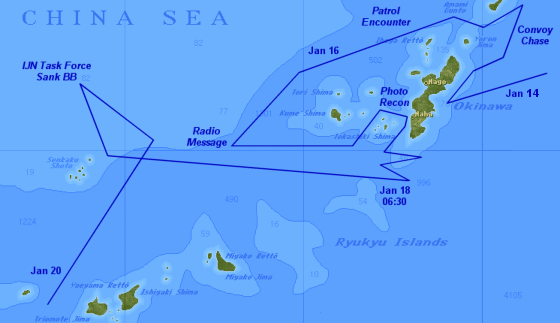
January 20th: Received new orders via coded radio transmission to relieve another submarine at the end of her patrol. CDR Murph Allen's USS Batfish (SS-310) had already left the area. We proceeded down the east coast of Formosa to take up station in the southern approaches to Formosa Strait.
January 21st: At 03:55 we were 10 miles SSE of Formosa's South Cape when we picked up multiple contacts on SJ radar bearing 232°T, range 16 miles. Turned to heading 329° to maneuver ahead of the convoy for a dawn attack.
At 06:17, visually sighted a destroyer bearing 340°R at 5000 yds and submerged to periscope depth. Within 20 minutes, we were inside the leading escort screen and looking at a large convoy of some 13 ships with 5 escorts heading north at 6 knots. Nearest merchant was 3000 yds ahead and we heard high-speed screws astern. The ships were arranged in four shallow columns of 3 to 4 ships each.
Set up a solution on a Standard Merchant ship in one of the center columns. At 06:46, we fired 2 Mk.18's at the target - range 1400 yds, depth 14 feet, 5-second interval, and 2° spread due to small bow angle. Took a quick bearing on another similar ship in the outside starboard column and fired 2 Mk.14's at her from a range of 1200 yds with a 4° spread and an 8-second interval since we were on the target's port beam. One minute later, after another quick bearing, we fired 2 Mk.14's from 1200 yds at a Converted Factory Ship in the outer port column.
About this time the first two fish hit and the escorting destoyers came alive with active pinging. At 06:49, the second pair of torpedoes found their mark, as did the last pair. All three targets were still afloat but afire, with the last target almost dead in the water. We fired 2 Mk.18's from the stern tubes at target #2 and dove under the lead ship of the convoy as she approached close by. We heard both torpedoes hit the designated target and returned to periscope depth to find her sinking. Target #1 had passed astern and was turning to port. Fired 1 Mk.18 from 600 yds at 0° offset and depth 14 feet. Fish passed astern of target and hit a Factory Ship in line behind her. At 06:54 we fired our last stern tube at target #1 with a 10° lead angle off the same solution at a range of 800 yds. Observed torpedo hit and target explode, breaking into 3 separate pieces. At 06:55 target #3 (Converted Factory Ship) was observed 1300 yards away still burning and making very little headway. Turned toward her at slow speed as torpedoes were reloaded. At 07:03 an escort passed close astern and dropped 4 depth charges which damaged the steering gear and started leaks in the maneuvering room and forward torpedo room. Several more charges were dropped astern, but caused no damage. Two minutes later with tube #1 reloaded, I raised the periscope and took a bearing on target #3 at 031°R, range 800 yds. Observed torpedo hit and explode 20 seconds later as escorts located our position and began firing their guns at our scope. Observed fatal damage to target #3 and saw crewmen abandoning ship.
Dove deep and turned northward to evade the six escorts. The remainder of the convoy was seen fleeing northwest. The density layer was still present at 125 feet, much to our relief. At 07:20 we had levelled off at 400 feet and the depth charging had subsided. Helmsman counted 28 depth charges in 15 minutes.
07:37 Came up to 300 feet, hoping the 40-psi reduction in outside water pressure would slow the leaking in the maneuvering and forward torpedo spaces. By 08:00 repairs had been completed and the flooding was under control as we started pumping out the water. Lost sound contact with escorts at 08:06. At 08:49 all the water had been pumped out as we turned west and reduced speed. An hour later, the steering gear had been repaired. Went up for a look at 10:00, found no SJ radar contacts and discovered that the SD radar had been damaged in the attack. The technicians had it operating again before noon.
Late afternoon, sonar picked up low-speed screws bearing 027°T. Went to periscope depth and at 16:33 sighted 2 merchantmen and 3 escorts 7 miles NE by N and heading SW. Began tracking from ahead to buy time until sunset, which was an hour away. Estimated convoy speed at 8 kts. Increased speed to 2/3 for 4 kts hoping to get in position for an attack at dusk. 16:53 Counted 2 marus and 6 escorts. Dove to 200 feet to avoid surface turbulence, verify the thermal, and gain slight increase in speed. 17:19 Sound picked up screws. Reduced speed to 1/3 and went to periscope depth. Sonar reported high-speed screws bearing 145°, 164°, and 211° Relative with low-speed screws at 175°R. We were positioned perfectly, with flanking escorts passing on either side with the targets astern, although I did underestimate the convoy's speed. Visual sighting at 17:23 with an Armed Merchant Cruiser in the lead and a Troop Transport or Converted Factory Ship bringing up the rear. Spotted another DD bringing the number of escorts sighted up to 7! Plotted solution on lead ship, now 1500 yds away. Target was a big merchant cruiser, approximately 12,000 tons. Lowered the scope and waited for target to pass by. At 17:30, fired 1 Mk.18 and 2 Mk.14's after target had passed by to starboard. 4° spread, 15-ft depth, and 5-sec intervals. All three fish hit and detonated, sinking the target.
Ordered hard left rudder to a course of 180° as we dove to 400 feet. Escorts had begun pinging. Three DC's were dropped shallow as we passed 360 feet and another one set deeper. Rigged for silent running. Batteries sorely needed recharging after morning attacks and running submerged all day. At 17:50, increased depth to 500 feet and changed course to 135°. Half an hour later we secured from silent running and proceeded SE at 1/3 speed. Lost sonar contact with enemy at 19:00. Surfaced at 19:35 for a badly needed battery charge.
January 22nd: We were 14 miles south of Formosa's South Cape when at 01:11 SJ radar detected two contacts bearing 084°T, range 8000 yds, dead ahead. Assumed contacts were small trawlers or sailing vessels due to the short detection range. Sighted two sampans at 01:30 bearing 015°R at a range of 3600 yards. Ordered battle stations, surface. At 01:37 commenced firing deck gun at nearest target when range was 1100 yds. First 5 shells missed, but the sixth hit and destroyed the target. Three minutes later, the second sampan was hit and sunk by the next shell fired at a range of some 1100 yds. Secured from battle stations and proceeded around South Cape up the east coast of Formosa.
January 24th: Weathered the Ryukyu Islands and set a course for Midway.
February 6th: Arrived Submarine Base, Midway.
3. Options
TDC – Manual
Realism – 115%
4. Weather
Moderate seas and partly cloudy skies were experienced for the duration of this patrol.
5. Aircraft sighted
One – during approach on Naha harbor for photo-recon. Probably part the enemy A/S patrol encountered there.
6. Enemy Ships Sunk
Date          Time     Location              Type                      Tonnage
——————————————————————————————————————————————————————————————————————————————————
17 Jan 1944   05:09    26Ί18'N - 127Ί12'E    Kongo-class Battleship    32,200 tons
21 Jan 1944   06:50    22Ί23'N - 120Ί23'E    Standard Merchant           6920 tons
21 Jan 1944   06:54    22Ί23'N - 120Ί23'E    Standard Merchant           6920 tons
21 Jan 1944   07:07    22Ί23'N - 120Ί22'E    Converted Factory Ship      3620 tons
21 Jan 1944   17:30    22Ί30'N - 119Ί36'E    Armed Merchant Cruiser    11,670 tons
22 Jan 1944   01:38    22Ί11'N - 120Ί56'E    Sampan                        70 tons
22 Jan 1944   01:41    22Ί10'N - 120Ί56'E    Sampan                        70 tons
——————————————————————————————————————————————————————————————————————————————————
TOTAL                                        5 ships                   61,330 tons
7. Enemy Ships Damaged
1 x Mogami-class Heavy Cruiser
1 x Converted Factory Ship
8. Summary of Torpedo Attacks
Attack  Target          Fired  Hit  Prem  Dud  Miss   Result
—————————————————————————————————————————————————————————————————————————————————————
   1    Kongo-class BB    6     4     -    1    1     Damaged target
   2    Mogami-class CA   4     1     -    -    1     2 torps hit & sank target #1 BB
   3    Std Merchant      2     2     -    -    -     Damaged target
   4    Std Merchant      2     2     -    -    -     Damaged target
   5    Factory Ship      2     2     -    -    -     Damaged target
   6    Target #3         2     2     -    -    -     Target sunk
   7    Target #4         1     -     -    -    1     Missed but hit & damaged a CFS
   8    Target #4         1     1     -    -    -     Target sunk
   9    Target #5         1     1     -    -    -     Target sunk
  10    Merchant Cruiser  3     3     -    -    -     Target sunk
—————————————————————————————————————————————————————————————————————————————————————
TOTALS                   24    18     -    1    3
9. Summary of Gun Attacks
Attack  Target          Fired  Hit     Result
———————————————————————————————————————————————————
  11    Sampan            6     1      Target sunk
  12    Sampan            1     1      Target sunk
———————————————————————————————————————————————————
TOTALS                    7     2
10. Enemy A/S Measures
Inability of enemy escorts to detect us was attributed primarily to consistent density layer at 110–140 feet, although they seemed less tenacious than in previous patrols.
11. Communications and Radar Performance
Radio reception was generally good to excellent.
SJ radar gear consistently detected larger targets at ranges up 35,000 yards.
Our first and only aircraft contact was initially detected by SD radar at 18,000 yards.
12. Sound Conditions and Density Layers
Sound conditions were generally good, with sonar contacts often made outside of visual range. Consistent density layer encountered at relatively shallow depth of 110-140 feet. Average temperature differential was 15°F. Suggest research to determine if this thermal is dependent upon season, current, or other factors.
13. Health and Habitability
The health of the crew on this patrol was excellent in all respects. There were only 3 sick calls made during this patrol with minor bruises and scrapes. No serious injuries reported. Habitability on this class of ship is much improved compared to most of the older boats in the fleet. Air conditioning and refrigeration gear have a very positive effect on health and morale. It is rewarding to see that design improvements implemented by BuShips during my service there have produced positive benefits.
14. Miles Steamed
Steamed 11,377 miles during this patrol, including 1471 miles in patrol area.
15. Fuel Oil Expended
107,611 gallons – 9.5 gallons per mile.
16. Damage Sustained
Hull damage: Light – 10%
System damage: None – 0%
• Note all system damaged repaired underway.
17. Endurance Factors
Torpedoes – 0
5-inch shells – 93
Fuel – used 91% of our fuel oil, most of it transiting to and from assigned patrol area.
Other factors – indefinite.
18. Patrol Ended
By orders of ComSubPac due to fuel considerations and expenditure of all torpedoes.
19. Remarks
Durability, versatility, and habitability in this class of ship are greatly improved over older boats. USS Seahorse made dives to depths of up to 500 feet without any indication of hull weakness or equipment failures. Thicker pressure hull and welded construction are welcome design changes. Torpedo performance has improved dramatically since last patrol. This vessel conducted 10 torpedo attacks against enemy shipping using 24 torpedoes with 18 aimed hits, 2 incidental hits, 0 prematures, and only 1 dud, for 5 enemy ships sunk. That is 4.8 torpedoes fired for each ship sunk during this patrol, a very acceptable number considering one target was a battleship. The crew, although inexperienced, performed well.
Respectfully,
USS Seahorse – 1st Patrol
January 14th – 20th, 1944
USS Seahorse – 1st Patrol
January 20th – 23rd, 1944