Windows 2000, 98 and ME 1
Monday January 28, 2002 13:13
Csd expects that the USB drivers will work lots better on XP than other Windows editions.
Legacy applications which ran under 95 or 98 didn't run on Windows 2000.
XP is supposed to have a compatibility mode which allows older Windows programs to run.
Netmeeting is integral to XP with the improvement of no jerky video found in 2000. Wednesday January 6, 2002 09:46
| Windows XP Is Selling Like Hot Cakes
The Associated Press REDMOND, Wash. — Microsoft Corp. says it has sold more than 17 million copies of Windows XP since the new operating system went on sale two months ago. “This is our best-selling release of Windows ever, and one, that is creating great opportunities for PC manufacturers and our other partners in the industry,” Microsoft Chairman Bill Gates said Monday at the International Consumer Electronics Show in Las Vegas, Nev. “We’ve seen a significant upturn in sales of digital cameras, printers and other peripherals and software that enable people to experience their PC in a new way.” Windows XP has a number of new features to support multi- media, including programs for listening to and recording music, playing videos and editing and organizing digital photographs. The retail upgrade for home computers sells for about $99. Sales of licenses of Windows XP by computer manufacturers are more than 300 percent higher than Windows 98 and 200 percent higher than Windows Millennium Edition for comparable periods after those products’ debuted, Microsoft said in a news release. Windows 98 came out in mid-1998 and Windows ME was released in September 2000. Microsoft did not give a breakdown for retail Upgrade, full-product or license sales for Windows XP. Albuquerque Journal Wednesday January 9, 2002 |
Here's an alternate view of Windows XP. Ouch!
Csd continues to believe that USB 2.0 drivers will work lots better on XP than other windows products. For a Microsoft business reason, of course.
Cassel's warning about high-tech business failures in 2002 may be something to be concerned about.
Csd is following digital cores for custom chips. Two leaders are ARM and the 8051 cores 1 2. And, yes, here's ARM Forth.
Of lesser popularity are cores such a Motorola's 56K dsp family. Moto doesn't generally license cores.
An ARM core license costs of th order of $200,000 plus about a twenty-five cents per chip royalty.
Parthus sell a 56K kock-off for about $20,000 with no per chip royalty. Parthus is not currently hiring.
Tasking sells a C compiler for the 56K. Note that you can buy an 8051 development system, normally $3290, for just $995!
So it's going to be interesting to see who's going to be around with what at the end of 2002. Tuesday January 22, 2002 06:46
| Cassel's Corner by Paul Cassel
2002—Year of the Big Yawn We have a war to win and economic wounds to heal. This makes it hard to be optimistic about what the next twelve months will bring At least once a year, I devote a column to my predictions for the coming year in things related to computer and technology. This is that column. Most folks seem interested in general industry trends, as well as what sort of speed or new technology we’ll see in personal computer systems. A few are also interested in finance, or what finance is to most folks—the stock market. I’ll start there and then move onward to specific technologies. I’m somewhat pessimistic about technology- -or computer-related stocks. If I remember correctly, Fortune magazine, in its April 2000 issue, had a point-vs.-counterpoint set of articles about the new economy. One fellow claimed that the old metrics of stock valuation are obsolete. He predicted a continuation of the NASDAQ bull market, even though, at that point, it was at roughly 5,000. His argument was simply that money had nowhere else to go if it wanted to earn in the future. His specific example of a played-out old economy stock was Coca-Cola. His argument was that while folks will not stop buying the stuff Coke makes, the company can’t drastically increase its sales because just about everybody who likes Coke’s products buys them. Contrast this, he said, to companies like Cisco, which has no known cap to its additional markets. The other guy in the article said that the raging bull market was a bubble. Neither was entirely right, but it sure seems today that the naysayer to the continued bull market had hit the right notes. So stocks like Cisco collapsed in price, while the company foundered a bit looking for outlets for its switches and related paraphernalia. As I write this, the NASDAQ is making a bit of a recovery, with stocks such as Cisco and Nortel again leading the charge. I’m skeptical that this trend will continue, because as far as I can tell, the fundamentals still aren't there. If you believe the bull optimist in that Fortune article, then these fundamentals aren’t important, and the drastic correction (if you can call it that) in markets was just that—a correction. What I’m afraid of here is that, just as we had an almost tulip- mania-type bull market at the end of the twentieth century, we’re now experiencing an exaggerated dead-cat bounce. Maybe I’m wrong here, and I’ll miss the resurgence, NASDAQ back to 5,000. If so, look on a street corner for some guy wearing a sign “Will Consult for Food.” will be me. Windows XP is a flop. Sure, it’s included in all new systems, but Microsoft didn't need to develop a new operating system to get this—it that market previously. Established users aren’t upgrading even at the sluggish rate they went from NT to Windows 2000. There are many reasons for this, but word of mouth is, I think, killing this product. It also has been the target of some rather unfair negative reviews, but those reviews sting. XP defaults to a user interface that will clearly baffle Windows 95/98/Me/2K or even NT user. When we objected, Microsoft countered with its lab findings that new users found this user interface easier than the 95 derivatives. Let’s say. that Microsoft is right here. (I don’t believe it.) What Microsoft is doing is sacrificing its established base for the theory that there are zillions of new users out there who have never seen any Windows product, and would buy only if the user interface were easier to use. The absurdity of this is so obvious I will not bother to elaborate, yet that is exactly what Microsoft is banking on with this product. Add in annoying balloons that pop up urging you, the experienced user, to sign up for Microsoft's instant messaging or a Passport, and you have a product that does not meet the most important criteria of a new purchase—customer satisfaction. An experienced user who upgrades to this product ,will too often feel like a sucker. Now, not all will, and many veteran computer users like this product, but there is no compelling reason to upgrade, and some solid reasons why you don’t need to bother. Primary among the latter is the activation’ (anti-piracy) scheme that many folks, even those who are scrupulous about licensing compliance, find repugnant. Microsoft Office XP is doing all right, but again, not burning any barns. I see this as continuing, and also impacting the bottom line just as Windows XP’s failure to meet upgrade projections. Over on the hardware sides we’ll see manufacturers push out newer and faster machines in hopes of finally finding the speed level that will cause folks to want to upgrade from the 700 or so megahertz level that many are content with. A while back, I wrote that buying a new machine will make you feel good about the purchase, and apparently many of you have done so with good results and satisfaction. However, many folks are still pumping along with older boxes. Much of the problem—if it is a problem—is that the newer machines are just faster versions of older machines. When the auto manufacturers back in October decided to ravage their profit margins by offering low prices coupled with zero percent financing, many of you bought new cars. This is a simpler thing, because if you dump that rattletrap Saturn for a nice new Ford Focus, you’ve improved your car situation drastically. A new high-speed Pentium 4 or AMD Athlon will be markedly better than what you’re using now, but the bump isn’t nearly as apparent as that car upgrade. Expect continued lower prices for all aspects of personal computing to continue the entire year. Also expect some folks going out of business, and others consolidating. I doubt that there will be any very interesting developments in software. Flat-panel costs will continue downward to where this technology will penetrate to homes and businesses. Cell phones will add features that you don’t want, but that will make them more expensive; so I don’t see much movement there. Basically, I look forward to a boring year. We have economic wounds to heal, as well as a war to win. These things militate against another boom. I hope I’m wrong. Contact Paul at: [email protected] Have an opinion that differs from Cassel's, or the views of any of CornputerScene’s writers? If so, let the rest of us know—we welcome your comments. E-mail your views to: [email protected] |
csd is a stickler for visible documentation.
One reason is that this type of work must be done exactly. One doesn't want to carry the information around in one's head. Even if you try, you forget.
Good documentation is essential to train others.
Or even go back to try to find out what you did at a later time! Thursday March 1, 2001 16:30
Here's how to install DriverStudio 2.0 on a new disk. http://members.home.net/bpayne37/ds2doc/ds2p1.html Windows does not always do the same thing for everyone. So this procedure might not work for everyone. We are frequently supprised that something has mysteriously changed. Problem-finding skills are perhaps the most important aspect of this type of work. |
Windows 2000 can spawn multiple virtual 86 machines.
If you have Vireo/Numega/Compuware's VtoolsD you can watch virtual 86 machines being spawned.
When you run, say Microsoft Word and Excel, together in windows they are both running in the same virtual machine. Virtual machine spawning is much more sophisticated.
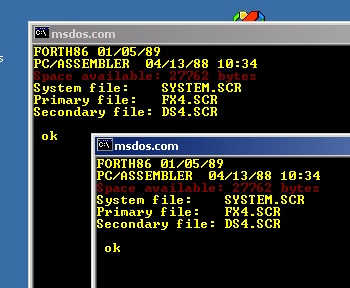
Here's an example of two copies virtual DOS machine windows running the same forth operating system under Windows 2000.
Since forth is an operating system it takes over DOS.
In the case of an 8051, the 8051 takes over the 86 Forth operating system which, in turn, took over DOS.
An 80C52 usb hub can effectively have its own operating system running in a virtual machine under the Windows 2000 Virtual Machine Manager.
This way a programmer can 'log on' to an 80C52 usb hub anywhere in the world to interactively take a look at what's going on in both the hardware and software.
This approach is used by Sun, Apple and others using Open Firmware. 1. Wednesday February 14, 2001 07:43
Here is a comparison of DriverStudio with competing products written May 21, 2001 by someone biased toward DriverStudio, but nonetheless, well done. Thursday May 30, 2001 13:04
| BlueWater Systems: Their tools are WinDK and WinRT. WinDK is a development
toolkit for defining device characteristics and automatically generating
a code framework for building device drivers. WinRT provides direct hardware
access for user-mode programs using C++, C, or VB(w/ WinRT-VB). The price
range(last time I checked) was $1,250 to $1,995.
Jungo(previously KRFTech): WinDriver provides direct hardware access for user-mode programs using C++ and C. It is similar in function and features to DriverAgent(NuMega), although DriverAgent provides for development in Java and VC in addition to C++ and C. The prices range from $999 to $2,999. Both BlueWater and Jungo's products only compete with the DriverWorks and DriverAgent components of DriverStudio. They do not offer any additional debugging, testing, tuning, and deployment tools. OSR: The OSR DDK is a toolkit for instrumenting driver code so that it can be traced and examined while running using OSRTrace or third-party debuggers. OSR DDK does not addist in the driver development process, and requires inserting extra code into drivers and recompliling them in order to track system calls and system function parameters. DriverStudio's BoundsChecker Driver Edition checks API parameters, and collects information on all events and calls associated with specified drivers, and displays it through DriverWorkbench. BoundsChecker also does not require inserting additional code into drivers and recompiling them, making it possible to monitor all drivers, including Microsoft's and those written by third parties. OSR has no competing tools to other DriverStudio components. OSRDDK costs $795(last time I checked...may be more, now). |
Here are first drafts of a abstract csd was asked to prepare for a talk before Albuquerque business people on March 28.
The request was made by an international technology consulting company.
The talk length is to be about twenty minutes.
csd got a phone call on Wednesday March 14, 2001 to remind it to prepare the abstract.
Like most documents, a few edits are required to convey what is meant as opposed to what was intented. Thursday March 15, 2001 09:38
Windows 2000, 98 and ME win32 driver model Windows NT 3.51, 4.0 and 2000 are based on an abstract operating system called the Mach kernel. In contrast Windows 3.1, 95, 98 and ME are based on brute force implementations. Peripheral devices such as modem, printers, scanners, ... were relative easy, in terms of cost for driver software, to connect to 3.1, 95 and 98 through dll and vxd drivers. On the other hand, NT 3.51 and 4.0 required kernel mode software driver costs usually started at $100,000 to develop! And kernel mode drivers would not work on 9x series! Cost of kernel mode driver development severely limited the number of peripheral hardware devices which were connected to 3.51 and 4.0 computers. Microsoft recently initiated what it calls the Windows Driver Model, sometimes also called the wdm or wdm32 initiative. Its purpose is to make a set of device driver services common to Windows 98, ME, and 2000 so that one driver works unchanged on all three platforms. A further goal is to reduce the amount of software work required so as to reduce the cost of driver development. One rush is starting to convert some dll, vxd and kernel mode drivers to wdm drivers provided the performance and increased reliability make economic sense.
Windows 2000 is gaining a reputation as One purpose of this talk is to explain the wdm32 initiative for those generally interested hardware/software trends and especially those planning a project to connect windows 2000, 98 and ME to their peripheral hardware products. Universal Serial Bus 2.0 and 1394 [Firewire] peripherals communicate up to 480 megabits per second may replace PCI and cardbus peripheral products in the future because of simplicity of connect and peripheral power supplied through the cable. A second purpose of this talk is to give an overview of possible USB/1394 microcontroller candidates which likely should be placed between custom peripheral hardware products and a Windows wdm driver. And give an idea of the approximate costs required to develop peripheral-side interface hardware and software. A second, more important, rush is also starting to develop relatively inexpensive new Windows 2000 wdm drivers to connect to peripheral hardware products to take advantage of the reliability, superior application task performance, and applications speed of Windows 2000. |
A wdm device driver is expected to work unchanged on Windows 2000, 98, and me.
But there are other concerns.
csd will try to enumerate some issues which need to be resolved before starting a device driver project. Thursday March 8, 2001 19:16
csd primarily does Windows 2000 wdm drivers. But will do peripheral drivers if the hardware involves the 80C51/2 family. csd wants to succeed in its driver projects. As result careful planning is required. Windows 2000 is one of the largest computer programs ever written. Driver writing requires messing with its guts. Great care is require to avoid disasters. The more reasonable expert help one gets on driver projects, the greater the chance of success and the lower the cost. This is one reason csd uses Numega DriverStudio 2.0, SoftIce, the DDKs etc. |
DriverWorks 1.2 98 deferred procedure call [dpc] crashed deep within ntkern or vmm.
Driverworks 1.2 own examples did not work on windows 2000.
DriverWorks 1.5 contained obscure board-specific power management code.
DriverWorks 1.5 own hellowdm did not load on restart on either 98 or 2000.
DriverWorks 1.5 wrecked the registry.
DriverWorks 2.0 rc1 through final release look to have been mostly rewritten by a super-expert.
The .inf files are relocated from 1.2 and 1.5 windows directory.
The wizard was removed from Visual C/C++ new project menu to a stand-alone.
DriverWorks 2.0 dpc was rewritten and works on both 98 and 2000.
NIH - not invented here and never seen in Japan.
csd doesn't support attempted reinvention of others good work. This is why we use Numega DriverWorks and Vireo VtoolsD. Better drivers at lower cost.
Source code is included with DriverWorks. One reason likely is that Numega SoftIce features source-level debugging.
csd has not yet counted lines of code in DriverWorks to estimate
its eventual cost.
Thursday February 9, 2000
07:39
Compuware/NumegaDriver Works |
|||
| 12/2/00 2.0 win 2k formal release 11/24/00 build 526 |
12/2/00 2.0 win 98 build 520 |
12/2/00 2.0 win 2k build 520 |
12/2/00 1.2 win 98 remeasure |
| 59,742,723 bytes 1004 files 107 folders |
57,962,588 bytes 1006 files 106 folders |
77,949,9948 bytes 1047 files 112 folders |
44,428,582 bytes 790 files 86 folders |
1.2 |
1.5 |
2.0.0 |
2.0 |
|
|
|
|
Windows 2000, based on the mach kernel, is entirely different than the window 9x series. The mach kernel is similar in concept to the Forth nucleus but many orders of magnitude more complicated.
Although a true wdm driver must work unchanged on 2000, 98, and me, performance differs between 98 and 2000.
A windows 98 Visual Basic 6.0 application occasionally doesn't get its 'time slice' at ring 3. The wdm driver the app is polling, however, continues to work flawlessly. The app misses interrupts since the interrupt service routine overwrites its circular input buffer.
The same app running on 2000 appears to always get its time slice. This is documented by a happy applications engineer in the email.
While Windows 3.11, 95, 98 and me can be made, more to less, to run in real-time, windows 2000 is the recommended operating system for industrial real-time applications.
wired.com reports MS Exec: Linux Is Going Down.
csd uses the unpopular Forth technology for 80C51/52 microcontrollers for the reason that Forth is about the largest real-time interactive operating system hosting it own incremental compiler and assembler which will work on that microcontroller family.
csd believes for reasons of
that windows 2000 will, in fact, crush Linux in the embedded marketplace.
Like Visual Basic, C/C++, and in-line assembler 6.0 will crush the Forth variant Java.
Yes, windows 2000 does crash hard [13X less frequently than 98!] with a blue screen of great complexity. It usually takes a long time of seeming inactivity for 2000 to 'blue screen'. ctrl+alt+del doesn't work. Only pushing reset works. Scandisk is not entered. And windows 2000 recovers nicely after a long time too.
csd, of course, wants happy customers. No working driver, no pay. On the other hand, if the driver works, then csd wants to get paid. Friday February 2, 2000 10:00
Subject: yyy wdm driver tests - good news Date: Wed, 31 Jan 2001 08:37:43 -0800 Bill- The win2k drivers you sent are looking real good! No unexpected missedinterrupts or delays. I am encouraged as the concept might actually work. I did have two unexplained windows 2K crashes early on - both when I wasstarting the grading part of the program which starts the interrupt handler. I don't know if it was VB or what. The system just froze up - no mouse, nokeyboard, no ctl-alt-del. Just the reset button. Since then, no problems. I still do not see any error bits/codes set when I do force missed interrupts. The isr does disable interrupts when it misses too many, as you explained, but still no error bits. This should be very minor. This is all very, very good.
Later, |
Windows 2000 task manager allows setting priority of appication execution unlike 98/me. This allows applications programmers have a better chance of making their ring 3 code runs in "real-time."
But do to better 'real-time', real-time code must be moved to ring 0.
Windows 2000's reliability [13x better than 98 as measured by http://www.nstl.com/] is, of course, one of the main reasons for switching to windows 2000. Tuesday January 23, 2000 13:00
| Microsoft Ads Pick a New Target
By Mia Penta SEATTLE — Microsoft Corp., which dominates the operating system market for personal computers, will launch a $200 million advertising campaign Monday to compete more directly with Oracle, IBM and Sun Microsystems in selling software to businesses. “Businesses today need to be fast, nimble and responsive to compete and respond to customer needs, yet a lot of the technology for business is big, slow and expensive,” Steve Ballmer, Microsoft president and CEO, said in a statement. Microsoft lags behind Sun Microsystems and Oracle when it comes to providing software for industry — an estimated $90 billion market annually. The advertising campaign targets heads of businesses, said Mike Delman, Microsoft’s general manager for advertising. One of Microsoft’s new commercials shows the server of a company whose Web site just went online bringing in scores of new customers. The server is so reliable, the advertisement implies, that the employees of the company are off celebrating — and not worrying about technology. A single balloon from the festivities floats by the server in the empty room. Advertisements in magazines and billboards will begin in February. Albuquerque Journal Tuesday January 23, 2000 |
Reliability and real-time reponse of Windows 2000 will make it one of the top choices for industrial embedded applications.
Windows 2000 performs better the more more memory added and the faster the processor. So hardware vendors love it. Friday January 11, 2000 09:16
| BUSINESS APPLICATIONS MICROSOFT
Windows 2000 Gains Momentum YEAR-OLD OPERATING SYSTEM IS FINALLY TAKING HOLD, ACCORDING TO A NEW SURVEY Nearly a year after Microsoft shipped Windows 2000, business customers appear to be getting serious about running the software, a new survey shows. More than half of the 232 Information Week readers surveyed by market research firm Enterprise Management Associates Inc. are either running Windows 2000, installing the Microsoft operating system, or planning to deploy the software by the middle of this year. The survey of Information Week subscribers who have technological or budgetary responsibility for Windows 2000 was conducted in November. According to the survey, which will be available to the public in March, 13.8% of IT departments are running Windows 2000 in production environments, and another 9.1% are rolling it out in production. Microsoft shipped Windows 2000 Professional, Server, and Advanced Server editions last February; the high-end DataCenter Server edition shipped to system manufacturers in August. Microsoft has said adoption of its new server systems—among the most complex software the vendor has ever delivered— will increase over the next year, as companies complete lengthy planning and testing cycles. The Enterprise Management Associates study shows that more than 57% of respondents plan to install Windows 2000 eventually—about half of them within six months (28.4%) and half (28.9%) within a longer timeframe. Just 19.4% of respondents say they have no plans to upgrade. Sponsors of the survey include BindView, Cognet, Computer Associates, EDS, FastLane Technologies, Hewlett-Packard, Intel, NetIQ, Unisys, and Veritas. Among a narrower sample of 100 IT managers at companies that have 1,000 or more employees and are running or deploying Windows 2000 or are planning to deploy it within six months, 23% say their Windows 2000 rollouts are part of regular upgrade cycles, while 21% say they’re upgrading to achieve better system reliability, and 16% of respondents say their decision was driven by application software that requires the new operating system. Other reasons include staying current with standards and with the competition (18%) and better security (11%).
But installing Windows 2000 is expensive, IT managers say According to the 100 respondents with complete, current, or near-term upgrade projects, 51% cite cost as a barrier or challenge to migration—it’s the No. 1 reason cited. Hardware costs are the most frequent complaint (cited by 22% of respondents), followed by software costs (17%). In addition, 39% of IT managers name difficult migration of servers. The most common difficulty in migration is limited expertise on staff, cited by 15% of respondents. Separately, 34% list incompatibility issues as a challenge, led by application incompatibilities (19%) and platform interoperabiity issues (10%). Just 5% have hardware performance issues. The operating system’s Active Directory is cited most frequently, by 30% of respondents, when they were asked to name the top three technologies or features that drove their decision to upgrade to Windows 2000. Second is security (19%), followed by better reliability (18%). Just 2% of respondents list Windows 2000’s clustering capabilities among their top three reasons. Windows 2000 Advanced Server supports two-node clustering for failover; Data-Center Server supports failover across four nodes. Only 3% of respondents cite integration with Microsoft’s new SQL Server 2000 database management system, another selling point of the system, as a top draw —AARON RICADELA More on Windows 2000: informationweek.com/819/microsoft.htm informationweek.com Jan. 8, 2001 |
Windows 2000 with its wdm initiative is catching-on in the marketplace. Wednesday January 3, 2000 15:53
| Microsoft whistles toward embedded with new
NT
By Charles J. Murray PARK RIDGE, ILL. — Microsoft Corp. announced the beta release of its Whistler Embedded operating system last week, stepping up its efforts in embedded computing. Based on the successor to the Windows 2000 operating system, Whistler Embedded is a “componentized” version of its predecessor, Windows NT Embedded 4.0. Microsoft executives hope that the new program’s modularity will boost its appeal among embedded system developers. “The problem with Windows NT was that a lot of embedded developers said it was just too big for their needs,” said Daya Nadamuni, a senior analyst at Dataquest lnc. (San Jose, Calif.). “So Microsoft has tried to improve it by making the new operating system more modular.” By delivering the new embedded system just 48 days after the beta one release of the company’s Whistler operating system, Microsoft also is sending a message that it is serious about stepping up its commitment to the embedded side of the computing business. Earlier this year, the software giant reorganized its embedded systems group and promised to deliver an embedded version of any major Windows release within 90 days of its commercial release. The move was seen as a concession to Microsoft’s dismal performance in the increasingly important embedded market. Industrial connection For developers, however, the new system ‘s componentization was the key to Microsoft’s announcement last week. By moving toward modularity, Microsoft hopes to make it easier for developers to peel away layers of code that aren’t needed and minimize the size of the main software kernel. That’s considered critical for success in the embedded market, because small footprint is important in applications like advanced set-top boxes, which Microsoft wants to target with its new release. The addition of two development and authoring tools aid in the componentization of the new Microsoft product. The tools, Database Manager and Target Analyzer, help developers author new components that aren’t delivered as part of the operating system. Database Manager enables them to integrate those components into the Integrated Development Environment, while Target Analyzer allows them to query the operating system to ensure that all of the critical systems, such as device drivers, are in place. Microsoft executives are still targeting the new embedded operating system toward the same high-end, 32-bit applications as its predecessor. “You’ll see Whistler Embedded prevail in applications where you need a connected, 32-bit device,” said Deanne Hoppe, lead product manager in Microsoft’s embedded and appliance platforms group. However, Microsoft’s new entry differs from those of competitors in one key area—its targeting of the industrial sector. The company has said that it will try to take advantage of industry’s desire to connect the factory floor to the front office. “As you look at the factory floor today, you see a lot of isolated islands of information,” Hoppe said. “That’s where Windows has a great opportunity—connection and interoperability with other areas of the enterprise.” Industry analysts say that such efforts in the $2 billion-a-year automation market could pay off for Microsoft. For years, many experts have believed that the industrial market was on the verge of switching from programmable logic control—which uses no operating system—to PC-type control, but no embedded company has made a concerted effort in the area until now. “Microsoft obviously sees some synergy in high-end automation machinery, such as robotic assembly systems,” Nadamuni said. “Those devices could feed into desktop-based systems that use a Microsoft-based platform. In that way, they can play a role in connecting the factory floor to the front office.” Wind River favored Still, Microsoft’s efforts in the embedded arena aren’t yet expected to result in a large-scale change in the market. In a recent survey of more than 5,000 design engineers by EE Times, Microsoft embedded operating systems were recognized as leaders by only 1 percent of the respondents, while 54 percent recognized Wind River operating systems. “This is not going to be the across-the-board threat to Wind River that Linux is, because Linux has the advantage of being royalty-free,” Nadamuni said. “But Microsoft does offer seamless interoperability between the desktop and the embedded appliance, and that could end up being increasingly important.”
Electronic Engineering Times December 22, 2000
http://eet.com/
Move seen as an effort to nudge users to Windows 2000 By Bob Trott AIMING ENTERPRISE customers away from the Windows 9x line and toward Windows 2000, Microsoft will no longer offer volume licensing for the consumer version of Windows. Microsoft will end volume licensing for Windows Me, the latest iteration of the consumer version of the operating system, on March 1,2001, according to the company, and volume licensing for Windows 95 and Windows 98 will end on June 30, 2001. The Consumer Windows Upgrade Advantage program will be curtailed at the end of December 2000. “It seems like a less-than-subtle way to push people toward Windows 2000’ said Dwight Davis, a Kirkland, Wash.-based analyst at Summit Strategies. “Microsoft clearly walked into this knowing they’re going to get flak from a lot of people?’ Simon Hughes, a program manager for Microsoft volume licensing, said the moves stemmed from the company’s research, which indicates that enterprises are adopting Windows 2000 Professional at a brisk clip and that instances of corporate use of the Windows 9x versions are decreasing rapidly. “The overwhelming majority of volume licensing customers have been purchasing Windows 2000 Professional since its launch in February 2000,” Hughes said. “There have been hardly any purchases of Windows Me through our volume licensing?’
Hughes said customers who have “specific business needs” and still want to buy Windows 95 and Windows 98 volume licenses can pre-purchase them before the deadlines and deploy them afterward, or can secure “downgrade rights” by buying Windows 2000 Professional and later deploying a Windows 9x operating system. The announcement came after officials from the Redmond, Wash., software giant warned that its revenues and earnings would not meet expectations for the quarter. However, Microsoft CFO John Connors insisted to financial analysts that Windows 2000 sales were meeting the company’s expectations. Although Hughes insisted that corporations were following Microsoft’s advice to use Windows 2000 Professional and leave Windows 95, Windows 98, and Windows Me to consumers, he could not provide enterprise adoption rates for the various operating systems. Microsoft may not have to push financial incentives aggressively to get users to gravitate more quickly toward Windows 2000, according to some industry research. Earlier this month, Framingham, Mass.-based IDC issued a study saying Windows 2000 shipments could account for almost 71 percent of all Windows NT and Windows 2000 shipments by the end of 2001. By the end of 2000, Windows 2000 Professional shipments will account for more than 40 percent of Windows 2000 and Windows NT shipments, IDC said. “We expect Windows 2000 to overtake Windows NT as the No. 1 platform in that category in 200l. Windows 2000 isn’t overwhelming the world just yet, but it is now growing faster than our conservative projections," said Dan Kusnetzky, program director of operating environments and serverware at IDC. Summit’s Davis added that Microsoft has made efforts during the last couple of years to simplify the volume licensing schema and better explain it to customers, but said the structure is still convoluted?’ Tom Sullivan and Ed Scannell contributed to this report.
INFOWORLD DECEMBER 25, 2000/JANUARY 1, 2001 http://www.infoworld.com/ |
The "blue screen of death" aka KeBugCheckEx is somewhat different in windows 2000 than it is in 95/98/me. And it is rarely seen at ring 3 app level!
But when developing ring 0 wdm apps, it is seen on occasion!
2000 does a memory dump to disk with some 'blue screens'.
csd's experience with windows 2000 shows it to be about an order of magnitude [13x?] more reliable than 98. Monday December 25, 2000 10:20
| GOODBYE BLUE SCREEN, HELLO RELIABLE MICROSOFT WINDOWS® 2000
PROFESSIONAL.
In the 24/7 digital economy, your users don’t have time to be staring at “blue screens:” NSTL test results show that Windows 2000 Professional is 13 times more reliable than Windows 98® Which means users will need far less support. But that’s just the beginning of the news on Windows 2000 Professional. You’ll also find enhanced deployment capabilities (including remote installation and unattended installs) which give you full control of large-scale system installations to save you time and resources. And your control of users’ desktops is broader than ever, from flexible access to total lock-down. Also, business data is available to users either locally or remotely and is secure with built-in features such as Encrypted File System and support for IPSec and L2TP. And, when on the road, users can take advantage of off line files and folders with the help of Synchronization Manager. All of which adds up to the complete OS for the digital economy. Microsoft Windows 2000 Professional. All business. All the time. For more reasons to upgrade existing machines or to specify Windows 2000 Professional on new machines, visit microsoft.com/windows2000/pfo. Software for the Agile Business.
INFOWORLD http://www.infoworld.com/ December 18, 2000 pages 30-31 |
csd reveived its copy of DriverStudio 2.0 by fed ex on on Wednesday November 22.
csd maintains 16-bit window Programmer's Work Bench with masm 6.10 on Windows 3.11 and 95. DriverStudio 1.2 on 98. DriverStudio 1.5 on 98 and Windows 2000. DriverStudio 2.0 rc1 on Windows 98 and 2000.
DriverStudio 1.5 is obsolete. After reformatting DriverStudio 1.5 disks, DriverStudio 2.0 will replace 1.5.
Window 2000 will be used exclusively for future embedded applications because of its reliability and application speed. Thursday November 23, 2000 12:07
| Windows 2000 to Drive PC Sales
Release of new applications may spark greater interest in the operating system. BY MARK ROSLET AND DOMIMIC GATES SEATTLE THE PERSONAL-COMPUTER MARKET IS HAVING A DOWN year in 2000, with slumbering corporate demand in the United States taking some of the blame. Now many analysts think Microsoft’s newest operating system for business could light a fuse under sales next year. Windows 2000, released in February, is Microsoft’s biggest push to date to provide the basic network plumbing used by corporations to link computers and connect them to printers, data and the Internet. But the complexity of the new operating system has slowed adoption.
Microsoft says 7 million copies of Windows 2000 have been sold through October though some analysts say this number is in inflated. Steve Kleynhans, an analyst for research firm the Meta Group, expects 10 million copies to sell by year’s end, with monthly sales picking up to 2 million in December. The product should reach its sales peak by the middle of 2001, he says. Installing the software is a challenge, and the degree of difficulty has been an obstacle to sales. Some corporate computer networks must be redesigned before Window 2000 can be used — a job that can take as long as six months. But now that software tools which simplify installation are coming to market, Microsoft expects sales to pick up. Fewer obstacles to installation could mean the buy in the fortunes of computer manufacturers and chipmakers, as many companies buy new, more capable PCs to run the power-hungry program. Sales to businesses make up more than 50 percent of the U.S. corporate market. Four in 10 corporate desktops run Windows 2000, says Richard Sullivan, an IBM marketing VP. About 85 percent of corporations will be running the software by the end of 2001, he says. So far, Windows 2000 has been most popular on laptops because of its battery-saving sleep feature. But the release of new applications software from Microsoft, including the e-mail and collaboration software Exchange 2000, will spark greater interest in Windows 2000 for desktops and servers, according to Redmond executives. In. the third quarter, slow adoption of Windows 2000 kept the lid on the corporate PC market. Overall, the U.S. market rose just 9.4 percent, according to market research firm IDC. Martin Reynolds an analyst with Gartner Dataquest, projects between 5 percent and 16 percent unit growth in the PC market next year — about what analysts anticipate for this year. That contradicts IBM Chief Louis Gerstner’s declaration earlier this month that “the PC is dead.” In a maturing market, holding ground is not bad news. E-mail: [email protected] and [email protected] NOV.27 - DEC 4.200 THE INDUSTRY STANDARD http://thestandard.com/ |
|||||||||||||||||||||
This particularly-good Visual Basic paid advertisement was scanned from Application Development Trends 1
Visual Basic60 is a completely different tool than previous versions of Visual Basic.
Other new innovations included an optimizing native-code compiler, which boosted the performance and scalability.
Previous versions of Visual Basic compiled into a Forth-like code not well described as "p-code." Better description is "t-code" for 'threaded code.'
Threaded code is usually implemented with stacks.
Visual C/C++ usually communicates with subprogram with structures rather than stacks. There is not so much 'pushing' and 'poping' for communication.
Visual Basic60 is more like a Fortran or C compiler. Reason is that it uses the C/C++ compiler!
The Visual Basic optimizing, native-code compiler improves application performance, which enables your developers to create applications that are up to 20 times faster than interpreted Visual Basic-based applications. Visual Basic uses version 6.0 of the award-winning Microsoft Visual C++® compiler. With native-code compilation, applications can be optimized for speed, processor-type and even executable size.
Java, because of its byte threaded code implementation, is terribly slow.
Here's an article comparing Java and Visual Basic. 1
Visual Basic60 along with VC/C++ are very fast. Speed is usually a requirement in real-time applications. This combined with the high-reliability of Windows 2000 makes all of the Microsoft tools almost unbeatable in embedded applications. Tuesday October 31, 2000 14:17
| The Visual Basic Community:
Since its introduction in 1991, Microsoft’s award-winning Visual Basic® programming language has grown in use and popularity as the premier choice for rapidly creating Windows® based applications. Today, with the release of version 6 of the Microsoft Visual Basic development system, over 3 million professional developers use the Visual Basic language in creating their solutions. Why is Visual Basic the first choice among these developers and their managers Simply put, these managers and developers have recognized the advantages of lower costs of development and reduced time to market that Visual Basic offers with its large community of development resources. In 1991, there were few options for Windows-based application development. Visual Basic was the first to offer a visual, event-driven model for rapid application development. Visual Basic allowed for a faster development cycle, something that was at the top of managers’ lists of needs. Over time, Visual Basic introduced a number of enhancements to make development teams more productive and their solutions more powerful. Support for a new breed of 32 and 64-bit based processors and the Windows NT operating system provided a true multithreaded and multitasked environment for the PC and Alpha platforms. The advent of the Component Object Model (“COM”) introduced application component reuse on a wide-scale, enabling teams of developers to work more productively than ever while writing less code. Most recently, Visual Basic 5.0 introduced ActiveX® Control creation technology for creating visual components that can be used in Win32®-based projects, introducing new levels of component reuse, and flexibility. Innovative productivity enhancements, such as IntelliSense statement completion and syntax tips, freed development teams to start programming more productively without drowning in language reference documentation. Other new innovations included an optimizing native-code compiler, which boosted the performance and scalability. The new generation of Visual Basic, with a strong component creation focus, opened the doors to a new generation of solutions for client-server and distributed application’ development. The success of Visual Basic can be largely attributed to its strong developer community This community is comprised of the developers themselves and the large number of third-parties offering courses, training, conferences, user groups, add-on products, Web sites, ActiveX Controls, components, and publications. With over 500 Visual Basic books currently in print (in English alone), support and education is available for everyone from the beginning programmer to the most advanced developer. Over 550 third-party software vendors offer literally thousands of add-on products to further support and enhance the productivity of developers, and the performance of their applications. These third-party products offer enhancements such as customizable business object frameworks, enhanced debugging toolkits, and robust ActiveX data controls that can be immediately incorporated into your solutions. Using third-party controls, components, and addon products, development teams can save many man-hours or even man-months of development time at a fraction of the cost of developing these solutions on their own. Microsoft recognizes that IT departments are facing the new challenges of a rapidly evolving development environment. Challenges such as new requirements for interoperability among data sources and required support for distributed and Web-based applications have put increasing pressure on IT departments to deliver more, in less time. With the introduction of Microsoft Visual Basic 6.0, the Visual Basic team continues its commitment to developing the best development tool for rapid application development to meet the growing needs of developers.
Introducing Visual Basic 6.0
• Enhanced performance Create faster applications in less time with the updated Native Code Compiler The Visual Basic optimizing, native-code compiler improves application performance, which enables your developers to create applications that are up to 20 times faster than interpreted Visual Basic- based applications. Visual Basic uses version 6.0 of the award-winning Microsoft Visual C++® compiler. With native-code compilation, applications can be optimized for speed, processor-type and even executable size. Work with data from any source with Universal Data Access Over 950/0 of all professional developers work with relational and non-relational data on a daily basis. Universal Data Access is Microsoft’s strategy for providing high-performance access to all types of information (including relational and non-relation al data) across organizations, from the desktop to the server. Universal Data Access uses Microsoft’s new standard, OLE DB and ADO 2.0 to enable all Visual Studio tools to access any data source on any platform, with a minimal amount of coding. Developers can manage data visually with Integrated Visual Database Tools Your developers can work more effectively with your database administrators to perform all their database activities-without leaving Visual Basic. The Microsoft Visual Database Tools give your development teams and database administrators the ability to examine Access, Oracle 7.3.3+, and SQL Server ™ 6.5+ databases used in a project. Your developers can then quickly and easily integrate reusable database objects into their applications. Visual Basic 6.0 also introduces the SQL Query Designer, a powerful tool that enables visual creation of queries without writing SQL statements manually. In many cases, this can save your developers hours of tedious work writing pages of SQL code. Connect to data sources without code through Advanced Data Binding Advanced data binding will free your development teams from the need to write code to connect to data sources on the client or the server. To use data binding, developers just connect to a data source (for example, an Oracle server) and point a data-consuming component (such as An ActiveX Control) at the data source to display and/or update the data. Visual Basic then automatically handles moving the data back and forth from the data source to the data consumer as well as updating the data when necessary-no code needs to be written. Visually develop reusable data components with the Data Environment Designer The Data Environment Designer is one of the most powerful new features in Visual Basic 6.0 providing an easy-to-use way for your developers to visually create reusable data-access components for the client or middle-tier. Once created, these components can be reused by inter or cross-departmental development teams, further enhancing the productivity of your development teams. Easily create data-centric forms and reports with Drag and Drop techniques Once a reusable data component is created with the Data Environment, your developers can quickly build sophisticated data forms and reports by dragging elements from the Data Environment without writing any code. Any data-aware ActiveX control can be used to present and manipulate data, including third-party ActiveX controls that support OLE DB and ADO 2.0. New to Visual Basic 6.0 is the Data Report Designer. The Data Report makes it easy for programmers to create and print sophisticated reports and provides programmatic control at run time. Like the Forms Designer, the Report Designer is fully integrated with the Data Environment Designer. Developers can use a drag-and-drop operation to move individual data fields (such as a name), or groups of fields from the Data Environment to easily create new reports. For a greater level of control, your developers can use code to manage formatting, printing, previewing, calculation, and saving of their hierarchical reports. Reduce your development costs with new Middle-tier testing and deployment tools In the past, one of the most difficult problems in developing server-side applications and middle-tier components has been the complexity of debugging the applications, and moving associated components to the server. Visual Basic 6.0 offers new features that will greatly benefit developers in these tasks, specifically the new capability to debug Microsoft Transaction Server (MTS) and Internet Information Server (IIS)-packaged components and deploy these applications to remote servers. MTS and ITS debugging will allow your developers to interactively debug distributed application components that have been packaged in MIS either for maximum scalability or in IIS for Web-based applications. Installing Visual Basic-based applications and components is quick and easy. Once your developers have debugged their applications, the new Package and Deployment Wizard will make installing Visual Basic-based applications and components quick and easy using industry standard protocols. Now with the ability to remotely post components to a production or staging server. More importantly, these components register themselves on the server, becoming available immediately after registration-just like Web pages. Offer broad-reach Web applications that run in any browser with WebClasses WebClasses enables developers to create server- based applications for the Web, that run in any HTML browser on any platform. This support for Web server application programming dramatically simplifies the complex and difficult task of creating a server-based Web application by empowering developers to use familiar Visual Basic programming techniques. WebClasses are COM components created within the Visual Basic IDE that, like all other Visual Basic components, exist within an event-based programming model. Of course, within a given WebClass, the programmer using Visual Basic can use the entire range of Visual Basic features and integrate third-party server-side components. In addition, tightly integrated support for server-side components. In addition, tightly integrated support for server-side IIS-based programming enables developers using Visual Basic to write code to “customize” responses from a Web server from within the Visual Basic development environment. Such server-side code can return HTML, XML, or other file types that are tailored for the requesting client. This feature significantly expands the existing capabilities of Visual Basic as a programming tool for the middle tier. Create robust client-side Web applications with the Dynamic HTML Page Designer There are many situations where a server side- only solution is not the best fit. For example, your network might not always be available, or there may be a need for a more robust, processor-intensive application that responds to the user in a more personalized way. Dynamic HTML pages with scripted logic have emerged as a solution to these problems. The problem for many developers has been that in order to use the Dynamic HTML object model, an intimate knowledge of these scripting languages was needed. In response to these issues, Microsoft has developed the Dynamic HTML (DHTML) Page Designer, a powerful new tool that enables your developers to create object-based HTML applications. Using Dynamic HTML as an alternative form surface, programmers using Visual Basic have a brand-new environment in which to create their applications. Dynamic HTML applications are hosted in Microsoft Internet Explorer 4.0 and compiled as a Win32 dynamic link library (.DLL). Once compiled, Dynamic HTML applications are deployed on users’ machines through a corporate Intranet or the Internet. This means that your developers can create portable, feature-rich, and highly dynamic applications and protect client- side intellectual property, while conserving precious server and network resources. Visual Studio 6.0: Complete Lifecycle Support for Team-based Development By acquiring the Visual Studio, Enterprise Edition development system, developers using Visual Basic 6.0 receive important new enterprise development features for building Windows DNA-based applications. These features, integrated directly within the Visual Basic 6.0 development environment, include: Enterprise database support, including the Enterprise Visual Database Tools for schema and stored procedure design on Oracle and SQL Server databases; a development version of SQL Server 6.5; and a development version of SNA Server 4.0 with connectivity to VSAM and DB/2 databases on A5400 and IBM mainframes. Enhanced life cycle productivity, including Microsoft Visual Modeler 2.0 for designing multitier applications based on the Universal Modeling Language (UML); as well as Visual Studio Analyzer for performance profiling and analysis of multitier applications. Team development support, including a distributed, team-based Web development system, Visual Source- Safe ™ 6.0 source code control system, Microsoft Repository, and Visual Component Manager 2.0 for organizing and sharing reusable business components across teams. Integrated application services, including a complete developer edition of Microsoft BlackOffice ®4.5 Additionally, Visual Studio, Enterprise Edition includes the following features which are directly integrated into Visual Basic 6.0:
• Database Designer. Create and modify Microsoft SQL Server and Oracle
databases, including designing individual tables as well as entire database
schemas. CONCLUSION Selecting a development tool is a critical decision for any IT manager and requires many capabilities to be taken into consideration. Before a tool can be selected, an organization must consider many factors including its existing development capabilities, code, platforms, architectures, and, of course, the ability of the tool to author scalable applications. In 1991, Microsoft introduced Visual Basic and a simple to use methodology for the rapid creation of Windows-based applications. In the seven years since, Microsoft has worked hard to ensure that innovative new features designed to benefit the developer are incorporated into the product. New data architectures, such as OLE DB and ADO, offer developers a new, more unified path for accessing data. The Internet, merely an academic experiment in 1991, has grown into a viable application development platform. Visual Basic builds on this platform with new features such as WebClasses and the Dynamic HTML Page Designer. Through an evolutionary process guided closely by the requests of its developer community, Visual Basic 6.0 has the right combination of power, flexibility, extensibility, and ease-of-use to create solutions for even the most demanding enterprise application development tasks. Combined with the vast library of third- party add-ons and components from independent software vendors, and the support of the developer community, Visual Basic 6.0 offers the largest number of extensibility options designed to make your developers more productive in the creation of high performance applications. (c) 1998 Microsoft Corporation. AU rights reserved. Microsoft, ActiveX, BackOffice, Visual Basic, Visual C++, Visual SourceSafe, Visual Studio, Win32, Windows, and Windows NT are either registered trademarks or trade- marks of Microsoft Corporation in the United States and/or other countries. Microsoft® FOR MORE INFORMATION, please visit the Visual Basic website at: msdn.micrososft.com/vbasic. All rights reserved. Microsoft, ActiveX, BackOffice, Visual Basic, Visual C++, Visual SourceSafe, Visual Studio, Win32, Windows, and Windows NT are either registered trademarks or trademarks of Microsoft Corporation in the United States and/or other countries. |
Windows 2000 is indeed a real-time operating system which is on orders
of magnitude more crash-resistant than 98.
This is largely due to it being based on the Mach kernel and wdm driver technology. Thursday October 5, 2000 09:59
Embedded System Programming October 2000
http://www.embedded.com/ |
Linux?
Customers want real-time data fed into Microsoft Office applications. Thursday October 5, 2000 19:17
Embedded System Programming October 2000 http://www.embedded.com/ |
Extensive testing wdm drivers from Visual Basic 6.0 has shown that Windows 2000 is perhaps on orders of magnitude less prone to crash than Windows 98.
And wdm drivers run faster on 2000 than 98!
Here's some data. Tuesday October 3, 2000 08:38
Friday 9/29/2000 9:16 AM Here is genuine experimental data collected using Windows 2000 from about 12:30 Thursday September 28, 2000 until 08:34 Friday. Real interrupt handler accesses ports, as seen in from windows 2000 .inf file, IOConfig=8@310-317(3ff::) and uses one interrupt IRQConfig=7 ; Here's the VB6.0 test code which prints the ring 3 and 0 software interrupt counters to the label box you see below. Private Sub lbllotsInts_Click() Screen shot of the Visual Basic 6.0 test app shows interrupts generated by the app and that no missed interrupts or mux channel failures were observed. The monitor at the bottom of the .jpg in Numega's DriverStudio 2.0 monitor. Mux channel pulses are routed to an 82c54 counter. For each interrupt, the 82c54 should decrement by 8. The wdm counts received interrupts and checks to see if the 82c54 decremented by 8. Any wdm errors are printed to the monitor. Printing both the .dll and wdm .sys software part numbers in the Visual Basic app is essential in both 98 and 2000 development. The wdm or dll you think you are running may, in fact, not be that one. Similar part numbers are required for the .inf file.
|
Microsoft ad on pages 32-33 of Electronic Design says the same thing said that this web site.
Windows 2000 is, in fact, a real-time operating system. Far superior to windows 98 which crashes much more frequently.
Windows 2000 is a very stable and easy-to-use real-time operating system largely because of wdm drivers.
CRN_ Do you think the Linux operating system will be successful?Thurow_ It can't possibly work. It's open architecture. People change it, and the changes aren't compatible. There are 18 different incompatible versions. That started as one system with open architecture. The only way [software] can be compatible is if one company owns it.
Interview with Lester Thurow, economics CRN_09/25/00 http://www.crn.com/ Tuesday October 3, 2000 10:33
| The Microsoft Windows Embedded Family
The Microsoft Windows® Embedded Family of
Choose from the widest range of embedded OS technologies that integrate seamlessly with Windows and the Web. Tap into a worldwide pool of more than 5 million Win32®-trained developers familiar with award-winning development tools, like Visual Studio®, to help develop your embedded applications. With three OS’s to choose from, there’s one that’s right for your next project. Electronic Design September 18, 2000 http://www.elecdesign.com/ |
DriverWorks 20 rc1 win 2k isr works in about real time.
Initial tests show that the same wdm isr code works faster on win 2k than 98. Wednesday September 13, 2000 12:14
| Wednesday 9/13/00 12:08 PM
Results of performance of a windows 2000 wdm driver responding to interrupts from a ComputerBoard a/d converter with an eight channel mux show that in 31 million interrupts, no interrupts have been missed. And no mux channel errors have been dectected. monitor Reader thread started (channel 1 = Default) About 178 seconds per 1,000,000 interrupts! And no missed interrupts. Windows 2000 is a real-time, within reason, operating system. |
Loading drivers in Windows 2000 requires care.
Reason is that old drivers can be mistakely loaded instead of new driver.
For this reason software revision notice is posted from both the wdm driver and ring 3 dll at Visual Basic form load time.
Visual Basic 6.0 and C++6.0 provide a seamless applications environment.
Wednesday September 13, 2000
15:55
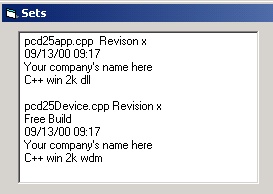
Here' and example of software part number passed from a ring 3 C++ dll and a ring 0 wdm to Visual Basic 6.0 |
Interrupt performance on 98 under ds20. Tuesday September 12, 2000 09:51
| Tuesday 9/12/00 7:39 AM
Interrupts are generated from software from Visual Basic 6.0. Here's the test interrupt routine. Private Sub lbllotsInts_Click() Here's the code printing to the monitor char strcon[10]; Here are the results 23.091726 System Pcd25wdm: 09/11/00 18:45 Pcd25wdmDevice::Create Status 0x00000000 No missed interrupts computed by comparing the output of an 82c54 counter and the software interrupt counter were seen. The time for the irs with NO dpc to execute between 142000000 and143000000 was 270 seconds. This was uncommented // Request deferred procedure call The time between 1000000 interrupts is about 270 seconds. |
Keeping up with the most recent updates we've found is advisable.
We use Visual Studio Service Pack 3. And the most recent ddks.
Service Pack 1 is focused on four areas, according to Perry: operating system reliability, including memory leaks and system hangs associated with third-party software; application and hardware compatibility, ....
While new errors creep-in with updates, the total picture is usually inproved. Sunday August 13, 2000 10:26
| Windows 2000 SP1 aims to fix problems with initial release
By Bob Trott MICROSOFT HOPES THAT a pack of bug fixes can patch up any concerns corporate users may have about Windows 2000. Last week Microsoft released the first service pack for Windows 2000, an 87MB download that fixes an array of problems with the 5-month-old operating system. Given the sometimes-iffy nature of Windows releases, many analyst houses, particularly Gartner and IDC, had advised corporations to hold off deploying Windows 2000 until Service Pack 1 was released. Nevertheless, Microsoft claimed last month that sales hit 3 million by the end of June. “Some customers who are more on the conservative side will possibly wait for a service pack, but all indications we had were that customers were not waiting,” said Mark Perry, director of product marketing for Windows 2000 Server. Service Pack 1 is focused on four areas, according to Perry: operating system reliability, including memory leaks and system hangs associated with third-party software; application and hardware compatibility, particularly installation problems associated with Windows 2000’s signed driver technology; setup and installation problems; and the several security updates that have been released since Windows 2000 officially debuted Feb. 17. Service Pack 1 also caused new problems with Windows 2000. According to Paul Thurrott’s Windows newsletter and http://www.winsupersite.com/ Web page, the service pack “breaks” two firewall technologies, BlackICE from NetworklCE and ZoneAlarm from Zone Labs. Perry acknowledged the problems and said the ZoneAlarm problem was a connectivity issue. He said Microsoft was not sure if the ZoneAlarm and BlackICE issues were related but was working on a work-around or permanent fix for them. Months before Windows 2000’s debut, many analysts warned that the product — a massive undertaking — would not be stable enough to deploy enterprisewide. “If NT 4.0 is a house of sticks, then Windows 2000 is the foundation for a house of bricks’ Gartner research director Tom Bittman said last summer’. “Everything we heard about Windows 2000 was encouraging, but we were in no hurry to adopt it’ said the IT manager at one East Coast-based manufacturer, who requested anonymity. “Now that the [service pack] is available, it’s much more attractive. “I understand [why] Microsoft [put] Windows 2000 out as soon as possible — because it was so late — but since that was just five months ago, I think marketing should have taken a back seat’ the manager said.” The true release date is now’ The service pack is available for download at http://www.microsoft.com/windows2000/default.asp or on CDs available through Microsoft. Actually, Service Pack 1 was available for download on other Web sites for a few days before the official release, Perry said, and more than 50,000 customers had downloaded it during its first two days of availability. “Across our Premier [licensing] accounts for large enterprise customers within the Fortune 200 range — we have about 2,200 worldwide — what we’ve seen so far since the end of last week is that a little more than half have downloaded the service pack,” Perry said. Microsoft has created two deployment options for Service Pack 1. Users can also opt for the Express Installation, which targets Windows 2000 with specific updates and is about 13 MB, according to Perry. The Network Installation, which Perry said corporations prefer, can install and deploy both Windows 2000 and Service Pack 1 in one process across the enterprise. INFOWORLD AUGUST 7, 2000 http://www.infoworld.com/ |
Wdms will likely become the major interface technology between Windows and peripheral hardware. Thursday August 10, 2000 09:02
| Windows Me offers wide variety of
enhancements
KIM KOMANDO Q . A guy at the computer store told me that there is a new release of Windows this summer that will shake up the world. Is he right? — Gary in Albuquerque A: It’s happening even as you read this. New versions of the world’s most popular operating system are being reincarnated and manufactured for purchase. For starters, Microsoft is closing the book on its Windows 9.x code base before the end of the millennium (the real end, not the Y2K end), appropriately with a version called Windows Millennium Edition. What’s a code base? Even though Windows 98 looks very similar to Windows 2000 (the successor to Microsoft’s high-end Windows NT), the underlying computer code is entirely different. This September, home computer owners will be invited to upgrade from Windows 98 and Windows 98 Second Edition to Windows Millennium Edition or Windows Me. It’s not Windows M-E, but Windows Me as in “me, myself and I.” If Microsoft holds true to its marketing history, Windows ME will be available as an upgrade for somewhere in the $80-$l00 range. For that price, you will get an interface that’s a little closer to the look and feel of the security-rich Windows 2000, plus a wide variety of enhancements destined to make using your computer more enjoyable. It may interest you to know, though, that many of the features collected in Windows Me are available as individual downloads from Microsoft. What’s more, other companies offer alternatives to many of these enhancements, too. And, you don’t even have to wait until September to get them. For example, Windows Me is much better at managing digital music files than Windows 98. You van rip tracks from your favorite CDs, create play lists and so forth. Very cool stuff. However, all these new music capabilities come by way of Microsoft’s Media Player 7. As you may have guessed, just like past versions of Media Player, you can download Media Player 7 from Microsoft for free and install it on your Windows 98 system. A number of other companies offer programs that can do these same things. Among my favorites is MusicMatch Jukebox (www.musicmatch.com). The free version comes with all but a few high-end features active. Windows Me also will enhance your Internet experience by including a better Web browser and online chat. In the case of the Web browser, we’re talking about Internet Explorer 5.5, another free download from Microsoft. The chat program here is naturally MSN Messenger, another freebie. Maybe you’re already using the Windows 98 Critical Update feature. By connecting with the Microsoft Web site behind the scenes when you’re online, this handy service lets you know when any new software downloads are available that are relevant to your particular computer. That way, you’re always assured of having the latest and greatest Windows software on your computer. If you are not using the Critical Update feature, you should be. Windows Me goes a step further by automatically finding and installing the software updates without any intervention by you. Quite frankly, I don’t care for this idea. I like being notified when updates are available, but I also like deciding if and when I should install those updates. There’s nothing wrong with Windows Me. It is a minor upgrade to Windows 98 that may not be necessary but makes Windows simpler to use. Even before Windows Millennium Edition runs its course, Microsoft plans to unify the entire personal computing world. under various versions of Windows 2000. Whistler begins testing this fall (due in the second half of 2001) and Blackcomb will follow (due in the second half of 2002). © 2000, WestStar TalkRadio Network. All rights reserved. Albuquerque Journal Monday August 7, 2000 |
Windows 2000 reliablity. Thursday August 10, 2000 19:19

Federal Computer Week June 19, 2000 |
NT 3.51 and 4.0 are headed for quick extinction Monday July 17, 2000 11:27
Windows 2000: The First 100 Days
We asked readers to share their first impressions of the new OS: good, bad, or ugly. Upgraders love the stability and power, but they hate the installation hassles. • By Scott Spambauer PEOPLE MOSTLY say the same things: It’s the best version of Windows yet. It never crashes. I love it! Now if only it supported my scanner... Melding the stability of Windows NT with Windows 98’s slick interface (and some of its hardware support), Windows 2000 is the power user’s dream operating system. Despite the remaining gaps in hardware compatibility and a street price of $219 (Windows NT upgraders can send in for a $70 rebate), Microsoft’s latest business-strength operating system is flying off the store shelves, selling 1.5 million copies in its first two months. The fact that it is outselling all versions of its NT predecessor suggests that it must be winning some converts from Win 95 and 98. To see how well Windows 2000 has delivered on Microsoft’s promises, we informally polled PCWorld.com visitors on their experiences with the upgrade. Most of them were happy with Windows 2000— especially with its stability. Almost unanimously, they reported none of the system crashes and performance-sapping memory errors so common with Windows 95/98. A few noted that (like its Linux rival) Windows 2000 had not once required rebooting. The catch, though, is in getting Windows 2000 installed. Whereas Windows 9X embraces just about any hardware configuration it meets, Windows 2000 raises red flags right and left. And since the new OS comes with fewer hardware drivers than Win 98, your chances of a rocky installation are pretty good. Most Web site visitors we polled reported compatibility problems or installation glitches with Win 2000. Because drivers for older products are a a low priority for many hardware makers, our survey participants often were planning to maintain dual-boot PCs so they could switch between Win 2000 and Win 98 when hardware incompatibilities arose. A few had given up on Windows 2000 completely. GOOD VS. EVIL SEVERAL READERS wished that Windows 2000 were cheaper, but when we asked if they would buy it again having gone through the upgrade, the overwhelming majority said yes. Though a few mentioned improvements to the interface and new under-the-hood features, the chief reason given for their approval was Windows 2000’s stability: Most users said they’d never experienced a single crash, freeze, or lockup—a welcome change from the frequent reboots required with Windows 98. International Data Corporation vice president Dan Kusnetzky says that the corporate users he surveys report much the same thing: windows 2000 is reliable, stable, and a good performer. “On those issues, Microsoft seems to have hit right on the mark,” says Kusnetzky. But to achieve such satisfaction, upgraders must first navigate an unpredictable and occasionally rough installation process. Scott Murray, a software developer in Vancouver, British Columbia, installed Windows 2000 on his office computer with nary a hiccup. So when he decided to try it on his home PC, he wasn’t prepared for the nightmare that followed. “Everything seemed to be going smoothly,” Murray recalls, “but after the system had copied the necessary installation files to the hard disk and rebooted, I received an error message that stated the ‘ntkernel’ file was corrupt.” Murray rebooted and re-installed the OS from scratch but ran into the same error. After replacing the CD- ROM drive, trying a different Windows 2000 CD, running hard disk diagnostics, and repartitioning and formatting the drive, Murray still got the error. He finally traced the problem to the system’s motherboard. At the motherboard manufacturer’s insistence, he installed several BIOS updates that eventually left his computer totally unusable. “I got painted into a corner, so I did what any customer who has enough money does,” he says. “I went and bought a competitors product.” With the new motherboard in place, Murray was able to install Windows 2000 without major problems. Murray’s experience isn’t unique. According to Austin Watson, president of TTCX— The Test Company in Bellevue, Washington, some PCs are simply “evil” while others are “lucky.” Watson, whose company performs Windows Hardware Quality labs testing for Microsoft and hardware vendors seeking the “Designed for Windows” logo, has seen his share of recalcitrant systems and devices. “We have an older laptop that I put in the ‘evil machine’ category, he says, adding that the manufacturer told him to give up on trying to install Windows 2000 on the laptop. Meanwhile, he was nicely surprised when the operating system installed like a charm on an aging Toshiba portable. “It’s the best-working OS I’ve ever put on that laptop,” he says. Although there’s no easy way to tell if your PC is a Windows 2000 lemon, Microsoft has posted a list of systems known to be compatible. HARDWARE HANG-UPS SOMETIMES THE overall Windows 2000 upgrade goes fine, but specific components don’t work right. Dave Matthews of South Bend, Indiana, gave up on Windows 2000 after experiencing loud pops and clicks in the Macromedia Flash animations he creates. Matthews tried to trace the problem to his PC’s Creative Labs Sound Blaster Live audio card, whose drivers were installed automatically by Win 2000. He found updated drivers on Creative’s Web site and installed them—to his immediate regret. “Those nasty things locked up Windows 2000 completely,” he recalls. Matthews had to restart his PC in Safe — Mode to remove the new drivers. After scouring newsgroups for help, he realized that simply reverting to Windows 98 Second Edition was an easier solution. A Creative spokesperson said the company hadn’t heard of the problems Matthews experienced. The problem in cases such as this, explains TTCX’s Watson, is that hardware developers scrambling to create new drivers for Windows 2000 can’t just reuse existing Windows 95 or 98 driver code, which by now is comparatively mature and stable. Readers were often dissatisfied with Windows 2000’s video-card drivers as well, noting that many support Microsoft’s Direct3D but not the OpenGL spec required for high-end gaming. Inveterate gamer Steve Watts of Westerville, Ohio, claims that Windows 2000’s implementation of DirectX—Microsoft’s audio and graphics-acceleration technology used primarily in games—contains a serious bug: When a game running on his PC in full-screen mode crashes, he can’t get back to Windows 20 00’s graphical interface to take control and kill off the frozen game. A Microsoft spokesperson could not comment on the specifics of the DirectX problem, except to emphasize that Windows 2000 is intended as a business product. Microsoft recognizes that power users and game enthusiasts may realize advantages from Windows 2000, but they use the OS at their peril. The company is sending a decidedly mixed message, however: Many of the first Windows 2000 updates on Microsoft’s Windows Update site focused primarily on game compatibility (see “Essential Tool Kit for Win 2K Upgraders” on page 56.) STORAGE SNAFUS WINDOWS 2000 users have also encountered two major problems in the area of storage. The OS works fine with most of Iomega’s popular Zip drives, but the company’s parallel-port models weren’t supported until Iomega released updated software. Users of Adaptec’s Easy CD (software for recording CDs) must upgrade to version 4.02 to burn discs under Windows 2000. Worse, an error in the DirectCD packet-writing driver (which lets you treat a CD-RW drive like a hard disk) resulted in one of the few “blue screens of death” reported under Windows 2000. (Adaptec has since fixed the bug via updated drivers.) But the largest pieces missing from the Windows 2000 hardware puzzle—in our informal survey, at least—seem to be printers and scanners. Our survey respondents reported that a wide variety of both types of peripherals did not work as expected (or at all) under the new operating system. Furthermore, some manufacturers have stated firmly that they will not be dedicating scarce development resources to creating drivers for older and discontinued devices, many of which were developed for Windows 3.x/9x and had never even run on Windows NT. The people we polled also reported that plenty of applications failed to run under Windows 2000—from aritivirus programs to games to the software that syncs a desktop computer with a Palm device. In many instances, software developers have already posted their own Windows 2000 compatibility updates. In situations where product-update patches are not available, users are left with only two alternatives: Give up the application altogether, or dual-boot between Windows 98 and Win 2000. ARE YOU PROFESSIONAL? THOUGH the steady stream of new drivers and compatibility updates is making the upgrade to Windows 2000 easier, Microsoft and its system- vendor partners don’t seem terribly interested in selling the operating system to home and small-office users. According to Naila Seif, director of strategic alliances for Compaq s Commercial PC Computing Group, Windows 2000 is the flagship OS on Compaq corporate machines but is available on only two of its retail systems—both geared toward small businesses. Similarly, while Dell offers Windows 2000 on all its business- oriented OptiPlex and Latitude PCs (and on its Inspiron notebooks), availability for its consumer Dimension desktops is spotty. In general, PC vendors appear to be sticking with Microsoft’s vision of which computers should ship with Windows 2000 and which with Windows 98. By fall, Compaq and Dell will undoubtedly offer Microsoft’s Windows Millennium Edition (aka Windows Me) on their consumer machines. The latest operating system in the Windows 9X line, Windows Me promises greater reliability than Windows 98, along with a few new features to attract upgraders (see “More Thrills, Few Thrills,” www.pcworld.com/junoo/millennium). IDC’s Kusnetzky, however, predicts flat growth for Windows Me Windows 200 - or wait instead for its successor. Code-named Whistler, that version should appear at the end of next year. AN OS TO COUNT ON IF WINDOWS ME a continues Windows 98’s legacy of compatibility at the expense of stability (which wouldn’t be surprising, considering that it still uses Windows 98’s shaky code base), tech-savvy consumers may pass it up as well. More than one of our survey participants bristled at the seemingly arbitrary distinction between consumers and business users. ‘I have no patience for the constant errors that I encounter using Windows 98,” states Stephen DiLorenzo of Rochester, New York. “I have been told over and over that an NT-based OS is for businesses, but I think home users are just as entitled to stability and reliability. A person surfing the Web and someone creating a spreadsheet are both entitled to operating systems that run without constant glitches.” Compaq’s Naila Seif grudgingly agrees. “Reliability,” she says, is something that everybody cares about. Consumers at home need even more reliability because they don’t have an IT organization to support them.” Whistler may put an end to the 98-versus-NT dilemma by combining the best of both operating systems. But if you don’t want to wait, the early reports on Windows 2000 are generally favorable. Just do your homework first: Make sure that your PC and its BIOS, peripherals, and applications are listed as compatible Microsoft’s Upgrading Windows 2000 site; also check the manufacturers sites, which may have more- current information. When in When in doubt, make a full backup, uninstall any products known to be incompatible, and pray that the rest are lucky, not evil. If your installation problems boil down to one unsupported peripheral, you may have to decide which you like more: the new OS or the pesky hardware. Scanners are pretty cheap these days—you can always buy a new one. PC WORLD JULY 2000 page 54-58 |
While wdm drivers work both on 98 and win 2k, the amount of work to get a wdm driver working on 2k is considerably more than on 98. Tuesday June 20, 2000 09:20
| Windows 2000 rollout: Don’t try this at
home
The rollout of Microsoft’s new operating system seems to be well underway Research firm Meta Group estimates that Windows 2000 has already been deployed in 1.5 million companies. Yet most IT organizations are still in the planning stages, and plenty of companies are just beginning to consider such a project seriously. One question every organization considering a Windows 2000 rollout will have to answer early on is, “Should we try to do this ourselves, or should we reach out for help from consultants and solution providers offering Win2K services?” The answer for most companies, said senior Meta Group analyst Kurt Schlegel, is, don’t try this at home. “You definitely want to get some outside help,” said Schiegel. “You don’t necessarily have to hire the physical labor if you’ve got the bodies and the internal expertise. But for the planning, architecture work, design, testing, and creating the installation build and scripts, you will want to at least talk with people who have done this before.” The clearest advantage of hiring an outside service provider or consultant is the simple fact that working with people who have done it before is likely to reduce the cost, hassles and inefficiencies of the process. Windows 2000 is a large, complex OS. It is freighted with features and functionality Someone who has implemented the system before is going to work much faster and much more efficiently than someone who is learning as they go. Also, third parties, by their very nature as company outsiders, are not involve in internal political squabbles, and tend to focus resources and keep a project on track. How much should you expect to pay for Windows 2000 services? According to Chet Webster, director of the Microsoft technology services group at Getronics, an Amsterdam-based network technology company offering Windows 2000 implementation services, the figure is between $200 and $250 per hour, and you are unlikely to find many consultants offering a flat rate. "Any consulting company knows that [the Windows 2000 rollout] has got to be done on a time and materials basis,” he said. “No one can realistically say that they can do it for you for a single price. Life is just too complicated.” According to Meta Group’s Schiegel, the overall cost of a Windows 2000 migration falls between $200 and $2,000 per workstation. If you are in a cutting-edge enterprise with a brand new IT infrastructure and very good automated processes for change management, it will not be so bad. But organizations that are working with older technologies and inefficient change processes are in for some pain—between $1,500 and $1,800 per seat, Schiegel said. “We expect that most folks are going be in the $700 to $800 per workstation range, he noted. “It’ll be a noticeable chunk out of their resources, and it’s going to require some planning.” —John K. Waters Applications Development Trends JUNE 2000 |
Bugs may be expected in about 5% of the code, according to Gannsle Tuesday June 20, 2000 09:26
| Peter Coffee was inundated with responses to his query: Are
bugs just the cost computing? The majority of the readers say no way.
Win 2k: Too many bugs? PC Week March 6, 2000
Bugs in released software are evidence that the organization and staffing of the software companies are not focused on quality software manufacturing but rather on marketing software (PC At Work, “Win2K rollout asks 63,000-bug question,” Feb. 21, Page 44). It’s not that knowing how to create bug-free software is a mystery, but rather that the incentive to create bug-free software is missing. It’s obvious that Microsoft does not think Windows 2000 has too many bugs. If consumers want higher-quality software, they can express that opinion at the cash registers and in the courts. Those are the only opinions that have the power of lowering the bug count.
Don Brown |
| The 63K number is reported defects [in Windows 2000], not the actual
number of defects. One would presume there are thousands more. While Peter
Coffee may be technically correct in saying that bugs are not inherent in
computer science, our experience during the last 50 years testifies that,
without exception, we can expect bugs in substantial numbers in virtually
all software of any complexity. Certainly there's increased cost of fixing
defects after the product is shipped—costs that would have been less
if the defects were repaired before release. On the other hand, not shipping
has an obvious cost of its own. Compromises, trade-offs and subjectivity
must be employed to make that decision.
Of course, decisions of this type are not limited to software. How far do you go in designing for safety, implementing safety [measures] and testing for safety in a commercial jetliner? Despite what we may like to think, someone ultimately makes a decision that, in effect, says there’s a practical limit, even in the value of human life.
DavidHolt |
| It is time to say “no more to software bugs. Since when is it
more important to meet a ship date than to ship solid product Ask any company
outside the software industry, and they will tell you that it isn’t.
Bradley W. Wood |
| It is time to demand that software work right—the first time.
S. Dean Saul |
| I think it would be a great accomplishment to see software of any
type produced bug-free. But is that a realistic expectation? I don’t
think so. Is it just a cost of computing? For now, I think it is.
Deputy Eldon L. Hale |
| Rampant bugs in an operating system are inexcusable. The operating
system is vital to the operation. The results of bug-free code are happy
customers who will, in turn, be repeat buyers (not customers who complain
and look for the day when there is a real alternative).
Jeffey Turnmire Applied Engineering And Management Corp. |
| I am sick and tired of having to patch the patches of software that
[are] installed on 87 servers. Maybe I could work on security and privacy
issues if I did not spend all my time debugging the software whose functionality
we have fully paid for and only received partially. We accept this as
normal?
Douglas W. Huggins |
| The Japanese kicked Detroit’s butt by the application of a simple
zero-defects philosophy. Bill Gates had better pray that that Japanese
don’t start writing oerating system software.
Doug Own |
wdm drivers work on win 2k, 98 and, of course, ME
Friday April 28, 2000
15:05
| Windows ME gets re-networked
By Stephanie Sanborn AFTER SURREPTITIOUSLY removing some networking features from Windows Millennium Edition (ME) in March, including connections to Novell NetWare and a proposed client for Active Directory, Microsoft last week returned some, but not all, of the missing capabilities. The company has now put back support for NetWare a decision that was due to “customer feedback throughout the beta testing process’ according to a Microsoft spokesman — but still missing is Windows ME support for Active Directory. The spokesman said that “Microsoft is evaluating providing an Active Directory client for Windows ME, but a final decision has yet to be made?’ Microsoft has an Active Directory client for Windows95 and 98 but has stressed that Windows ME is intended specifically for the home, which many believe is the reason for the lack of Active Directory support. However, for IT managers running the Windows 9x family on the desktop, the decision still limits their upgrade options. “This puts us in kind of a tough spot’ said an IT administrator of a shipping company, who requested anonymity. “A lot of us out there are running [Windows] 98 or 95 and we’re kind of being shoved toward Windows 2000 whether we like it or not. Al Gillen, a research manager for server infrastructure software at IDC, in Framingham, Mass., noted that even the existing Active Directory support in the Windows 9x family does not provide full features of the Windows 2000 client. “You cannot manage the desktop, you cannot drive policies onto that system [like you can on a Windows 2000 client],” Gillen said. “The client software they have made available for Windows 95 and 98 ... basically just allows you a better view into the [Active Directory] tree to see what’s going on in there and what services are available?’ The IT administrator said he will take a hard look at Windows ME before figuring out his upgrade plans. “I’ll have to see what Windows ME offers when it comes out,” he commented. “If we can get it to do what we want, with or without whatever network connections it offers, that will be great. If not, I guess we’ll have to look for another solution." Microsoft Corp., in Redmond Wash., is at http://www.microsoft.com/ INFOWORLD APRIL 24, 2000 http://www.infoworld.com/ |
Other than wdm advantages of switching to Windows 2000 Wednesday March 29, 2000 07:41
| Cassel's Corner by Paul Cassel
Windows 2000 Win2K is more secure, robust and stable than other Win releases—it also requires some hefty hardware. By the time you get this issue, Windows 2000 should be on the store shelves. I’ve been using this system, in various forms and names, for a few years now. This is as good a time as any to review this, the newest and, to some extent, the most anticipated Microsoft Windows. Initially, windows 2000 was to be the successor system to both windows NT and Windows 98. That is, it was to be the merger of the two fundamental Windows lines, but something happened on the way to the CD pressing machine. The new system, based on Windows NT with features added, turned out to be a bit large for an “everyman’s” system. Also, the hoped-for hardware and software compatibility with legacy systems didn’t pan out fully: That’s the bad news. The good news is that the general plan for Windows 2000 did work out, at least as well as these things ever do. The new system is much more compatible than previous NT-type systems and is enormously more robust than any of the consumer Windows versions. It’s tough, if not impossible, to really quantify these things (although computer magazines always try), but if pressed, I’d say that the new system is 85 percent as compatible with legacy software as is Windows 98. Add to that the fact that it’s more stable than any Windows NT, and you see that, for most people, this is the right system to use
The only caveat for most folks is the large system requirements that even the smallest version, Professional, demands. Forget the numbers on the box. You will need a bare minimum of 96 MB of RAM, and that’s bare, folks. I’d really prefer to say that you should have 128 MB. You’ll see significant performance improvements right up to 256 MB RAM. If you do a lot of raster or video work, you can figure to go up even higher, but this is more a function of the work you’re doing than the operating system.
A fairly typical installation of Windows 2000 will eat 650 MB of disk space. This is largely wasted space from my view, but not from Microsoft’s. I’ve managed to halve this space by using methods not only undocumented, but frantically discouraged by the company. You see, all the recent operating systems from Microsoft come with some sort of system protection scheme that should seamlessly and without user intervention replace defective or unauthorized file with “correct” ones in case of system, user or installer errors. Microsoft chose the brute force method of assuring system integrity. Each installation of Windows 2000 comes with duplicate files that will move into action in case the system senses originals have been corrupted or replaced. While this works, it exacts a fearful toll on disk space. Microsoft’s position is that this space isn’t wasted, but rather put to good use, as it results in an almost bulletproof installation. My personal view is that I can restore from the CD at any time, so I don’t need all these files on my disk. Microsoft responds by saying that this might work for me, but won’t for most people, and I suppose the company knows what it’s talking about. Besides, disk space being as cheap as it is lately, my objection is really more aesthetic than reasonable. I have to admit that the Microsoft solution to system stability, while hardly elegant, does work flawlessly. So you’ll need 128 MB RAM and a multi-gig hard disk to run Windows 2000. It’s not very sensitive to system speed, with a 266-MHz system being fine for most uses. For most folks, getting or upgrading to this hardware is worth it. Here, in a nutshell, are several reasons why Windows 2000 is (to my way of thinking) the right system for any user who has the hardware to run it. 1. Simplicity of installation and function. The new system uses the automatic system checker to keep itself running perfectly. No longer will Microsoft blame rogue installer programs that overwrite vital system files because the operating system will strike back with an overwrite of its own. The newest Plug and Play (PnP) is incorporated into Windows 2000, making it an utter no-brainer to install new hardware or configure your existing hardware. 2. Fine power management is finally here in an NT-based system. The new Hibernation is as close to true instant-on after full-power-down as we’ve ever had. There is also real instant-on, but that does require some power drain. Most modem desktops and all laptops can use these new features. I personally use Hibernation and skip most of my boot time, but still enjoy having my system fully off (powered down).
3. If you’ve never used a system that just runs and runs without ever crashing, you owe it to yourself to give it a try. Windows 2000 is extremely robust. Linux fans will claim their system is more robust, but it is also much less flexible even if this is true—a claim that’s hard or impossible to prove. Applications can and will crash on Windows 2000 just as they will on any system. The difference is that, in doing so, they’ll not harm the system itself. 4. Windows 2000 will run much more software than its predecessor, Windows NT, especially in the consumer categories like games. I’ve not tested this with the extremely problematic applications like old Clipper programs that have given all Windows fits, but for the most part, it works just fine. From time to time, a game or two won’t run or some sort of application that requires dedicated hardware won’t kick due to that hardware, but for most people’s use, Windows 2000 will serve perfectly. 5. True system security in a desktop is here. By security, I mean that not only can you restrict access to authorized eyes only, but also the improved file system exclusive to Windows 2000, NTFS, will mean no more mysteriously lost data. Nothing can protect against physical damage to a disk, but the newest version of NTFS will protect against any faults an operating system can protect your data from. These five reasons sum it up for individual users. Corporate users will find an additional set of advantages, such as Active Directory and superior scalability, but that’s another story for another time. As you can tell, I’m enthusiastic about this system and will, in coming months, publish articles dealing with installation and operational tips, tricks and traps. I also have a new book out on this system, Windows 2000 Professional Unleashed by Sams, available now published by Sams now. 1
Paul Cassel's e-mail address is: ComputerScene Magazine http://www.computerscene.com/ March 2000 |
Windows 2000 press Wednesday April 5, 2000 18:54
| Greeting Uncertain for Windows 2000
By CLIFF EDWARDS SAN FRANCISCO — Windows 2000, Microsoft’s new corporate operating system debuting next week, can give businesses greater computing power to help them cope with the challenges of the new Internet economy. But whether businesses will buy it is far from certain. The release of Windows 2000, which cost more than $1 billion to develop, comes at a time when the seemingly unassailable software giant is facing challenges on several fronts, including a government antitrust lawsuit and intensifying competition amid an increasingly unpredictable economy. Despite its name, Windows 2000 is not an upgrade to the consumer-oriented Windows 98 but rather a successor to the corporate operating system Windows NT 4.0. While some home users may choose to purchase Windows 2000 for its Web application services and its increased security, the new operating system is designed for businesses that need to conduct complex business operations on or off the Internet. Cost may prove to be a deterrent for some users, with individual versions starting at $149 and network versions starting at $599, climbing according to the number of users licensed. Windows 98, on the other hand, retails for $89. Analysts so far have given Windows 2000 favorable reviews, albeit with some caveats. “This is probably the best product Microsoft has ever released in terms of meeting the expectations of the purchasing audience,”. said analyst Rob Enderle at research firm Giga Information Group. “It’s also a product that may be shipping too late for its own good. About two years ago, they probably would have been able to hold back the emergence of competing products, but now the genie’s out of the bottle.” The release of Windows 2000 was delayed for more than a year, allowing companies packaging the upstart Linux operating system and rival Sun Microsystems Inc. to gain inroads among such leading e-commerce companies as eBay Inc. and Amazon.com Inc. The additional time spent in development may help prevent a common complaint about initial Microsoft releases: They’re buggy and cause computer shut-downs. A survey by the Gartner Group also points to another possible problem: They estimate that one in four companies will experience software compatibility problems in upgrading to Windows 2000. Comments by a Gartner analyst Friday helped push shares of Microsoft down $6.061/4, or 6 percent, to $99.933/4 per share on the Nasdaq Stock Market. “We know the potential Windows 2000 has, but we want to test it to make sure that it is a stable platform for all the functionalities our site has to offer,” said Ron Syan, systems administrator for online drugstore CVS.com, which now uses Windows NT. “That means we’re not going to run out and install it just for the sake of being first; we’re taking a cautious approach.” Albuquerque Journal Saturday February 12, 2000 |
Win 2k Minidrivers Wednesday 01/19/1999 07:52
Consider all system variables Windows 95 and Windows NT perform same basic functions, with a few significant differences [A] strong case exists to use either Windows 95 or Windows 4.0 [NT stands for "new technology"). Windows NT is Windows 95 with additional system stability, salability and security features not found in Windows 95. The extras do not mean though that NT is also short for "near technology." Hardware compatibility and software issues are prevalent using Windows NT and that's about to change with a new release of Windows NT rumored to hit the streets in the first quarter of 1998. ... Windows NT is a secure system, allowing users and administrators complete control of system files and resources. Almost anything associated with a Windows NT machine can be locked or restricted in some way. The security in Windows 95 is, well, lame. Power users love Windows NT. You can have multiple processors in an NT machine, succumb to fewer system crashes than with Windows 95 and get faster performance than you get with Windows 95. The main objection to using Windows NT has been that you need to have some Windows experience to avoid getting a migraine while using it. For starters, Windows NT does not support Plug and Play and Windows 95 does. Plug and Play automates the installation of new hardware and sets up software so that the hardware works properly. When you install a new hardware add-on, such as a modem or sound card, Windows 95 will do its very best to make sure that it works. It's pretty rare when Plug and Play turns into Plug and Pray. Windows NT users have no such luck. They may find themselves with IRQs, DMAs, memory ranges and other sticky configuration issues when installing new hardware. I still have nightmares about configuring one of my Pcs that runs Windows NT. If you still use old DOS games or Windows 16-bit programs, forget Windows NT. You'll need Windows 95 because for the most part, Windows NT can't run older programs. Some multimedia titles, games and memory management programs use virtual device drivers (VxDs). VxDs work like other device drivers, that is, they act like a middleman between the operating system or application software and the hardware. Windows NT doesn't support VxDs but Windows 95 still does. To be sure that your software will work with Windows NT, check Microsoft's Web site for details (http;//www/microsoft.com/noworstation/Partners.htm). Old and rare hardware causes a problem for Windows NT that Windows 95 sails through. Windows 95 supports about 1,000 more hardware device drivers than Windows NT. You need drivers for a printer, CD-ROM drive, video card and so on. For a list of hardware tested on Windows NT, go to http://www.microsoft.com/hwtest. Portable and notebook computer users should stick with Windows 95. Windows NT lacks power management feature and is really weak of PC card support. The desktop operating system line is about to become blurrier shortly. The upcoming release of Windows NT 5.0 appears to be getting the boost it need to make more Windows 95 users take notice. The real issue is which operating system to pick. Windows 95 and its upgrade will still be geared toward individual home users and Windows NT and it kin for power users. If you've been eyeing Windows NT and have legacy hardware, old software or use a notebook PC, wait until version 5.0 becomes available.
Copyright 1997, The Kommando Corp. You can visit on the Internet at http://komando.com or e-mail her at [email protected]. Albuquerque Journal, Tuesday July 15, 1997 |
Windows 2000 and 98 both run wdm device drivers.
"WDM expands on the driver/minidriver model that has proven so successful with SCSI and NDIS drivers. A developer who understands the issues of a hardware bus or a class of device builds a class driver. Other developers (like you and me) write minidrivers that handle specific hardware."
| Win2K has cutting-edge features
QUESTION: I was wondering what the deal is on Windows 2000.1 just got Windows 98 and now, I hear that there is another upgrade! What is going on here! Help! — Gerry in Albuquerque ANSWER: You can feel the excitement starting to grow because of Windows 2000. Slow down, pal. Despite the name, Windows 2000, scheduled to the hit the streets about a month from now, is not the “successor” to Windows 98. That is called “Millennium.” Windows 2000 is, in fact, the next version of Windows NT, Microsoft’s operating system that was designed mostly for corporate networks and workgroups. When you read “Windows 2000,” think “Windows NT 5.0.” If you have never thought of using Windows NT before, you may wonder why you should consider now. Granted, Windows 98 is fine or most people. Win2K (as it’s come to be called) offers many cutting-edge features that will eventually find their way into Windows 98 or more likely, its successor. The question is: Do you want them now, or do you want them later? F or example, when. Microsoft rolled out Office 2000, it introduced “smart menus” — application menus that monitor how you use Word and Excel, and then adjust themselves accordingly. The end result is application menus that are customized to the individual way you work. This idea of menu intelligence has been carried over into the Windows 2000 Start menu. The more often you use a particular application in Windows 2000, the more predominant its placement becomes on the Start menu. If computer time is money for you, productivity enhancements like this can add up Win2K also tries admirably make short order of finding the information you need, whether it’s on your own computer, on your internal network or even out on the Internet. An integrated search feature peeks into all your resources simultaneously, no matter where they are located. Add to that an improved Help interface — one that puts contents, index and search results on the screen at the same time — and you should be able to get from here to there with minimum effort. How many times have you cringed when you read on-screen, “You must now restart your computer for changes to take effect”? Even worse, how many times has your system locked up and forced you to do the three- finger salute — hitting Ctrl-Alt-Del at the same time? Microsoft claims that Windows 2000 will reduce the number of both planned and unplanned restarts. According to Microsoft, there were 75 scenarios in Windows NT 4.0 that required a planned restart. In Win2K, this number has been reduced to a mere seven. What is more, Win2K constantly monitors certain system functions that can cause problems, and corrects those problems before they become apparent to you. And that it did when we used a beta, or testing, version of Win2K. Installing and uninstalling software is also easier with Win2K. That is because the operating system monitors these activities to make sure you really get what you want out of these operations. But the new “Installer service” (as Microsoft calls it) doesn’t stop there. Each time you load an application, the Installer service checks to make sure the application is installed correctly. If it’s not, the Installer service corrects any installation problems automatically.
One area where Windows 98 pulled ahead of Windows NT was in hardware
support. The former had better plug-and-play features, and handled a wider
variety of hardware types. This is no longer the case with Win2K. It has
full support for both USB IEEE 1394 (a.k.a, FireWire, which is USB’s
high-speed cousin). Windows 2000 also supports the latest video technologies,
such as Accelerated Graphics Port (AGP), multiple video cards and monitors,
OpenGL 1.2, DirectX 7.0, and VideoPort Extensions.
© 2000, The Komando Corp. All right reserved. Visit Kim Komando at www.komando.com or send e-mail to [email protected]. You can listen to Kim Sundays, 11 a.m.-2 p.m. on KKOB-AM.
Albuquerque Journal Sunday January 16, 2000
|
Win 2k [not w2k] is coming! Thursday 12/23/1999 07:00
| Building GARGANTUAN
Software
by Eva Freeman Imagine a stack of paper the height of a 19 story building. That's what a printout of Microsoft's Windows 2000 would look like, if anyone cared to print it. With 29 milion lines of code written mainly in the C++ computer language, the new operating systern (OS) is by far the largest commercial software product ever built. In fact, the development of Windows 2000, and its implementation in a wide range of computer systems and locations, is arguably the most extreme feat of software engineering ever undertaken. To understand how software could grow to such immensity, think of it not as monolithic object but as an assemblage snap-together blocks. There's the core large enough by itself but just one part the whole that is Windows 2000. Also bundIed in are such components as an Internet browser, transaction processing (tools for upating information almost insranraneouly as new data are received) and a multitude drivers, which link peripheral devices such as printers to the OS. The drivers alone count for more than eight million lines of code, with just one of them comprising in excess of a million lines by itself. So it is conceptually not difficult to comprehend how an operating system with a plethora of features could grow to become a digital behemoth. Less obvious, though, is why Microsoft chose to take on this daunting venture of extreme software engineering and, after deciding to do so, how the company was able to build the product. Microsoft officials assert that their reason for raking an all-encompassing approach to the design of Windows 2000 is simple: customers asked for it. Company management was well aware that software complexity and bugs grow roughly geometrically with size, but major customers, especially at Fortune 500 corporations, had stated that they needed certain capabilities included in the operating system. The underlying concept is controversial—that it is more efficient for Microsoft to integrate a comprehensive set of subsystems all at once, rather than for each organization on its own to integrate the particular functions it requires.Everything about Windows 2000 is huge, starting with its 29 million lines of code. To tame this monster, Microsoft had to develop a new set of strategies, all while getting more than 4,000 computer geeks to work as a team It's a trade-off: the benefit is that the OS will perform a breathtaking number of functions; the cost is that the OS becomes very large and potentially slow, unstable and buggy (what critics refer to as "bloatware"). "We knew from the start how hard it would be to build such a functionally rich OS," remembers Brian Valentine, vice president of the Windows OS division at Microsoft. "But our customers were demanding this level of complexity. What we created with Windows 2000 was not so much a new OS as a new view of the role of the OS." Traditionally, operating systems have handled only a limited set of tasks, for instance, the allocation of resources such as computer memory, depending on whether the OS was designed for personal computers, network management or another specialized application. Windows 2000 takes an alternative approach; it is a single OS that spans most uses, thereby providing uniform security and system services to myriad computers, from individual laptops to clustered servers in corporate data centers. The theoretical advantage is that users will need to learn just one program—albeit a mammoth one—for a wide variety of systems and applications. Along with a novel way of thinking about operating systems, Microsoft had to invent a different methodology for developing software. Specifically, simulation tools for modeling how the software would work were of limited usefulness. (Unlike other massive engineering projects, the Microsoft venture found scale models essentially worthless.) More important, at the level of size and complexiry of Windows 2000, writing code was no longer the central activity Indeed, testing and debugging have accounted for between 90 and 95 percent of the work.
The greatest challenge in building Windows 2000, however, was not technical. Because every team member possessed so much specialized knowledge, a high level of staff turnover would have devastated the effort, which started three years ago. "My main responsibility is to make sure that the people who joined the project at the start stay with it to the conclusion," Valentine says. As the individual responsible for managing the entire Windows 2000 team, Valentine has grown to appreciate how crucial the human side is for developing megasoftware: "The difference between extreme engineering in software and other types of extreme engineering is that [with software] the architects are also the builders. Virtually everyone working on this project is highly trained, and no one is expendable or easily replaced. There are no unskilled laborers here, and the most important thing I do is to try to keep everyone on board." One vital means of keeping the Windows 2000 staff together was to create a sense of family—not an easy job on a project of this size. Consider these numbers: Valentine is ultimately responsible for 4,200 people, induding 2,000 Microsoft staff and 800 employees of Microsoft's partners (Intel, for instance) working full-time on the company's Redmond, Wash., campus and 1,400 contract personnel. IN A TYPICAL DAY , WORKERS EXCHANGE ABOUT 90,000 E-MAIL MESSAGE ON THE PROJECT. Another 1,500 Microsoft and contract staff are working on Windows 2000 in other parts of the U.S. and around the world, notably in Israel and India, using the design and test tools on Microsoft's global network to coordinate their efforts with the main campus. So every Friday afternoon, the entire Windows 2000 team comes together in the company cafeteria, the only room on the Redmond campus that can several thousand people. Part weekly report, part pep rally, these meetings are used by Valentine as much to maintain camaraderie as to keep the staff well informed. Sensing that the anonymity involved in such a massive endeavor was becoming an issue, Valentine brought thousands of markers to one Friday meeting. "I wish each of you could put your signature on the OS, but as the next best thing, let's put our names on the cafeteria," he told them, laughing. By the end of the meeting, the walls were covered with thousands of signatures. For holidays, Valentine dresses appropriately, as on St. Patrick's Day, when he gave the weekly report while wearing a leprechaun costume. On April Fools' Day, the floors were covered with thousands of Superballs, those toy rubber balls with superhigh bounces. "Brian will do whatever it takes to keep the team together," says Iain McDonald, the Windows 2000 project manager. "I don't think anything embarrasses him, so long as it works." And, of course, each major release of the fledgling software is always an excuse for a huge party. The week may end on a playful note, but the rest of the time is pure business. Because of the critical importance of testing and debugging, a group of 50 to 60 managers meets at nine in the morning every weekday (as well as on Saturdays and Sundays when a release date approaches) to go over the daily reports of errors found in the Windows 2000 code These bugs arrive from a variety of sources independent software vendors from the outside who are developing appliction software that will run on Windows; select customers at so-called beta site who test the software under the actual conditions of usage; Microsoft's in internal tests, which involve a large portion the computer systems at the company and overseas test sites. During this "war room" conference, which McDonald usually chairs, each bug's impact is carefully assessed. How much damage will it cause? Will the fix introduce a new problem? Who should take care of it? The bug is then handed over to the test department, headed by Sanjay Jejurikar, who assigns it to one of 25 triage teams. They log the severity of the bug into a database, then make the necessary fix. After that is done, the revised code is sent to the Build Lab, the center of Windows 2000 testing. Working in the Build Lab has got to be a hardware geek's idea of heaven. To ensure that Windows 2000 will run successfully on every possible hardware configuration, the multiple rooms of the Build Lab contain at least one of every type of system, storage device, modem card, Internet card and other eltronic accoutrement. For video cards alone, as just one example, the computers in the Build Lab host almost 1,200 designs and configurations. To enable the test group to release an updated version of Windows 2000 every day, Microsoft enforces a strict schedule for submitting revisions to the software. he day's changes - about 250 is a typical number — are checked in between 1 and 4 P.M. After that deadline, the Build Lab begins to enter the changes, and the new release, referred to as the "build," is typically ready between 6 and 8 P.M. This latest version of Windows 2000 is then available for download over the company's internal network. Additionally, by 9 P.M. the Build Lab has pressed and distribured about 2,000 CDs of the softal ware. Before 7:00 the next morning, the build verification test, which evaluates the stability of the previous day's build, is under way.
About 3,000 individuals at Microsoft use the daily build, locally known as "dog food," as the operating system of their personal computers. Why dog food? Edmund H. Muth, group product manager for the Windows OS division, explains, "Before dog food manufacturers try their latest product in a test market, what do they do? They bring in their own dogs. Their own dogs have usually developed pretty picky habits, and if they don't like the dog food, the manufacturer doesn't test it on someone else's dog. It's the same thing here. We don't send the OS to beta sites until our internal users have said they like it." Getting to that point has not been easy. The daily test cycle ends around 3:30 P.M., at which time all comments and criticisms are collected for the next day's war room. One benchmark of what extreme testing entails: in a typical day, workers exchange about 90,000 e-mail messages on the project. Additional tests to stress the software in lifelike conditions are conducted in one- and two-week cycles. Every six weeks those chunks of code that have been thoroughly tested are evaluated one last time and then locked. Valentine explains the underlying theory: "We found that we can only screw up so much in six weeks. Longer than that, and it gets too hard to figure out what's going on." The code, however, is never cast in stone. If a subsequent bug is discovered, Microsoft will fix it, even if that means running additional extensive tests to ensure that the correction will not trigger problems in other parts of the program that have already been frozen. But not every bug is fixed. "In a software system of this size, you always have to consider the risk that fixing a bug could impact the system somewhere else," Jejurikar, the head of testing, says. According to him, Microsoft always fixes four broad types of bugs: those that cause system crashes, introduce security holes, create Y2K problems or lead to users being denied some type of service. Other kinds of glitches that the company may decide are not worth eradicating include ones that will surface only under unusual conditions, affecting just a small number of customers. Microsoft documents these types of errors and saves possible fixes so that they can be provided to users as needed. In a perfect world—and with projects to develop simpler software—the idea of intentionally leaving in bugs might seem unthinkable, but Windows 2000 brings home the reality of extreme software engineering. A system of this magnitude cannot be flawless; it can only be tested and documented as thoroughly as time constraints allow. That said, Microsoft is in the final stage of preparing Windows 2000 for prime time. This last and most massive part of testing is occurring not within Microsoft but at beta sites of the company's key customers and partners, including thousands of firms that manufacture the accompanying computer hardware and complementaty software applications. All told, the final test version of Windows 2000 is being poked and prodded in 23 languages and 130 distinct dialects at 300,000 corporate sites located in more than 50 countries. At press time, Windows 2000 was scheduled for official release in the fourth quarter of 1999, nearly a year late (nor uncommon in large software projects). Many financial analysts who follow Microsoft believe the company's future will depend on the success of the product. If that turns out to be true, evety bug fixed will have been well worth the effort.
SCIENTIFIC AMERICAN presents EXTREME ENGINEERING
|
Win 2k release info Wednesday April 5, 2000 19:05
| Windows 2000 Code Released
Retail Products Will Be Available Feb. 17
By Michael J. Martinez REDMOND, Wash. — After an arduous three years of development, Microsoft has announced the release of the finished code for Windows 2000, the latest operating system in the Windows family. "It's a great release for our customers. "We haven't shipped it until it's ready, and today it's ready," Brian Valentine, senior vice president of Microsoft's Windows Division, said at a morning news conference. Code for Windows 2000 was being delivered Wednesday to software manufacturing plants in the United States, Europe and Asia to begin duplicating disks, building boxes and delivering the product, said Deborah Wilhingham, vice president of the company's Business Enter- prise Division. Retail customers will be able to purchase Windows 2000-based products on Feb. 17. Windows 2000, which will succeed Windows NT version 4.0 for Microsoft's corporate coming nearly a year later than Microsoft intended. The delay has meant more opportunities for other software makers, such as Sun Microsystems and the numerous companies supporting the free Linux operating system. That makes this version of Windows doubly important, as Windows 2000 rypresents the company's technological and financial future for the next few years. Windows 2000 is designed for high-powered computers and networks for businesses; it is based on a different software architecture than Windows 98, which is aimed at the home market. Prices begin about $149 for each user, while versions for network computers start around $599 and climb according to the number of users licensed. But industry analysts say the software price alone is only a small portion of the total cost of converting to the complex new system. Even Microsoft officials say Windows 2000 will not fly off the shelves the way Windows 98 did last year. The complex operating system,estimated 35 million lines of code, can give even the most tech-savy company pause. "This is no simple upgrade. Switching from NT to Windows 2000 will be like installing a whole new operating system," said Laura DiDio, senior analyst with the Giga Information Group. That, analysts say, will drive up the overall cost of Windows 200O. In fact, although the price of Windows 2000 licenses will remain steady compared with NT 4.0, analysts agree there are a number of added. costs to consider, including training, added memory for servers lost production time as the Windows 2000 network gets up to speed. Giga recently completed a study of a sample network of 30 servers and 5,000 workstations. In that study, a company would have to spend $535,000 to get Windows 2000 up and running on its servers, and another $973 per workstation - a total of $5.4 million. Because of that, few companies will initially be willing to install Windows 2000 within the first three months of its release, according to research firm International Data Group. Albuquerque Journal 12/16/1999 |
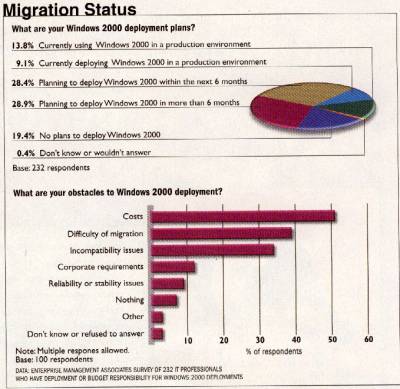
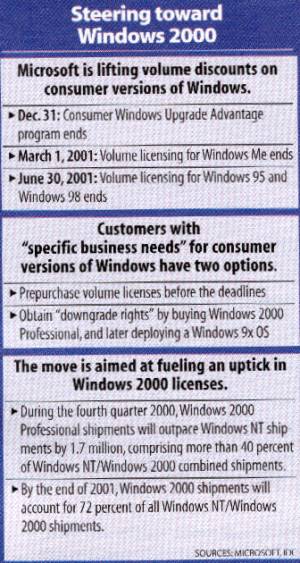
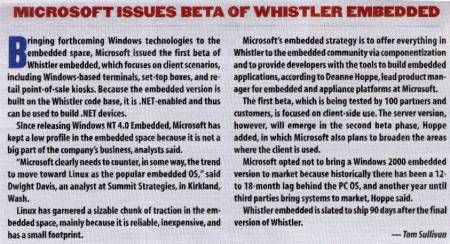
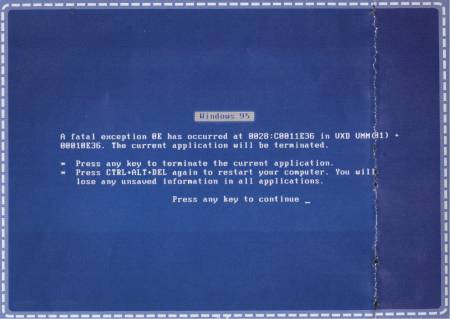
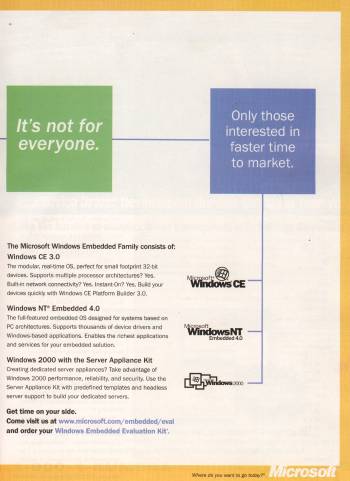
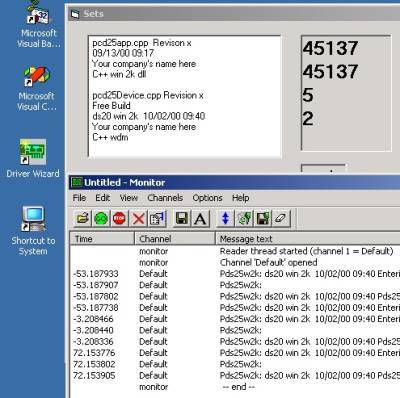
 operating systems offers a comprehensive
software platform forbringing the next generation of intelligent and connected
devices to market faster.
operating systems offers a comprehensive
software platform forbringing the next generation of intelligent and connected
devices to market faster.