 Certification of wdm drivers by Microsoft
is an initiative. This is one reason why csd recommends use of a driver
package like Compuware/Numega DriverStudio 2.0.
Certification of wdm drivers by Microsoft
is an initiative. This is one reason why csd recommends use of a driver
package like Compuware/Numega DriverStudio 2.0.
Universal Serial Bus 1
Thursday January 3, 2002 08:09
1394 looks to have some serious competition. Saturday February 9, 2002 13:57
| Spec gives you USB on the go
ONE OF THE CRITICISMS of the USB interface has been its lack of support of peer-to-peer connections. If you wanted to move a song from one MP3 player to another, for example, you had to connect them to a PC, move the MP3 file from the first player to the PC, and then move the file from the PC to the second MP3 player. To solve this problem, the USB 2.0 Promoters Group has created the USB On-the-Go Supplement to the USB 2,0 specification (see "Understanding USB On-the-Go," EDN, Nov 11, 2001) You can access Revision 1.0 of the supplement, which was released on Dec 19, 2001 , at www.usb.org/developers/onthego. In line with the new spec, Transdimension offer the single-chip, $5.95 (10,000) QTG243 USB On-the-Go host/function controller to help you create USB devices that can communicate with each other without connecting them to a PC, Transdimension claims that the OTG243 will allow manufacturers to add USB pee-to-peer connectivity for much less than adding and IEEE 1394 port, which already support peer-to-peer connections. The OTG243 controller has on-chip memory and targets devices that can't afford to devote a lot of processor resources to it USB connection. By locating only active endpoint and transfer descriptors in controller memory, the OTG243 can efficiently process transactions and reduce system bus contention. The controller support 12- and 1.5 Mbps USB 2.0 devices. You can choose between an 80-pin LQFP or BGA package; Transdimension also licenses the intellectual-property cores. _ by Greg Vrana Transdimension, 1-949-727-2020, www.transdimension.com At www.ednmag.com, click on Reader Service link and enter no. 385 EDN January 3, 2002 |
USB 1, 1.1 and 2.0 are very complicated protocols.
Drivers for these protocols are something an individual, or even corporation, doesn't want to try to implement. Or probably can't.
But here's what we've expected to hear. Microsoft is bringing us around to be XP adopters!
Over the past two years, Microsoft has been working with industry partners on the USB 2.0 project. We are pleased to announce that USB 2.0 drivers will be available for Microsoft® Windows® XP through Windows Update early in 2002. USB 2.0 driver support for Windows 2000 is still under development, and will be available later in the first quarter of 2002.
Microsoft will not provide USB 2.0 support for the Windows 9x platform or Windows NT® 4.0. 1
Csd is planning an experiment to go directly from a disk running Windows 95 OSR2 to XP. In part to try XP's compatibility modes. Like some 95 programs which which won't run on 2000 will run on XP.
An individual or corporation can use a Microsoft UBS 2.0 driver to connect to its custom hardware provided, of course, some company, say Cypress, has done both the hardware and software USB 2.0 job on the peripheral side.
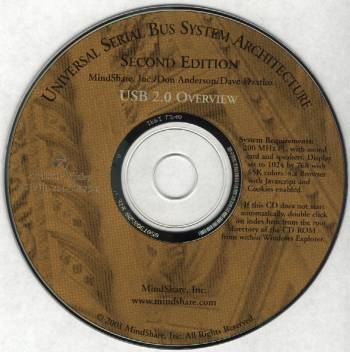
Csd finds the cd rom on USB 2.0 from
Mindshare
very valuable to help with USB 2.0 understanding.
Much of project success relies of know what not to do! Like trying to write a USB 2.0 driver! And we don't have to. Microsoft is doing this for us! On the PC side.
But there is still the peripheral-side problem we're exploring solutions to. Friday February 1, 2002 12:34
| WINDOWS XP TO ACCOMMODATE PROTOCOL
Microsoft changes course, throws weight behind USB 2.0 BY BRUCE GAIN Microsoft Corp. has unceremoniously announced on its Web site that it will support USB 2.0 early this year, after the software giant’s Windows XP operating system did not incorporate drivers for the protocol when the new OS debuted toward the end of last year. The move represents an obvious boon to USB 2.0 chipset suppliers such as Intel Corp. and peripherals vendors that have long had devices ready for the 48OMbit/s protocol that connects PCs and peripherals. “Trying to do anything without Microsoft support and drivers stops any kind of effort to support any technology,” said Bob Merritt, an analyst at Semico Research Corp., Mountain View, Calif. “So this has really opened up the higher speed ranges for USB for the manufacturers of the attachments, because they really couldn’t go too far without Windows support.” Microsoft’s decision not to support the USB 2.0 protocol late last year came as a surprise to many analysts and observers. Instead, the Redmond, Wash., company offered drivers for the FireWire standard, which Apple Computer Inc. and Texas Instruments Inc. developed and which offers data transfer rates of 400Mbits/s. While not offering any insight into why it initially decided not to support the faster USB 2.0 standard and to adopt FireWire instead, Microsoft recently posted on its Web site the following: “Over the past two years, Microsoft has been working with industry partners on the USB 2.0 project. We are pleased to announce that USB 2.0 drivers will be available for Microsoft Windows XP through Windows Update early in 2002. USB 2.0 driver support for Windows 2000 is still under development and will be available later in the first quarter of 2002.” USB 2.0, according to Merritt, will likely follow the course of its predecessor, USB 1.0, which offers data rates of l2Mbits/s. “USB 1.0 waited for support by Microsoft before it really started moving, and the rest of the technologies follow the same way,” he said. () EBN January 14, 2002 www.ebnonline.com |
Certification of wdm drivers by Microsoft
is an initiative. This is one reason why csd recommends use of a driver
package like Compuware/Numega DriverStudio 2.0.
These packages are much more likely to contain all of the code Microsoft requires for driver certification than if you try to do it yourself Tuesday January 1, 2002 17:02
| Lab compliance testing sought for USB,
1394
By Junko Yoshida SAN MATEO, CALIF. — Makers of USB or IEEE 1394 devices are increasingly asking independent testing laboratories to help ease the laborious task of compliance testing. The turn to the labs comes as industry groups seek more effective tools to design comprehensive test suites for the so-called “plugfests.” These efforts include the 1394 Trade Association’ s recent adoption of the Tree and Tabular Combined Notation (TTCN) standard. When lesser-quality 1394 or USB devices show up on the market, component and system vendors must maintain a high- quality standard for their interfaces to make sure their systems comply with the standard. “We need to stave off cheaper imitations,” said Max Bassler, chairman of the 1394 Trade Association. Moreover, putting in place effective testing methods is especially critical, since trade groups like the 1394 body and the USB Implementers Forum (USB-IF) are under pressure to succeed with new logo and icon programs intended to insure interoperability among various systems—both on the electrical and system-application levels. The USB-IF has been certifying several third-party labs to test USB devices—not only for USB cables and connectors but also for USB devices, hubs, systems and silicon building blocks. The USB-IF recently added MCCI (Ithaca, N.Y.), a developer of USB drivers and firmware, as a newly certified USB 2.0 low- full- and high-speed device- testing lab. Others already certified by the USB-IF include NSTL Inc. (Conshohocken, Pa.), Professional Multimedia Testing Centre (Belgium), XXCAL (Culver City, Calif.), Contech Research Inc. (Attleboro, Mass.) and ETC (Taiwan). Meanwhile, the 1394 Trade Association recently decided to use the TTCN standard for 1394 protocol conformance testing. TTCN, an ISO/IEC 9646 standard originally designed for telecom, where robust protocol conformance is mandatory, is “a formalized language to describe test suites,” said Richard Mourn, president of Quantum Parametrics (Scotts Valley, Calif.). The 1394 Trade Association expects to apply TTCN-based tests in all IEEE 1394 specs that include command sets or protocols above the physical (PHY) layer, including updates and enhancements. Saves on labor Since TTCN turns test specs into C-function calls for realworld applications, it can spare the human labor of reading, interpreting and then translating into hard code a system specification originally written in English, Mourn said. In essence, TTCN can develop a test suite that looks and feels identical in each application, regardless of its author. MCCI president Terry Moore said plugfests represent a growing problem today as more USB devices hit the market. “It has become difficult to manage testing so many devices in such a short period of time—like three days—during one plugfest,” he said. Moreover, waiting the customary three months for another plugfest to test one’s product has become unacceptable for those seeking faster time-to-market solutions. “For many companies, three months is a lifetime,” Moore said. Some vendors also worry about confidentiality. While it’s customary for compliance testers and those who bring proprietary, unannounced devices to plugfests to sign nondisclosure agreements, the testing, by nature, is a semipublic forum. Although system vendors try to conceal a new product in a paper bag or a cardboard box, “you’d know what they have, as you wait in line” for their verification tests to finish, said Moore. Instead of going through an often-torturous plugfest, system vendors can now go to private testing labs certified by the USB-IF. The goal for MMCI, for example, is to test a USB system product in about two weeks USB, 1394 without requiring product engineering staffers to attend, said Moore. The 1394 Trade Association plans to follow the path innovated by the USB-IF, said Bassler. The association is now “interviewing one or two labs” that can test 1394 cables and connectors for compliance testing, he said. The search for third-party testing labs that can test physical-level conformance as well as the Open Host Control Interface (OHCI) has also begun, Bassler said. Quantum Parametrics has already submitted a proposal to the 1394 body, he said. “Eventually, we’d like to see about 10 different companies getting involved in setting up this process.” Technical confidence The flurry of test activity among trade groups stems from the industry's pressing need to reduce the burden - now unfairly placed on consumers - of sorting out complex digital connectivity and interoperability issues. As they roll out new logos and icons, system vendors want to ensure both electrical and functional conformance. Previously, private logos such as i-Link and Firewire that appeared on systems were just a marketing device, said Mourn. “With our new 1394 logo program, however, we want to build technical confidence behind that logo.” Next year, the 1394 Trade Association will roll out a new compliance logo for its members and a new compliance icon for consumers to identify the right sockets and the right connectors to buy, Bassler said. The 1394 body is heading for uncharted waters that USB-IF has never had to sail, especially in ensuring function-level conformance for various 1394- equipped systems. Because of USB’s fundamental master/slave model, conformance testing for USB devices is relatively painless, as long as companies like Microsoft Corp. or Intel Corp. have correctly implemented the USB host on the P.C platform. In contrast, the peer-to-peer communications for which 1394 is designed could create a whole new set of problems. Besides checking the electrical properties in baseline 1394 test suites, the 1394 group also needs to implement “network testing” as well “functional-conformance test suites,” Mourn said. Network harmony Network testing is critical, to assure that a new 1394 device added to the 1394 network can not only perform its functions properly but also does not disrupt other devices already on the network. TTCN comes in handy “because we can use the language to emulate the traffic on the network,” said Mourn. “We can track the traffic and try to determine what’s happening in the real-world scenario. Functional-conformance test suites will grow over time, said Mourn. Today, a digital-video camcorder and a hard-disk drive—even though each is equipped with a 1394 interface—have no idea what they are supposed to do on an application level, when the two are connected. To make that connectivity useful for applications, the 1394 trade group first needs to determine “profiles”—a set of certain minimum functions all the digital-video camcorders or all the hard drives can perform. Again, the TTCN will play a critical role in developing standard test specs that fit across different devices ranging from high-definition TV, notebooks and set-tops to personal video recorders and cameras. The testing complexity that faces the 1394 association today will likely have great relevance to the USB group when it begins to deal with the emerging USB On- The-Go spec. Unlike regular USB, On- The-Go is set up for point-to-point communications—without a PC to bridge two devices—in a fashion similar to 1394. With USB On-The-Go, Mourn said, the USB group “will have to solve problems we are already solving with 1394.” TTCN has not been discussed in the USB community yet, MCCI’s Moore said. But he acknowledged that TTCN might be useful for creating USB On-The-Go testing procedures. Moore said that unlike 1394, On-The-Go allows a collaborating pair of devices to elect a host device. After the election, the existing USB host/device protocols are still used. Nevertheless, USB On-The-Go opens new challenges in testing. System vendors need to design test cases that will challenge a device-under-test with electrical scenarios that cover many real-life situations the device might see, Moore said. Electronic Engineering Times November 19 ,2001 www.eet.com |
Texas Instruments may give Cypress stiff competition with its TUSB5152.
csd received its EZ-USB FX design kit from Cypress on Saturday February 10.
csd is considering implementing both an 8051 and dual datapointer 80C52 forth operating system on one or more of these usb parts tied to wdm drivers on Windows 2000/98/ME. Tuesday February 13, 2001 06:31
Cypress targeting peripherals to maintain lead in USB market
BY CRISTA SOUZA With the market for high-speed USB set to take off this year, Cypress Semiconductor Corp. is hoping to retain its position as the leading supplier of USB controllers by offering a family of fully integrated devices for bandwidth-hungry peripherals.
The first of these, the EZ-USB FX2, supports the 480-Mbit/s USB 2.0 specification and is targeted at printers, scanners, mass storage, and broadband systems. Unveiled last week, the chip integrates an 8051 microcontroller, a serial interface engine (SIB), a USB transceiver, on-chip RAM and FIFO, and a programmable interface. Cypress plans to expand the EZ-USB family later this quarter with a controllerless device that offers a high level of integration for systems that ready have a processor. USB 2.0 offers speeds 40 times faster than USB 1.1 and is low cost, creating an alternative or replacement for low-end SCSI devices, which are expensive, require more slots to hook up, and are not hot-pluggable. In-Stat Group, Scottsdale, Ariz., expects the market for USB peripherals to grow from virtually nothing in 2000 to more than 230 million unit shipments in 2004. However, designing systems to meet the high-speed specification presents a new set of challenges, said Dave Podsiadlo, high-speed USB product manager at Cypress, San Jose. “Now that you’ve got data coming in at higher speeds and in much bigger packets, you’ve got to get the data off-chip quickly somehow” he said. “Additionally the transceiver portion has become much more complex—more like the high-speed communications standards we’re used to.” By integrating most USB functions on one chip, Cypress said the FX2 keeps the processor from being a bottleneck. The chip employs what Cypress calls Quantum FIFOs, which combine end-point and interface data buffers into one big FIFO—implemented as 256-bit x 16 dual-port blocks—to decrease latency between the USB host and the peripheral system. Cypress’ General Programmable Interface (GPIF), a microcoded state machine, acts as the master translator between Quantum FIFOs and the outside world. The GPIF replaces a PLD by emulating standard interfaces such as UTOPIA, ATAPI, and EPP It can be programmed to connect directly to ASICs, DSPs, or microcontrollers. In addition, using a “soft” architecture enables OEMs to begin production while still qualifying code or doing last-minute changes, according to Cypress. The architecture allows 8051 firmware to be executed from external RAM, uploaded from external serial non-volatile memory, or downloaded from the host PC. The EZ-USB FX2 is currently sampling. Production quantities are expected later in the first quarter, priced from $8.25 to $9.75 in 1,000-piece
EBN February 5, 200
www.ebnonline.com
BY JAYANT MATHEW Cypress Semiconductor Corp. last week introduced the EZ-USB FX2, a USB 2.0 peripheral controller the company said offers customers high-bandwidth capability and speeds 40-times faster than the current USB 1.1 solution. The USB 2.0 controller consists of an 8051 processor, a serial interface engine, a transceiver, on-chip RAM and FIFO, and a general programmable interface. San Jose-based Cypress (nyse: CY) claims the USB 2.0 offers a signaling rate of 480Mbits/sec., up from l2Mbits/sec. found in USB 1.1, making this ideal for mass storage, printers, scanners, broadband 5 applications, digital video and legacy conversions.
Cypress designed the EZ-USB FX2 to be fully compatible with 3 USB 1.1, allowing for plug-and-play of peripherals. “This is an improvement in performance, which is a technical feat and maintains ease of use,” said Norman Taffe, director of marketing at Cypress. As a result, the EZ-USB FX2 works with existing cables with dynamic detection and power management features as its predecessor. USB revolutionized the concept of peripheral connectivity by eliminating the need for multiple, legacy I/Os in PCs such as serial, parallel and PS/2 interfaces. The Cypress USB portfolio consists of low-speed microcontrollers capable of a signal rate of 1.5Mbits/sec., full-speed microcontrollers capable of l2Mbits/sec. and now the high-speed solution. According to Taffe, Cypress grossed about $80 million selling 83 million USB controllers and claims more than 50 percent of the market. Taffe said Cypress will ship between 6 million to 10 million units of its USB 2.0 controller this year and expects the number to reach 235 million units in 2004. Cypress also forecasts shipments of its USB 1.1 controller to reach about 373 million units in 2004. Cypress is betting on the EZ-USB FX2 controller to extend its dominance in a market where demand for USB peripherals is expected to rise to 500 million units in 2003 “I think USB 2.0 is going to be a pretty strong product for them,” said Bob Merritt, director of emerging markets at Semico Research Corp, Phoenix, adding that “Intel is pushing this for them.” He believes interoperability and convenience will ensure that every PC comes loaded with USB ports. Intel (nasdaq: INTC) certainly thinks so and its USB initiative will result in more PCs with USB, Merritt said. Intel has incorporated USB controllers starting with the I/O controller hub 2 (ICH2) in Rambus-enabled chipsets. Cypress said Intel will include USB 2.0 for desktops by the end of the first quarter, while VIA Technologies Inc. is expected to deliver one by the end of the fourth quarter. Intel is also slated to introduce one for mobile PCs by the end of the year. Intel and others endorsed USB 2.0 over IEEE 1394 because USB in a desktop takes up less space in the south bridge, requiring less silicon, Merritt said. Cypress designed the EZ-USB FX2 based on what it calls soft architecture. “Developers can change and update firmware through the Internet, while our competitors are ROM-based,” Cypress’s Taffe said. This allows for last-minute code changes and qualification of code during production. The EZ-USB FX2 is sampling now and will be available in production quantities at the end of the first quarter. It is priced from $8.25 each to $9.75 each in quantities of 1,000 units. Electronic News February 5, 2001 |
The 80C52 microcontrollers are built by so many companies that they will all likely do very well in the marketplace.
We need to watch the competing Texas Instrument TUSB5152 which operates at 96MHz with two clocks per instruction.
The two low-power modes of the 80C52s make them ideal for low-power peripherals connected to a Windows 2000 PC with a wdm driver.
Numega DriverStudio 2.0 has extensive power policy hooks which can be used to send power-down instructions to a peripheral.
The 80C52 side software will likely be sufficiently complicated that it should be ram-based and have an operating system installed on the 80C52 for debugging. Tuesday March 6, 2001 07:45
USB 2.0 integrated peripheral controller debuts AN INTERESTING flip-flop is occurring in the migration from USB 1.1 to USB 2.0, and Cypress Semiconductor is partly responsible. When USB 1.1 first appeared, Intel made sure that your PC had a USB host controller by essentially giving away that function in the Pentium chip sets. However, few USB 1.1 chips were available with which to build peripheral or hub controllers. Now, with USB 2.0 catching on, the opposite is happening. USB 2.0 interface chips and controllers for peripherals and hubs are appearing, but host-chip support is lagging: Intel and Via, for example, don’t plan to ship USB 2.0 chip sets for PCs until late this year. Cypress claims to have shipped more than half of all USB controllers currently in use and now is the first to market with a USB 2.0 integrated peripheral controller. The EZ-USB FX 2 includes an enhanced 8051 processor running at 48 MHz, an SIE (serial-interface engine), a USB transceiver, on-chip RAM and FIFO, and a GPIF (general programmable interface).The SIE is smart enough to handle basic USB-protocol and -enumeration operations, leaving the 8051 free to run your peripheral-application firmware. The FX 2 has a 4-kbyte FIFO to handle 480 Mbps of data. The GPIF supports common bus standards, including ATA, UTOPIA (Universal Test and Operation PHY Interface for ATM), enhanced parallel port, and PCMCIA, eliminating the need for glue logic in most applications. The EZ-USB FX 2 is now available for sampling, and production quantities will be available during this quarter. The FX2 comes in three configurations and packages and costs $8.25 to $9.75 (1000). If you have already selected a processor for your peripheral design, you may want to consider an intelligent USB 2.0 interface from Cypress. The EZ-USB SX 2 is essentially an FX 2 minus the 8051 processor. The SX 2 uses the same intelligent SIE, GPIF, and 4-kbyte FIFO as the FX 2. The chip comes in a 56-pin SSOP and will be available for sampling in this quarter. The price is $5.29 (10,000). —by Greg Vrana
Cypress Semiconductor, Enter No. 385 at www.rscahners.ims.ca/ednmag. EDN March 1, 2001 www.ednmag.com The EDN web address causes an Unhandled exception in IEXPLORE.EXE: 0c0000005: Access Violation consistently in IExplorer 5.0! |
csd has a Cypress EZ-USB FX, not FX2, development system.
The FX2 development systems are said to have "yield problems" and are being sampled in limited quantities.
We will test the Larky, Kolowsky and McCoy assertion
Firmware and driver examples included in the developer’s kit can help to bootstrap the iso development and have transfers up and running on the first day of development.
We are optimistic because of the extensive software support both on the PC and 80C52 side.
If all goes as planned you can contact csd using Microsoft Netmeeting to try-out the Cypress EZ-USB FX communicating over USB 10-1.1 and later the FX2 using USB 2.0. Here's a link to practical Netmeeting applications. Thursday July 26, 2001 13:04
| THE USB CONNECTION
Eric Huang USB Poised For Mass Adoption into Windows XP Systems IMPLEMENTING USB IN SILIcon is easier than ever. USB standards are open, clear and mature. USB certification labs test for compatibility. USB 2.0, also known as Hi-Speed USB, is poised for mass-market adoption with Microsoft Corp. providing support in Windows XP and Windows 2000 this year and chipset integration expected next year. With hundreds of USB 2.0 consumer products expected in the market in 2001 and 2002, USB building blocks, such as semiconductor chips and semiconductor intellectual property (IP), give companies a head start in building a Hi-Speed peripheral. When considering your next peripheral design, you have three options for implementing Hi-Speed USB: build it yourself, buy a chip or license USB IP. Each option has appeal, but for Hi-Speed designs, IP integration is the best approach. The build-it-yourself approach seems attractive at first. Internal development creates a USB skill- base and allows for integration into the ASIC for the lowest bill-of- material (BOM) cost. Your engineers say they can implement a USB design in afew months, and the only cost to you is the engineering resource. This is a great option if you have excess engineering resources. However, if this is not the case, you can use scarce engineenng resources to improve features for your peripheral instead of creating both the USB logic and verification environment on your own. For Hi- Speed USB, interoperability with earlier USB systems is required for backward compatibility. USB experience and the verification are critical to meet compliance. These factors make USB chips or IP attractive options for reliability. The buy-a-chip option is great for rapid introduction of peripherals at low volumes of 10,000 to 50,000 units. Some chips provide all USB functions, including both digital and analog logic, allowing designers to drop-in the USB connection into a system board. Due to the complexity of the analog portion, which must operate at 480Mbits/sec., many chipmakers sell a discrete physical layer (PHY) chip that provides only the Hi-Speed analog logic. Licensing USB IP and integrating it into the ASIC is the best long-term option. Companies sell both the USB digital controller and analog PHY IP. The IP offers a low BOM cost, fast design time and high reliability. A low BOM cost results from integrating the USB function onto the ASIC. Licensed USB IP provides engineers with both USB IP and verification environments developed specifically for reuse and integration. And since the IP has been used and reused in many customer designs, you leverage their experience. Dedicated IP companies train customers on the USB standard, IP and verification. Your engineers develop the expertise quickly. This adds up to fewer chip turns and faster time-to-market. Most importantly, your engineers spend time innovating. Of course, you should be sure the IP you license is high quality. IP companies, EDA companies, chip companies and foundries all offer USB IP. Look for companies with a proven record in providing USB IP, source code, training, documentation and verification. A wide range of offerings is also a good indicator, such as offering USB host, hub and peripheral controllers that have been successfully used in production volume applications. A careful evaluation in both dollars and resources always points to purchasing USB IP. Eric Huang is the product marketing manager at inSilicon Corp. based in San Jose. |
DSP-MIXED SIGNALS
COMMENT You’ve Come a Long Way, USB THE UNIVERSAL SERIAL Bus (USB) has been around for awhile. USB is an open interface standard that has been included on PC motherboards since late 1997. In 1998, the iMac was introduced, featuring only two I/0 interfaces—USB and Ethernet. The first versions of the USB spec (1.0and 1.1) supported max imum transfer rates of 1Mbytelsec. with a raw bit rate of l2Mbits/sec. Windows ‘98 provided the first OS support for USB with built in drivers for a range of devices, including mice, keyboards and speakers. In April 2000, the USB Implementers Forum (Microsoft, Intel, Philips, HP, Compaq, NEC, and Lucent) released version 2.0 of the USB specification. This release added a new high-speed transfer rate. High-speed USB is 48OMbits/sec., 40 times faster than the fastest rate offered in USB 1.1. USB supports two types of transfers for moving large blocks of data: bulk for moving data that cannot tolerate errors and isochronous (iso) for moving data that cannot tolerate delay. Bulk transfers ensure the data is transferred reliably with no lost or corrupted data. However, the amount of data transferred in a given period of time is not guaranteed. Bulk data is “fill data” that only uses the bus when there is no other traffic. Isochronous transfers are scheduled to occur at a defined rate that has been negotiated between the host PC and the device. However the data may arrive corrupted or not be sent from time to time. Selecting between iso and bulk is fairly straightforward. If the iniegrity of the data is most important, then bulk transfers should be used. If it is more important for the data to be on time than correct, iso transfers should be used. At first glance, it seems illogical to select iso as iso provides corrupted data on time instead of corrupted data later. But there are several instances in which data cannot be late. A simple example is an audio stream during a telephone call. The audio must keep up with real-time in order to make the phone usable. Losing a few snippets of conversation is preferred over the listener falling further and further behind the speaker. Another example is video, where it is preferable to miss a frame of the image and maintain the real-time flow of the image. USB bandwidth is divided into 1,000 frames per second. Isochronous transfers in USB 1.1 were limited to a single packet per device endpoint per frame. The largest packet was 1,023 bytes, yielding an aggregate data transfer rate of 1Mbyte/sec. USB 2.0 not only increased the data rate to 480Mbits/sec., it also subdivided each of the frames into 8 microframes to reduce the need for buffering in the device. USB 2.0 also increased the number of 1,024 byte packets per microframe to 3 for each device. Thus, the achievable iso data rate in USB 2.0 jumps from 1Mbyte/sec. to 24Mbytes/sec. (1,000 frames/sec. 8 microframes/frame x 3 packets/microframe x 1,024 bytes/packet). The most obvious multimedia application that is opened up with the introduction of USB 2.0 high speed iso is for inexpensive video cameras. USB video cameras have been available for years, but the limited bandwidth of full-speed USB has resulted in disappointing resolutions and frame rates. A full- speed USB video camera only has the bandwidth to transmit uncompressed CIE (352x288) video at 5 frames/sec. This device would require more than 90 percent of the available bandwidth that must be shared by all USB devices inthe system. At high speed, the same camera could operate at 30 frames/sec. and use just 10 percent of the available bandwidth. As a real-world example, currently available digital video cameras transmit at a constant data rate of 4.5Mbytes/sec. for video and audio combined. This is well within the capabilities of high-speed iso. Windows support of USB is based on a layered architecture that minimizes and can even eliminate the need for custom device drivers. At the lowest level is the USB driver (USBD). Layered above the USBD are class drivers, drivers that are generic to a range of devices with similar characteristics. For iso support, the class driver is the Stream Class Driver (stream.sys). Audio and video drivers are layered above stream.sys. Windows ‘98 includes support for audio devices, and Windows 2000 improves upon this support by reducing the possibility of audio data being delayed by other operating system tasks. Windows ‘98 SE and Windows 2000 add some support for digital video. USB 2.0 high- speed devices can use the streaming driver to access up to 24Mbytes/sec. of bandwidth. PCI hosts that support USB 2.0 appeared in retail shops in April. Microcontrollers that support the new 2.0 standard are sampling now. The Cypress EZ- USB FX2, for example, is an 8-bit microcontroller that is USB 2.0 compliant and supports iso transfers at a sustained rate of up to 24Mbytes/sec. A flexible external interface allows it to be easily connected to a multimedia data source such as a video camera ASIC. Firmware and driver examples included in the developer’s kit can help to bootstrap the iso development and have transfers up and running on the first day of development. Steven Larky is a design engineering director, Steve Kolokowsky is a reference design department manger, and Mark McCoy is a staff software engineer at Conexant Systems Inc., based in Newport Beach, Calif Electronic News, July 23, 2001 http://www.e-insite.net/electronicnews/
|
| Cypress Semiconductor Corp. Revenue: $185.6M, down 38.3% Net loss: $17.9M San Jose-based Cypress said it is raking steps to cut its operating costs amid signs the company may not post a profit for the full year. The chip supplier said it will cut 500 manufacturing jobs, slash 10% tf nonmanufacruring positions, and take an asset write-down charge of up to $180 million. “Our company’s quarterly revenue has effectively been cut in half in six months,” said T.J. Rodgers, chief executive, in a statement. “The absence of a sizable short-term recovery in the datacom segment—despite promising signs in the computation and consumer segments—along with pressure on average selling prices, will cause us to be unprofitable for the rest of 2001, unless we take action.” EBN July 23, 2001 http://www.ebnonline.com |
Hi-Speed USB aka USB 2.0 appears ready to do bad things to FireWire aka 1394. Reason is that usb already commands space on Wintel motherboards.
1394 may never command space on Wintel motherboards.
Question 5 shows that FireWire, because of Apple computers, is actually ahead of Hi-Speed USB at the moment since converters are already on sale.
Here's the bus adapters available at CompUSA
1 Western Digital FireWire to card bus at about $99.
2 Western Digital FireWire to PCI bus at about $99.
3 Adaptek FireWire to PCI bus.
4 Maxtor FireWire to PCI bus at about $49.
Whether Hi-Speed USB or FireWire, serial data gets converted to parallel and read or parallel data gets converted to serial and written on the PCI or PCMCIA busses.
wdm drivers are required to connect both Hi-Speed USB and FireWire devices to Windows applications. Wednesday March 28, 2001 07:06
THE USB CONNECTION
Top Hi-Speed USB AT THE RECENT INTEL Developer Forum (IDF) in Silicon Valley, the USB Implementers Forum hosted a pavilion where well over a dozen USB 2.0, or Hi-Speed USB, products gearing up for market introduction were displayed and demonstrated. These included host add-in cards and PC Cards, hubs and devices. The peripherals included scanners and storage devices such as hard drives, CD/RW, DVD and magneto-optical (MO) drives, and flash-card readers. Traffic in the pavilion was extremely high, with a lot of interest and questions about Hi-Speed USB and the new USB logo. Many of the questions were asked repeatedly, so lam devoting this article to addressing these most commonly asked questions. Question 1: When do you expect to see the first USB 2.0 host adapters and peripherals shipping? The first USB 2.0 (dubbed Hi-Speed USB for consumers) products are expected to start shipping within months. Several companies have already announced that they expect to ship products starting in April. Dozens of products are expected to be in the marketplace by the back-to-school sales season, which begins in the June/July timeframe. Question 2: What are some of the first types of products that will be shipping? Many of the devices that were shown in the USB-IF booth at IDF are various types of storage, such as hard drives, CD/RW, DVD and MO drives, and flash card readers. Scanners were also present in the booth, with three different vendors each showing their own. We also expect to start seeing demonstrations of printers, cameras, and even Ethernet adapters very soon. Question 3: What is the performance of these devices? Hi-Speed USB, with a bus bandwidth of 480 Mbit/sec., has more bandwidth than most peripherals in the marketplace need. Therefore, we would expect to see that peripherals will no longer have their performance limited by the bus, instead the limit will be the peripheral itself. Some early performance data that was shown in the USB 2.0 technical session at IDF shows this to be true. For example, a couple of different hard drives and CD/RW drives were measured with the IDE-to-USB 2.0 bridge compared to their native IDE. According to hard drive benchmarks, the USB 2.0 hard drives typically achieved about 90 to 95 percent of the performance of the same hard drive on its native IDE. CD/RW and other storage devices typically performed about the same on USB 2.0 and native IDE. When compared to their performance when running with USB 1.1 (l2Mbit/sec.), these storage devices showed significant improvement when using USB 2.0. For example, hard drives have been seen performing 10 times to 15 times faster on USB 2.0 than on USB 1.1. Reading or burning an audio CD proved to be about 5 times faster on USB 2.0—cutting down the time for writing a CD from 24 minutes on USB 1.l to only four minutes on USB 2.0. Question 4: Do these devices run on existing PCs with USB 1.1 ports? Since Hi-Speed USB is fully backward- and forward-compatible with the original USB, Hi-Speed USB devices will run on the huge installed base of USB 1.1- equipped PCs (at l2 Mbit/sec.). This is a tremendous benefit to consumers and IT managers alike, as they can share Hi-Speed USB devices across their entire base of USB 1.1- and 2.0-equipped PCs. Question 5: How can I upgrade my existing PC with USB 2.0? Host adapter add-in cards should start shipping in the marketplace soon. These will allow a typical PC with a PCI add-in card slot to support Hi-Speed USB. PC cards for notebooks are also expected to start shipping sometime in the second quarter of this year. Question 6: Why is there a new USB logo? When will I see it on products in retail stores? The USB Implementers Forum has introduced a new logo for use on USB-device packaging and collaterals. The license to use the logo requires that the product pass USB-IF compliance testing. Therefore, PC OEMs, retailers, and consumers should look for the logo when buying quality USB devices. Products are already starting to show up in retail with the new logo, such as some scanners recently announced by Hewlett-Packard Co.
Further information, including postings of the most recent product and
technology announcements, is available at the USB Implementers Forum website
at www.usb.org.
Electronic News March 26, 2001 page 24 |
While on-the-go may or may not need a wdm driver, it needs a microcontroller with the usb protocol on board.
Like the Cypress EZ USB FX.
But csd guesses that a wdm driver will be required. Tuesday March 20, 2001 17:14
On-the-Go simplifies USB connectivity New standard to let devices exchange data without computer BY JEANNE GRAHAM While USB doesn’t enable devices to exchange data without using a PC or server, it soon will. The USB Implementers Forum (USB-IF), an industry group with a vested interest in the technology, is poised to approve this summer the specifications for USB On-the-Go. The technology, a subset of the USB 2.0 standard, will allow consumers to connect a digital camera to a printer, or a PDA to a smart phone, via a USB port on the device. It’s at this point that the serial peripheral bus will begin to pose a real threat to peer-to-peer technologies such as Bluetooth and 1394 FireWire, market watchers say USB’s advantage: it’s familiar to consumers. USB is not necessarily a better technology than Bluetooth or 1394, but it has deployed better marketing campaigns, industry analysts said. 1394 is a technology that Apple Computer Inc. has championed for years, while Bluetooth is a wireless technology driven by cellular phone manufacturers. For wide market distribution, both will compete with USB for position with vertically integrated consumer electronics manufacturers, said Bert McComas, an analyst at InQuest Market Research, Gilbert, Ariz.
“A consumer product manufacturer will say, ‘Give me one good reason to go with USB,’ McComas said. “Well, one good reason is that every PC in the world has a USB port.” And even though On-the-Go does not need a PC to work, the presence of USB in so many PCs makes it a known commodity, McComas said. “USB wouldn’t be where it is today without everybody using it,” he said. The USB-IF claims more than 500 members and a board of directors consisting of representatives from Compaq, Hewlett-Packard, Intel, Lucent Technologies, Microsoft, NEC, and Philips Electronics. The market for peripherals supporting USB 2.0, the category that will include On-the-Go, will jump from zero units sold in 1999 to about 235 million units by 2004, according to InStat Group, Scottsdale, Ariz. “The USB consortium did a good job of marketing,” In-Stat analyst Robyn Bergeron said. “It got in with Intel and really marketed it to the consumer as something to make their lives easier. For a lot of people who buy peripherals such as scanners, USB has left an impression on their minds.” The market for applications of this technology is wide open, Bergeron said. “It’s things we haven’t even thought of yet,” she said. TransDimension Inc., a privately held fabless semiconductor company founded in 1997, is one of the companies planning to grab market share as the On-the-Go technology evolves. “We originally saw USB as PC technology only,” said David Murray, vice president of marketing at the Irvine, Calif., company “The PC market is very mature as far as USB is concerned. Now we see it going directly into set-top boxes.” TransDimension is a member of the USB-IF committee designing the On-the-Go specifications and will be ready to translate those specs to silicon as soon as they are approved, Murray said. “It will take us two months to get samples back from the foundry, after the specs are completed,” Murray said. “We’ll be ready” EBN March 12, 2001 http://www.ebnonline.com/ |
usb, wdm drivers, and 80c52 processors are closely related.
Initial interrupt tests show DriverWork 20 rc1 works perfectly on
both 98 and win 2k. This includes the dpc.
Saturday September 9, 2000
10:21
| Momentum grows for USB 2.0
By David Lammers and Loring Wirbel SAN JOSE, CALIF. — The movement toward the 2.0 version of the Universal Serial Bus is picking up steam. At the recent Intel Developer Forum here, silicon vendors showed integrated silicon for hosts, hubs and peripherals that support transfer rates of up to 480 Mbits/second for the high-speed standard. That is nearly 40 times faster than the USB 1.1 specification, which tops out at 12 Mbits/s, said Jason Ziller, an Intel Corp. manager who chairs the USB Implementers Forum. At those speeds, USB 2.0 is expected to play a key role in multimedia computing, wireless LANs and Internet-access appliances. For example, a USB 2.0 high-speed link could make it much easier to “burn” a CD-R recordable disk with MP3-compressed audio files from a portable audio player, he said, or with video from a digital video camera that supports the USB 2.0 interface. External hard drives are in development that will transfer data at more than 400 Mbytes/s. Windows NT did not include USB support, but Microsoft Corp. has included the USB 2.0 software stack in its Windows 2000 operating system. That move is expected to foster USB’s adoption in the commercial marketplace, just as Windows 98 played a major role in making the original USB interface a success. Also, the Windows Millennium OS, due out next month and aimed at the consumer market, will support the 2.0 specification. Compliance lab Intel announced that it has set up a compliance laboratory at its Hillsboro, Ore., facility—the USB 2.0 Peripheral Integration Lab—where peripheral manufacturers will be able to bring equipment for debug and compliance feedback. Also, Intel will build motherboards based on the Pentium 4 processor that will include discrete USB 2.0 control silicon. Other desktop vendors are expected to offer either built-in support, or add-in boards to the host, as early as the fourth quarter. And "the peripheral vendors are not waiting,” Ziller said. "They are planning to come out with peripherals, such as printers, external storage, video-conference cameras and scanners that will be marked ‘USB 2.0 ready.’ ” The new version is expected to displace the USB 1.1 specification starting next year, while maintaining compatibility with the older peripherals. Also, the cables and connectors are interchangeable. More information is available at the USB Implementers Forum site, http://www.usb.org/. Among the silicon offerings rolling out for USB 2.0 are devices from Lucent Microelectronics, Cypress Semiconductor and Sican Microelectronics. Lucent has consciously chosen to make its 2.0-compliant USS-2000 host controller backward-compatible with USB 1.1. The controller, resident in the server to control multiple device types, complements the USS-2X1 physical-layer chips that comply with USB 2.0. Overlapping functions Sujal Shah, director of computer I/O marketing in Lucent's access business unit, said that an interesting overlap in function is occurring with the 480 Mbit/s USB 2.0, as devices compliant with the new standard overlap in speed and function with IEEE-1394 devices and are occasionally used in isochronous video appliances Lucent produces chips for 1394 as well as one controller that handles both USB and 1394 though Shah said he still sees market segmentation. In his view, video and image-capture devices will use 1394, while printers and Internet appliances rely on USB. “USB will tend to stay dominant in host-to-peripheral applications, while 1394 will dominate in peer-to-peer applications,” Shah said. The four-channel USS-2000 combines a single 480-Mbit/ USB 2.0 host and four separate 12-Mbit/s USB 1.1 hosts with integrated transceivers. Also on the chip are a PCI interface module, a pipeline cache control module, a list-processor module, a serial interface engine, a PCI power-management module, a memory buffer and a PCI bus arbiter. The device can interface with any 32-bit PCI bus, at either 33 or 66 MHz. The physical-layer USS2X1 devices reside on the client side of a USB 2.0 hub. The device can operate in a USB 2.0 or USB 1.1 mode, with appropriate termination provided on-chip for either speed. The chip transmits and detects the chirp patterns required in the high- speed detection sequence of USB 2.0. Shah said that many OEMs had been asking for four-channel board-level solutions to ease the upgrade to USB 2.0, so Lucent worked with Belkin Components Inc. to develop a four-channel 48-Mbit card called QuadraBus, which Belkin is selling as a transitional product to evolve to the USB 2.0 host and client chips. Cypress Semiconductor Corp., meanwhile, has announced that its USB 2.0 high-speed peripheral control silicon has passed muster at the Intel compliance lab in Hillsboro. The EZ-USB FX2 single-chip solution integrates a USB 2.0 transceiver, a serial interface engine, an 8051 controller and a programmable interface. Other companies have opted to use an FPGA for the digital portion - and a separate analog device for the transceiver function. Cypress, the largest supplier of USB silicon, expects to see revenues triple to about $100 million this year. Sican Microelectronics Corp., headquartered in Hannover, Germany, introduced a synthesizable soft core, called the USB 2.0 Function DesignObjects, at the Intel Developer Forum. Sican developed the hard- ware descriptions, a Windows 2000 device driver, the ARM firmware and an evaluation board. The solution is aimed at a customer-specific ASIC that would support USB 2.0 high-speed functionality in peripherals. The USB 2.0 DesignObject supports the de-facto standard USB 2.0 Transceiver Macrocell Interface (UTMI) interface between the PHY and link layers of the protocol Electrical Engineering Times September 4, 2000 http://www.eet.com/ |
Importance of implementing peripheral-side software is beginning to over-shadow wdm drivers.
Cypress, of course, is offering 8052-based USB and USB EZ-USB-FX/2 solutions to the peripheral-side microcontroller.
csd's initial experience with the 8051 family was a result of Sandia Labs building the 8051 as a radiation-hardened part.
Here's a Sandia report on use of the 8051 as part of a hardware authentication device 1.
A Sandia-approved book resulted from the operating system software port project 1 2.
Getting peripheral-side microcontrollers to reliably communicate over USB/2 with each other or a wdm driver is the new challenge.
csd is looking forward to connecting its EZ-USB-FX to a wdm driver! Friday November 30, 2001 13:11
| designfeature By
Kosta Koeman, cypress Semiconductor
USB’s DAYS AS A HOST-CENTRIC BUS ARE NUMBERED. USB ON-THE-GO TECHNOLOGY WILL SOON ENABLE USB PERIPHERALS TO COMMUNICATE WITHOUT A HOST PC. THE NEW CAPABILITIES WILL EXTEND TO A RAFT OF CONSUMER PRODUCTS WHAT IS ALREADY BECOMING THE PC WORLD’S MOST POPULAR EXTERNAL BUS. Understanding USB On-The-Go THE USB SPECIFICATION INTRODUCED a simple and inexpensive infrastructure for easily connecting multiple external peripherals to a PC. That was several years ago; today, more than 500 million peripheral devices are designed with USB ports, making USB the market’s dominant I/O-connectivity standard. The widespread availability of USB peripherals is now driving non-PC applications, such as mobile, handheld, and embedded post-PC applications, to adopt USB for direct-I/O connections. In addition, many devices that have traditionally functioned as peripherals now require direct connections to other devices. USB’s greatest limitation—its lack of support for point-to-point communication between devices—has deterred its use in consumer- electronic devices, such as mobile phones and PDAs. However, these devices are gaining popularity and intelligence, increasing the need for direct connections among them. The answer to this requirement is in a developing standard called USB OTG (USB On-The-Go), a supplement to the USB specification that eliminates the requirement for a PC to act as host in exchanges of data among connected devices. There has been much speculation—and, unfortunately, some misinformation—regarding USB OTG. The OTG specification’s goal is to enhance certain USB peripherals to enable them to also act as hosts for a selected set of peripherals. OTG introduces point- to-point communication between these enhanced USB peripherals. OTG’s complexity comes from the requirement that these dual-role devices be able to directly exchange data with each other. Moreover, because the specification targets portable devices with significant power constraints, the initial OTG host must supply only a small amount of power. Two connected devices take turns functioning as the bus host and the peripheral, thus maintaining the current USB host/peripheral architecture model. The OTG host always initiates communication with a normal bus-enumeration process (bus reset, acquisition of USB descriptors, and peripheral-device configuration). After these steps, the device serving as OTG host may transfer data to and from an OTG device performing as a peripheral. The OTG specification defines a mechanism for exchanging the roles of OTG host and peripheral. The initial role of each device is defined by which mini plug a user inserts into its receptacle. There are two types of OTG devices: dual-role devices and peripheral-only devices. A dual-role device can function as either a USB peripheral or an OTG host. Dual-role devices must be able to supply at least 8 mA on VBUs. Though a peripheral-only device has no host capabilities, it must be able to request a dual-role device to communicate with it. Dual-role devices must minimally operate at full speed. Operation at high speed is optional. Peripheral-only OTG devices may operate at any of USB’s three signaling rates. OTG dual-role devices support only a subset of all USB devices (potentially, only one). Supported devices may be other instances of the same OTG dual- role device, other dual-role devices, or self-powered USB peripherals that the dual-role device can power. The dual-role device must provide drivers for the listed supported devices. For example, an OTG still- image camera may have a driver for a specific printer or for a set of printers. In such a case, a user will be able to print from that camera to only the specific printer or the set of printers; it is unlikely that he or she will be able to print to every USB printer. The dual-role device’s vendor must provide drivers for all of the supported devices. An OTG-device vendor that claims to support a class of devices, such as keyboards, that meet the power requirements for OTG peripherals must supply the corresponding class driver. CABLES AND CONNECTORS The USB 2.0 specification defines three types of connector pairs (plugs and receptacles): the standard-A, the standard-B, and the mini-B. The mini- B connector was developed for smaller peripherals, such as mobile phones. Because work on OTG began before completion of this mini connector, a new pin, the ID pin, was added to the plug in anticipation of OTG’s needs and was left unconnected in the mini-B plug. The OTG specification introduces a fourth plug, the mini-A, and two receptacles, mini-A and mini-AB. The differences between the mini-A and mini-B connectors are as follows. First, each plug is keyed so that the mini-A plug does not fit into a mini-B receptacle, and a mini- B plug does not fit into a mini-A receptacle. However, the mini-AB receptacle accepts either a mini-A or a mini-B plug. Second, the mini-A plug’s ID pin is shorted to ground. The overmoldings of the two plugs are different; the mini-A plug has a more oval shape, whereas the mini- B plug is more square. Last, the plastic inside the plugs and receptacles is color- coded. Inside the mini-A plug and receptacle, the plastic is white; inside the mini-B plug and receptacle, the plastic is black; and inside the mini-AB receptacle, the plastic is gray. The USB 2.0 specification defines two cables: the standard-A to standard-B and the standard-A to mini-B. OTG defines two more cables: the mini-A to standard- Band the mini-A to mini-B. The end-to- end delay of the mini-A-to-mini-B cables has been reduced to allow the use of adapters at the A end of the cable. Adapters are required to allow for connecting different combinations of devices. For example, connecting a USB device with a captive cable and a standard-A plug to an OTG dual-role device requires a standard-A-receptacle-to- mini-A-plug adapter. Conversely, connecting an OTG device with a captive cable and a mini-A plug to a standard-A port requires a mini-A-receptacle-to- standard-A-plug adapter. The only permitted usage of the mini-A receptacle is on an adapter. There are no usability issues when users are connecting two dual-role devices. However, when a user is connecting a peripheral-only device to an OTG dual-role device, he or she might plug the mini-B end of the cable into the dual-role device and then try plugging the mini-A end of the cable into the peripheral-only device’s mini-B receptacle. Because the mini-B receptacle is keyed to prevent its accepting mini-A plugs, users should let the differences in the cable ends guide them to reverse the cable connections. The color-coding inside the plugs and receptacles plus the overmolding requirements for the plugs can also be a guide. DUAL-ROLE DEVICES Because each OTG dual-role device incorporates a mini-AB receptacle, a mini-A-to-mini-B cable can directly interconnect the devices. Users will perceive no difference in the devices based on the cable connection. That is, users will not know which device is the initial OTG host and which is initially the peripheral. A dual-role device’s initial role is defined by which end of the cable a user inserts into the device’s mini-AB receptacle. The dual-role device with the mini-A plug is the initial OTG host, also known as the A-device. Conversely, the dual-role device with the mini-B plug is the initial peripheral, also called the B-device. The dual-role device determines which end of the cable to insert by whether or not the ID pin is shorted to the GND pin. The A-device must supply the voltage on VBUS when a communication session is in progress. This key difference between the A- and the B-devices causes the two connected devices to be unequal and prevents a peer-to-peer connection. Because the A-device supplies the voltage on VBUS and, therefore, controls when a communication session occurs, the B- device requires a mechanism for requesting a communication session. This mechanism is the SRP (Session Request Protocol). PERIPHERAL-ONLY OTG DEVICES Peripheral-only OTG devices are normal USB peripherals, but they also support the SRP These devices must have an OTG capability descriptor, which indicates that the device supports the SRP but is not a dual-role device. Last, peripheral-only OTG devices may use only the B receptacles or must have a captive cable with a mini-A plug attached. Peripheral-only OTG devices may not use the mini-AB receptacle. The SRP is the mechanism for a peripheral-only device and a dual-role device, configured as a B-device, to request a communication session with a dual- role device configured as an A-device. This protocol consists of two signaling methods generated by the B-device: data- line pulsing and VBUS pulsing. The A-device must detect one of these two methods and respond by starting a communication session. Two protocols are defined because having them simplifies implementing A-devices, which need to be designed to respond to only one of the two protocols. (There are small advantages and disadvantages in responding to either method.) There is virtually no added cost, other than some extra firmware, in having B-devices generate both methods. Dual-role and OTG peripheral-only devices must be capable of generating the SRP. First, the B-device executes data-line pulsing; the B-device must pulse its pullup resistor for 5 to 10 msec. The B- device must then drive VBUS (VBUs pulsing) for a period long enough to charge a capacitance on VBUs. The capacitance is smaller than 13 µF to at least 2.1V. OTG devices have a capacitance of 6.5 µF or less but do not charge above 2V a VBUS capacitance of 96 µF or more. (Standard hosts have a capacitance of 96 µF or more.) This limitation prevents the VBUS current from the B-device from damaging standard host ports. EXCHANGING DEVICE ROLES The OTG specification defines a negotiation protocol, the HNP (Host Negotiation Protocol). This protocol provides a means by which the A- and B-devices can exchange the OTG host and peripheral roles. Because the A-device is by default the bus host, it supplies the voltage on VBUS. When the A-device drives, the voltage rises above a valid level, and the B-device asserts its pullup resistor. When detecting a connection, the A-device resets and enumerates the B-device. The A-device then uses the functions that the B-device provides. Once the A-device finishes using the B-device, it may determine that the B-device is a dual-role device by querying for the B-device’s OTG-capability descriptor. If the B-device responds with a valid OTG-capability descriptor that indicates it supports HNP, the A-device generates a set-feature command (HNP Enable), which informs the B-device that it may assume the host role once the bus is suspended. (The A-device can also determine that the B-device is a dual-role device by successfully completing this set-feature command.) The A- device then suspends the bus. The B-device signals that it wishes to assume the host role by signaling a disconnect (deasserting its pullup resistor if operating at full speed or deasserting its pulldown resistors if operating at high speed). In response to the B-device’s disconnect, the A-device asserts its pullup resistor and operates as a peripheral. After the B-device resets and enumerates the A-device, the B-device may use the functions that the A-device provides. Once the B-device finishes with the A-device’s functions, the B-device suspends the bus and asserts its pullup resistor, returning to operation as a peripheral. Detecting the bus suspend, the A-device signals a disconnect and resumes the host role. If the B-device is a dual-role device, and the A-device doesn’t wish to use the B-device’s functions, the A-device reissues the same set-feature command and then suspends the bus. If the HNP_enabled B-device fails to signal its request to assume the host role within a specified time frame, the A-device can end the session by dropping VBUS. If the B-device initiates a session, the A-device may skip enumeration after reset by issuing the set-feature (HNP_Enable) command while the B-device is still in the default state. If the command succeeds—that is, if the B-device is a dual- role device—the A-device suspends the bus. If the command fails—that is, if the B-device operates only as a peripheral— the A-device enumerates the B-device and, if possible, services the reason for the session request. DIFFERENCES WITH USB 2.0 Because portable devices are typically battery-powered, forcing such devices to source a relatively large amount of current would result in very short battery life. The current-driving capability is often unnecessary anyway, because the device connected to the portable device is often self-powered. Instead of providing 100 or 500 mA at its port, a dual-role device must provide at least 8 mA. Dual- role devices are allowed to provide more current to accommodate additional peripherals but are not required to do so. Another key difference is the VBUS capacitance at the connector. OTG dual- role devices have a capacitance of 1 to 6.5 µF Standard hosts have a capacitance of 96 µF or more. This difference is significant during the SRP. When an OTG device performs VBUS pulsing, it drives a charge onto the VBUS line through either a constant current source or a resistor. If the OTG device is connected to a standard host, the voltage will not be driven above 2V, thereby avoiding any possible damage to the host. However, because OTG devices have much smaller capacitance than standard hosts, another OTG device will have its VBUS line driven above 2. 1V. Section 7.1.2.2 of the USB 2.0 specification defines four test points corresponding to the connectivity from host silicon (TP1) to host connector (TP2) to peripheral connector (TP3) to peripheral silicon (TP4). The maximum allowable delay is 30 nsec. Section 7.1.16 of the USB 2.0 specification limits the cable delay (from TP2 to TP3) to 26 nsec. Because of the possible use of adapters, which are allowed a 1-nsec delay, any cable with a mini-A plug is limited to a cable delay of 25 nsec. Using a 5m standard-B-to-standard-A cable with a standard-A-receptacle-to-mini-A-plug adapter violates, by 1 nsec, the 26-nsec limitation. However, when operating as peripherals, OTG devices have an only 1-nsec delay between TP3 and TP4, and, when operating as OTG hosts, a 1-nsec delay between TP1 and TP2. Therefore, the 30-nsec delay between host and peripheral silicon is preserved. COMPLIANCE PROGRAM A compliance-specification parallel to the OTG specification is under development. The document will define a compliance program that includes OTG-device role-exchange-support testing, OTG-host signal-quality testing, session- start-protocol-support testing, peripheral-only-device power-constraint testing and end-user-experience testing. The USB-IF’s (USB Interface Forum’s) current USB 2.0 peripheral-compliance program is a precursor to the future compliance program. Because OTG devices are USB peripherals with the additional ability to directly communicate with other OTG devices, they must pass both the USB-IF-compliance program and the OTG-compliance program to be considered OTG-compliant.
The USB OTG specification introduces new mechanisms to enable new
applications for USB peripherals. Only the drivers that the OTG dual-role
device contains limit the number of combinations of OTG devices that users
can connect. The introduction of OTG will not result in every OTG dual-role
device communicating with all other OTG devices. Initially, it will support
only a small number of devices. However, the list of supported OTG dual-role
devices will quickly grow. In the future, vendors of OTG dual-role devices
will likely include a mechanism for downloading drivers to their devices
to expand the number of supported devices.
ACKNOWLEDGMENT The author acknowledges the work and contributions of the following people, who helped to draft and edit the USB OTG specification: David Murray of TransDimension; David Wooten of Cypress Semiconductor; Zong Liang Wu, PhD, of TransDimension; and Mark Yi of Opti Inc.
AUTHOR’S BIOGRAPHY
Kosta Koeman is a staff software engineer with Cypress Semiconductor (Woodinville, WA), where he has worked for more than a year. He holds a BSEE from the University of Washington (Seattle) and an MSEE from the Oregon Graduate Institute (Beaverton, OR). EDN November 22, 2001 http://www.e-insite.net/ednmag/ |
All of the USB hardware will have to communicate with windows 98, 2000, and ME through wdm drivers. Friday September 29, 2000 08:29
In-Stat Insights USB to Dominate PC and Peripheral Markets BY ROBYN BERGERON ALREADY UBIQUITOUS IN NEW PCs, THE USB SOON will be the dominant interface between PCs and peripherals. USB already is present in 99 percent of PCs shipping today, and by 2004, about 750 million USB-equipped desktop and notebook PCs will be in use. Shipments of USB-enabled peripherals will grow 141 percent in 2000 and an average of 55 percent per year through 2004. Video cameras and scanners are the peripherals most likely to be equipped with USB today. In 1999, 54 percent of video cameras and 38 percent of scanners shipped with USB ports. The USB standard also will be incorporated into printers, monitors, keyboards, mice, analog and digital modems, stand-alone hubs, external storage drives and other peripherals. By 2004, 88 per cent of scanners shipped will feature USB technology as will the majority of peripherals. A four-year-old interface that has a maximum through-put of l2Mbit/sec., USB 1.1 is substantially faster than legacy PC interfaces such as parallel, serial and PS/2 types. The next USB standard, USB 2.0, will operate as much as 40 times faster than USB 1.1, at up to 480Mbit/sec. All USB 2.0 products will be fully compatible with l.0 and 1.1 devices.
USB 2.0 will be fast enough to support multiple
USB 2.0 products will become available in the third or fourth quarter of 2000 and will ramp up quickly over the next few years. Intel, however, is not expected to integrate 2.0 into core logic chipsets until the third quarter of 2001. Other core logic chipset suppliers are expected to deliver USB 2.0 two to three quarters later than Intel Corp. Therefore, PC OEMs have three choices regarding USB 2.0 implementation: • Wait for Intel Corp., Advanced Micro Devices Inc. or others to integrate it into core logic Most PC OEMs will offer at least a few models over the next couple of years with USB 2.0 based on a motherboard with a discrete host or an add-in PCI board. This will present a large opportunity for component manufacturers such as Lucent Technologies, NEC Corp. and Phillips to sell millions of USB 2.0 host controllers before semiconductor firms incorporate USB into core logic chipsets. PC OEMs currently include both USB and legacy interface in most designs, but they plan to phase out legacy interfaces to reduce costs. Most will have at least one legacy-free model by the end of 2000. This article is based on InStat’s new report USB: Quest for the “Universal” PC Connection. Robyn Bergeron is an industry analyst with Cahners In-Stat Group. She can be reached at [email protected] or at 480-609-4537 Electronic News September 11, 2000 http://electronicnews.com/ |
USB 2 8051 controllers need to talk to Windows 98 and 2000 wdm drivers Monday May 23, 2000 12:28
| leading edge
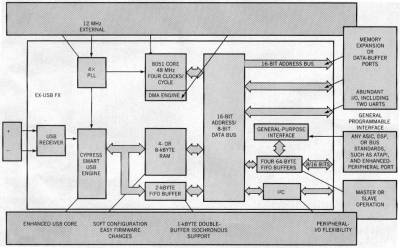
USB chip ignites turbo boosters THE UNIVERSAL SERIAL Bus (USB) has served its purpose as a simple-to- use interface for low-speed peripheral devices, such as mice, keyboards, digital still cameras, and many more. But for some applications, “USB” equals “unbelievably slow bus” because it tops out at 12 Mbps. This moniker will no longer apply, however, once USB 2.0—hitting turbocharged speeds as high as 480 Mbps—rolls out this year. This speed challenges even FireWire in certain applications, such as streaming video, mass storage, and digital-subscriber-line modems. Cypress Semiconductor has started building the infrastructure to support the USB 2.0 specifications with the introduction of its steppingstone EZ-USB FX family. Although the physical interface and cabling is the same as that for Version 2.0, the signaling voltages are much lower, and the transmission is terminated rather than reflective (as on the first version). In addition, the processor and other circuitry must be more robust. The EZ-USB FX family includes most of the logic that USB 2.0 needs but still requires some beefing-up; hence, the “steppingstone” designation. If you are starting a USB design, you may want to consider this design because it expands on Cypress’ EZ USB and makes it easier to upgrade to USB 2.0. New to the FX family, a DMA engine supports burst rates as fast as 48 Mbytes/sec. The family also includes I/O ports with two UARTs, a general-purpose programmable interface (GPIF), and four 64-byte FIFOs buffer. The GPIF, a user-programmable state machine, allows you to interface to ATAPI, Utopia, or your own custom hardware without system-level glue logic. The GPIF also controls the FIFO buffers, which can operate in 8- or 16- bit interface mode. Cypress provides white papers on how to support the various peripheral-interface standards; the company also provides a Windows-based tool that helps you write your vectors for the GPIF. The GPIF supports a clock domain for the 48-MHz 8051 and an external clock domain. Cypress built all of these features on a 48-MHz, four-clock/cycle 8051 core, a “smart” USB core, an PC interface, and a 4X PLL that were all part of the original EZ-USB family. One of the unique capabilities of EZ-USB is that when you first plug in the peripheral, the chip downloads the firmware, enumerates, and releases the processor from re- set. At this point, the peripheral again enumerates, and the 8051 takes over. During enumeration, the USB host controller issues “get-descriptor” commands to the peripheral. The 8051 responds by sending the vendor, device, and product IDs and a variety of other descriptive items. For the EZ- USB FX family, the DMA controller and the integrated FIFO buffers reduce the load on the processor to about 2% of the processor bandwidth. The processor has only to set up the DMA controller and let it transfer the data to the FIFO buffer for each 64-byte packet.— by Markus Levy
Cypress Semiconductor, Enter 480 at www.ednmag.com/infoaccess.asp EDN May 11, 20000 http://www.ednmag.com/ |
The role of quality wdm drivers which are binary compatible between Windows 98 and 2000 are critical to success of USB 2.0 communications too. Monday May 5, 2000 09:48
| USB 2.0: It’s Official
BY JERRY ASCIERTO Setting the stage for a showdown between rival high-speed bus standards, the USB 2.0 Promoter Group last week released the much-anticipated, final USB 2.0 specification. In his keynote address at the Windows Hardware Engineering Conference, Pat Gelsinger, Desktop Products Group vice president for Intel, unveiled the spec for the high-bandwidth serial bus. The bus, an alternative to the IEEE 1394 Fire Wire specification, provides a standard means of allowing peripherals to connect to computers. It promises to be more than 40 times faster than USB 1.1, achieving a speed of 480Mbit/sec. “This looks like a really good start for 2.0, and things seem to be on track,” said Scott Hudson, a senior analyst of PC Technology for the market research firm Cahners/In-Stat Group. “By Christmastime 2001, the world should be up to its nose in 2.0 peripherals.” Hudson added that before mass adoption takes place, several key milestones have to be met. “The two things that have to happen before 2.0 really takes off are: one, they have to integrate the host controller into the core logic chipsets, and two, the software drivers have to be in place,” Hudson said. The spec could spell bad news for firms banking on 1394. While each technology has its own application focus—USB 2.0 for PC peripherals and 1394 for audio/visual consumer electronic devices— the extent to which each technology will overlap remains unclear. FireWire supporters are quick to note that not only is 1394 out on the market now, but it’s a superior technology. “Without a doubt, 1394 is the performance leader,” Hudson said. This sentiment was echoed by 1394 Trade Association Chair James Snider, who chose to accentuate the positive in responding to the challenge of USB 2.0. “All of the leading PC and peripherals manufacturers have identified 1394 as the key element in the convergence of computers and digital home entertainment systems,” Snider said. According to Cahners In-Stat Group, the total units shipped for USB peripherals will grow from around 80 million in 1999 to nearly 500 million units in 2003. And InStat believes that the total available market for USB peripheral ICs will grow from $131 million in 1999 to $692 million in 2003. Texas Instruments and Apple Computer inc. were the originators of 1394. When Apple’s planned licensing fee of $1-per-port met with industry resistance, Intel took it upon itself to unveil a rival technology and formed the USB 2.0 Promoter Group with Compaq, Hewlett-Packard, Lucent, Microsoft, NEC, and Philips Semiconductors. Peripherals compatible with 1394 have the capability to communicate peer-to-peer without a PC. In other words, 1394 peripherals don’t need a PC with an Intel microprocessor inside to work. Critics argue that Intel was threatened by such a prospect and sought to produce a superfluous technology to further its empire. Although Intel has eliminated 1394 host controllers from its core logic chipset technology roadmap, Apple and Sony currently are shipping PCs with 1394 ports and some third-party chipset vendors are planning to include 1394. “By its actions, Intel is stunting the potential growth of 1394 peripherals, which leads to less interest from potential 1394 silicon suppliers and relatively high prices,” Hudson said. ELECTRONIC NEWS May 1, 2000 |
Both USB 2.0 and FireWire projects will require wdm drivers Monday May 5, 2000 09:50
| THE USB CONNECTION
JASON ZILLER Talking USB 2.0 Santa Clara, Calif USB 2.0 WILL EXTEND the speed of the connection from l2Mbit/sec. on USB 1.1 up to 480Mbitlsec. on USB 2.0, providing an attachment point for next-generation peripherals that will complement higher-performance PCs and user applications. USB 2.0 will be both forward and backward compatible with USB 1.1 and will use the same cables and connectors, resulting in a seamless transition for end users and allowing them to continue using their existing peripherals. USB 1.1’s data rate of l2Mbitlsec. is sufficient for many PC peripherals such as mice and keyboards. These peripherals will continue to operate with no change in USB 2.0 systems. The higher bandwidth of USB 2.0 will permit PC peripherals with more functions, including higher-resolution videoconferencing cameras; next-generation scanners and printers; fast storage units; and faster broadband Internet connections. It will make today’s user applications more productive, for example, reducing the time to download a “roll” of digital photos from a few minutes on USB 1.1 to a few seconds on USB 2.0. USB 2.0 offers a compelling opportunity for peripheral vendors to migrate their USB peripherals to higher performance while still allowing them to sell the same peripherals into the large installed base of USB-capable PCs. USB 2.0 also benefits PC vendors because they can use the existing USB connectors already on their PCs. This is especially important on small form-factor desktop and mobile PCs, where there is no space for additional connectors. Since the formation of the USB 2.0 Promoter Group was announced at the Spring 1999 Intel Developer Forum, tremendous progress has been made in the development of the technology. The USB 2.0 specification Rev 0.9 was released in December 1999, signaling the beginning of USB 2.0 product development. Dozens of industry vendors are currently readying their products to be available in 2000. The final spec release is scheduled for later this month. Also, the first public USB 2.0 demonstration was given at the Spring 2000 Intel Developer Forum. The first systems and peripherals are expected in the marketplace starting in the holiday season of 2000. USB 2.0 is on track, according to the aggressive schedule put forth last year. Many of the key milestones in the technology’s development have been achieved faster than many industry observers expected. The reason for this success lies in the fact that USB 2.0 is an evolution of an existing technology, rather than a brand new development effort. This has implications across all aspects of the technology. Many of the same industry experts who developed the USB 1.1 specification are leading the development of USB 2.0, incorporating all of their learning from USB 1.1. Also, since the high-speed mode has the same basic architecture of USB, migrating existing USB peripherals to USB 2.0 is an incremental design change. Even the device drivers will be the same as USB 1.1 in many cases. The biggest challenge is in the high-speed transceiver that supports the 480Mbitlsec. signaling. Fortunately, there are several leading industry vendors who are experts in this high-speed signal design, some of whom are already sampling prototype transceivers. From a business standpoint, there is no reason for peripheral vendors to wait to migrate their existing USB products to USB 2.0 because the backward compatibility will allow them to plug into the large installed base of USB-equipped PCs. The quality of USB 2.0 devices and their compatibility with USB 1.1 PCs and devices is of paramount importance. In order to make a successful transition from USB 1.1 to 2.0, the compliance- testing program must be able to catch products that do not perform to the expected level of quality. The evolutionary nature of USB 2.0 is again a benefit here, as the existing high-quality USB testing program is being upgraded to apply to USB 2.0 high-speed products. The will result in a high “bar” for USB 2.0 high-speed devices to meet immediately. The initial phase of the USB 2.0 ramp later this year will allow industry vendors to focus on extensive interoperability testing before the technology ramps more broadly in 2001. In addition, a new trademarked logo planned to intercept the introduction of USB 2.0 high- speed products will provide more incentive for vendors to pass compliance testing. The intended result is to provide a smooth transition to higher performance for end users, while retaining the benefits of USB technology.. Jason Ziller is chairman of the USB Implementers Forum and a technology initiatives manager at Intel Corp. The USB Connection appears monthly in Electronic News. ELCTRONIC NEWS April 24, 2000 |
While the two serial ports and parallel port were good ways to get information into and out of a PC, as opposed to ISA or PCI bus cards, the USB and variants appear to be in our future.
Note use of the 8051 core for software control of a USB peripheral chip. Friday March 31, 2000 10:23
An Introduction to USB Development by Jack Ganssle
Today, Universal Serial Bus comes standard on all PCs. Now USB is encroaching into the embedded space, especially the part that includes Internet appliances. Internet Appliance Design An Introduction to USB Development Jack G. Ganssle USB is supplanting old-fashioned parallel and serial interfaces in all sorts of applications. This article will get you well on your way toward including USB support in your product. The Universal Serial Bus (USB) was born out of the frustration PC users experience trying to connect an incredibly diverse range of peripherals to their computers. It's the child of vendors whose laptops require a small profile peripheral connector. It further promises to reduce the proliferation of cables and wall transformers that overwhelm even the smallest computer installation. Above all, USB offers users simple connectivity. It eliminates the vast mix of different connectors for printers, keyboards, mice, and other peripherals. In a USB environment, DIP switches aren't necessary for setting peripheral addresses and IRQs. It supports all kinds of data, from slow mouse inputs to digitized audio and compressed video. Perhaps USB seems an inappropriate topic for Embedded Systems Programming. Why would embedded folks care about something as PC-centric as USB? The fact is, every USB device is an embedded system. If you're building an application that connects to a PC, realize that USB is supplanting old-fashioned parallel and serial interfaces. Sooner or later you'll have to migrate away from RS-232 since there are other options (USB, Firewire, and others). USB overview USB is a serial protocol and physical link, which transmits all data differentially on a single pair of wires. Another pair provides power to downstream peripherals. The USB standard specifies two kinds of cables and two variations of connectors. High-speed cables, for 12Mbps communication, are better shielded than their less expensive 1.5Mbps counterparts. Each cable has an "A" connector on one end and a "B" on the other. Figure 1 shows that "A" connectors go to the upstream connection while the "B" version attaches downstream. Since the two types are physically different it's impossible to install a cable incorrectly.
[T]he host device driver The days of simple interfaces like RS-232 are long gone, as are the frustrations of making incompatible devices talk reliably. USB is a complex standard that requires an enormous amount of software support, both on the firmware side and in the host computer. Most host-end connections, for better or worse, will be PCs running a Microsoft operating system. USB is not supported at all in DOS, Windows 3.x, or Windows NT. Windows 95 provided some USB drivers, though only in the later versions starting with OEM Software Release 2.1. All Windows 98 releases include a full set of drivers for common USB applications and Windows 2000 (the next generation of both 98 and NT) will too. Some of the most brilliant firmware engineers quail at the thought of writing Windows drivers, with good reasons. Unhappily, a USB driver is a difficult beast. The good news is that in many cases the drivers provided with Windows will handle even your custom peripheral. Let's look at how Windows drivers function. Microsoft's roadmap for drivers in Windows 98 and beyond relies on the Win 32 Driver Model (WDM), which layers different parts of the communications process into a stack of drivers (see Figure 2). Application code (via Windows API calls) communicates with class or custom drivers in the WDM. Within the WDM stack itself data transfers use lower-level IRP (I/O request packets) rather than API calls. ... Cypress bought Anchor (www.anchorchips.com) last year; Anchor's EZ-USB 8051-based chips use a standard instruction set and come in a wide variety of RAM and ROM sizes. They, too, offer a $495 developer's kit. ... Full text and pictures in Gannsle's article is available at http://www.embedded.com/ but requires some searching, clicking and slow-loading to find. |
USB and 1394 wdm driver development may require a coordinated effort between PC wdm software and peripheral hardware/software.
wmds must connect to these, maybe with a microcontoller directly connected to the chip.
A peripheral microcontroller is likely required to handle buffering between the wdm and peripheral hardware Monday March 27, 2000 21:13
Monday, May 22, 2000
7:00 a.m. — 5:00 p.m. Registration Open Tuesday, May 23, 2000
7:00 a.m. — 5:00 p.m. Registration Open Wednesday, May 24, 2000
7:00 a.m. — 5:00 p.m. Registration Open
Thursday, May 25, 2000 MONDAY MAY 22, 2000 SESSION #111T USB Developers Workshop Paul Berg, PEB Consulting and Annabooks USB Developers Workshop Instructor 2 Day Tutorial Monday May 22 8:30 am - 4:30 pm and Tuesday May 23 8:30 am - 5:00 pm Workshop Topics: Overview of the Universal Serial Bus • USB 1.1 and 1.0 Specifications • What is USB 2.0? USB System Concepts & Terminology USB Host & Device Architecture • Enumerating USB Devices • Standard Commands and Descriptors • USB Hubs USB-IF & DWG (Device Working Group) • Compatibility Workshops and Checklists • USB Common Class • USB Device Classes Designing a USB Device Developing Host Suppor Demonstration Lab • “hands-on” reading a USB Bus Analyzer trace • private plugfest • working with USB trees of hubs with modems keyboards, video cameras, mass-storage TUESDAY MAY 23, 2000 SESSION #111T USB Developers Workshop 2 Day Tutorial, cont. Monday May 22 8:39am - 4:30 pm and Tuesday May 23 8:39 am - 5:09 pm See Monday abstracts for session description SESSION #121T Windows CE Embedded Developers Workshop 2 Day Tutorial, cent. Monday May 22 8:30 am - 4:30 pm and WEDNESDAY MAY 24, 2000 UNIVERSAL SERIAL BUS SESSION #311 Track Keynote USB — The Next Step Jason Ziller, Intel, Chair, USB -IF Wednesday May 24 8:00 am - 9:00 am This session will open with a review of the market environment for USB today, and the great success it is enjoying on a wide range of peripherals. This successful technology is evolving to a higher performance range embodied in the USB 213 specification. An overview of USB 2.0 will he given, with focus on the faster speed while maintaining full compatibility with USB 1.1. The benefits of USB 2.0 will be discussed, along with the types of peripherals that will use the higher speed, and the types of user applications that will benefit from it. There will be a demonstration of USB 2.0 high-speed peripherals. All of the industry enabling plans will be presented, as well as schedules for the rollout and ramp up of the technology. SESSION #312 Care and Feeding of USB 2.0 Components Dave Thompson, Lucent Technologies Wednesday May 24 11:00 am - 12:00 pm The first USB2 silicon components are now sampling and careful planning is required for harnessing this new bandwidth. This presentation will review the basic differences between USB 1.0 and USB2 devices at the electrical component level addressing board and system level considerations. Specific examples of circuit implementations will be reviewed. SESSION #313 USB 2.0 Performance Challenges Lane Hauck, Cypress Semiconductor Wednesday May 24 1:30 pm - 2:30 pm With version 2.0, the Universal Serial Bus enters a new era that makes USB a cost-effective solution for mass storage, scanners, cameras, and other high bandwidth applications. Due to the 40X speed increase (12 Megabits/sec to 480 Megabits/sec), USB 1.1 architectures require serious rework to accommodate the higher bandwidth. This presentation begins with a brief overview of the USB 2.0 specification, emphasizing the enhancements that provide the higher bandwidth. The introduction is followed by a discussion of some of the challenges involved with handling the bandwidth requirements in a cost-effective peripheral. SESSION #314 USB Connectors Richard Hill, ID Systems, Inc. Wednesday May 24 2:45 pm - 3:45 pm Session topics: Interoperability and Compliance Testing for USB Connectors, Cable and Fabricated Assemblies; The Mechanical, Electrical & Environmental tests required; A review of the EIA Test Procedures/Methods to be used; What is required of companies submitting for USB-IF Listing; What USB-IF provides approved companies; What are the advantages of the program to DEMs who use the USB-IF Listing to specify suppliers; What is required for developing new connector standards. SESSION #315 USB Analysis Nader Saleh, Catalyst and Developing Protocols for USB 2.0 Roy Shay, CATC Wednesday May 24 4:00 pm - 5:00 pm Nader will look at a new breed of instrumentation, offering new standards in test and measurement, allow developers to get products out to the market faster and more reliable than possible before. Today, most products become obsolete in less than a year, therefore getting products out to the market quickly and effectively without sacrificing reliability is critical. Instrumentation used to develop, debug and test these products can play an important role in the final results. Roy will discuss the intricacies related to the implementation of the protocol for the new USB 2.0 specification. During this discussion, attendees will learn about the issues associated with designing products that utilize the USB 2.0 protocol and will be shown methods to easily update the new protocol and obstacles associated with it. Additionally, attendees will be provided with information regarding protocol analyzers, traffic generators and system test equipment. SESSION #352 Multimedia Support in 802.11B Networks Rajugopal Gubbi, ShareWave, Inc. Wednesday May 24 1 1:00 am - 12:00 pm The challenge in networking at home is to connect devices anywhere in and around the home in a way that is simple, reliable, secure, and inexpensive. Wireless LANs are an attractive solution for this, as they do not demand any changes to the existing electrical wiring. To date, the high cost and impracticality of adding new wires have inhibited the wide spread adoption of home networking technologies. As the robust and sleek radios are becoming affordable, wireless LANs are making way into home. IEEE 802.11, standard for PHY and MAC in wireless LAN (WLAN) currently defines the asynchronous data services and the services required in enterprise scenario. Examples of these services are roaming access, association, disassociation, distribution system services (OSSI, etc. Realizing the potential market for multimedia transportation over WLAN and the same at home, IEEE802.11 is working towards the multimedia services over WLAN. This effort is aimed to address the required mechanisms to provide the Isochronous services that are essential for efficient transportation of multimedia data like audio and video. This session discusses the mechanisms that need to be employed to support such services in 802.11 networks. Some of the mechanisms required to be addressed are, bandwidth management, quality of service, error correction, organized way of sharing collision free duration among the coordinators and proxy services required to support low power devices in the network. SESSION #353 Home Networking: The Next Generation Cyrus Namazi, AMO and HomePNA Wednesday May 24 1:30 pm - 2:30 pm Home networking has arguably become the computing catchphrase of the year. The rapid growth of multi-PC households expected to reach 30 million by the year 20001 has inspired numerous vendors to market inexpensive and easy-to-install home networking solutions that enable consumers to share peripherals, Internet access, files, games, and even processing power throughout their homes. With the debut this fall of second-generation home networking systems, the industry is now taking the technology-and the competition-to a new level. This session will discuss the enhanced home networking solutions available today, as well as to explore the content and business issues crucial to fulfilling the industry’s vision of the wired home of the future. Attendees will leave the session with an appreciation the range of home networking solutions made possible by new 10Mbps technology, be able to evaluate the various networking options, including phoneline, powerline, and radio frequency, available to today’s home PC users, and understand how the long-term trends in home networking will affect content providers, appliance manufacturers, and many others. SESSION #354 1394 in the Home 1394 Trade Association - Wednesday May 24 2:45pm - 3:45pm Session topics: 1394 home networking presentations — Overview of industry progress, bandwidth needs, media, required components, how to get started, and myths vs. facts. SESSION #355 Windows Support for Universal Plug and Play Jeffrey Schlimmer, Microsoft Wednesday May 24 4:00 pm - 5:00 pm Microsoft is making Windows a rich platform for developing and hosting UPnP applications. The platform will include a COM API that enables full UPnP device discovery and control. The applications built on this platform will provide end-user and programmatic control of UPnP devices. For device vendors, this platform is a key tool for developing compelling devices and getting them to market quickly. THURSDAY MAY 25, 2000 UNIVERSAL SERIAL BUS SESSION #411 USB in the Mac OS Craig Keithly, Apple Computer Thursday May 25 8-30 am - 9-30 am The session includes an overview of the USB architecture inside Mac 0S 9, its built-in support for USB compliant devices, and driver development tools that are available. As part of the overview, you II also get a snapshot of Mac 0S market share data for USB peripherals and brief review of many of the USB products that are currently available. You’ll also learn how to avoid some common development pitfalls and how to accelerate your Mac development so you can jump-start into the hot Macintosh USB market. SESSION #412 USB Host in Embedded Systems Dr. Ping Liang and Dr. Jing Wang, TransDimension Intl. Corp. Thursday May 25 9:45 am - 10:45 am This session presents the technologies and solutions meeting the demands of USB hosts in embedded non-PCI platforms. Originally designed for the PC market, USB technology otters many advantages to embedded systems: open standard, high data rate, standard class drivers, strong industry backing, availability of development tools, well planned and supported growth path, abundance of consumer and specialty USB devices, plug and play embedded systems, development, and meeting customer demands. Embedded USB hosts have many applications including embedded USB host products. Applications in these markets include set-top boxes, cellular/web phones, handhold devices/PDA, Internet appliances, automatic test equipment, industrial automation, Ethernet terminal, switching box, POS, medical instruments, gaming machines, SOHO networks, web-based logistics and dispatching devices, etc. The participants will gain an understanding of the hardware and software architecture requirements, choices of solutions and key design issues in integrating a USB host in an embedded system. SESSION #413 USB Device Update Darrell Redford, Iomega Chair, USB—IF Device Working Group Thursday May 25 11:00 am - 12:00 pm Darrell Redford of Iomega, chair of the USB Device Working Group, will discuss the current work status of each of the DWG classes. DWG is the main group which define the detailed specification of each of the classes: Communication, Cable and Connectors, Security, HID, Image, Mass Storage, Power, Scanner, Smart Card, Still Image and Printers. This session will help the audience to understand the direction of USB technology. SESSION #414 USB Communication Class Paul Berg and Terry Moore, MCCI Thursday May 25 1:45 pm - 2:45 pm This session will examine the USS Communication Device Class specification. We will focus on explaining how the specification applies to data communication devices such as modems, ethernet-like devices, residential broadband, home networking, and cell phones. We will also discuss future trends in these classes, and some of the implementation issues that arise when working with common operating systems. SESSION #415 USB Mass Storage David Luke, In-System Thursday May 25 3:00 pm - 4:00 pm This session will present the USB Mass Storage Class specifications, including background, theory of operation, and details of the Bulk-Duly Transport Specification. The presentation will also address some of the practical considerations involved in creating a USB mass storage device, including performance issues. SESSION #415 The Easy Way to Develop USS Devices John Hyde, Intel Thursday May 25 4:15 pm - 5:15 pm The array of features that USB offers is impressive, but when you try to discover how “live insertion” or “automatic device recognition” is implemented you are offered the USB Specification to study. After reading this twice, you still don’t know how to add a simple parallel port via USB, let alone an audio or video signal. This session cuts through the complexity and presents a cookbook method of adding several low to medium bandwidth devices to a PC Host. No operating system drivers, DLLs or other magic is required - all the examples can be implemented using applications level software. |
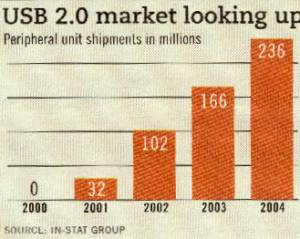
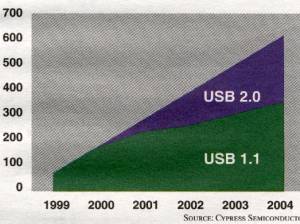
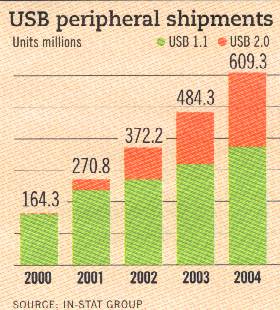
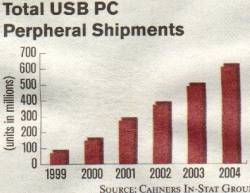 isochronous devices such as digital
video cameras and digital speakers that can render USB 1.1 technology
insufficient. USB 2.0 performance compares favorably with the throughput
of the IEEE 1394 bus, a competing technology that will have a bigger impact
in the consumer electronics industry than in the PC industry.
isochronous devices such as digital
video cameras and digital speakers that can render USB 1.1 technology
insufficient. USB 2.0 performance compares favorably with the throughput
of the IEEE 1394 bus, a competing technology that will have a bigger impact
in the consumer electronics industry than in the PC industry.