Financial posts
Friday Decenber 6, 2002
14:00
If everybody believes something, it's probably wrong. We call that
Conventional Wisdom.
In America,
conventional wisdom that has mass acceptance is usually contrived: somebody
paid for it.
We have another Example
C is a better microcontroller software technology than either BASIC
or Forth.
The Asian Financial Crisis in Perspective
by
J. Orlin
Grabbe
Conclusion
It may be, as they say, that Asia is the 21st Century. Certainly
you can see it coming. Guests at the Imperial Hotel in Tokyo can now receive
their own private e- mail address, as well as Internet and newsgroup access,
for the duration of their stay. I'm sure Frank Lloyd Wright would have
approved. It's a little piece of the future available to antediluvian nomads of
the 20th Century.
But getting the rest of the country--far removed from the Imperial
Palace--up to speed will not come easily. It may not come at all. It takes
years to recover from an asset bubble. And what can be said of Tokyo is equally
true of Hong Kong, Bangkok, Jakarta, Seoul, and Beijing. The financial crisis
isn't over. The economic crisis isn't over. On Nov. 3, James Wolfensohn,
President of the World Bank, said "the worst is over". He's wrong. The worst
has only just begun. And this is the way Asia will enter the 21st Century.
Not with a bang, but a whimper.
In sum the spinmeisters continue to spin, but the economy still
looks weak and
the market remains highly overvalued. The rally is losing
steam and appears ready to roll over.
"Every extra dollar borrowed by a consumer now puts us all a dollar
further from recovery,
the debtor a dollar closer to default, and his bank a dollar
closer to a bigger loan loss provision than it would have had to face by
foreclosing while there was still something to be salvaged."
My mind refuses to stop thinking about Ben Bernanke's pledge to
work the offices of the Fed to actually take positive, calculated steps to
achieve a simmering, permanent inflation in the USA by buying debt, and
cranking up the printing presses to pay for it all. There is probably no policy
statement that any Fed Governor could utter that could possibly cause my
eyeballs to spin around in my head - blip blip blip - like that one does.
The theoretical underpinnings of such a bizarre statement is that
this will allow the Fed to, theoretically, always have room to cut rates, so
that, theoretically, preposterously-overvalued assets can always become even
MORE preposterously overvalued, since some clueless knothead of the future will
always, theoretically, borrow money to buy your entire inventory of
ludicrously-overpriced assets from you, and thus, theoretically, insure that
you make an effortless profit and thus prevent, theoretically, the deflation
from ever affecting asset prices in a, theoretical, downside fashion.
Theoretically. In short, the Fed is issuing a policy of guaranteed
profitability from merely borrowing and buying assets!
This is fabulous! All my life all I've ever heard from anybody is
that they want me, probably the most clueless dolt on the planet,
to give them that one
hot investment tip, that inside-track idea, that has zero risk and maximum,
eye-popping returns. And guess what? Now I have one! I say, with the
booming, haughty authority in my voice born of confidence, "Anything that is so
abundant, so widely held, so broadly distributed that it would cause the
government and the Federal Reserve to get verrrryyyy nervous if its price ever
went down!"
"The economy is in great shape," says Milton Friedman. And don't
worry about deflation, says the Nobel Prize winner.
"Deflation is a
consequence of bad policy, not a cause of bad results." The Great
Depression of the '30s could have been avoided, he says, if the Fed had merely
increased the supply of money fast enough.
Isn't it wonderful, dear reader? We mean, that the economy is in
such great shape....and that central bankers can avoid any really bad results
simply by changing their policies! But hey, why didn't they change their
policies before $10 trillion got exterminated in the world's stock markets? And
before nearly 2 million Americans lost their jobs since the slump began in
March of 2000? And who's to say they won't wait until another $10 trillion goes
to money heaven before getting their policies right ...
To be sure, deflation remains the talk of the town and the
widespread expectation of most investors. But resurgent inflation seems
increasingly likely. On Wednesday, during my appearance as a co-host on CNNfn's
morning show, I announced, "Inflation is a buy. If it were a stock, it would be
selling for eight times earnings and less than book value." - Admittedly, the
mighty forces of deflation and inflation are still battling each other in a
fight to the death. But inflation seems to be prevailing, or at least that's
the implied verdict from several financial markets. Both the CRB Index of
commodity prices and the gold price have been trending higher for more than a
year. More recently, since early October, bonds have tanked, copper has surged
and the dollar has failed to rally despite a powerful stock market rally.
Debt! Not if we use
BASIC-52++™ and 80C32 Forth, of course!
Debt. During the boom times--and anticipating a glorious new era of
deregulation--power companies borrowed a stunning $600 billion. They used that
money in part to bulk up their speculative trading operations. But mostly they
used it to buy entire power companies or construct natural-gas-fired power
plants.
That bill is coming due. Starting next year and continuing through
2006, a whopping $90 billion of debt has to be either repaid or renegotiated,
according to Standard & Poor's. Few of the companies appear able to repay
it; the collapse of energy trading has put them in a severe cash crunch, and
several are close to bankruptcy. Speculative trading is no longer profitable,
of course, but far worse is the fact that power plants aren't generating much
cash flow either. The overbuilding has helped lower the cost of energy--and the
economic downturn has meant that the country simply isn't using as much power.
Power prices are severely depressed.
Welcome to the next great debt disaster. "The debt bubble in
this industry is massive," says Karl Miller, a former energy executive who
is now a senior partner at Miller McConville & Co., a private firm that is
buying distressed assets. Starting next year many energy firms teetering on the
edge of Chapter 11 are going to fall into it. Once again the brunt of the
losses could land on some of the nation's largest banks. For instance, J.P.
Morgan Chase, which has acknowledged lots of bad telecom and cable loans, says
it has another $2.2 billion in exposure to merchant energy companies. "People
have been focused on the bankruptcies of Enron, Global Crossing, and WorldCom,"
says Miller, "but this sector is the sleeping giant."
Deflation?
Guns are blazing on the anti-deflation front.
Policy makers in Japan and the United States have elevated
deflation to their number one concern. Even European authorities have
finally joined the game, as evidenced by an aggressive 50 bp ECB easing, with
the euro-zone inflation rate still above the so-called price-stability
threshold. The full force of the global policy arsenal now seems aimed at
arresting deflation. And that’s very good news.
The bad news is that there’s no guarantee the medicine will
work. Policy traction is most difficult to achieve at low levels of inflation
and nominal interest rates. Just ask Japan. In the case of the US economy,
stabilization policies typically work their charm on three sectors –
consumer durables, homebuilding, and business capital spending. With all three
sectors having gone to excess in recent years, any response to policy stimulus
could be surprisingly muted. In Europe, monetary stimulus is being offset by
the combined headwinds of fiscal consolidation and lingering structural
rigidities, especially in the labor market. History tells us that deflationary
remedies must be administered early and aggressively. Only time will tell if it
already isn’t too late.
80C32 USB SOCs
hopefully running BASIC-52++™ and 80C32 Forth minimizes costs and
increases profits! The system software exists and is essentially free!
Both the operating systems and an apps built upon
BASIC-52 and 80C32 Forth work better than with obscure expensive and reinvented
operating systems.
The
Morales and Payne legal project is going well. We've
got them in writing and there is a possiblity that judges Dee Vance Benson and
Antonin Scalia are, in fact, honest!
Thursday December 5, 2002
08:13
Senior
citizens have a lot to worry about these days. Pension funds disappearing -
being stolen by high tech. Possible government induced inflation if deflation
is, in fact, real.
The pension funds for Wisconsin and Milwaukee public employees
filed a lawsuit against WorldCom Inc.'s investment bankers Tuesday, accusing
them of using false financial information to help sell the telecommunication
company's bonds to investors.
The State of Wisconsin Investment Board and City of Milwaukee
Employes' Retirement System filed the lawsuit in Dane County Circuit Court in
Madison. Pension funds in at least six other states have filed similar suits.
The lawsuit says the state pension fund lost almost $38 million
and the city pension fund lost about $9.5 million on WorldCom bonds. The
lawsuit seeks recovery of those losses. ...
The lawsuit alleges WorldCom and its investment banks raised
billions of dollars through public offerings of investment-grade bonds that
were sold with prospectuses and registration statements containing false
information. The lawsuit says money raised from selling bonds to the public was
used to pay off short-term debt and release the investment banks from billions
of dollars of lending commitments they had issued to back up WorldCom's
short-term debt.
Goldrick P/E correction
Goldrick reponded that in the old days anything above 10
[TEN!] was considered a total crap shoot.
There will be new winners too.
Software maker Phoenix Technologies Ltd. (NasdaqNM:PTEC - News)
on Thursday said it will cut 11 percent of its work force, or 60 jobs, close
certain U.S. plants and move some operations to Asia.
Phoenix said it will close its facilities in Irvine,
California, and Louisville, Colorado. The moves will reduce the company's
North American employee base by 24 percent.
Phoenix said it will add customer service engineers to its offices
in Taiwan and Japan.
The San Jose, California-based company said the restructuring will
result in a one-time charge of $5.5 million in the first quarter of 2003. It
said it expects to save $8 million annually from the changes.
Shares of Phoenix closed at $6.36 in Wednesday trading on the
Nasdaq stock market.
Threaded code is slow!
Lacovara tried to get
Sun witness Dennis Carlton, an economics professor at the
University of Chicago, to admit that factors such as Java's performance issues
may have held back the acceptance of Java and hindered its ability to
compete with Microsoft's .Net platform for developing Web services. ...
"The more applications that are specific to an operating system,
the more demand for that operating system," Carlton said.
But, again, 90% of the work is usually done in 10% of
the code. So recode the 10% in assembler.
Speed of code is not the only consideration. Forth,
Basic, and Java are about the most memory efficient technologies.
Memory efficiency is very important in an 80C32 with
its limited memory.
Where is the bottom?
P/E 4-15?
The fortunate speculator who had funds to answer the first margin
call presently got another and equally urgent one, and if he met that there
would still be another. In the end all the money he had was extracted from him
and lost. The man with the smart money, who was safely out of the market when
the first crash came, naturally went back in to pick up bargains. (Not only
were a recorded 12,894,650 shares sold on 24 October; precisely the same number
were bought.) The bargains then suffered a ruiness fall.
Even the man who waited out all of October and all of November,
who saw the volumne of trading return to normal and saw Wall Street become as
placid as a produce market, and who then bought common stocks would see their
value drop to a third or a fourth of the purchase price in the next twenty-four
months. The Coolidge bull market was a remarkable phenonmemon. The
ruthlessness of its liquidation was, in its own way, equally remarkable."
Those who cannot remember the past are condemned to
repeat it.
George Santyana, 1905
Wild senior citizens are tracking senior citizen
stories
NEW YORK --
International Business Machines Corp. (IBM, news) has chosen to
fund its pension plan now, instead of doing it gradually over a three-year
period, because IBM's cash flow and balance sheet are strong enough to allow
it, especially now that the pension deficit has shrunk by a third to $3 billion
thanks to rising stocks.
Google has done a technology jump on other internet
news services! google
news.
Way we gather information and hopefully distribute
information like 80C32 USB SOCs hopefully running BASIC-52++™ and 80C32
Forth is going to change in a positive way to.
Delfation from google news
Prices in the United States are already deflating and the
Federal Reserve risks a long Japanese-style slump unless it acts decisively,
warns CIBC World Markets chief economist Jeff Rubin. "
`Big D' is back, and this time deflation is no longer solely in the
domain of asset prices," Rubin wrote in a commentary released today.
"For the first time in nearly 50 years, private-sector prices are
falling in the U.S. economy.
"Prices for everything from Christmas sweaters to DVD players are
tumbling in the face of a soft global economy and stiff competition from
producers, which is helping U.S. shoppers stretch their spending power.
Although the abundance of bargains is benefiting consumers and may
keep them in the malls at a crucial time for the economy, the falling prices
have been a bane for businesses whose profits have been crimped.
Some economists are worried that if price declines spread more
broadly throughout the economy, the United States could face a worrisome threat
of deflation in a similar vein to what Japan is experiencing.
So far, most analysts and Fed officials view deflation -- a cycle
of falling prices, profits and wages -- as a remote risk for the U.S. economy
but one that bears watching, especially in light of the Japan example.
Csd speculates that new technology, debt, pension
shortfalls, and maybe deflation may have a bad effect on the 2003
economy.
And hopefully has a solution which it knows something
about. And is fun too! 80C32 USB SOCs hopefully running BASIC-52++™ and
80C32 Forth.
Ross, below, is
referring the Java's ease of port between microcontrollers.
Forth, the predecessor of Java,
is equally easy to port to other microcontrollers.
Sandia labs ported Forth from the 8085 microprocessor
to the 8051 microcontroller, both of which it built as rad hard
parts.
"Would the world as you see it have reached fruition if one
platform was speaking to PCs and the other to devices?" Motz asked Ross. Motz
was referring to the notion that Java is more prevalent on devices and
Microsoft, with its .Net platform, is dominant on the desktop, as both sides
established in court.
Added Motz: "The whole vision was that these platforms were going
to be compatible for everything.
If Microsoft continues to dominate the PC market, and
assuming they develop the technology to interact with handheld devices,
assuming it was dominant in the PC market, would that over time affect its
ability to win the whole field?"
To this Ross replied, "Yes.
Even though the software will run on a cell phone, the development will take
place on a desktop machine." He added that developers building on a desktop
with Microsoft tools are likely to write to a Microsoft-based platform, such as
Microsoft's .Net Compact Framework.
In Forth software development bill occasionally got
confused whether he was running the code on the 8051 or the
PC!
Csd sees a serious business technology problem with
what the Javans are doing.
USB 2.0 coupled with gigahertz PCs and Microsoft
Visual Basic, C++ 6.0, and Office means that more and more computation are
going to be done at the PC side as opposed to the peripheral
side.
This going to hurt both the peripheral side
microcontroller business and, as a result, the Java business.
And this is hurting Sun's core business since PC are
now outperforming Sun workstations. And selling at a fraction of the cost of a
Sun workstation.
As a result Sun's stock price
SUNW is
tanking. And it looks as if
Sun is
getting defensive.
Talk about technology innovation!
The above quote came from
google news.
Google news opposed to other news sites such as
CNN, google news is about
completely automated with the google search engine searching the web for the
most popular articles!
Posted P/E ratio
information!
Goldrick reponded that in
the old days anything above 10 [TEN!] was considered a total
crap shoot.
and
our model predicts a decline in the PE ratio from
around 30 to a ratio between 5 and 16 in the next twenty years.
2003 may prove to be a very interesting
year.
Clearly hardware and software are facing deflation.
This is, in some ways, simply great. Gigahertz
PC with infinite amount of memory and disk drive space for several hundred
dollars.
However, if you are trying to make a living in high
tech is is not so neat. Especially, if you borrowed lots of bucks and are
possibly going to try to pay them off with decreased
earnings.
Possibly since bankruptcy is usually the way
out.
Chapter 7 for software companies since they usually
have only tons of undocumented code which is a liability, not an
asset.
Chapter 7 is getting harder to get.
Chapter 13 is becoming more popular with
bankruptcy courts. And is not nearly as much fun as Chapter
7 since you don't totally get off the hook for debts.
The feds are finally starting to realize they may
have a deflation problem.
Dig this!
Deflation -- a general fall in consumer prices usually brought
on by a severe economic slump -- can exact a heavy economic toll by raising the
real burden of debt.
Like Japan, the United States appears to be suffering a hangover
after an equity bubble, and worries have grown that the Fed, which has already
pushed short-term interest rates to a four-decade low of 1.25 percent, could be
just one economic shock away from finding itself with too little
ammunition.
You can read their possible solutions
above.
"The Great Crash: 1929" by John Kenneth Galbraith is simply
fantastic.
No one knew what to do to get out of the depression.
Galbraith enumerates a stunning sequence of missed
predictions by economists.
We are clearly going to have an interesting
2003. Especially microcontroller hardware and software!
80C32 USB SOCs hopefully running BASIC-52++™ and
80C32 Forth continue to look more and more attractive! And really fun
interfaced to Windows, of course!
In addition, a Goldman Sachs survey reported that
US companies are set to underspend their IT budgets this year
and into next year. They found that it would take a second half 2003
recovery for spending to even increase by a paltry 2-to-3 percent for the full
year. This is completely out of line with Street estimates of 7 percent revenue
growth, and is likely to lead to further widespread earnings disappointments.
In our view, those who think that the market can continue to rise on its own
momentum are in for a rude surprise.
However, Merrill Lynch's chief U.S. strategist, Richard Bernstein,
who has been among Wall Street's most bearish gurus the past few years, does
not subscribe to that upbeat assessment.
He views the markets' heady run-up — especially the Nasdaq
composite's gaudy 30.1% rise — since hitting multiyear lows Oct. 9 as a
dangerous signal that speculation is alive and well. As a result, he
reduced his recommended exposure to stocks and increased his bond holdings.
Lights go out at Stanford after tech bubble burst
The
doors will be closed and the lights turned off at Stanford University this
holiday season as the elite private US school takes unusual steps to save
money.
The economic recession that has pummelled the technology
sector is being felt in the intellectual capital of Silicon Valley, the
string of communities between San Francisco and San Jose that is home to the
world's largest concentration of technology companies.
About P/Es.
Bill and Patty's son pointed out yesterday that to
bring P/Es into historical ratios either the earning have to go up or the price
has to come down. Logical.
Bill asked 75 year old Purdue grad then Sandia labs
engineer
Bill
Goldrick yesterday what he considered reasonable P/E.
Goldrick reponded that in the old days
anything above 10 [TEN!] was considered a total crap
shoot.
Debt, deflation, and pension shortfalls might do
bad things in 2003.
Microsoft has been
trying to sink Java. So here's an interesting twist.
BALTIMORE (Reuters) - A federal judge hearing Sun Microsystems
Inc.'s (NasdaqNM:SUNW - News) antitrust suit against Microsoft Corp.
(NasdaqNM:MSFT - News), said on Tuesday that forcing Microsoft to carry Sun's
Java software in the Windows operating system could be an "attractive" remedy.
...
Microsoft dropped Java, a computer language designed to run on
various operating systems, when it introduced Windows XP last year. It
later reversed itself and said it would start including Java in a Windows XP
update, but only until 2004.
Csd was told that Microsoft was not doing quality
control checking on Java!
Spending lots of money
with Keil for an antiquated non-operating system cross development
environment is not a good idea. Especially if we are in a
deflating economy.
Breaking down the components of September’s consumer price
index, Rosenberg has noted that if it were not for a handful of items that
comprise a mere 7 per cent of the CPI – auto insurance premiums (+9.5%
y-o-y), tobacco (+9.2% y-o-y), hospital services (+9.0% y-o-y), and tuition
(+6.5% y-o-y), the US inflation rate would already be running below the one per
cent level. By contrast –
personal computers (-21% y-o-y), software (-8%),
long-distance telephone charges (-4.5%), toys (-9%), utilities/fuels (-2.3%),
automobiles (new cars -1.1%, used cars -3.2%), television sets (-11.1%), VCRs
(-6.0%), audio equipment (-6.0%), tools/hardware (-2.0%), airfares (-5.2%),
sporting goods (-2.1%), etc, - a whole range of day to day products are already
recording significant price deflation. ...
Equally important however is that by denying the reality of the
economy’s current plight - in order to avoid spooking investors, corporate
managers, and consumers in the short run perhaps - the Fed is damaging its
deflation fighting credibility. ...
Stocks rise, as Buffett put it, first for the right reasons, and
then for the wrong ones. Stocks were cheap in '82...the Dow rose 550% over the
next 14 years. Then, by the time Greenspan warned of "irrational exuberance",
stocks were no longer cheap. But by then, no one cared. Benjamin Graham's giant
"voting machine" of
Wall Street cast its ballots for slick stocks with go-go
technology and can-do management. Stocks rose further; and people became
more and more sure that they would continue to rise. ...
"What happened in the 1990s," says Robert Shiller, author of the
book "Irrational Exuberance," is that people really believed that we were going
into a new era and were willing to take risks rational people would not
take...people did not feel they had to save. They spent heavily because they
thought the future was riskless."
But risk - like value - has a way of mounting up, even while it
seems to disappear. The more infallible Alan Greenspan appeared...the more
"unduly escalated" asset values became. Having warned of a modest "irrational
exuberance," the maestro created a greater one.
Senior citizen concerns.
Like the unseen menace that stalked Elm Street, the pension
monster has been hidden in the shadows. Now it's stepping out into the light.
And is it ever one mammoth ugly creature: Big corporate pension plans in
America owe some $1.2 trillion to their current and future retirees, and for
the first time in years companies don't have enough money stashed away to pay
for those benefits.
The size of the current shortfall? $240 billion. To put that in
perspective, that's more than half of what they're expected to earn this year.
It's the day of reckoning in corporate America. You've
probably read that companies are restating their pension assumptions and will
take a hit to earnings as a result. You've no doubt seen how the stocks of some
huge, widely held companies like General Motors, Ford, Delta, and American
Airlines' parent, AMR, have been pummeled, in no small part because of concerns
about their underfunded pension plans. But what you may not realize is the
extent of the havoc this monster can wreak. The debit is not just an accounting
mirage; companies will have to start pumping cash--some $29 billion next year
alone--into pension funds. That's real money. Money that won't be going to
dividends or research or new plants. In other words, the monster is going to
suck the blood out of those corporations.
But it looks like we
have time to do two!
This means tough times will continue for computer and software
companies for at least another six months until IT spending picks up. And
when it does, long-term growth in IT budgets will likely be in the 6 to 7 per
cent range compared with the 10 to 13 per cent growth during the years prior to
the dotcom "bubble" years.
Monday December 2, 2002 19:41
12/01/2002 - Updated 09:39 PM ET
Cable may see hostility on rates
Given a choice between angering Wall Street or consumers, whom do
you think cable operators pick?
That didn't take you long, did it?
You may have had some help, though, if you're one of the millions
of subscribers who are starting to receive the familiar annual letters telling
you how much rates are about to jump.
Time Warner Cable, Comcast, Cox and Cablevision Systems are among
the operators that either have raised, or plan to raise, prices in the 4%-to-8%
range, well ahead of inflation, which is virtually flat.
The average basic cable bill, now at about $34.52 a month, is
up 45% since cable was deregulated six years ago.
The real world of high tech is a bit different
than what the high tech merchants expect you to believe
David Lieberman figures the cable companies will have a tough
time meeting Wall Street’s expectation, especially if the companies plan
to rely on price increases to boost cash flow.
He notes
that Time Warner Cable, Comcast, Cox and Cablevision Systems are among the
operators that either have raised, or plan to raise, prices in the 4%-to-8%
range. That’s well ahead of inflation. The basic cable bill is now
around $34.52 a month, up a whopping 45% since cable was deregulated six years
ago. Good thing the programming is better.
We've got news, or bad news, for all of
us.
Cable is only currently charging about 1/4 of
what it costs them to operate.
And they may have technically obsolete media.
Fiber optics in sewers.
Study how Comcast got
Excite software for about free!
1
2 3 4
So, cognoscenti, the cable companies all expect us to
get hooked [needle in the arm] on their services so we must submit to their
increases.
But there may be a problem for cable.
Satellite Internet connection.
We're in to high tech solutions!
And fun too!
Cheers
A new study of American demographic patterns and the stock
market predicts that while the market may rally periodically, its overall
direction will be downward until around 2018.
The professors' approach is complex, but it depends on a
simple indicator: the ratio of the number of middle-aged people to the number
of young adults in the population. When this ratio rises, the overall market's
price/earnings ratio will rise, too, the professors predict. When the age ratio
declines, as it is expected to do until about 2018, the P/E will also decline.
. Demographics are the most critical factor in determining long-term market
trends, they say, because investment behavior largely depends on age-related
patterns. Younger adults, from 20 to 39, are generally consumers. Middle-aged
people, 40 to 59, tend to invest in stocks.
Demography and the Long-run Predictability of the Stock
Market
Calculations from the annual population tables of the Bureau
of the Census shows that this ratio will decline from its current value to
around 0.9 in 2018 (see Figure 3). Using Table 2 , which has a high cohort
ratio close to 0.9, with á = 2 or á = 4,
our
model predicts a decline in the PE ratio from around 30 to a ratio between 5
and 16 in the next twenty years.
Here's another
future PE guess.
These pieces of information will make investing in
about 80% of corporations look unattractive.
As the bear market has ravaged the stock market, the assets of
U.S. pension funds were annihilated. State and local pension funds - whose
figures are a matter of public record - have fallen in value from $80 billion
in 2000 to $25 billion today...a 70% decline. Although I don't have complete
figures for U.S. corporate pension funds, those numbers won't look much
different from the state and local government accounts (which often use the
same pension fund managers). ...
Only one in five corporate pension plans will have enough funds to
fully cover liabilities next year if weak economic conditions persist,
according to an analysis released by a consulting firm this week.
Pension Crisis Will Worsen in 2003
With retirement plan funding headed for a crisis, FASB contemplates
possibility of accounting rule changes. Also: CPAs prod SEC to broaden rules on
misleading auditors.
So much for the two-month stock market rally.
The corporate pension crisis is expected to get much worse over the
next year or so as the nearly three-year bear market has forced many companies
to make contributions to their defined benefit plans to cover shortfalls and
comply with federal laws that protect workers’ pensions.
Retirees are more likely to sell stocks than buy
them.
These days, no company wants to risk having investors dump its
shares because of a perceived pension-plan problem.
FOR THE FIRST TIME IN YEARS, lots of companies have to actually do
something about their pension funds, most of which got fat and happy during the
great bull-market ’80s and ’90s. Pension funds have lost money for
three straight years because stock prices have fallen so sharply. Now the bill
is coming due. Trevor Harris, chief accounting analyst at Morgan Stanley,
estimates that the
360 of the
Standard & Poor’s 500 companies that still have “defined
benefit” pension plans will have aggregate pension deficits of $240
billion at the end of this year. That’s compared with a slight surplus
at the end of last year, and a $263 billion surplus at the end of 2000. Think
of it: a half-trillion-dollar swing in just two years. Even by federal
government budget standards, that’s serious
money.
Then there is all of the debt.
The lingering excesses of America’s post-bubble business cycle
– especially
a massive current-account deficit and record private sector
debt loads – makes it hard for me to believe that there will be a
vigorous response of the US economy to the latest dosage of policy
stimulus.
"The length and severity of depressions depend partly on the
magnitude of the 'real' maladjustments,
which developed during
the preceding boom and partly on the aggravating monetary and credit
conditions." - Gotfried Haberler, Prosperity and Depression,
1937
Then there is Internet to get software/hardware truth
to readers.
"The world isn’t run by weapons anymore, or energy, or
money. It’s run by little ones and zeros, little bits of data. It’s
all just electrons.... There’s a war out there ... and it’s not about
who’s got the most bullets. It’s about who controls the information.
What we see and hear, how we work, what we think, it’s all about
information."
, of course, is good
information.
So time to get the PC side of Embedded Controller
Forth for the 8051 family workin under on both Windows 2000 and 98SE.
At the peak of the bubble in 2000, some 450 corporations had
launched VC units, according to a recent study released by a trio of professors
at the London Business School. More than 100 of those units are no longer
active, according to the study--including those at British Airways,
Compaq Computer, Marconi, and the Vodafone Group. Of the
remainder, you can bet another 100 or so would love to wash their hands clean
of the whole experience. ...
Though CSFB won't talk on the record, industry watchers say
the firm is representing Hewlett-Packard as it attempts to off-load its venture
holdings. Insiders say HP plowed roughly $250 million into its portfolio, which
at its peak had a valuation north of $1 billion. In a galling lesson for HP,
sources say the entire portfolio is expected to fetch no more than $10
million.
Keyboard work! Which now needs to be done after the
thinking phase of the project is over.
Japanese it is reported, spend roughly 80% of the time
planning a project and 20% of the time executing the
project.
It has been said that the reverse is true in the
U.S.
Deflation?
In 1995, Japanese experts watched in disbelief as the nation
slid into
deflation. Economists insist conditions are different in
the U.S. But the similarities -- low interest rates, high debt levels and
falling prices -- suggest the threat is real.
But we're going to try to beat this with improved
software productivity tools. And have fun which doing this too!
But this week, when AOL Time Warner holds a much-anticipated press
conference, there won’t be any backslapping. In fact, there won’t be
any Jerry Levin, who abruptly retired months ago. Case, the man who helped send
his partner packing, will be there, though there likely will be a harsh
spotlight on him. The man now running the show, Richard Parsons, will unveil a
new AOL Time Warner strategy: to create a kind of “must-have AOL,” in
which consumers would pay extra for exclusive online offerings from Time Warner
siblings. In effect, it turns the company’s original model on its head,
with Old Media re-energizing the New Economy division. The mantra from Parsons
these days is to under promise and over deliver. After all, no one is in the
mood to hear spin from a company that was never able to live up to its own
hype. The
combined company’s stock, which peaked at $56.60 in May 2001, hit bottom
in July 2002 at $8.70, and is now trading at about $16. That collapse has wiped
out a stunning $280 billion in value for one of the market’s most widely
held stocks since the deal was announced. And its capitalization may take a
further hit—the company faces its second investigation by the SEC and the
Justice Department over its accounting.
The company’s stock is so beaten down that, NEWSWEEK has
learned, several Wall Street buyout firms have explored making a bid for the
company’s assets, particularly its online operations.
Bill's ms and phd student
Lewis wrote AOL, Time
Warner, and the
Crash
of 2000.
Speaking of
mistakes.
On most measures, we are in the sixth-worst bear market ever
experienced. A few weeks ago, when the market was about 10% lower, it equalled
the previous record set in 1937, and qualified as the second-worst bear market.
The report examines correlations between the magnitudes of declines
in previous bear markets and subsequent recovery times. It finds some sobering
relationships. By using regression analysis, it estimates the recovery time we
could expect in this bear market.
The conclusion is that, for a total market decline of about 45%,
the historical relationships suggest the recovery period should last about 96
months. Even if the current decline of about 38% does represent the bottom -
which the firm does not believe - six years would still be required.
The pattern of previous recoveries is also revealing. In the past
27 bear markets and their subsequent recoveries, the average price move in the
recovery phases was 59%, double the average decline of 29%.
However, the recoveries from bear markets take far longer than the
declines; the average recovery phase lasts 57 months, three times longer than
the relatively quick decline of 17 months.
Earnings and valuations will influence the timing
and pace of a recovery but the report is wary on valuations. It
says the market's current p:e of about 35 is "very high" relative to the
long-term historical mean of 15.
The pension liability problem may bring lots of companies
under! Or their pensioners put on the
street!
The firm's valuations suggest it could fall further to around
25, or 27% lower. On historical precedent, it adds, a further decline of this
magnitude could take another nine months, with the best and worst we could
expect being seven months and 19 months respectively.
What will 2003 economy be like? We'll
see!
Think BASIC-52++™
and 80C32 Forth ... and interactive fun!
Not all trends are bad, of course. But many still go unnoticed.
Take the bull market of the 1990s, for example. The Netscape IPO that launched
the mania occurred in the spring of 1995...five years before the market's peak.
Few people understood what was likely to happen. In his 1994 book, The Road
Ahead, about the future of computer technologies, Bill Gates, doesn't even mention the word "Internet."
The biggest trend we see in place right now can easily be captured
in one word: debt. Since 1992, there's been an ominous shift in debt from the
public to the private sector. Federal borrowing rates have declined, while
private borrowing has grown at a rate never seen before in America.
In 1992, the government borrowed around $300 billion; private
industry borrowed $200 billion. Since then, private borrowing has increased
every year except 2000 and now tallies over $1 trillion per year. Federal
borrowing, as you know, declined until mid-2000 and was actually negative for a
few years (indicating a Federal surplus). But, overall net debts - private and
Federal combined - increased during the whole period, moving from around $500
billion per year in new debt to over $1 trillion per year in net debt
addition. ...
The vast majority of the debts we added in the 1990s were used to
fuel massive financial speculation in corporations and home mortgages.
As these financial assets begin to deflate, the debt remains, causing the debt
to loom higher and higher as a percentage of assets. Total debt, as a
percentage of GDP, has grown from around 150% in 1982 to nearly 300% today.
...
As the bear market has ravaged the stock market, the assets of
U.S. pension funds were annihilated. State and local pension funds - whose
figures are a matter of public record - have fallen in value from $80 billion
in 2000 to $25 billion today...a 70% decline. Although I don't have complete
figures for U.S. corporate pension funds, those numbers won't look much
different from the state and local government accounts (which often use the
same pension fund managers). ...
Meanwhile, news of enormous future charges to earnings based on the
mandatory contributions to their sagging pension funds are filling the pages of
the financial media. For example, SBC announced this week it would take a $2
billion charge against earnings next year to begin repairing its pension plan.
Raytheon says it must pay $500 million towards its pension fund over the next
two years. Right now, Wall Street estimates that 10% of the S&P 500's
earnings next year will go towards underfunded pensions. ...
Capacity utilization in electronics, for example, has
declined from 90% in 1999 to under 65% today. ...
This rapid decline in capacity utilization is one of the symptoms
of a credit bubble bursting. ...
And if the US is going into a deflation there could be some real trouble
here.
The Lucent high tech story is absolutely
scary.
While the crash of the technology sector
has triggered a surge of bankruptcies, few of the failed dot-coms or other New
Economy companies have had traditional pensions. Lucent is something different,
a maker of high-tech gear for the communications industry with roots deep in
the Old Economy and with many more retirees than current workers.
Lucent is contractually bound to pay each of the 275,000 people
covered by its pension plan, and its work force of 35,000 must generate the
cash to keep the pension trust funded. These circumstances parallel those
of the steel sector, where stripped-down remnants of once-huge work forces now
struggle to sell enough steel to pay the last generation's retirement benefits.
Especially in a possibly deflating
economy.
Senior citizens have to be careful. And keep somewhat
busy and entertained too!
Here's an article which
may be trying to make you feel okay about being ripped off.
Baby boomers with skimpy pensions, rising health care costs and
portfolios mauled by the bear market fully expect to work in their retirement
years — 71% of them, a recent survey by Allstate says. Nearly half said
they expect to keep working because they'll need the income.
Yet many workers who stay on the job past age 70 are smacking into
a series of laws and regulations that may boost their taxes, deplete their
retirement savings and erode the value of their Social Security benefits. Some
say the federal government seems determined to penalize them for continuing to
work.
Bill designed lots of
pc boards at Sandia labs.
We contracted production to a number of pcb vendors.
Then we used contract assembly to build the boards.
Most are no longer in business.
Csd believes that with 80C32 SOCs the pcb are going
to be much simpler, ie fewer parts on layers.
The complexity will have to transferred inside the
chip.
| PCB industry still in the doldrums
Weak demand sparks flurry of fab closures in North
America
BY CLAIRE SERANT
Hopes for a recovery in the printed-circuit-board market
next year have faded.
Weak demand, stiff overseas competition, unrelenting price
erosion, and shortened lead times are forcing many PCB manufacturers with soft
balance sheets to significantly scale back their operations in North America.
Teradyne Connection Systems (TCS) knows the story. With
plans to close its PCB fab in San Diego next month, the company will have only
one PCB plant in North America, at its Nashua, N.H., headquarters.
"The San Diego site could manufacture 44- layer boards," said
Tom Pursch, vice president of Teradyne's Components Business unit and manager
of TCS, a division of Boston-based Teradyne Inc.
"As we rationalized our demand and looked at where the world
was headed, we realized we did not need two North American board shops," Pursch
said.

Last week, Honeywell Advanced Circuits (HAC) auctioned off
two PCB fabs it had closed earlier this year in two Minnesota cities, Buffalo
and Roseville. The auction included the sale of some manufacturing equipment
from its lone PCB fab in Chippewa Falls, Wis. HAC is a subsidiary of Honeywell
International Inc., Morristown, N.J.
Domestic demand is so poor that North American PCB makers
are using less than 50% of overall capacity, resulting in steep operating
losses for many.
Worldwide PCB revenue in 2001 fell 24%, to $32.5 billion, and
will increase only slightly, to $33 billion, this year, mostly because of
Taiwan board suppliers that are expanding into China, said Andrew Rassweiler,
an analyst at iSuppli Corp., El Segundo, Calif
At the same time, OEMs have been aggressive about their
desire to have PCBs made in lower-cost Asia. And Asian PCB manufacturers that
make their living producing low-layer- count boards complied by adding more
capacity to make higher-layer- count boards, according to analysts.
"Asian board makers can competently service more than
two-thirds of North American production today," said Chris Whitmore, an analyst
at Deutsche Bank Securities Inc., San Francisco, in a report.
"They are adding capacity and gaining technical know-how at
an alarming pace. PCB fab fundamentals will continue to deteriorate until we
see a rebound in end- market demand and a substantial decrease in worldwide
capacity."
TCS is mulling plans to form a partnership with an Asian
company, while at the same time focusing on revamping its remaining North
American fab, Pursch said.
"We'll focus our North American capabilities on niche
products-high-end, high-capability, high-mix, low-volume, some military
applications, and quick- turn boards for new-product introduction," he said.
"Over time, we'll continue to subcontract out lower-end products where the
capability exists in low-cost regions."
Changing times
Indeed, North American PCB manufacturers will have a
different look in the future, according to Jim Savage, an analyst at Thomas
Weisel Partners LLC, New York.
"High-volume, medium technology and low-layer-count board
production will never come back to North America. That business is shifting to
China," Savage said. 'Anyone whose business is based on that will not be
successful.
"The business that stays in North America will be quickturn
and high technology with big, complex backplanes, advanced and high- frequency
materials, and high-density, high-layercount boards," he said.
Vertically integrated EMS providers with PCB plants in North
America, such as Flextronics International Pte. Ltd. and Sanmina-SCI Corp.,
have indicated further consolidation is on the horizon.
Michael Marks, Flextronics' chairman and chief executive,
told analysts that he expects to make further reductions in the Singapore EMS
company's global PCB fab business in light of soft sales. Analysts believe
Flextronics will target underperforming plants in North America and Europe.
This year, Flextronics' PCB division, Multek, saw its North
American sales drop to $130 million from $270 mil lion in 2000, said Harvey
Miller, a partner with Kirk-Miller Associates, a Palo Alto, Calif., consulting
firm that has created Fabfile Systems, a database of PCB fab companies.
In July, IBM Corp. sold its Endicott, N.Y., PCB fabrication
operation to a newly formed company named Endicott Interconnect Technologies
Inc. The move was part of the Armonk, N.Y., computer manufacturer's ongoing
effort to cut $5 billion from its supply chain.
The former IBM site is expected to generate sales this year
in North America of $210 million, a 34% drop from sales of $320 million in
2000, according to Fabfile.
Returning to the core
Industry observers said IBM's sale followed the lead of
other OEMs with underperforming PCB fabs that decided to eliminate their
exposure to the market and turn attention to core business fundamentals.
"OEMs are under such competitive pressure that it goes down
the supply chain to suppliers," Miller said. "There's no loyalty at all,
especially when times get hard. Suppliers are trying to beat variable costs.
They can't buy new equipment or do much research and development in this
situation. It's a matter of surviving."
And some North American PCB fabrication makers with
operations in China consider themselves survivors.
"We have different cans to play," said John Hastings,
director of investor relations at Viasystems Group Inc., St. Louis. "We have
facilities in China, Europe, and North America. We're not like some companies
that are just focused on North America."
But Viasystems, which closed a large Richmond, Va., PCB
plant last year, saw its board sales drop to $180 million this year from $440
million in 2000, according to the Fabfile database.
"This by far is the longest downcycle we've experienced as
an industry," TCS' Pursch said. "We came off such a high in 2000 that the peak
to the trough is a lot farther than it's ever been." <>
EBN
november 25, 2002 |
We have to contain 80C32 SOC operating system costs
... and have a better product.
In Electronic News' annual ranking of top semiconductor companies,
many of the players moved up or down the charts. All companies saw their
revenue figures plummet over the course of the year.
As a group, the top 25's semiconductor sales dropped from more
than $167 billion to just less than $112 billion this year.
| BUSINESS
PICTURE A BIT BETTER FOR NEXT YEAR
IT industry growth slows sharply in 2002
BY ROBERT RISTELHUEBER
The information technology industry suffered its largest
decline ever in 2002, with a growth rate of -2.3%, according to market research
firm IDC.
However, IDC, Framingham, Mass., expects the $875 billion
dollar market to recover in 2003, growing at a rate of more than 5%.
Overall, the IT industry has contracted by roughly 3% over
the past two years, compared with an average annual growth rate of 12% the past
20 years, IDC said.
Major contributors to this year's decline include a 9.3%
reduction in worldwide sales of IT systems, comprising PCs, servers, and
workstations. Meanwhile, the global storage market shrank by 10.6% in 2002 and
isn't expected to recover to its 2001 level until after 2006.
The worldwide network equipment market experienced a 7.6%
decline as sales to telecom service providers dropped sharply And the services
market, which today represents more than one- third of total global IT revenue,
also underwent a dramatic decline as the average contract value fell to a
three-year low, IDC said.
Although IDG projects IT spending to resume growth in 2003,
it cautioned against unrealistic expectations. Software spending will remain
weak while price competition will inhibit revenue growth in the hardware
sector. Services growth will be similarly restricted by smaller projects.
Beyond 2003, IDC expects growth rates to improve for several years, followed by
slower growth later in the decade.
The research firm also emphasized that significant changes in
the economic or geopolitical environment, such as a prolonged war in Iraq or
another plunge in the stock market, could result in lower growth rates for IT
spending. Because of the possibility that these more negative external
conditions might be realized, IDC produced for the first time an alternate
"down-side" forecast.
Under these more negative conditions, IDC believes worldwide
lT spending growth next year will be closer to 2%, with spending in future
years approximating real GDP growth. <>
EBN
november 25, 2002 |
Csd doesn't like the page size to be over 500k bytes.
This page is.
Deflation?
The only truly serious deflation the United States experienced
in the past century was at the beginning of the Great Depression, when prices
fell about 10 percent a year from 1930 through 1933. In a new book, "A
History of the Federal Reserve, 1914-1951," economist Allen Meltzer of Carnegie
Mellon University says the deflation and the Depression were primarily the
result of a mistaken Fed policy that allowed the money supply to decline
sharply. That policy was reversed when President Franklin D. Roosevelt devalued
the dollar against gold and the resulting inflow of gold led to a renewed
expansion of the money supply.
Last week Meltzer told an audience at the American Enterprise
Institute that he was confident the Fed, using different tools, could deal with
any deflationary threat.
Many financial analysts agree with that assessment, but they
caution that times could still be tough despite Fed action to flood the economy
with money. In a deflationary situation, however it came about, American
consumers and businesses might have become so worried and uncertain about the
future that they hold back on spending, even with interest rates at rock bottom
and plenty of cash available.
Government statistics show that average prices for products have
declined in the past year, including those of cars, clothing, computers,
furniture, gasoline and heating oil. So, too, have the prices for services such
as telephones, hotel rooms and airplane tickets, even as costs for other
services such as health care, housing, education and cable television continued
to rise. ...
Deflation, like cholesterol, comes in good and bad varieties.
...
By contrast, the bad kind of deflation occurs because there are
too few customers chasing too many goods and services,
resulting in repeated rounds of competitive price cutting that leads to
layoffs, falling wages, and a decline in business investment and consumer
spending.
That attendance at last
week's Comdex was a far cry from two years ago, when the show attracted more
than 200,000 visitors.
In 2000, more than 2,300 vendors displayed their wares at the
show; this year, just 1,100 showed up
Who stole the
pension fund money?
Some cashed in at the top of the bubble. Those who
likely caused the bubble, of course.
And you think these things happen by accident?
There are some highly intelligent people whose total
goal is to gain financial wealth. And they are planning their next move. The
bond market? The real estate market?
Only one in five corporate pension plans will have enough funds to
fully cover liabilities next year if weak economic conditions persist,
according to an analysis released by a consulting firm this week.
The firm, Watson Wyatt & Co. (NYSE:WW - News), also said Monday
if the weak stock market continues, the percentage of companies that will need
to contribute to their pension plans next year could more than double to 65
percent.
U.S. companies will have to pump billions of dollars into
pension plans weakened by the current bear market. Federal law requires
companies to protect the solvency of pension plans, which guarantee benefits to
retired workers.
Possibility that we are going into a
deflation is real.
But nothing prevented the subsequent launching of the
late-1990s hi-tech boom, arguably the most astonishing burst of irrational
exuberance in history.
The damage done during the financial mania has left many structural
imbalances that only time and a continuing bear market can correct. ...
The record debt accompanied by tremendous worldwide overcapacity
and an overvalued stock market will take time to correct. ...
Individuals and corporations with too much debt will have to
eventually work their way out or go bankrupt.
In a deflation case spending lots of money on system
software is not a good idea. Spend some of your time learning something new and
have some fun too.
The sale price of app software might not be high
enough to pay for expensive development software.
While we read a lot of hype about the economy
some probably put there by some to intentionally make the market go up
so that some can sell as soon as this happens, state economic data may
be a more reliable indication of what's really happening to the
economy.
The outlook for state budgets across the US was described as
"bleak" and "dire" on Monday in a grim report that contained an unusually blunt
plea from governors for billions of dollars in new federal support.
The National Governors Association warned that state budgets
were now in the "worst shape since World War II", highlighting the
economy's weakness and the reversal of budget fortunes across the US over the
past two years. ...
All states currently enjoy high, investment-grade credit ratings,
but S&P warned last month of possible rating downgrades for debt issued by
Arizona, California, Connecticut, Indiana, Kansas, Kentucky, Ohio, Oregon,
Tennessee and Washington.
Financial conservatism is likely a good idea in these
times. Keep the debts down. Or plan on bankruptcy, of course! But it's getting
harder to do Chapter 7.
Courts are forcing more Chapter 13s.
Thing likely will get get better and we want to be
there with some neat 80C32 and PC side software when they do ... without
spending tons of money, of course!
If you happened to log on to this site, then please
look at
Nolo press on this site.
What Nolo press is trying to do with legal matters,
we are trying to do with 80C32 software.
Good turkey day and good internet reading
too!
This is the time to get ready for
the next up cycle.
Our CREF retirment income has taken a big hit in this
bear market.
Where is
the bottom?
We must continue to be conservative and get the
software working we need to do the job at reasonable cost.
Keil is not the solution!
USB and 80C32 SOCs look to be winner ... running
BASIC-52++™ and 80C32 Forth, of course!
Happy turkey day!
Deflation?
Sun margins to narrow
Mr McGowan said
competitive pricing would cause Sun's gross margin to narrow
"slightly" from its gross margin of 41.2 per cent in the first quarter. He
declined to provide more detail on the quarter, noting that Sun was only eight
weeks into a 13-week period.
Sun, which last month said it would cut about 4,400 jobs, said most
of the US layoffs had been completed and the majority of the job cuts outside
of the US would be completed by the end of the third quarter. Shares in Sun
nosed up 1 per cent to $3.80 in after hours trading.
HELSINKI, Nov 27 (Reuters) - Contract electronics maker Sanmina-SCI
Corp (nasdaq: SANM - news - people) said on Wednesday it would cut almost 30
percent of its staff in Finland due to
persistently weak demand.
Csd's 19 inch Relsys monitor failed Sunday
night.
Monitor Masters said they would fix it for $79. But this
about the price of a new 17 inch.
Monitor Masters offered a reconditioned 21 inch
Hitachi for $95 with 60 day warranty.
Csd took this offer.
Then Csd delivered the failing Relsys to a dealer for
proper recycling.
Monitor Masters reported that Albuquerque is getting
increasingly concerned about
ewaste. They reported that individuals may still be able to
get away throwing a monitor in the trash. But companies can't do
this.
Embedded Processors by the Numbers
by
Jim Turley
About zero percent of the world's microprocessors are used
in computers. Yup. Every PC, Macintosh, engineering workstation, Cray
supercomputer, and all the other general-purpose computers put together account
for less than 1% of all the microprocessors sold every year. If you round off
the fractions, embedded systems consume 100% of the worldwide production of
microprocessors.
What Turley is also saying is that about 0
percent of microprocessors are properly recycled.
Microprocessors have some very toxic components known
to cause birth defects.
The semiconductor industry is facing serious
problems.
Bill Gates (pictured), Microsoft's chairman, said
the world's largest company will make fewer acquisitions and
investments than in the past, following big losses on equity holdings in cable
and broadband companies, particularly in the UK. He acknowledged that the
software company would have done better to invest its money in US treasury
bonds during the late 1990s rather than take stakes in these groups.
"We are chastened. There are some investments that you will see us
do, but probably less altogether and with a lot more care and in connection
with strategic relationships," said Mr Gates in an interview with the Financial
Times. ...
"We want to keep our R&D spending strong even during industry
cycles. A strong balance sheet - it doesn't necessarily have to be quite as
strong as ours - a strong balance sheet is a very important element in that,"
said Mr Gates. The company is investing $5.2bn a year on research and
development.
After an
important legal filing yesterday afternoon, Csd is resuming
the project to convert the PC side Forth software to Visual Basic 6.0, C dll,
and C++ wdm driver.
Microsoft software tools reduce the cost of software.
But does this lead to deflation?
Global: Fighting Deflation
Stephen Roach (New York)
Policymakers at America’s Federal Reserve have finally joined the
battle against deflation. And I commend them for that. I have been critical of
the US central bank over the past few years for its unwise exuberance in
nurturing asset bubbles -- first in equities and, more recently, in property.
But I am entirely supportive of the Fed’s recent efforts to atone for its
sins and now address what I see as the major risk of our time -- deflation. Key
questions remain as to whether the actions will work and what impact they will
have on the broader global arena. But this is important progress.
Software will get less expensive.
Improved technology, like BASIC-52++™ and 80C32
Forth, of course, will make peripheral end software less
expensive.
Fewer programmers will be needed!
The days of signing bonuses and foosball lounges for IT employees
are fading fast.
The latest evidence: IT payroll costs are set to go down—yes,
down—next year.
According to the Robert Half Technology 2003 Salary Guide,
starting salaries for information technology professionals are projected to
decrease an average of 1.3 percent in 2003. "Economic uncertainty combined with
an extended high-tech downturn continues to impact IT hiring activity,"
said Katherine Spencer Lee, executive director of Robert Half Technology. "For
the most part, starting salaries have stabilized, with increases in base
compensation reserved for the most sought-after specialties, such as network
architecture, disaster recovery, and systems security administration."
Debt burden increases by 61%
Monday, November 25, 2002
People with financial problems increased their debts by 61 percent
last year and have more than $52,000 in credit card debt on average, according
to a new study by the national financial counseling center Myvesta. The debts
of the organization's average client skyrocketed from $162,847 last year to
$262,825 this year, including mortgages, car loans, credit card bills and other
debts. Myvesta's typical client pays $1,039 a month in credit card bills,
$1,440 on a mortgage and $719 on a car loan.
We have to keep software costs down. Many need the
money for other things!
Let's look at some debt load web
sites.
America's Total Debt Report
Circular Flow
and Distribution of U.S. Money Supply Income Loads
This is all scary. Super scary!
Guys, we have to limit what we are paying for
peripheral side 80C32 SOC software to get our jobs done.
Paying thousands of bucks to Keil for an obsolete
technology is not the way.
The six identified changes in high tech
hardware/software technology coupled with a monumental debt load in a possibly
deflating economy may cause some of us to question
How low can we go?
So we need to hold down 80C32 software development
costs while building more reliable apps on top of existing
known-technology interactive real-time operating systems. BASIC-52++™
and 80C32 Forth, of course!
NIH is bad.
And these are very important project for all
citizens.
Our civil rights are in danger, having been stolen by
crooked, in writing of course, lawyers.
The lawyer infestation and current economic problems
are not unrelated.
Keep in mind that lawyers contribute nothing to the
GNP!
Hopefully the law projects will conclude soon so that
more time can be devoted to port, not reinvent, 80C32 Forth to
SOCs connected to gigaHertz PCs through USB.
Because of the law business bill was forced to learn
C/C++, dll, vxd, and wdm driver technology. And even Visual Basic 6.0 app
programming to prove that error bits from a wdm driver were, in fact, properly
being transferred to ring 3.
"Economists say America is unlikely to follow into Japanese-style
deflation," said a recent Wall Street Journal article, "because U.S. leaders
reacted to their slowing economy much more quickly than Japanese leaders
did..."
Oh?
The question bores most people. But it haunts us like an unsolved
crime. Spectators, we sit on the edge of our chairs to see what will happen
next.
The U.S. economy seems to us to be following a script written
in Japanese. With only an occasional improvisation, and a broad allowance for
cultural differences, the essential dialog in America 1995-2001 has been very
much that of Japan 1985-1991. The plot was much the same - hotshot new era
meets cold realities of marketplace. ...
"Every extra dollar borrowed by a consumer now puts us all a dollar
further from recovery, the debtor a dollar closer to default, and his bank a
dollar closer to a bigger loan loss provision than it would have had to face by
foreclosing while there was still something to be salvaged."
When a software company goes belly-up, there are not
many tangible assets.
A cd-rom with the software source. Documentation?
Probably not.
Chapter 7, not 11, is what software vendors do.
Csd has some very interesting software chapter 7 and
lawyer stories.
Lawsuits by frustrated software customers. Really
interesting to see. Not participate in.
Before the Nasdaq, a small company that wanted to raise
capital had to borrow from a bank or float a bond issue, which meant it had to
pay interest.
A better way was to sell stock to the public and essentially
collect interest-free money. If the company was big enough, it might
qualify for a listing on the NYSE or the American Stock Exchange. If not, it
could take its chances on the over-the-counter market, a kind of Wild West of
financial markets where information moved slowly and share prices often swung
crazily. ...
To many investors, it wasn't a specious comparison. No stock market
in history climbed as fast as the Nasdaq did from 1997 to early 2000, and
almost none took away the winnings as quickly.
Just wait until the Chinese get into software.
India Indians are already into software.
Deflation like we've never seen it!
Most Indians and Chinese couldn't afford computers
until they became so inexpensive.
In the Malaysian industrial center of Penang last year, some
16,000 jobs disappeared from the high-paying electronics industry, including
those of managers and engineers. "Their companies ask them to go to China
to help set up factories," Kenneth Stephen Perkins, a union leader, said of
such skilled employees. "When they come back to Penang, they are informed they
no longer have jobs."
The semiconductor industry is the deflation leader.
And also many semiconductor companies are in deep
debt. And may have to service this debt with less revenue from their
products.
May is used since some or many will simply
chapter 7 or 11. This may have been the plan in the first place.
Again using Dr. Bernanke’s own words (but from our
antithetical analytical framework): “In other words, the best way to get
out of trouble is not to get into it in the first place.” Precisely! And
that is what Dr. Richebacher has been preaching for years. Paraphrasing the
good doctor, “There is no cure for a Bubble other than not letting it
begin in the first place.” If the Wall Street darling Benjamin Strong
would have acted responsibly to
safeguard sound money and financial stability – thus
thwarting financial and economic excess in the mid-twenties as things began
running completely out of control - it is likely that financial collapse and
depression could have been avoided. And applying Dr. Henry Kaufman’s quote
regarding the Greenspan era: “The Fed missed its timing.” Well,
Benjamin Strong bet the farm and lost. Greenspan has lost the ranch, although
the “house” apprehensively consents to his gambling on his
neighbors’ homesteads. Blaming the Great Depression on those that were
rightly fearful of escalating dangerous financial and economic imbalances
– those dreadful “Bubble Poppers” – is such a gross
distortion of the facts and an injustice to sound economic analysis. Long live
the Bubble Poppers!
Since we are all trying to avoid financial disaster,
you might be interested in
Just like the wondrous meteor storm I dragged myself out of
bed to marvel at early Tuesday morning,
real
interest rates are plunging from the heavens. They are negative already,
but history shows they can plummet much, much lower before we emerge safely
from the clutches of this horrific supercycle Great Bear
bust.
The
Morales and Payne legal projects are progressing well.
Computers, of course, are leading
deflation.
A leader in the price-slashing is eMachines, which is promoting a
system with a powerful 1.7-gigahertz processor and a 40-gigabyte hard drive for
$399.
Manufacturers are cutting prices to move machines by year's end
and make up for sales projections that were too optimistic, analysts
say.
Those 80C32 vendors who implement USB 2.0 runnng a
BASIC-52++™ and 80C32 Forth operating system, of course, should do just
fine.
Infineon, the German semiconductor manufacturer,
is bracing itself for deep operating losses in contrast to
analyst forecasts for an operating profit in the current fiscal year through
September 2003.
The group, however, is challenging analysts' low sales expectations
and forecasting optimistic revenue targets for the period. In an internal paper
drawn up by Infineon's supervisory board, seen by FT Deutschland, the world's
third-biggest producer of chips for personal computers expects operating losses
before tax and interest to exceed €200m ($200m).
Ulrich Schumacher, chief executive of Infineon, had previously
declined to give a forecast for the current fiscal year. "The market situation
is far too unpredictable", he said at an annual press conference two weeks ago.
...
The company recently reported a record net loss of €1.02bn for
its fiscal year to September, compared with a loss of €591m a year
earlier, on sales of €5.21bn, down 8 per cent year-on-year.
and
Meanwhile, I think the Fed finally gets it. The "it" in this
case is deflation. A remarkable speech by Fed Governor Ben Bernanke says it all
(see his November 21 address "Deflation: Making Sure ‘It’
Doesn’t Happen Here" posted on the Fed’s Web site). This speech, on
the heels of the larger-than-expected 50 bp monetary easing of November 6,
leaves little doubt in my mind that
the Fed has gone into a full-blown anti-deflation drill.
and
Washington, Nov. 21 (Bloomberg) -- The U.S. is unlikely to
experience deflation because of the country's strong financial system,
efficient capital markets, and a central bank which has the right policy tools
to prevent a general fall in prices, Federal Reserve Governor Ben Bernanke said.
Csd hopes all of you are following articles at the
prudentbear and
Zeal for they may save
some of your remaining investments.
High tech is likely in some of the most serious
trouble in history.
Deflating economy is now
mirrored.
Adam Hamilton's November 15, 2002 has a very interesting
article on where the NASDAQ may end up and choices for
investment.
Senior citizens, of course, are and should be
concerned that their pensions funds are being stolen! Some by high tech
companies whose products are going no where in the marketplace.
While updating the Keil link, bill got a phone call from
Lewis.
Gee, Bill's ms and phd student
Lewis wrote AOL, Time
Warner, and the
Crash
of 2000.
Lewis pointed out that his prediction turned out to be even
worse than he expected.
But we also discussed what will be future winners. And this
may involve
random numbers. And Internet too, of course!
SCADA (supervisory control and data
acquisition)?
Hmm, we're working so that anyone connected over Internet to
an intelligent 80C32 SOC sensor can log on to that 80C32 SOC over
Internet.
Maybe we need a absolutely brilliant
crypto security
system too?
Bill would have never gotten into Internet if it were not for
John
Young.
But now here, this is simply
a
BLAST!
Have a good weekend.
Hey, we hope, Allah willing of course, to be able to
run BASIC-52++™ and 80C32 Forth on this machine with only the USB
connector connected.
The Cypress board is sitting on top of a printout of
an email from Russia and a complete description of the
CAVE algorithm.
Investments.
The debt
chart article moved.
Here's the replacement.
Deflating economy?
Csd, a
senior citizen operated business, is hearing more and more
stories of retirees being financially ruined by the stock market crash. They
are being forced back to work.
Since the rate of return is smoothed over a number of years, the
significant drop in equities since early 2000 is only now starting to impact
corporate earnings. A recent study by UBS Warburg says that S&P 500
companies are running their first pension deficits since 1993. The report
estimates that a combined pension surplus of $252 billion in 1999 has turned
into a deficit of $126 billion. The impact on income statements is significant.
Last year S&P 500 companies showed pension income of $8.2 billion, but this
has now swung around to an expense of $5.4 billion. Pension fund investment
income in 2001 was 16.3% of the total profits for the entire index.
Comstock
The stock market decline may not be
over if price/earning ratios are a valid criterion.
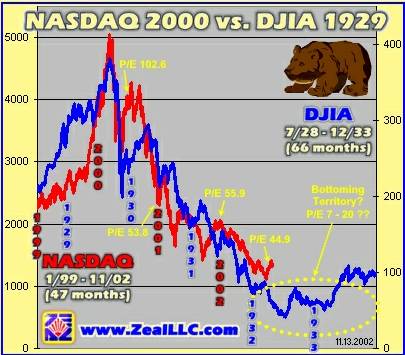
ZEAL
And high tech old workers usually can't go back to
their jobs. Many didn't keep up with new technology.
Economics professsor
Bob Wallace recommend bill read "The Great Crash: 1929" by John Kenneth
Galbraith.
Galbraith made clear that no one knew the bottom of
the stock crash even long after it bottomed.
Friday November
15, 2002 16:46
Companies must contain software costs in a possibly
defalating economy.
At an Estate Planning Workshop bill attended on
Tuesday, Alan Read of CLA,
reported that 80% of the wealth in the US was owned by citizens 65 or
older.
So it's natural crooks flock to where the money is.
The pension funds. And senior citizens too.
Some of them use high tech venture ploys to bilk
bankers and investiment firms of senior citizens money.
Think Visual Basic 6.0, 80C32
BASIC-52 and even Forth.
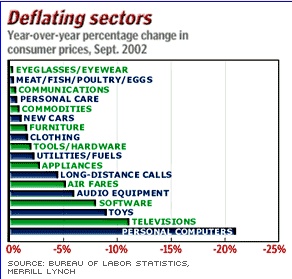
We have an idea about whose dollars may disappear.
The senior citizens. They might be forced to live only on social
security ... as long as that lasts.
Who is going to get stiffed on all the
borrowed dollars?
What has happened to stock prices during the past decade
reflects the state of Japan's economy during this same period, one typified by
stagnation and deflation.
cbs.marketwatch
NEW YORK (CNN/Money) - Though most economists doubt the scary monster
called deflation will wade across the Pacific and level the United States the
way it polished off Japan, many U.S. businesses still have a real problem
raising prices, and that could affect some stock prices as well.
money.cnn
Please note the change below.
Look what's happened to the VCs, especially those
who invested in non-80C32 SOCS. ARM, ARC, Tensillica, .... the fools or
possibly crooks.
Here's an example of the problem:
Honeywell.
Absolute brilliance = productivity
High tech appears to be having terrible times,
especially in silicon valley.
Here's the underlying problem.
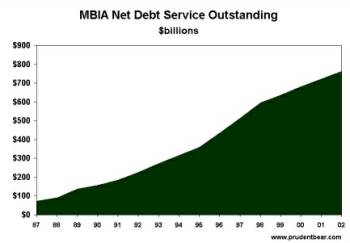
The problem will be even more serious if we enter a
deflating economy.
Fewer bucks to pay off expensive borrowed bucks. In
the real world, of course, this means who in his right mind is going to
try to do this.
Chapter 7 or 11 is the only way. Screw the
investor.
But csd doesn't agree with this strategy. But this is
likely to happen.
Where are the debtors going to get the dollars to pay
back the loans?
In an inflating economy lots of buck pay off few
borrowed bucks. This is doable.
Csd, of course, is conservative, but you can
tell this from
the web.
And we are having fun!
Look what's happened to the VCs, especially those who
invested in non-80C32 SOCS. ARM, ARC, Tensillica, .... the fools or possibly
crooks.
Too Much Ventured Nothing Gained VCs are a hurting bunch.
New companies feel their pain.
FORTUNE
Monday, November 25,
2002 By Russ Mitchell
Deflation might happen this next year.
[I]n the case of the Internet, one need look no further than
the 75 percent decline in the Nasdaq to understand that very little of the
economic benefit of this new technology has flowed to any but the earliest
investors. In the end, a key segment of society did profit from the bubble.
According to J. Bradford DeLong, an economic historian at the University of
California at Berkeley, consumers are the big winners. They enjoy the low
prices that flow from ruinous competition and reap the benefit of improved
products and services that result when companies use new technology to operate
more efficiently.
How the Bubble Economy burst
Steven Pearlstein
The Washington
Post
"The problem is that the Fed is still pursuing a restrictive
policy," said David Hunter, chief market strategist at Kelly & Christensen,
who argued the Fed's policy moves have continuously proven to be too little and
too late. "It is not the fact that inflation is the lowest in decades that
causes me to forecast deflation in 2003, it is the Fed's lack of understanding
of the immediacy and magnitude of the deflation risk."
So great is the risk -- and the Fed's blindness to it -- that
Hunter expects 2003 will be the "worst economic year this country has
experienced" since the 1930s. Rather than preventing deflation's onset, the
myriad structural differences between the U.S. and Japan will result in a "much
swifter and steeper" descent into deflation here vs. the gradual creep there,
he suggested.
thestreet.com
BUBBLE : The Influence of Venture Capitalists 'Johnny
Appleseed' for a Risky Field Doerr's Ambition Paid Off -- at First
Here another fascinating link to the
current economic problems.
Here's more on the debt problem.
Cheers.
The economic condition of the US
is pretty horrifying when one studies the
Prudent Bear's
graph.
Sunday November 10, 2002
19:52
Silicon Valley got blindsided with Windows 2000. And
maybe getting blindsided again with USB 2.0 while pushing 32 and 64-bit
peripheral microcontrollers.
And maybe suffering
unemployment consequences for these
mistakes.
Also many corporations and
individuals are
burdened with debt which rose with the
bubble economy.
So many, not some, companies may try to
pay off debts in possibly a
deflating economy. And will likely go broke like Enron,
Global Crossing or Excite with a chapter 11 or 7.
Got to watch Cypress about this with its apparent
astronomical
debt in this apparent deflationary economic cycle.
The moral of this commentary for the intelligent [as
opposed to the
other type. ...
Retirement checks are simply great for freedom of
expression!] 80C32 SOC vendors is to get Forth and BASIC-52 running quickly
on their chips interfaced to Windows through USB and a wdm driver!
Tuesday October 29, 2002 16:12
Shred's
article has message similar to Manner's
article
The tech stocks that led the market
in the 1990s may not lead in the 2000s. The Oracles, Sun Microsystems and
Ciscos may not be the next technology leaders, and their early struggles could
be an indication of shifting market leadership. Buying Xerox in the early 1970s
would have cost you severely since then, but buying Intel would have made you
wealthy. The challenge for tech investors is to spot those emerging leaders.
Watch for breakouts and accelerating fundamentals, and ignore laggards.
We will, of course, see what happens!
Wednesday October 23, 2002 14:30
Predictions are made that
1
in 3 high tech companies will fail.
Richard McClendon has some
ominous economic
predictions.
Friday October 18, 2002 12:25
Gee, Bill's ms and phd student
Lewis wrote AOL, Time
Warner, and the
Crash
of 2000.
Monday October
7, 2002 18:20
ARM stock has declined
from about 6 to 2 in the past week.
The October 2002 issue of Embedded Systems is only 48
pages long. The magazine looks like it is having financial problems. Few
advertisers.
One reason Forth isn't as popular as it should be is
that magazine, like esp, don't push it since other language and operating
system vendors are spending money for magazine advertising. Welcome to the real
world.
The editor in chief of esp appears a bit depressed.
So we'll post his editorial.
Michael Barr
Get Rich Slow
By a show of hands, how many of you jumped ship from a stable
engineering company to a startup in the late ‘90s? I bet if you
didn’t, you at least thought about it or had a few offers. I never jumped
ship myself, but straddled two boats at once, trying to make a quick million on
a tight budget of night and weekend hours.
I guess I always knew the
air would come out of the bubble at some point. And I sure as heck knew it
wouldn’t be good to be on top if that happened. So my partners and I kept
our day jobs and focused on long-term issues in our business planning. How
would we profit from our ideas in ways other than a quick sale of the company
or an IPO? We figured we’d identified a product and a market for it, so
needed only to develop the code and keep expenses lower than revenues while we
increased sales.
Still, we crossed our fingers and hoped as much as the
next guy that we would time our business just right and make a bundle somehow.
We certainly weren’t going to turn down a multimillion dollar purchase
offer—and were so confident our company was worth it that we turned down a
bona fide small, private funding source and free help from an experienced CEO
because it would’ve valued the company far less initially.
In the
end, unfortunately, the bursting of the bubble took not only the really bad
ideas but also many good ones (including ours) down with it. By the time we had
filed our patent application, developed our prototype, and written our business
plan, all of the funding sources for search engine enhancements had dried up. I
suspect several of the venture capital firms and search engine companies we
talked to would’ve jumped at the chance to be involved with our idea just
a few months earlier. But the game was up. And two years later— long after
we wrote off our personal investments in the company—the capital we needed
to quit our jobs and work toward profitability still isn’t available. So I
have a new plan.
My new plan is to get rich slow. To play the part of the tortoise
rather than the hare. Engineering is a good, stable profession, and one that
generally pays well—especially if you have a specialty as in demand as
real-time embedded systems design. It’s really not a bad life, if you can
get it.
So rather than try to outwit or outplay, I’ll just try to
outlast—and I’ll save everything I can along the way. Besides,
it’s a lot easier to stick to your core values and make the world a better
place little by little when you’re not busy making an end run. To see how
extremely disjointed the two paths can become, witness any of the recent
corporate scandals.
Honesty, integrity, and responsibility should be
the core values of all practicing engineers. And we should practice them
outside of work as well. There’s more to life than engineering and money,
as fun as both are. So I’m stopping to smell the roses now more, too. It
sure is nice to have my nights and weekends back! And that’s worth a lot
to me.
[email protected]