Economics of Software
Monday January 28, 2002 13:08
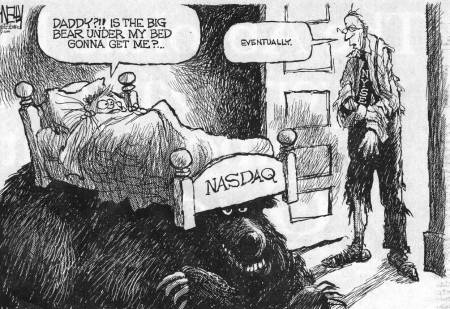
2002 may be a year of shakeouts in the electronics and software industries.
Holding down software development costs is becoming critical.
Demand-soared in relation to supply, Paulsen said. Through much of the period, corporate managers could care less about costs because they could raise prices.
This is one reason we're working on the port of the 8052 Embedded Controller Forth operating system 2 to the CY3761 and CY3861 EZ-USB-FX/FX2 development systems.
There needs to be an alternative to the Anchor/Cypress/Keil C/assembler-based batch software development environment for productivity, cost and other reasons.
Once you get used to a real-time interactive operating system running on the target machine, it's hard to return to a batch cross development environment.
With the Anchor/Cypress/Keil development system, one loads binaries on to the development system.
In Forth or BASIC environment, one loads source code on the development system. The target microcontroller incrementally assembles and compiles its own code.
But you can, of course, metacompile your app code with the os to load a binary on the target microcontroller. Friday January 25, 2002 19:50
| Economist: Go back to the future
Eminent forecaster says the high times were an aberration
BY WINTHROP QUIGLEY To see the future of the American economy, take a look at 1940, advises James W. Paulsen, chief investment officer of Minneapolis-based Wells Capital Management. Paulsen, whom BusinessWeek magazine dubbed the most accurate economic forecaster of 2001, contends the post-World War II economy is not only an aberration in history, it actually came to an end in the 1990s. Paulsen was scheduled to speak on the economy in Albuquerque tonight in a dinner presentation to members of the New Mexico Society of Financial Analysts. The societys 42 members are financial analysts, money managers and investment advisers. Members manage more than $25 billion for their clients, said its president, Jane Farris, a pension funds manager with Lockheed Martin. In the immediate future, Paulsen told the Journal in an interview, look for a lackluster recovery at best, with unemployment possibly reaching 6.5 percent. The big story this year is going to be how low the inflation rate goes, Paulsen said. He projected inflation in 2002 as low as 0.5 percent. In historical perspective, Paulsen said, demand drove the post-war economy. Demand was spurred, first, by demographics. Much of the population in the industrial world would reach peak earning and spending years post-World War II The Great Depression of the 1930s had taught governments they could spend their way out of economic downturns, Paulsen said. Finally, Americans got over a historic distrust of debt, with government policies such as mortgage loan tax breaks, encouraging it. Demand-soared in relation to supply, Paulsen said. Through much of the period, corporate managers could care less about costs because they could raise prices. The trends reversed in the 1980s. The Ronald Reagan and Margaret Thatcher ideology called for less government spending. Developed world populations aged and therefore spent less. Beginning in 1987, Americans began to eschew debt as white-collar layoffs rose and government borrowing fell, Paulsen said. He calls the result the death of demand. Through most of the 1990s, sales grew at the slowest rate in any decade since the Depression, Paulsen said. Corporate managers could no longer ignore expenses,, but since it had been 40 years since management had had to worry about efficiencies, there was plenty of fat to cut. That worked until the mid-1990s, Paulsen said. With easy cuts gone, companies began massive technology investments, hoping to improve productivity. The mergers and acquisition boom took off as companies tried to find economies of scale, cost savings and more sales. Even with sales down, improved efficiencies improved profits, and the stock market soared. Job growth was slow, but since recession was avoided, unemployment fell through the decade while government surpluses grew. Without demand, prices could not be raised and inflation almost disappeared. That lowered the cost of money, so people can afford to buy more with the same wage, Paulsen said. Economies, such as Japans, that couldnt or wouldnt attack expenses went into the tank. Paulsen said. When you look forward, the primary problem is lack of demand growth, he argued. Paulsen believes American business will look offshore for new demand. Far from exploiting workers and resources in the developing world, It is in Americas economic interest to help global economies thrive so new demand is created he said. For the short-term future, Paulsen said he is looking for a soft recovery. I think its going to be a very, very weak recovery, and disappointing maybe a 1.5 to 2 percent increase in gross domestic product. Unemployment could reach 6.5 percent, he said. But low inflation will be the real story, with the rate for this year probably going as low as 0.5 percent. Policy-makers have asked the Federal Reserve System to stimulate the economy through rate cuts alone, but tight fiscal policy and currency exchange rates have worked against stimulation, Paulsen said. Were trying to exit this (recession) without using all the policies, he said. I dont think its going to work. The 3-year-old New Mexico Society of Financial Analysts hears from experts such as Paulsen about eight times a year, Farris said. If our members are better informed and educated, they better serve the broader investment community, she said. Investors are cynical about some of the investment advice they have received in the past year or so, Farris acknowledged. It hurt too much to be out of the stock market, she said. It hurt too much not to have the investment. People started to ignore sound advice. But, she added, People lack the long-term view of investments in general to put the events of the past two years in perspective. This is what you can expect people with the chartered financial analyst designation to have. Albuquerque Journal Business Outlook Thursday January 24, 2002 |
Tough times in high tech in 2002.
Friday January 25, 2002 09:33
| 430 Workers Log Off at Gateway
Call Center Falls Silent
By Diane Velasco Gateway Inc., the nations fourth-largest computer maker, abruptly closed its Rio Rancho call center Thursday, leaving 430 New Mexicans among the ranks of the 2,250 expected to be laid off nationwide. The San Diego-based company has lost sales and market share against its competitors, troubles made worse by the general downturn in the economy. The decision was made based on our business needs and costs, said human resources director Tim Huval at the Rio Rancho center. This is tough, but we had to make some tough business decisions. Workers were promised that they would continue to be paid and receive health benefits for 60 days, Huval said. In addition, they would receive payment for accrued vacation time. Their full-time job will be to find a job in 60 days, Huval said. Bank of America Rio Rancho Call Center said Wednesday that it is adding 200 jobs with an average salary of about $10 an hour. The Gateway center, which took calls for technical support from customers, will be turned into a job-placement center, Huval said. At the end of 60 days, employees will be offered a severance package. Im sorry it happened, but they gave very valid reasons I couldnt disagree with them, said a 42-year-old man who had been a technical support consultant at the center for about one year. He gave his name only as Kevin. When Gateway opened in Rio Rancho in 1998, it received $3.7 million in state job training funds. In April, it canceled a planned $1.7 million expansion of the center, citing the fact that it didnt receive all the state job training funds it expected. Instead of adding 204. jobs with an expansion, the center scaled down from 480 people list year to 430. Rio Rancho city administrator James Jimenez said the center didnt contribute any significant gross-receipts taxes because it was an inbound call center. The center was built with the help of an $8 million industrial revenue bond. Gateways property taxes were waived for five years. Because Gateway is closing within the five-year time limit for the bond, the company will have to pay Sandoval County a portion of its previously waived property taxes, Jimenez said. The county treasurers office could not be reached for an estimate. Gateway received the bond Dec. 1, 1997, and opened in early 1998, Jimenez said. City finance director Dick Kristof said it was too early to tell what fiscal impact the closing would have. Rio Rancho Economic Development Corp.s executive director Noreen Scott said the first short-term effect will be the loss of the annual $28,000 payment Gateway made to the school district in lieu of property taxes. Nationwide, the company cut 5,000 workers last year, nearly a quarter of its work force, and closed 27 stores in an attempt to return to profitability. The most recent closings come as the company reported a net profit of $5.1 million, or 2 cents per share, reversing the loss a year ago of $128 million, or 40 cents per share. We said wed return to profitability in the fourth quarter, and we did, said Ted Waitt, chairman and chief executive officer. That profit came despite the fact that domestic computer sales fell 17 percent to 681 ,000. Excluding one-time items, the company earned $5.1 million, or 2 cents per share. Analysts surveyed by Thomson Financial/First Call were expecting Gateway to earn a penny a share. Gateway also closed its Colorado Springs call center Thursday, laying off 400 people there. In addition, the company plans to eliminate its offices in California and Massachusetts and close 19 stores in nine states. Gateway develops and manufactures personal computers, software, servers and workstations for individuals, business and government agencies. Services include training programs, Internet access, support and financing programs. Gateways stock closed Thursday at $6.36 on the New York Stock Exchange, down from $6.60. A year ago, it was trading at $23.30. The Associated Press contributed to this story. Albuquerque Journal Friday January 25, 2002 |
DaimlerChrysler CEO predicts stock
futures Friday June23, 2000
07:19
| Short
Binary Futures AOL, Time Warner, and the Crash of 2000. Lewis is one of Payne's ms and phd students in computer science.
|
All vxds and NT kernel mode drivers must be converted to simple and fast wdms to make money with Windows 2000/98 products.
But .dlls will be just fine under both 98 and 2000.
These new wdms must be properly documented. Sunday April 23, 2000 10:17
| Venture Leverage Inflates E-Balloon
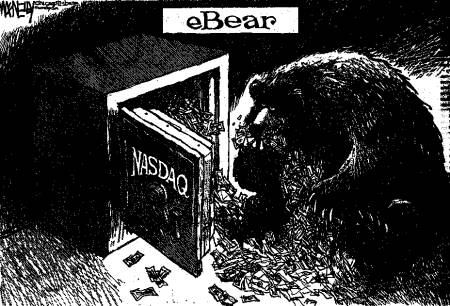
Mathew Miller By now its old news that todays gyrating Nasdaq reflects a speculative bubble that seemed destined to burst. Whats less well understood is that the process by which high-tech firms get their early funding helps fuel this fragility in public markets down the line. To be sure, Americas nimble venture-capital sector is a source of competitive advantage. Only in the United States are billions funneled to start-up firms with no asset beyond a promising idea. European or Japanese entrepreneurs, dependent on more traditional (and conservative) forms of bank financing, can only envy the process. But theres a catch: The whole thing works because its a rich mans game. Venture funds are rich peoples way of pooling money for bets on risky investments. Top funds often require a minimum investment of $1 million to $5 million; this is not for the guy with company 401(k). Once assembled, these funds can have $100 million or $200 million or even a billion dollars that they then seek, indeed need, to invest in new firms. The vital thing to understand is that folks who have this much cash to invest in high-risk situations can afford to lose the money without affecting their lifestyle. The number of people in this happy circumstance has soared thanks to the long bull market and the record-long economic expansion. More rich people have more discretionary millions to bet on high-risk ventures than ever before. Theyre also motivated to roll the dice. For the last five years every rich person in America has seen friends or acquaintances make genuine killings on high-tech start-ups. They see little downside to getting a piece of this action, especially when it wont change their familys standard of living if the worst happens and they lose the cash. When you take these fresh billions on the supply-side of venture capital and toss in the Internet revolution, you have a combustible mix. Too much money is chasing too few good ideas. Thats not to express skepticism about the way the Internet is transforming the economy. Its simply a statement about the quality of businesses being funded. In the early days of a new technology called the automobile, after all, there were 3,000 companies building cars. Only a handful survived. In the meantime, this surplus venture cash turns old relationships upside down. Instead of begging for money, entrepreneurs thought to have good ideas are in the catbird seat, able to pick and choose among potential funders for the strategic advantages they bring (like prestige, contacts or industry expertise). Venture firms compete furiously to get into hot deals, often making snap decisions in a matter of days or even hours with little scrutiny. For most of us this might seem crazy, but for people investing rich peoples money it isnt: If just one in 20 bets pays off big, it more than covers the outright loss of all the others. This need to strike oil fuels the macho culture of venture capitalists who lust after fabled 10-X returns that is, 10 times your investment, or 1,000 percent, within a few years. Apparently its just the little people who now rest content with, say, the 20 percent annual return produced by broader market indexes these last few years. The last piece of the puzzle come in the drive by venture firm to reach their liquidity event the initial public offering (or IPO). Too many companies are going public too early (i.e. with utterly unproven business models) so that venture funders can cash in while the getting seems good. The hype surrounding these firms fuels unsustainable valuations that are bound to fail to earth, as were starting to see. The fact that rich people deploy their wealth in this way is, for the most part, socially constructive. It gives us todays eBays and Amazons. But it also gives us the 98 percent of high-tech firms that will fail, many not until after they've gone public. Ironically, thanks to the democratization of investment made possible by online trading it's average investors who jump in to buy these sexy stocks that get left holding the bag - and outsized loses they cant afford. Matthew Millers e-mail address is [email protected]. Copyright, Matthew Miller. Distributed by Los Angeles Times Syndicate
Albuquerque Journal Wednesday April 19, 2000
|
| Has the Bubble Been Punctured in Tech
Stocks?
Have the markets really punctured the dot.com bubble? IT WAS fun while it lasted. But Americans, from bosses to janitors, may have to find something else to talk about at baseball games and round the water cooler. No longer will it be possible to inspire thinly disguised envy by hinting that you are starting a dot.com, or have just made a fortune with a bet on an Internet company. In Californias Bay Area, workers may now stay in one job long enough to know the names of their colleagues instead of quitting every other week for an Internet start-up dangling juicier share options. A salaried position with a firm more than a year old may rediscover its appeal. Office-workers may even wear suits again. It is early days. But if this comes to pass, thanks will be due to the plunge in the price of dot.com shares that helped to pull the Nasdaq index down to 3,321 on April 14thBlack Friday, according to New Yorks tabloid Daily Newsmore than 34% lower than the record high reached on March 10th. Most people would concede that some of the silliness needed to be taken out of the tech revolution. The markets reaction to bad inflation figures, and the fear that these would bring higher interest rates, seemed to achieve that. The big question now is whether the backlash against the new economy is the first stage of a more serious crash in share prices in the old economy as well. Even after Black Friday, most bulls remained, well, bullish. Nasdaq was still down only to where it stood last November, and remained almost 40% higher than this time last year. The blue-chip Dow Jones Industrial Average, too, although down 12% from its all-time high, was broadly back to its November value (see chart). Gloom, the bulls argued, was overdone, creating huge opportunities for bargain-hunters. Abby Joseph Cohen, a famous bull from Goldman Sachs, uttered reassurances on CNBC, a financial-news television channel, about a 15-20% rise in stock prices by year-end. That calmed Americas investors who, since the crash of October 1987, have learnt to buy the dips. Janus, a mutual-fund outfit that has ridden the bull, remained upbeat. You get periodic shocks, says David Corkins, a Janus portfolio manager, but things are pretty good. There are lots of companies with increasing returns on capital. It was a widely shared sentiment. Unlike many investment firms, Janus suffered no redemptions even in the thick of the carnage. Fresh investment slowed, but only a bit. Come the rebound early this week, the firms focus on the companies with the best growth, even if they often traded at the highest valuations, was rewarded. Bears who had been a bit too quick with their Schadenfreude were embarrassed when, on April 17th-18th, the forecast bloodbath turned into sharp rises in the Nasdaq index. CNBC, meanwhile, was breaking recordsfor viewing figures. Even so, many believe that the market is now moving into a bearish phase, perhaps a severe onetemporary rallies being normal on the way down. Even after the crash of October 1929, the market had recovered most of its lost ground by 1930. Parallels to 1929 are too conservative, says Michael Belkin, a well-regarded quantitative analyst. He now expects the main indices to fall back to their 200-week averages, as they have done after past bubbles have burst. That implies around 8,500 for the Dow and around 2,100 for the Nasdaq index. The indices actually disguise a two-year-old bear market. Since April 1998, most days on the New York Stock Exchange and Nasdaq have witnessed more stocks falling than rising (see chart). Initially, the declines came in old-economy shares. But more recently, dot.coms and biotech firms have been hammered. The market for initial public offerings (IPOs) has frozen, at least temporarily. This weeks planned sales of shares in companies such as AltaVista, an Internet search-engine, and Yupi Internet, a Spanish-language website, were postponed. If the freeze were to continue, it would destroy start-ups that were banking on their IPOs to finance their future growth. Also, many of the dot.com firms that have gone public are fast running out of cash. If they cannot persuade investors to buy some more of their shareswhich, in current market conditions, will not be easythey could go bust. Things look particularly bad for drkoop.com, a medical-advice site now trading at $2, down from a high of $46. Wisely, its founder, Everett Koop, a former surgeon-general, sold 10,000 shares for $9 each in February. Another cash-constrained dot.com, Peapod, an online grocer, last month sold a 51% stake to Royal Ahold, an offline grocer. If the public securities markets remain closed, there will be many more such mergers. To an extent, the attack on tech stocks has punished firms that were not succeeding. Few investors would be surprised to see a rise in the failure rate for IPOs, since the market, with its willingness to fund firms rather early in their evolution, has become more like a venture-capital portfolio. But the market also seems to have penalised some good firms as well as bad (though since so few new technology companies make money, it is often hard to tell the difference). Dot.com insiders feeling snubbed by investors can, of course, invest more themselves. But even that may not lift the share price. Take Healtheon/WebMD, a medical dot.com with a blue-blooded Silicon Valley pedigree. On April 7th, after its shares had tumbled to $22 from a high of $126, its founder, Jim Clark, the brains behind Netscape, and John Doerr, a partner at Kleiner Perkins, a top venture-capital firm, pledged to invest a combined $220m of their own money in the shares. This did not stop the shares falling further. Sandy Robertson, a veteran Silicon Valley investment banker, says that, if the market continues to shun good publicly traded dot.coms, venture capitalists may soon start to take them private again. Dot.com workers have been feeling the pain. According to Matt Ward of WestWard Pay Strategies in San Francisco, more than 25% of employee stock options are now in the red. New accounting rules mean that repricing them down will count against profits. It is possible that this will make employees even more willing to do their own repricing, by taking a job elsewhere. Potential new recruits will be sceptical about promises from start-ups about possible options gains after a swift IPO. The bleeding of executives from traditional firms will slow down and may even reverse. A few months ago, the biggest risk seemed to be the opportunity cost of staying put. No longer. Even so, venture capitalists remain extremely upbeat. They still have more capital than they know what to do with. And they still believe that the Internet is going to change the world, and that the revolution is in its infancy. Moreover, most venture capitalists are delighted with the public market valuations for dot.coms, even at their current reduced levels. Since it went public on February 29th, the market capitalisation of Onvia, a small-business-to-small-business exchange, has gone from $6 billion to about $1 billion. Yet, during the first round of venture financing a year ago, it was valued at only $20m. I may not make 200 times my moneybut if it is only 10-15 times, that is still a fabulous result, says one of the lucky adventurers invested in Onvia. For bears, that probably indicates how far the market still has to fall to reach rationality. The Economist, April 22-28, 2000 |
| The Rumor Mill by Paul Cassel
Lest you think that youre the only one in the entire world who isnt growing rich day-trading tech stocks, the best information I have is that 77 percent of these guys lose either all or almost all their money. Sure, the indices are rising, but the tech stuff is a very thin market with a few monsters offsetting many dogs, thus shoring up the index. Oh yeah, there is always the fortune to be easily made in IPOs. Well, the good ones are all on alloca- tion and you wont get any of those, or if you do, you know who you are. lm not saying dont do it; thats your call. im only saying that if youre not doing it, at least you still have your money where many players dont. ... ComputerScene Magizine April 21, 2000 http://www.computerscene.com/ |
High tech software and hardware long-term viability is reliant on visible internal documentation of high-complexity products. Monday April 20, 2000 13:17
| Is the Technology Bubble Bursting?
THE wild ride in the world's stockmarkets grows ever wilder. Time and again, plunging prices have caused investors to ask if this is the crash, only for the market to turn around. Yet behind this volatility, one trend is clear: enthusiasm for technology stocks seems to be waning. In the past six weeks, the Dow Jones Industrial Average, dominated by old-economy firms, has crept higher; but Nasdaq, stuffed full of technology stocks, has fallen sharply. On April 4th, it closed 18% down from its record high on March 10th (though it is still well up since the middle of last year). At one stage on April 4th it had fallen by 14% on the day. Typically, it then rose on April 5th. The disillusionment with tech stocks has been even more pronounced elsewhere in the world, particularly in markets such as Bombay and Seoul. In Japan, Softbank and Hikari Tsushin have hit downward trading limits most days in the past week. The London Stock Exchange supplied the perfect metaphor for the times by failing to open for most of April 5th because of technical glitches. The swings in the main indices have been dramatic enough, but the behaviour of individual shares has been even wilder. During the morning of April 4th JDS Uniphase, a maker of parts for the next generation of optical fibres, saw its market capitalisation bounce between $58 billion and $82 billion. In March it had been valued at $109 billion. Many shares are now more volatile than they were in the 1987 stockmarket crash, according to Lawrence McMillan, an independent options analyst. Why are previously high-flying equities suddenly so out of favour? Rising short-term interest rates may be one culprit. With little or no debt, many analysts had assumed that tech stocks were immune to interest rates. Yet higher rates mean that investors face a higher cost of capital, and they should also raise the discount rate on future earnings. Investors may also have become better at valuing such shares. Rather than buying en bloc, they may now be going only for those that have a reasonable expectation of profits. Old-economy companies are also making a fist of embracing the Internet, increasing their appeal and reducing the lure of new-economy firms that had hoped to replace them. Increased volatility may also have taken its toll on investors' appetite for risk. And individual investors who have borrowed to buy shares are experiencing the pain of meeting margin calls. Nor is there a traditional flock of investors who want to buy cheap sharesso-called "value investors"and who have traditionally provided a floor under prices if they fall too far. Such fund managers have become unpopular laggards during the bull market: witness the recent retirement of Julian Robertson, who ran Tiger, a once-big hedge fund, and the travails of Warren Buffett, of Berkshire Hathaway. Value investors have lost ground to a school of investing based on how companies will do relative to expectations in the coming quarter, and to another fashionable group of large investors known as momentum investors, whose bets are made solely on the direction in which a market is heading. Add these together and you have the elements in place for a panic. The catalyst this week came on April 4th when a judge ruled in favour of the Justice Department's antitrust lawsuit against Microsoft. The shares of one of America's biggest firms dropped sharply. Although this hurt the Dow, to which Microsoft has recently been admitted, its problems were more than made up for by gains in old-economy companies. But Nasdaq contains many big technology firms as well as Microsoft, including Cisco, Intel, and Oracle. Shares in most of these firms slumped too. Perhaps, in part, because of fears of antitrust suits against them. Microsoft has been the quintessential growth stock since the mid-1980s because it has managed to maintain its huge market share and profit margins in a fast-growing market. For investors that has been a splendid money-making opportunity; to a judge it might smack of monopoly profits. Although Microsoft may be more truculent than most, it is not unique in having characteristics that could attract an antitrust investigation: high market share and big margins. Look across the technology landscape at leaders such as Intel (chips), Oracle (database management), Cisco (routers), and Sun Microsystems (servers). All have a dominant market share that might seem monopolistic. This is not a coincidence. New-economy companies often have huge costs for development, but low costs for every extra customer. The best products cost no more to buy and, given scale, cost less to make than those of competitors. Result: winner takes all. Yet any regulatory threat to that dominance could remove one of the last props from tech firms' exorbitant valuations. That thinking seems to have been at work this week. For those of a historical bent, it has all happened before, says Richard Sylla, a professor at the Stern School of Business. In 1962 the market lost almost a third of its value after President Kennedy implicitly threatened antitrust action in response to price hikes by the steel industry (prompting the response from US Steel that "higher steel prices cause inflation like wet streets cause rain"). In 1903, in the "rich man's panic", losses were even steeper following Theodore Roosevelt's trustbusting attacks on industry. How low can it go? Even without further antitrust action, technology stocks could have further to fall, because their valuations have become so stretched. How stretched is difficult to determine, because traditional valuation methods are not good at coping with fast-growing companiesespecially if they have neither dividends nor profits. For what it is worth, however, Nasdaq trades on a price/earnings ratio of 62 times trailing earnings. Between 1973 and 1995, its p/e never exceeded 21. An even scarier picture is painted by an analysis done by Grantham Mayo Van Otterloo, a fund-management firm. This uses a model that reflects the unusual recent profitability of American companies, especially technology firms. In particular, the model picks up the growth posted by Microsoft and its like and is careful to expect only a gentle reversion to average returns. An intriguing result is that big, established technology firms are less overvalued than the rest of the market and did not seem expensive until 18 months ago. But the bigger picture is less happy. Until 1995, the Nasdaq was at "fair value", but no longer. Fair value, according to the model, is some 70% below current levels. Worse still, says Jeremy Grantham, a partner in the firm, the market is unlikely to stop falling when it hits fair value. "If it stopped there, it would be the first time in history. That's never happened at the end of any bubble." The consequences of a big fall would extend far beyond a dip in the price of Silicon Valley property and sales of luxury cars. The biggest effect would be felt in the new-issue market. A number of deals are already being quietly held back. Nobody wants to be first to pull the plug, because that would be an admission of weakness. But once one does, expect others to follow. A month ago, it was rare for a new issue to trade below its offer price. Now, over 40% do. A dozen offerings from the past year are almost worthless. For firms that rely heavily on the promise of lucrative stock options to tempt the best staff, this might prove terminal. Typically, America's new mercenaries join a company within a couple of months of a hot flotation, says Matthew Cowan of Bowman Capital Management, a fund-management firm. If the shares then trade below the offer price, many will leave just as quickly, especially since their options will be struck on the price prevailing when they joined. For the myriad new firms with no cash, the stockmarket has become a crucial, but entirely unpredictable, means of rewarding employees. They may still survive. For the truth is that nobody knows if this is the end of the tech bubble. Reason suggests that tech stocks should go down. But if reason had much to do with share prices, they would never have risen to their current heights. Wall Street's finest will do all they can to get the bandwagon rolling again. American investors still have the equity faith: tens of billions of dollars of retirement money are even now heading for the market. Many investors are preparing to react, as they have so profitably to previous market downturns, by "buying the dips". Alan Greenspan, the Fed chairman, may feel less need to raise interest rates now that share prices show some sign of heeding earlier warnings. And, lest anyone forget, it is presidential election yearand Bill Clinton will be keen to get Vice-president Al Gore into the White House. A booming stockmarket would help in that regard. On April 6th, Mr Clinton hosted a conference on the impact of new technology on the American economy, featuring such luminaries as Mr Greenspan, Bill Gates and Abby Joseph Cohen, a stockmarket guru. Having seen the impact on share prices of the Microsoft judgment, Mr Clinton might even want to call off the antitrust bloodhounds. As a politician, he has usually favoured votes over principles. The Economist, April 8-14, 2000 |
Software distribution may continue to be done by cd rom but maintenance will be done on Internet Thursday April 6, 2000 20:11
| Business Will Never Be The Same Again
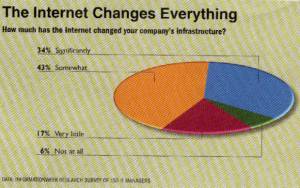
Movingwhether its across the hall or across the countryoffers the promise of a fresh start, especially if most of the accumulated clutter is left behind. To some IT managers, mastering the Internet must feel like moving from a condo to an igloo. The weather might be fairly predictable, but the working conditions are almost always challenging. To help understand the Internets impact on IT infrastructure, Information Week Research recently asked 150 IT managers to identify their key challenges and opportunities. Almost all IT managers in the study said E-business has changed their companys enterprise architecture. Only 6% report no changes.
More than half of companies in the study arent disrupting their
infrastructures, choosing instead
to No matter the arrangement, few companies are going it alone when constructing their E-business infrastructure. In all, 49% have outsourced at least part of the job, and that number is expected to jump to 67% within the next 12 months. IT managers report that finding skilled staff able to integrate Web front ends with back-end systems is extremely challenging. IT managers say their top priority is simply to improve relations with customers, business partners and suppliers, followed by better internal communication and efficiency Is the Internet transforming your companys infrastructure, and if so, how? Let us know at the address below. HELEN DANTONI
Research Manager Own the data behind InformationWeek Research. See our available reports at informationweek.com/reports
Money is a key concern for three in four companies designing and building E-business solutions. But with so much depending on the performance of Internet initiatives and expectations for results riding high, three factors supercede IT investment when it comes to building an Internet architecture. Reliability is the most significant consideration of the IT managers in the study. Nine in 10 report that impeccable service is their major infrastructure concern. Security is also important, but to a slightly lesser degree. And for 79% of the managers surveyed, ease of application integration rounds out their list of key concerns. InformationWeek.com April 3, 2000 |
Windows 3.11, 95, and 98 VxD and NT kernel mode drivers have to be converted to wdm drivers Thursday April 6, 2000 20:52
| Windows 2000, E-Biz spending To Soar In Second Half Of
Year
BY JOHN ROBERTS THE WINDOWS 2000 transition will kick into high gear in the second half of this year, providing a solid boost to IT spending. This, coupled with the headlong rush by companies of all sizes to embrace e-business, will pump up spending for the rest of the year. The transition to Windows 2000 by both enterprise clients and small-business customers will reach its peak anywhere from six months to one year, according to a CRAT survey of solution providers conducted in January. Most solution providers also expect the new operating system to boost sales of other IT products and services. In line with the pace of transition, the impact should be strongest in the second half of this year. As the transition picks up steam, other IT spending could rise anywhere from 10 percent to 15 percent above what it otherwise would have been, CRN estimates. E-business will continue to be a driving force for IT spending as well. CRN research data shows that among smaller solution providers, e-business revenue now accounts for 25 percent of total sales revenue, and the percentage is increasing. These solution providers expect their e-business revenue to increase by an average of 21 percent in the next three months alone, and to more than double over the next year. Data from the just-completed 2000 CRN Small Business Survey is consistent with these trends. The average small business plans to devote nearly 20 percent of total IT spending to e-business in the coming year. This is in line with their expectation that the percentage of overall sales revenue coming from online sales will nearly double during this period. As a result of these trends, CRAT forecasts spending by large companies will average $415,000 per company in July. If realized, this would be 7 percent above actual spending in July 1999. A seasonal drop in spending that normally takes place during the summer months will to an extent offset the impact of Windows 2000 and e-commerce. Large companies are defined by CRN as those with annual revenue of at least $500 million. Looking at midsize companies, CRN forecasts spending in May to average $32,000 per company. While lower on a sequential basis than the forecast for April spending, the figure, if realized, would be well above actual spending in May 1999. The same factors cited earlier will help fuel the year-over-year spending gains, although Windows 2000 will not be as big a factor in the spring months as it will be in the summer and fall. CRN defines midsize companies as those with annual revenue of between $20 million and $ 500 million and at least 100 employees. Turning to small businesses, defined as those with annual sales of between $2 million and $20 million and fewer than 100 employees, CRN forecasts spending in the second quarter of this year will be 5 percent to 7 percent higher, in dollar terms, than in the same period last year. The upgrading of existing PC systems and networks, as well as e-commerce, will help move spending higher. As is the case with midsize companies, Windows 2000 will nor be as big a factor in this period as it will be in the second half of the year. The general business climate in the United Statesone of the keys factors influencing the pace of IT spendingremains superb. But scenarios exist that are no longer far-fetched and could, if they come to pass, take economic growth down a peg or two. For example, oil prices have more than tripled in the past year, an increase not seen since the Iranian revolution in the late 1970s disrupted oil supplies. In the past two decades, U.S. indus tries have become much more energy efficient and are now using far less oil than they once did, but the impact of an increase this size on the cost of producing goods now is being felt by industries across the board. With most companies unable to raise prices enough to cover these increases, profit margins will be squeezed. In addition, the rapid growth of the U.S. economy during the past several years has squeezed the supply of available labor to unusually low levels, while the unprecedented stock market boom has put wealth in peoples pockets and increased the demand for goods and services of all kinds. Fearing this will further increase inflationary pressures, the Federal Reserve will continue raising interest rates in an effort bring the pace of U.S. economic growth down to a more sustainable level. But as this happens, and as the growth of corporate profits slows, what will happen to the stock market? Will we continue to see prices of so-called old economy stocks sinking? Can technology stocks remain immune to economic events and continue to soar, or will they begin to feel the pinch as well? And what if consumers begin to feel more uncertain about their future economic prospects, in particular the safety of their stock-market-created wealth, and begin to cut back on their own spend ing plans? And if companies see slower growth of revenue and profits, how will this affect their plans for technology deployment and spending? Maybe it will not affect their plans at all. Technology spending has proven unusually resistant to changes in the economy in the past, and the e-business-led revolution taking place in the way business is conducted is a powerful force for continued spending growth. But none of this is a given, and solution providers would do well to keep this in mind and be ready to react to situations that could upset the rosy outlook for IT spending this year. CRN
FORCASTER FACTS Windows 2000 implementation expected to boost sales of other IT products and services. E-business spending also expected to increase with solution providers. General business climate in the U.S. is one of the reasons for the increased pace in IT spending. Oil price hikes, inflationary pressures and higher interest rates could upset IT spending. COMPUTER RESELLERS NEWS MARCH 27, 2000 www.crn.com |
High tech, big wreck?
Not with the right designs, right amount of code, proper documentation, and internet distribution and maintenance. Monday March 27, 2000 08:56
![]() Albuquerque Journal Saturday March 18, 2000 |