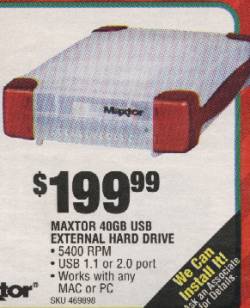
The Circuit City ad to the right appeared in the
Sunday
csd doesn't know that chip set is used in We have made inquiries about how the Cypress EZ-USB-FX2 USB 2 8052-based chip is coming. The documentation of USB and even 2.0 is very good. |
Firewire wdm
interfaces
Sunday February 3, 2002 08:22
1394 Cypress EZ-USB-FX-like peripheral-side microcontrollers seem hard to find.
Texas Instruments builds the TUSB5152 1 80C52 part which is somewhat similar to the Cypress EZ-USB-FX.
TI, however, appears to be pushing its ARM products more than the 5152.
1394 is going to have problems, unlike USB, getting PC motherboard real estate.
Putting USB and/or 1394 on a pci or cardbus card is not that spiffy of a solution.
Reason is that a non-Microsoft driver will have to support the card. It's much better to let Microsoft do the USB 2.0 driver work! Which Microsoft is doing! Tuesday January 29, 2002 07:59
| Burning up the house
PREVIEW Demo to highlight FireWire-based home networking AT CES, WHICH STARTS NEXT WEEK in Las Vegas, home-connectivity enthusiasts will get their first look at how the IEEE 1394 (FireWire) interface can link entertainment and computing clusters around the home. The demo, hosted by Texas Instruments in a “connected house” on the show floor, will highlight one of the primary benefits of the I 394b revision of the FireWire standard: long-distance cable runs. Using 1 394b, consumers will be able to string category-5 cable on runs as long as 100 meters. Although 1 394b supports top speeds of 800 and 1600 Mbits/sec, data rates at such distances will be limited to 100 Mbits/sec. Still, that speed proves sufficient even for demanding applications such as carrying multiple high-resolution video streams. Moreover, the links will provide consumers with access to any content anywhere in the house by linking high-speed 1394 clusters in the living room, home office, and other rooms. TI’s demo will highlight a growing number of new consumer products that feature 1394a (the original FireWire), which tops out at 400 Mbits/sec. In addition to digital camcorders, the ranks of FireWire-enabled products now include upwards of a dozen new HDTV sets, digital high-definition VCRs, and digital set-top boxes from the likes of Mitsubishi and Sony. Moreover, consumer-targeted PCs increasingly support the speedy connection. TI believes that 1394 will be the perfect backbone for the home network. Already, you can run computer-centric Intemet-protocol traffic over 1394 simultaneously with isochronous multimedia traffic. The backward-compatible 1394b links can connect clusters that contain existing 1394a products, new 1394b products, or a mix of both. The TI demo will highlight the company’s previously announced I 394b chip. Expect the first 1 394b products to appear on store shelves for the 2002 holiday season.
iJacking The hottest 1394-enabled peripheral going isApple's iPod digital music player. Pundits have praised its 5-Gbyte disk drive, but what really sets the device apart from other players is its speedy 1394 port, which allows transfer of music files at hard-disk speeds. And with 1394 support growing in the Windows camp, many PC users are coveting the iPod. By the time this issue mails, such people may be able to hijack an iPod for use with Windows. Their weapon in the crime will be Mediafour’s Windows XPlay software, which was earlier known—to Apple’s displeasure—as XPod. The beta release of the program is expected to cost less than $40. PC users will be limited to using music in the MP3 format, rather than alternatives like Windows Media Audio. However, as covered In this month’s feature on audio codecs (see”Flying hi-fi,” pg 40), MP3 is by far the most popular format anyway. Moreover, the voluminous 5-Gbyte disk in the iPod makes a more efficient coding scheme far less important. The interesting aspect of iPod becoming a viable option for PC users will be how many iPods Apple can deliver once the available market explodes. At the $400 price point, Apple can’t be making much money on the iPod due to the cost of its 1.8-inch disk drive. Indeed, Apple may not want a bigger market in the short term. commVerge 2002.01 |
There is no question USB ports are on all new PC motherboards.
Legacy free motherboard have 4 USB ports and no serial or parallel ports!
The future of 1394 is a bit uncertain when it comes to a port on the motherboard. A pci/cardbus card is a poor second choice.
Intel is a USB founder so 1394 may have some problems.
Even Sony now uses USB in its digital cameras. Friday February 1, 2002 07:09
COMMENT Dan Devine 1394: Sunshine on a Cloudy Day THE SEMICONDUCTOR industry has experienced one of its cloudiest years ever. Yet a few glimmering rays of sunshine have poked through the gloom. One of those rays is IEEE 1394 technology. Known as Fire Wire in Apple Computer products and i.Link in Sony offerings, IEEE 1394a is a digital data transport serial bus standard used for transporting data at speeds up to 400Mbits/sec. The next generation of 1394 technology, known as 1394b, will increase data speeds to 800Mbits/sec. and beyond while enabling connectivity over longer distances (up to 100 meters) between PCs and consumer electronics devices. 1394b also provides for optical media as a transport vehicle. In the 1394a arena, the market, applications and support of key industry players are coalescing to form the foundation for growth. Specifically, the 1394a market is real and here now. 1394a has been the common high-speed interface on digital video camcorders for years. And market interest in this application continues to gain momentum. Digital camcorders allow digital video editing. In this process, the camcorder creates streaming video that is then downloaded to a PC where it can be stored, edited and sent to another user’s computer or burned onto a CD or DVD disc. Digital video editing is a great consumer application because people can easily create professional quality home movies and short videos that are easily transmitted to friends and relatives far away. Simply put, you can’t do digital video editing without IEEE 1394a technology. Other 1394a applications include high-performance scanners and portable hard drives. Today, most 1394-enabled PCs provide this interface via peripheral component interconnect (PCI) add-in cards, and most of these are high-end PCs. Although a PCI card is a viable way to quickly and easily add IEEE 1394a to a PC, it is costly compared to designing the IEEE 1394a device onto the motherboard. It can cost approximately 50 percent less to implement 1394a directly on a PC motherboard compared with providing IEEE 1394a technology in a PC via an add-in card. PC manufacturers should be planning to equip the motherboards of new PCs with an IEEE 1394a device from the low- to high-end to address customer satisfaction and loyalty concerns. Imagine buying a new PC today that lacks PCI or IEEE 1394a. Within the next year, you decide to buy a digital camcorder (prices of which are dropping) and you find your new PC is already obsolete because it can’t be used with your new camcorder. You would probably be an unhappy customer and unlikely to buy that brand of PC the next time. By equipping all their new PCs with IEEE 1394a capabilities, PC manufacturers provide consumers with the latest technology they are likely to need until it’s time for their next PC. Digital video editing growth projections underscore the great potential of this market. By the end of 2002, Cahners In-Stat Group estimates that more than 30 million digital video cameras will have been sold. That number is expected to increase to more than 70 million by 2005. (Cahners In-Stat Group is owned by Cahners Business Information, the parent company of Electronic News.) PC manufacturers should also know that many recent industry developments boost support and momentum for embedding IEEE 1394a technology directly onto PC motherboards. Intel Corp. demonstrated its support for using IEEE 1394a technology on its new PC motherboard (concept PC) called Hannacroix at Comdex this past November. Microsoft Corp. announced support of IEEE 1394a in the company’s Windows family of operating systems, including Windows XP. Apple Computer Inc. blazed the path for IEEE 1394a market acceptance as the original developer of the technology. And Apple continues to push rapid and widespread use of IEEE 1394a technology with its operating system. William Shakespeare once wrote, “What’s in a name?” To the semiconductor industry I ask: “What’s in a number?” The answer is 1394. Last year, more than 35 million PC-based and consumer electronics products were equipped with 1394, according to Cahners In-Stat Group. And that number is expected to surpass 200 million by the year 2005. So as this industry continues to endure mostly cloudy skies, it can draw inspiration from the ongoing and recent momentum of the 1394 market. The market is crystallizing. The applications are known. And industry support is unwavering. It’s time to make 1394 a bigger number than it already is. Dan Devine is the global marketing manager for Agere System’s 1394 and USB products. He can be reached at [email protected].
Electronic News January 28, 2002
www.electronicnews.com Struggling Agere will close two more plants and lay off another 300 By Charles J. Murray PARK RIDGE, ILL. — Agere Systems Inc., the troubled communications giant that was spun off from Lucent Technologies Inc. a little over a year ago, said last week that it plans to close two plants in Pennsylvania and to sell one in Florida over the next 12 to 18 months. Facilities in Reading and Breinigsville, Pa., will be shut down, and the ICs and optoelectronics operations from those plants will be moved to the company’s headquarters in Allentown, Pa. The plants, which employ about 1,600 and 1,100, respectively, will reduce their workforces by about 300 people. The company also said that it is seeking a buyer for its wafer fabrication facility in Orlando, Fla. Agere executives hope to workout a deal in which that facility’s 1,100 employees would be absorbed by the new owner. An Agere spokeswoman said that the company will pare some optoelectronics products that “are not leading-edge,” but would not say what those might be. In addition, Agere hopes to act as a customer of the Orlando wafer fab, obtaining products from the new owner, she said. The company said it has had discussions with several potential buyers. Poor timing Agere executives said the moves are being made as part of an effort to bring the struggling company to profitability. Industry analysts said that Agere’s troubles are partially a result of bad timing. “It’s challenging enough to deal with a downturn in any situation,” said Joseph Byrne, communications semiconductor analyst for GartnerDataquest (San Jose, Calif.). “But to deal with it while you are going through a spin-off and reorganization makes it much harder.” Agere was spun off from Lucent Technologies in December 2000. It then struggled through a difficult initial public offering in March 2001, in which the new company raised less capital than its executives had hoped. Since that time, the company has fought to stay afloat. In April, Agere said it would lay off 2,000 employees; in July, it said it would cut nearly a quarter of its 16,500 workers; then in December it targeted another 950 employees. “Nearly every major supplier of communications chips has suffered a severe downturn this past year,” Byrne said. “Especially hard hit have been the companies with the greater exposure to the WAN and carrier markets. Agere is just one of them.” The company also said last week that its revenue for the quarter ended Dec. 31 totaled $537 million, down approximately 61 percent from the year- ago period. Industry analysts said that the coming year may be better for Agere and others in communications chips. “2002 will be better because inventories that were built up in 2000 have already been worked off,” Byrne said. “But the outlook is still very muted and cautious.” Electronic Engineering Times January 28, 2002 www.eet.com |
From csd's perspective both USB and 1394 offer a far-superior method of communication over a PC's two serial and one parallel[1284] port. Both supply power to a peripheral. Both are much faster.
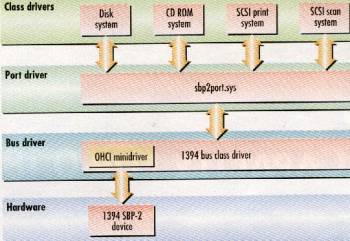
Most important, however, is that Microsoft already supplies drivers for 1394 and usb. The driver writer merely must write, then get working, an app interface to the Microsoft class drivers.
But you may have to upgrade to XP to get USB 2,0 support.
csd is purchasing a Maxtor 20 gig 7,200 disk for XP in a few minutes at Office Depot for $79!
Most challenging is implementing either 1394 or USB 2.0 protocol on the peripheral microcontroller!
Because of the high-speed of both buses and multiple endpoints, much of the peripheral protocol software can be handled within the wdm driver. This simplifies the peripheral microcontroller software. Friday July 27, 2001 07:23
CONVERGENCE The Historic Battle of 1394 Agere abandons USB 2.0 for 1394b
BY STEVEN FYFFE The escalating conflict between the IEEE 1394 andUSB standards is about more than just technology—it’s about ideology. “It’s like Mac vs. PC,” said Dan Harmon, connectivity peripherals marketing manager at Texas Instruments Inc. And the growing discord carries all the historic undertones of Apple’s holier-than-thou war against the IBM and Wintel (Microsoft and Intel)-led PC mainstream. USB has a master-to-slave architecture where the PC runs the show and the peripheral devices obey. In contrast, IEEE 1394—Fire Wire to Apple and i.Link to Sony—takes a peer-to-peer approach, where more intelligent peripherals negotiate to decide which device is most capable of controlling the bus. The emerging battleground is the digital home of the future. “It’s really about the bigger issue of how the architecture of a home environment is set up,” said Bob Merritt, director of emerging markets at Semico Research Corp., Scottsdale, Ariz. “That is the battleground. “USB 2.0 basically assumes there is a PC in the middle of the network that takes care of all the arbitration functions. The group that likes the PC structure, such as Intel and Microsoft, prefers the philosophical idea of having a PC in the middle of the network because that’s a critical spot. “(IEEE) 1394 does not require a PC in the middle to arbitrate bus conflicts. The group that is not PC-oriented is coming from the video and home entertainment area, such as Sony, and they like the idea that they don’t have to deal with a PC, and they like the idea of peer to peer. “In the home of the future, you will have a data network within a house. The question is whether the devices that you attach to are going to report to a PC... or whether you will be able to attach things at random, and the bus structure will be sophisticated enough to handle new devices coming onto the bus without having a hierarchical structure.” The Historical Perspective In the beginning, the two standards were supposed to peacefully coexist at separate ends of the bit-speed spectrum, with USB handling low-bit-rate devices, such as keyboards, and 1394 taking care of high-bandwidth consumer devices, such as digital camcorders. But now those two areas are starting to overlap. The USB 2.0 specification takes USB from l2Mbits/sec. up to 480Mbits/sec., which is actually faster than current 1394 products that run at around 400Mbits/sec. The Institute of Electrical and Electronics Engineers (IEEE) is still working on the next-generation 1394b specification that promises to speed the technology up to 3 2Gbits/sec. But even that won’t eliminate the overlap with USB 2.0. As more common ground appears, the battle lines are becoming clearer. The USB camp suffered a public defection last week when Allentown, Pa.-based Agere Systems Inc. announced it was dropping plans to release two USB 2.0 chips and focussing instead on speeding its 1394b Agere’s decision was not a vote of no-confidence in the future of USB, said Sujal Shah, marketing director for the computer I/O business unit at Agere (nyse: AGR/A). “Resources are limited and we can’t necessarily invest in every technology,” Shah said. “I don’t think this was a statement that we believe one of the technologies is going to win out over the other. We are looking at the areas where Agere needs to grow and how that plays into our strategy.” Others companies, such as Dallas-based TI, are hedging their bets. “We believe you should build both and let the market decide what the mix is versus choosing one over the other,” said TI’s Harmon. “There will be 1394 and there will be USB coexisting on the PC platforms and consumer electronics platforms, and the need for peripherals to support both those standards. I was very surprised with (Agere’s) announcement.” The increased competitive overlap between the two technologies is mirrored within TI (nyse: TXN). Internal divisions that used to deal separately with USB and 1394 were recently merged, Harmon said. “Initially we had multiple people calling on the same customers promoting competing technologies,” he said. “What we as department leadership realized was that it did not make good sense for supporting our customers, so we reorganized along vertical equipment lines. “From a technological standpoint USB and 1394 are going to compete. Storage is a prime example. You are going to go to your electronics store of choice and sitting on the shelf right next to each other will be a 1394 external hard drive and a USB external hard drive. “Storage is probably the largest gray area. Next, would-be scanners, and printers might also fall into that area.” More set-top box makers are considering incorporating 1394 alongside USB, said Vahe Akay, vice president of marketing at Santa Clara, Calif.-based Tvia Inc. “The cost of 1394, whether it is the licenses or royalties or device development, has come down significantly,” Akay said. “Most of the people in the set-top box and Internet appliance world today are using USB, but in the next 12 months, there will be more of the same OEMs incorporating 1394 at the same time, or in the same box as USB.” But in the PC space, 1394 faces an uphill battle. Earlier generations of USB are already finnly entrenched there, and Intel Corp. is offering to give USB 2.0 away for free with forthcoming chipsets. The Intel (nasdaq: INTC) factor was probably a big consideration in Agere’s decision to pull out of the USB 2.0 market, said David Murray, vice president of marketing at Irvine, Calif.-based TransDimension Inc. He was part of the team at Compaq Computer Corp. that helped develop the original USB specification. “Agere probably just said, ‘By the time we get our stuff out in decent volumes, Intel is going to have their stuff out and the market is going to be limited,”’ Murray said. “At some point you have got to say you can’t be everything to everybody. The market for 1394 might be small overall, but the market for Agere might be bigger, because in the PC space Intel is going to integrate (USB 2.0) for free and have the ability to give that away for free to PC OEMs.” Inside Intel, the company claims to be split along ideological and product lines, though there is little doubt it is betting more heavily on USB. “Intel is behind both technologies for different application purposes,” said Jason Ziller, technology initiatives manager at Santa Clara, Calif.-based Intel and chairman of the USB Implementers Forum. “USB chipsets are shipping in the first half of next year, and we expect that to be the primary connection to PC peripherals.” Intel’s main goal in supporting USB is selling more CPUs, according to Bert McComas, principal analyst at InQuest Market Research, Gilbert, Ariz. “Intel is not interested in anything where the PC is not the master,” McComas said. “Everything else is a slave and has the intelligence ripped out of it so the PC can do all the thinking. “If you have to use your PC to get the digital video out of your camera, then you are likely to want to do something with it on your PC. The more people Intel gets doing that, the more CPUs they are going to sell. Their reasoning all lines up to that. They would rather see USB than 1394.” So do peripherals want to think for themselves? Or would they prefer to be told what to do? Maybe one day we will find out. Until then, market forces look set to decide the politics of peripherals. Electronic News July 23, 2001 http://www.e-insite.net/electronicnews/ |
An Apple computer proponent stated on Monday that Apple hasn't achieved the success with iLink/Firewire/1394 it had hoped. Therefore, Apple is now promoting USB 2.0 over 1394.
Sony, a big fan of 1394, is now selling digital camera with USB connectivity. Tuesday December 11, 2001 16:41
The Circuit City ad to the right appeared in the
Sunday
csd doesn't know that chip set is used in We have made inquiries about how the Cypress EZ-USB-FX2 USB 2 8052-based chip is coming. The documentation of USB and even 2.0 is very good. |
Csd hasn't tried its wdm drivers on XP yet. Snider's states
Windows XP operating system, which provide new and unprecedented levels of 1394 support.
Csd speculates that support for USB 1.1 and maybe 2 is included with XP. This will be big incentive to move from 98/2000 to XP! Thursday December 20, 2001 15:16
IN THE LINE OF FIREWIRE JAMES SNIDER 1394: Home for the Holidays TWO YEARS AGO, THE LIST of consumer electronics and computer products equipped with the 1394 serial bus was short enough for a paragraph or two. Today, despite the temporary lull in the markets, that list is impressively long. It’s worth taking a look again with the holidays imminent. Sony Corp.’s PlayStation 2 game console was, thanks to its precursor, already popular and fully equipped with 1394, providing a new level of competitiveness. Everyone knows about that one. A later addition to the 1394 list is Apple Computer Inc.’s iPod, a 5Gbyte MP3 player that can keep 1,000 pieces of music with a l60Kbit per sec. compression rate in one place; it can also function like a hard drive. Its 10-hour battery and compact 6.5-ounce package, coupled with its FireWire — what Apple calls 1394 — make it as innovative as anything that has come along this year. Introduced in October, the iPod is lifting consumer electronics spirits in time for the holiday season. Next on a holiday wish list is a new PC or notebook. All of the major PC makers, including Dell, Gateway, HP, Compaq, Sony and Apple, now include 1394- enabled PCs in their portfolios. And this year, Microsoft Corp. weighed in with its Windows XP operating system, which provide new and unprecedented levels of 1394 support. Next stop: 1394 storage. All kinds of new storage devices came on the market this season, as the 1394 standard finally gained recognition for one of its greatest strengths. Maxtor announced an 80Gbyte 1394 drive, the Personal Storage 3000DV, with a 7,200rpm mechanism. CMS Peripherals is still celebrating its Comdex “Best of Show Award” for its 100Gbyte Automatic Backup Solutions (ABS) line of external storage solutions. USM Telecommunications has its Disk-On-The-Go mobile storage solutions, and QPS introduced a 120Gbyte portable Que! M3 ultraslim drive and a 32X CD-RW drive. And let’s not forget the DVDs such as the Alera Technologies Cruiser DVD+RW. Also new this year is 1394- equipped digital HDTV. Sets from Sony and Matsushita are ready now. Samsung, which demonstrated an early model, is also ready for the early adopter. Prices are coming down quickly. Including the 1394 bus in the FIDTV allows the user to record and play shows or movies by linking the HDTV set with a similarly equipped set-top box. (There are lots of those coming to the market now, too). Don’t be fooled into thinking the Digital Video Interface, or DVI, will do all the things that 1394 will in these HDTVs and set-top boxes. It won’t. Other advanced consumer electronics systems represent upgraded and enhanced versions of original 1394-equipped digital cameras and camcorders. The 1394 bus first emerged in digital cameras and camcorders back in late 1995. Now, all new cameras and camcorders include it. This year’s models are fast, efficient and smaller than ever. Canon’s mini-DV line of digital camcorders — described as so versatile it’s capable of taking both still and moving pictures — has a single 1394 cable for editing, copying or recording with seemingly no loss of image or sound quality. The market has no lack of products with a traditional 1394 strength: digital video authoring, editing and playback. Ravisent’s iDVD suite, introduced at Fall Comdex, simplifies DVD and video CD editing, authoring, burning and playback of home video from a desktop PC. Some predicted 1394 would be limited to these digital video systems. But they’ve been proved wrong, as 1394-enabled audio products are coming from all over the world now. These include CD changers, such as one from Pioneer; music synthesizers and audio amplifiers from Yamaha; and a prototype CD- RW from Philips, which combines audio playback, audio record and control signals, all along a single 1394 wire. The 2001 product list goes on and on, and so too does the list of 1394-equipped prototypes. At Fall Comdex, Intel Corp. announced its Hannacroix motherboard, a vehicle to demonstrate many technologies Intel hopes to see in future PCs. In Hannacroix, Intel supports both its own USB 2.0 and IEEE 1394- a for connecting devices such as digital cameras, MP3 players, network cards and hard disks. IEEE 1394 is going to be moving ahead in 2002 when 1394-b — faster, with more bandwidth and cable length an easier to design with — reaches the market. James Snider is the executive director of the 1394 Trade Association, www.1394ta.org Electronic News December 17, 2001 www.electronicnews.com |
TigerDirect sells FireWire to PCI bus adapter cards for 3 or 6 ports
and a dual port cardbus notebooks.
1
We expect FireWire chips to be included on a PC motherboard soon.
Monday May 5, 2000 09:29
| Chip suppliers look at methods to design
1394b
By MARK HACHMAN A new method to implement the next-generation IEEE 1394b interface may return the technology the PC, dramatically escalating sales of the supporting components. Presenters at the Windows Hardware Engineering Conference 2000 (WinHEC) in New Orleans week asked chip suppliers to develop a PIL-OP method of designing 1394b chips. The a approach won public support but as yet no product endorsements from Intel Corp., which cut the 1394a implementation from its chipset road map more than two years ago. Behind the scenes, vendors are jockeying for position. The 1394b specification is in the final stage of ratification, but companies like Lucent Technologies Inc. have had 1394b device silicon for years and are waiting for final approval to bring their chips to market. The suggested method is similar to the approach Intel has endorsed to separate the digital and analog portions of PC audio in its Audio Codec ‘97 (AC’97) specification. Intel and other companies believe that a 1394b implementation should include a digital PHY Integrated Link, potentially integrate into the chipset, and a Fan-Out PHY (FOP), a separate chip that could be built onto the motherboard or external devices to allow backward-compatibility with the existing 1394a standard. “It’s the only method to implement 1394 on the PC,” said Steve Bard, a member of Intel’s Mobil Computing Group. Although declining to comment on production plans, he said Intel remains committed to 1394 on the PC and will help to support the technology through software, design engineering, and other services. IEEE 1394a has become the de facto interface for consumer electronics, and Apple Computer Inc. whose “FireWire” technology formed the basis for the industry-standard IEEE 1394 specification, has made IEEE 1394a a key component of its iMac digital-video-editing stations. Dell Computer Corp. sells a similar product a part of its Dimension PC line, but uses a dedicated IEEE 1394 add-on card to minimize cost. But 1394 has not taken off on the PC because no current PC chipset integrates it, forcing 1394-enabled PC designers to pay a higher bill of materials. “IEEE 1394 contains both analog and digital, and PC-core-logic designers absolutely hate analog technology,” said Michael Johas Teener, chief technical officer at Zayante Inc., formed when Apple’s FireWire team departed almost en masse when the company declined to develop the technology. Furthermore, two different connectors were designated for PC and consumer-electronic devices, he said. Dell, for example, has chosen to use a IEEE 1394 add-on card because no current PC chipset includes 1394 technology, and ruled out buying motherboards with a discrete 1394 chip as well. “We always look at ‘take rates,”’ Dell’s term for the rate at which customers buy PCs fitted with a new technology, said Brian Zucker, technology evangelist at Dell’s small-business and consumer group. ... EBN MAY 1, 2000 http://www.ebnonline.com/ |
The role of quality wdm drivers which are binary compatible between Windows 98 and 2000 are critical to success of 1394 communications. Monday May 5, 2000 09:45
| IN THE LINE OF FIREWIRE
KEVIN LYNCH The PC in the 1394 Peer-to-Peer World Allentown, Pa. TODAY’S PC IS GOING TO have to get comfortable with not being the master of the consumer electronics universe. The evolution of the peer-to-peer consumer electronics market- place allows camcorders to talk to television sets, digital cameras to talk to printers, and other transactions to take place that can be more conveniently carried on without having to find a PC to insert in the middle As applications evolve, we will see groups of 1394-enabled devices hooked together in a cluster, with each node on the cluster requiring a minimum set of “smarts.” In this scenario, each node will need a minimal knowledge base. These peer-to-peer clusters an themselves a new vision of distributed computing. Historically, distributed processing tried to break up a big problem and distribute it to multiple computers. The new generation brings together processing elements for functions and applications never before possible. In this brave new world, ways for a cluster to solve a problem will evolve, creating building blocks that allow nodes to communicate on a very low level while connecting with each other. The ways to cluster, performed largely through software will only evolve after these block are deployed to the market. The first requirement is that all nodes in a cluster gain the fundamental elements necessary for distributed computing: processing capability, a library supplying distributed services, and a set of policies to discover one another and interact. This discovery process is at work behind the scenes in today’s 1394-enabled devices, including consumer electronics and computer peripherals. When someone buys a new device, installing it in a 1394 cluster is as easy as plugging it in: the device announces its presence over the 1394 interface. The next stage, initiating a salutation function, requires a set of policies and mechanisms that needs the distributed computing services. These services are brand new and many devices are not yet able to execute them well. Bluetooth, a wireless technology that provides a discovery process built into the specification, is a good example. Using this discovery-process mechanism, devices can recognize that another device is nearby and software can offer the user services and utility based on the interaction. Through a common language the devices recognize each other and announce their intentions and/or capabilities. For example, a digital camera coming into proximity with a printer might announce, “I want to print.” The printer, in return, announces, “I can print,” and the transaction can take place. Today’s PC can simplify and enable a variety of functions that are too complex or too expensive to include in today’s 1394 devices. With the PC as a partner with the other devices in today’s 1394 cluster, the desired job can be executed most efficiently and a device entering the 1394 cluster can extend the range of its functionality. For example, a PC can act as an agent providing distributed processing functions such as the cluster salutation in addition to application and storage capabilities. For example, Jini connection technology, developed by Sun Microsystems, helps in that it harnesses the required elements for distributed computing. A library of services that can be used by Java programs, Jini supports casual interaction and potential temporary connections between devices. For example, when a camera and printer both support Java plus Jini, the camera can send a subroutine to the printer that will ensure that the camera’s data, no matter what its original format, is understood by the printer in a format it can print. The printer’s Java environment directs it to feed the picture into the Jini-supplied subroutine for reformatting. The combination of Jini services and a 1394 interface fulfills the fundamental requirement for distributed peer-to-peer processing. In this scenario, the PC is in the background, not where the action is. The hardware needed to support Java and Jini is becoming more and more affordable. This will lead to the adoption of distributed computing practices and policies. Once this happens, the PC should evolve from the center of the action to an invaluable partner and catalyst in distributed computing. Eventually there will be enough horsepower in every device to satisfy the minimum distributed-computing requirements. Then the PC’s role will change again. Stay tuned. Kevin Lynch is a strategist in the Computer Products division at Lucent Technologies Microelectronics Group based in Allentown, Pa. In the Line of FireWire appears monthly in Electronic News. ELECTRONIC NEWS April 24, 2000 |
wdm drivers are known for their simplicity and speed.
wdm drivers described in Fierstein's 1394 promotion are very complex and costly to develop. Saturday April 29, 2000 11:24
Applications keep expanding for 1394
BY SCOTT FIERSTEIN The 1394 bus is a low-cost high-performance, 100 percent digital serial connection for digital audio-visual devices, consume: PCs and home networks. It is the digital interface of choice for the transmission of digital audio-visual data for the consumer electronics industry with adoption by such products as digital set-top boxes, digital TV and digital VCR. With 400 Mbits/second commonly used today 1394 is increasingly being adopted by PC manufacturers for peripheral interfacing. Currently eight out of the top 10 PC OEMs offer products with 1394. Over 20 million 1394-enabled end products have shipped through 1999, led by camcorder and PC systems. As the base of 1394 products expands, the specification continues to become more robust and to deliver even higher band width. With 800-1600 Mbits/s becoming available by the end of 2000, it is well ahead of the current bandwidth requirements. By achieving these data rates, 1394 can also expand into internal system interconnect sockets for products such as disk drives. Long-haul (100 meters) versions of 1394 are also being developed for multiple cable mediums (i.e. plastic and glass optical fiber and Cat 5). Finally an extensive infrastructure of application protocols are already supported by 1394 for PC peripherals, peer-to-peer audio/video transmission and control, as well as Internet Protocols. Collectively, these capabilities position 1394 as the convergence mechanism for consumer PCs, consumer CE devices and home networks. 1394 is a network solution that is available now that offers high speed, ease of use and low cost. The 1394 Trade Association has enrolled over 150 member companies. The development infrastructure is already in place and as more end products become 1394 enabled, the consumer will experience the strength of 1394, ‘connecting diverse systems with one network.”
As early as 1986, Apple Computer, Hewlett-Packard Co., Intel Corp. National Semiconductor Corp. and others were investigating new serial technologies for next-generation computers, and thus the 1394 digital high-performance serial bus standard was conceived. The first specification was completed in 1987 and described an interface that ran at 1 Mbit/s and was intended to connect printers, scanners and external storage devices to computers. Over time, the standard evolved to include support for isochronous devices (e.g., cameras) and higher data rates (up to 400 Mbits/s). The 1394 Trade Association was for med in the fall 1994 to further the development of the technology. With the goal in mind to bring about an open specification that was governed by an industry-recognized standards body, the trade association was successful in supporting the IEEE’s ratification of the 1394 specification in December 1995. Though the initial target devices for l394 were PC peripherals, the consumer electronics industry proved to he the early adopters. In the mid-1990s the consumer electronics industry decided to go digital and it selected 1394 as the digital interface that would let it do that. As a consequence, the new digital generation of camcorders, TVs, VCRs, set-top boxes and audio products are implementing 1394 today. Digital camcorders were the first 1394 products to enter the market in the fall of 1995. Today, 1394-enabled camcorders are shipping from Sony Corp., JVC, Canon Inc., Sharp Corp. and Panasonic. In fact, according to industry insiders, 2000 will be the last year that new camcorders are produced without 1394. The target for many of these A/V companies is the 2000 Summer Olympic games. In the computer industry there are 1394-enabled PCs from Apple Computer (G4s and iMacs), Compaq Computer Corp. (several models of the Presario), Sony (in every PC and notebook), Gateway 2000 Inc. (five models of notebooks) and NEC Corp. as well as several PCs and notebooks in Japan from Epson Co. Ltd., Sharp, Panasonic and Fujitsu Ltd. Off-the-shelf mother- boards, PCI add-in cards and PC Cards are shipping today. Core chip-set manufacturers are integrating 1394 into their solutions and are expected to ship in 2000. In 1999, 8 million computers shipped with 1394, but this is just the beginning. In 2000, many more PC makers will ship 1394 models, with estimates of total PC adoption rates of 40 percent for desktop PCs and even higher for portables. With support for PC peripherals in the Microsoft Windows 98 Second Edition operating systems, Windows Millennium Edition (Windows Me), and Windows 2000, along with Apple’s Mac OS, peripheral devices are rapidly showing up in the market. PC peripherals including scanners, printers, external storage and desktop cameras are shipping today. The work of literally hundreds of engineers has, over the last five years created a massive amount of supporting infrastructure for 1394. At the simplest Level, the IEEE 1394 specification describes how to send information between two devices. The hard part is defining all the higher level protocols that use the connections to do useful things. There are standards and specifications for virtually every type of consumer electronic device. There are printing protocols, scanner protocols and disk protocols, among many others, to handle the “traditional’ PC peripherals. There are standards for providing content protection over 1394. 1394 provides excellent support for Internet Protocol. New standards like Universal Plug and Play (UPnP and HAVi (Home Andio/Video interoperability) make networks easier than ever to construct. UPnP allows devices to describe capabilities in a declarative fashion using XML and export user interfaces in HTML. Relying on these two Internet technologies makes constructing UPnP devices easy for systems designers, and removes the need for users to configure individual devices or add device drivers to systems. In contrast, HAVi allows the product designer to export user interfaces and driver-like control code written in Java to recipient devices. Although different in approach, both UPuP and HAVi will simplest the configuration of connectivity between 1394 devices for customers. The existing and potential uses fox 1394 span a wide range of applications. As a consequence, it is hard to say that any particular applications arc the targets for 1394. This makes for a very exciting future. As 1394 continues to proliferate, die extended network of diverse end equipment will expand even further. Below is an abbreviated list of where 1394 is being used: • Laptops, PCs, workstations and servers; • PC peripherals; • Consumer electronics and AV home networking • Telecom/networking; Automotive and industrial; • Audio visual home networking backbone. 1394 can support any mix of these applications simultaneously, and this versatility comes from the standards rich feature set. 1394 is a multipseed technology currently running at 100, 200 and 400 Mbits/s, Next-generation silicon that allows speeds up to 800 Mbits/s is currently sampling. The latest version of the standard (13941,) doesn’t stop there however, as it also provides the frame-work for fully backward-compatible 1.6-Gbit and 3.2.-Gbit implementations. 1394 not only supports higher speeds but also provides the capability to transmit over longer distances. The current standard recommends a maximum cable length of 4.5 meters. The 1394b standard extends those distanees by supporting optical cable lengths of 50 meters for plastic optical fiber and 100 meters for glass optical fiber and hard polymer clad, as well as 100-Mbit/s operation over lengths of up to l00m on Cat 5. The capability to transmit data over these extended distances positions 1394 as the home-networking, high-bandwidth solution. 1394 provides for real-time data transfer that is called isochronous data transmission and guarantees bandwidth. 1394 combines this with excellent support for asynchronous transmission, which efficiently exploits all remaining bandwidth and provides guaranteed delivery. The standard is a peer-to-peer technology, so PCs can talk to each other and peripheral devices can send data to each other without going through the PC. That is critical for use in consumer electronic devices, as one would want the PC to be able to work with VCR and set-top box, without going through a PC. For example, digital camera makers are interested in sending images directly to a photo-quality printer without using the PC. This opens their market to people who do not own PCs or to people who would not know how to use the PC to make the connection from the digital camera to the printer.
The topology supports both daisy- chaining and branching. The simple rule is to find a port and plug in your device, with the restrictions of not forming a loop. The latest version of 1394 will automatically disable connections that make loops. A further restriction limits daisy chaining to not more than 17 devices. All 1394 devices are “hot plug-and-play” so the bus does not have to be power cycled after plugging in a new device and the PC doesn’t have to be rebooted. All 1394 devices act as peer-to-peer repeaters, removing the need for special devices such as hubs. A compelling advantage 1394 provides is power over the cable, so devices such as hard drives. desktop cameras and scanners do not require an additional power supply. Whereas other interfaces either provide no power or severely limit the amount of power supplied via the cable, most PC manufacturers today are providing from l2W to 24W of power over 1394. This eliminates the need for an external power brick for many devices, which not only reduces overall system cost, but also gets rid of the rats nest of wires plaguing today’s systems— most of which are power cords. Ideal read warrior It might seem strange, but the ability of 1394 to carry significant amounts of power also makes it ideal for the road-warrior who carries his/her portable and some extra peripheral devices. With 1394, the peripheral can be powered by the PC’s power supply or, in an emergency, the PC’s battery. This reduces the weight that has to be lugged around as well as the cost of the devices (no extra power brick to buy). To address the licensing issues surrounding 1394 intellectual property the industry has formed a 1394 patent pool. The patent pool is a collection of all the essential intellectual property that is required for 1394 implementation. Those companies with patents that are considered necessary and essential for the final implementation of 1394 have released their rights to the patents by submitting them to the 1394 patent pool. A 25 cent royalty is due for each system that is shipped and this is not a peer-port royalty. It is 25 cents per system regardless of how many ports, parts or nodes are included. This royalty is paid to the 1394 Licensing Authority(1394LA), which is the administrator of the 1394 patent pool. What’s with the name, 1394? That is the number of the IEEE standard that defines the technology. It is now being marketed under the brand names of FireWire (trademarked by Apple) and iLINK (trademarked by Sony). The 1394 peripherals and consumer electronics products that work on an iMac will also work on a Windows-based system. USB 2.0 is an excellent upgrade for current USB applications that need extra bandwidth. The end benefits of USB 2.0 sound similar to that of 1394: ease of use, PC peripheral interconnectivity and high bandwidth. Upon closer inspection, it becomes evident that the two technologies are fundamentally different and in different stages of development. Foremost to the discussion is the fact that 1394 is available and shipping today at 400 Mbits/s with the features mentioned above, and development is well under way for further capabilities. This provides a compelling reason for PC, PC peripheral and consumer electronics manufacturers to implement the interface in support of the legacy-free and ease-of-use initiatives being promoted by the industry and demanded by the end user USB 2.O is only now developing the transceiver functionality needed to send and transmit data between nodes, let alone the target and hub silicon devices that are needed to perform the basic network functions. Once device support is available, driver support is needed as well as the application protocol software required for specific end equipment. Consumer apps Basic consumer applications for USB 2.0 are not likely before mid-2001. USB 2.0 has only just finished defining the specification. Silicon will take a year to develop, debug, test and go into production. Software will take an additional year. In contrast, 1394 is fully supported by multiple versions of Apple, Microsoft and Linux operating systems. Further, 1394 has already achieved support for real-time AV transport, content protection and TCP/IP over 1394, let alone multiple demonstrations of wireless 1394 over lengths of 15 meters. In terms of network implementation, 1394 is designer-friendly. The peer-to-peer network capability minimizes design considerations as compared to the PC-centric hub network of USB 2.0.
ALSO CONTRIBUTING TO THIS ARTICLE WERE COLIN WHITBY-STEVENS, ZAYANT RANDALL
TROST, TEXAS INSTRUMENTS INC.; DAVID WOOTEN, COMPAQ COMPUTER CORP.; BOB MOSES,
DIGITAL HARMONY; AND DAVE SROKA, PHILIPS.
Eltectronic Engineering Times April 24, 2000 http://www.eet.com/ |
100, 200, and 4000 megabits/second. wdm drivers will be required on the PC side to connect to Windows 98/2000 Monday April 17, 2000 13:47
| High-Speed Products Target IEEE 1394 Fire wire
Applications
Three new devices—a PCI card for desktops, a PCMCIA CardBus card, and a 20-Gbyte external drive—have been designed for the emerging high-speed IEEE 1394 Firewire interface. As part of Evergreen Technologies’ fireLINE family of Firewire interface products, they afford- ably connect PCs, computer peripherals, and consumer electronics devices. “Evergreen’s fireLINE product family will offer technology on two levels, and at extremely affordable prices,” explains Mike Magee, president and CEO of Evergreen Technologies. “First we’re offering the 1394 connection—or port— for the many existing desktop and portable PCs without that port. Then, once consumers have the 1394 connection to take advantage of high-speed 1394 devices, Evergreen plans to offer a full line of high-performance 1394 devices, including external hard-disk drives, CD-RW drives (known as CD burners), and hard-disk Raid arrays.” Priced at $99 and $149 respectively, the PCI Card and the PCMCIA (Card- Bus) Card provide high-speed data communication between desktop and portable PCs, as well as up to 63 different computer peripherals and consumer electronic devices at a time. De- vices that operate with the 1394 interface may include digital cam- corders, CD-RWs, scanners, etc. The fireLINE connector cards allow consumers to transfer dense data, such as graphics files, large database files, spreadsheets, audio, and digital video, to their PCs with unparalleled speed. Digital video editing is one natural application for 1394 connections. Both of the fireLINE connector cards support Windows 98 and later operating systems. They also have hot-swap- ping and plug-and-play capabilities. The fireLINE PCI Card for desktops is equipped with one internal and three external IEEE 1394 connectors. It merely requires a standard available PCI slot in the desktop for installation. The PCMCIA Card for portables has two external IEEE 1394 connectors, and it only needs a type III-compliant PCMCIA slot and above (CardBus) for installation.
Evergreen Technologies Inc., 808 N.W. Buchanan Ave, Corvallis, OR 97330-6218;
(541) 757-0934; |