Alaska Trip
Itinerary
Tuesday April 30, 2002 07:23
Sunday
November10, 2002 20:14
Citizens
Meet marty ... and jake ... and the duck, too.
This is how we try to finance these neat trips.
We're so happy many of you have visited this site.
Dig this!
----- Original Message -----
From: Lynda Mapes
To: bill payne
Sent: Monday, November 04, 2002 9:35 AM
Subject: RE: Internet hits
You know, I have had more reaction to this story than anything I've ever written here. Thanks for the note. My only regret about that trip is that it wasn't LONGER. Lynda
Here's a link to some pictures from that trip.
This was a fun trip. We highly recommend it.
And remember.
Short time here, long time gone.
Delay is not a good idea.
Pat
Patty said we had to
give you confirmation on the Bellingham to Ketichan cabin.
We confirm.
It was 103 degress in Albuquerque yesterday. Cooler weather will be a change.
I like hot weather. Patty does not.
It will be interesting to see how
the Pacino
glasses work. Saturday June 1, 2002 09:12
Jacque Jehle
sent us the below article on the Alaska Ferries.
Jacque and Chuck Jelhe were our neighbors in Pullman,Wa. in the 1960s.
Bill talked to Pat of Alaska Ferries today.
We went over the itinerary. Bill asked about food aboard the ferries.
Both food and lounge facilities.
We talked about the possibility of a gas shortage or, at least, elevated prices between now and June 14. There is a real possibility of this. And other things too.
White ford gets about 12 mpg.
We have grey rabbit which does better.
Here's grey rabbit in the Tres Hermanas out side of Columbus, New Mexico
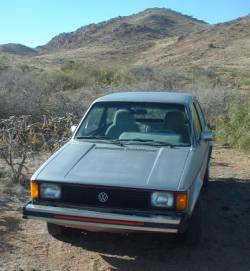
scene of the infamous March 9, 1916 invasion of the continental US in history. Until 9/11/2001, of course.
Taking grey rabbit to Alaska might be a bit gutsy. Along with repair manuals and lots of tools too. But Bill is not above this.
And white honda, with no ground clearance, which does lots better on gas mileage.
Then, of course, there is red pinarello.
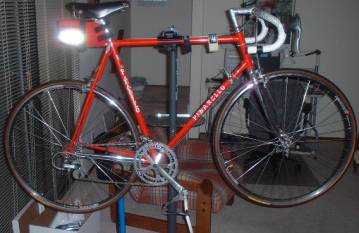
Which is getting tuned-up. Just in case.
Then, too, you can walk.
Remember. There is no such thing as a WWI!
Monday April 29, 2002
21:05
The
People's Cruise
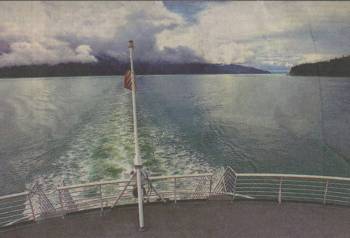
Story by Lynda Mapes Photos by Mark Harrison I opened my window to the perfume of the sea and drew the covers to my chin, snug for a night’s reading in my private cabin as the ferry, Taku, slid away from a Juneau dock, heading south for Wrangell. In the morning I discovered the window sill was just the right width for a cup of coffee. I sipped it slowly, watching the layered mists and seascape of Alaska’s Inside Passage unspool past my cabin window. Traveling southeast Alaska by ferry is of modern econcomy travel. It's the poor man's curise , a naturalist's delight, a perfect solace for an overburdened soul. I'm amaazed that something so cleve, so pleasant, so afordable and so eay to do has survived the misery of modern economy travel. A message under the clock on every ferry reads “Alaska time is ship’s time.” It’s true in several ways: the ferries feel like a safety zone from the modem world, a place to stroll, talk, read, picnic, lounge and dream while watching twining mists, the endless play of light on water and snowfields glimmer on the mountains. Beginning in Bellingham, the system’s southernmost port, the Alaska Marine Highway goes anywhere in Southeast Alaska that the luxury cruise ships do, and to many remote, unspoiled places they don’t. And the ferries run year-round. I used the boats last summer last summer to check out the tourist scene and totem poles in Ketchikan: see the Mendenhall Glacier and spawning sockeve in Juneau; explore ancient petrogrlyphs in Wringall and watch bears feasting on salmon at Anan Creek, on Alaska’s Cleveland Peninsula near Wrangell. I also got to know a number of fellow ferry travelers, a group as diverse as their destinations. We all had one thing in common: the desire to travel indpendent, without the rigid schedule or higher cost of cruise ship travel. Most of us combined float time with time in port, using buses, cabs, and taxis to get around. BEAUTY MINUTES AWAY I flew to Juneau from Seattle to begin my float trip, with an itinerary that would take me south first to Wrangell, then Ketchikan. My first day in Juneau surprised me. I didn’t realize Juneau offered so many easily accessible outdoor opportunities in addition to the amenities of a city. Five minutes by bus or taxi from the airport is the Mendenhall Glacier, the most visited in the world, and for very good reason. At the US Forest Service visitor center I watched chunks of calved glacier the blue of a Husky’s eyes bobbing in a cold sea dimpled with rain. The glacier, a river of ice, poured in frozen white ripples through the mountains to meet the water. A visitor center at the glacier is big
enough to handle the heavy traffic of the cruiseships.I found solitude on a trail that wound down to the water’s edge, with a clear view of the glacier. A live fish-cam trained on the spawning salmon in Steep Creek inspired me to take a trail to a viewing platform directly over the creek. Within minutes I found myself alone in a forest, seeing the first spawning salmoh of my life. The bright red heads of the spawning sockeye glowed in the green water, and their tails slapped furiously in the current. I was amazed at the sight and sound of thesefish, a five minute bus ride from the nearest MacDonald’s. This moment crystallized the beauty of ferry hopping in Southeast to me: The ferries and the tiniest bit of initiative reward the independent traveler with a richness of scenery, wildlife, and companionship, on the boats and off. I was able to see the glacier and spawning salinon without paying for a cruise ship ride or a helicopter flight seeing tour. After a succulent halibut dinner I headed to the ferry terminal to board the lovely Taku for a dreamy night sailing to Wrangell. WHALE OF A WAKE-UP People sleep everywhere on the ferries: in private cabins; in armchairs with footrests in the TV lounge and in the observation deck: stretched out on the carpeted floor; in the padded children’s play area; in deckchairs in the solarium and in tents they pitch in the bow, secured to the deck with duct tape. I had to wait until morning to meet some of my fellow travellers. Some were holed up in the writing lounge, gazing out the picture windows and writing in journals. Others strutted the deck or snoozed in deck chairs. Gordon and Sophie Jensen of Humboldt, South Dakota, told me that they were traveling through Alaska for seven weeks using the ferries for part of their journey. For two land-locked folks who run a farm-fertilizer company, the sight of humpback whales breaching off the ferry’s bow was a thrill. Sophie, 66, woke up most of the sleeping passengers in the observation deck with her yells of excitement when the whales shot out of the water just after daybreak. Gordon, 70, captured the whales on videotape. Herb Hasselbee, 67, a Maryland computer programmer, took the ferries to sight see and whale watch. He deliberately chose ferries over a tour by cruise ship. “I don’t like organized things, I like to do it myself. It’s the poor man’s cruise.” My sentiments exactly. A WALKING PLEASURE The Taku glided into Wrangell, a town of about 2,800 on an island 85 miles north of Ketchikan. There is no public transportation in Wrangell, but taxis and rental cars are available. Hotels are right by the dock, as is the town’s main street, with several restaurants. Wilderness outfitter and tour guides also have set up shop at the dock, making it easy to book car-free ferry adventure. Just walking through town is a pleasure. Pleople wave from their pick-ups take time to show you their favorite views. Evemngs, kids tool around the streets on bicycles and scooters. Wrangell resident Sylvia Ettefagh likes to say her town is so small no one needs to use turn sigtials. “Everyone alerady knows where you are going.” As the daylight lengthened I headed to Petroglyph Beach, a mile round,trip from the ferry dock. The late-afternoon light was perfect for viewing petroglyphs carved in black and grey rocks, scattered on the beach. The carvings are believed to date at least 1,000 years. The meaning of the more than 40 shapes of spirals, faces, whales, and fish is unknown. Are they territorial markers? Do they mark a birth or death or tell a story? Welcome returning salmon? The beach is delightfully without hype. There’s a collection of interpretative panels anita short flight of stairs to the beach, and then you are on your own. The petroglyphs are not arranged, labeled, cataloged or sign-posted. I found them myself, amid the barnacles, blue and lavender mussel shells and seaweed. The meaning of 1,000-year old Petroglyphs is unknown. Are they territorial markers? Do they mark a birth or death or tell a story? Welcome returning salmon? The beach was deserted, the sun low and warm. The tide quietly sorted beach stones salted with barnacles. GUIDE WITH GUNS On my second day in Wrangell I chartered a trip to the Anan Bear and Wildlife Observatory on a boat operated by Alaska Vista Tours. The first hint this trip would not be dull was our guide, Wrangell resident Terry Buness, who greeted us at the dock in the morning at the charterboat Kraken, packing a .44 magnum and a shotgun. Buness piloted us through glittering blue saltwater bound for Anan Creek, southeast of Wrangell on mainland Alaska’s Cleveland Peninsula, threading our way through the channels and islands of the emerald green Tongasa National forest. At $75 for the day, including the boat trip, it was a bargain. We hiked an easy, less-than-one-mile trail to the US Forest Service bear observatory over the lower Anan Creek Falls. Eagles called overhead and ravens carried on an intricate conversation of squawks and gurgling sounds. Salmon berries glowed red and yellow in the shafts of sun piercing the tree canopy, and shoulder-high devil’s club bristled with spines. Frisbee-sized pawprints, shredded skunk cabbbage and piles of bear scat by the trail let us know we had big company And it was easy to see why: Anan Creek’s abundant run of salmon, 213,000 strong last year and the third largest run of pinks in Southeast Alaska, thrashed up the rapids. Buness walked with his shotgun at the ready and magnum on his hip; we followed. The sweet smell of cedar and fir gave way to the stink of rotting salmon as we reached the banks of the creek, with an open-air observatory and camo-draped photo blind on one side. On the other side were the bears.
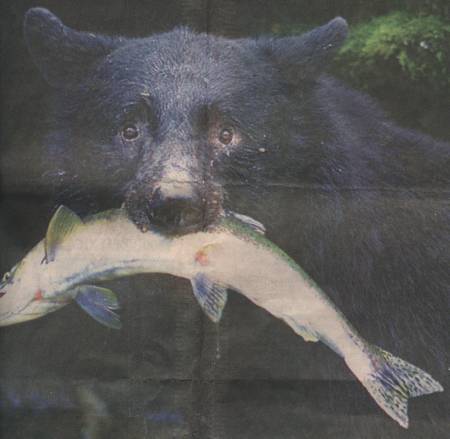
They shambled down the wooded hillside opposite the creek, then settled in at the creek’s edge, close enough for us to see their individual teeth and the ripple of their muscles. One bear slotted its rump into a creek-side. cave and lay there, its powerful jaws and paws poised over the creek to snag passing salmon without even having to get up. The bear plunged its snout into the water and came up with a silver salmon, chomping a crimson bite out of its back as the salmon thrashed desperately. A sow thrust her snout into the salmon beating their way up the current, her muzzle alive with a fish for two cubs by her side. She climbed to a flat rock after the cubs ate, washed the fish slime from their faces with herm tongue, then rolled on her back back and cradles them against her masive chest as they nursed. I watched the bearsfor hours, sharing the viewing platform and blind with fewer than a dozen otberpeople. Back on the Kraken, Buness motored to a whitewater river, to show us sockeye salmon milling at its mouth, their long, powerful bodies thick as a thich as a thigh finning in the current. ENTERING PASSENGERS The stars were shining in a perfect night sky swirling with nothern lights as the Kennicott slides to the dock at Wrangell, en route to Ketchikan. The newest in the fleet, with an acoustica1 tile ceiling, brutal fluorescent lighting and loud carpeting, the ferry felt like a cross betwen the office and acheap casino. My cabin was a utilitarian cubical with none of the TAKU's little hideaway. The reading light over the bed was the harshest 1've seen since my last hospital stay. The walls were so thin when the guy in the next cabin rolled over in bed, I felt the wall cuve. Kind creepy. And I know it was a guy because heard his every cough. Up at ap to pack for a 5:45 a.m. arrival in Ketchican I found an espresso machine in the gallery. I atumbled back to my room and encountred the ship's staff banging on passeger's doorrs to roust them to disembark. Working on the ferries is never dull, said crewmeinber David Kimberley. In thtee years afloat, Kimberley said he's seen it all. Naked European sunbathers in the solarisium; stowaways who bed down on piles of dirty linen in the laundry; an amorous couple unaware they were providing a very X-rated view through the sunroof of their dome for the e entire dining room in the deck above. "Passengers make our trip very interesting," Kimberly said. I'm getting material for my novel while I work." Consider Daniel Born, 25, and her companion Tim Ciosek, also 25, whom I met on the Ketchikan ferry route. Brown fingered her necklace of bird bones and trade beads, collected on a remote British Columbia beach midway through her summer-long exploration of the coast by kayak with Ciosek. Eating breakfast in the dining room of the, ferry, they told of battling storms, bears and the huge wakes of cruise ships that sent them paddling to the shore for safety. Ciosek said he liked mooning the big boats from the beach. Brown, who'd never been in a kayak before the trip' said she found the head of a bear carcass on a beach and mailed it home to her mother in Ohio, with a note asking her to bleach it and save it for her. TOURISTS EVERYWHERE As we docked in Ketchikan I knew right away we were in for a different kind of time than we spent at Wrangell. One huge cruise ship had already docked and several more were to arrive that day. By noon, the downtown docks were teeming with people as thick as the salmon in Anan Creek. Ketchikan can see its population jump by half on a busy cruise-ship day. "I don't want all these other people in my picture," wailed a cruise ship tourist on the packed boardwalk of Creek Street, the city's historic district, crammed with tourists walking four abreast from gift shop to gift shop. They grazed the gold nuggets and tiny bottles of fireweed honey and packed into Dolly's House, a restored brothel quite infamous in its day. It wasn’t any quieter on the water, with seaplanes maring off from the Tongass Narrows arid tourists lined up on the bridge over Ketchican Creek shoulder to shoulder, fishing for hatchery. Floating abover it all was the yodeling of actors inThe Great Alaskan Lumberjack Show, re-enacting feats of logging daring-do a stone’s throw from the Creek Street tourist district. I preferred the totem park at Saxman Native Village, three miles south of town. Ringed by 26 totems gathered from around Southeast Alaska, it felt like an oasis of quiet and authenticity after the crowds and kitsch of the downtown dock. I walked the park wondering at the the faces, animals, and spirit-creatures rendered in weathered wood sprouting ferns and moss. Some of the totems are more than 100 years old. Ketchikan is a totem lover’s city, with original and modern poles as well as replicas of ancient carvings to see throughout town. Inside a carving shed at Saxman I met Nathan Jackson, a prominent Tlingit artist. Jackson carved some of the landmark totems in Seattle, and created the totem designs caste in bronze manhole covers in Seattle’s streets. Jackson’s warm welcome, his calm, take-your-time storytelling, the fresh cedar curls on the floor, and the well-used hand tools on the work benches felt more like the real Alaska I’d made this trip to see. To me, Ketchikan was more dominantly flavored by the cruise-ship industry than Juneau, where I began my ferry trip through Southeast. But in ten days of ferry travel, I had only one regret: I wished I had scheduled more time to cruise on the boats with no destination at all, for the pure pleasure of the voyage. Lynda Mapes can be reached at 206-464-2736. E-mail: [email protected]. The Seattle Times Sunday March 11, 2001 |
Friday April 26, 2002 20:56
Nathan
Nice to see you and your Afghan hound, Charlie, yesterday afternoon.
You said the Chartruese Pixee lures worked best in Alaska.
Here's the pixee lure selction I see at Cabela's

Which ones are the Chartruese ones?
I can't disount the explanation of color blind.
Since you worked at Sandia labs and now work at Kirtland, I will lend you a copy of the infamous Swiss Radio International Hans Buehler tape.
Meet Laszlo. Hans and Ahmad. John Young. Orlin 1 2. Ted. and Bill 1. We all like to do interesting things.
Your friends may be interested in listening to it too. Please feel free to copy.
Lots of dead kids here.
Keep up-wind
Thursday April 25, 2002 16:11 7
Pat
I just talked to Nathan. His sister lives in Homer.
Here's her motor home bumper sticker.
Homer, Alaska
Nathan said he'd review this itinerary. And help me select the right pixee fishing lures for salmon.
What happens if we have no gas by the summer?
Thanks for your help again.
Please check itinerary to make sure all is okay.
We're going to bring 1972 White Ford on Alaska trip.
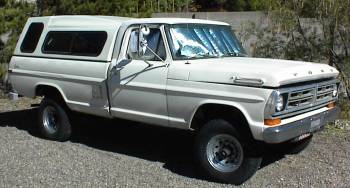
Along with lots of tools, of course.
I really like this computer stuff 1 2 3
Here's Patty and Bill on June 9, 1962.
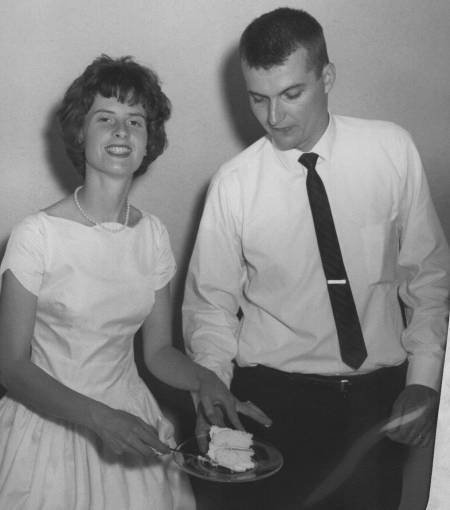
This is my retirement trip. I'll be 65 on June 11, 2002. Allah willing, of course.
I really need this
trip! Fighting with the feds for 10 years has been a strain ... particular on
them.
Morales and I are having a pretty good time.
In the summer of 1955 I worked in Alaska. I stayed at the home of the late senator Gorsuch on Turnigan arm.
I met victims of the McCarthy era who got fired from their University jobs and ended-up in Alaska.
Mrs Gorsuch introduced me to them. Hey, this is happening again!
bill
To and from Alaska Wednesday April 24, 2002 07:57
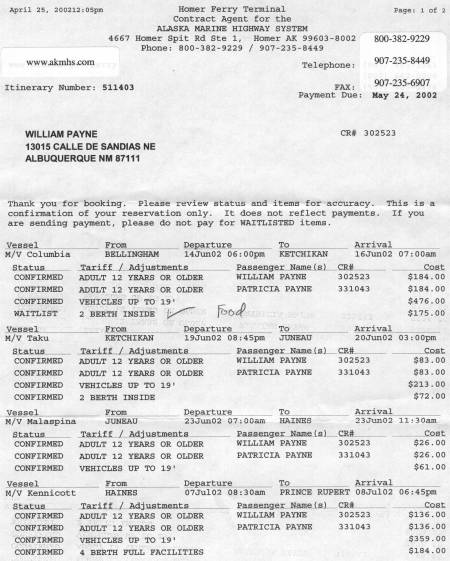
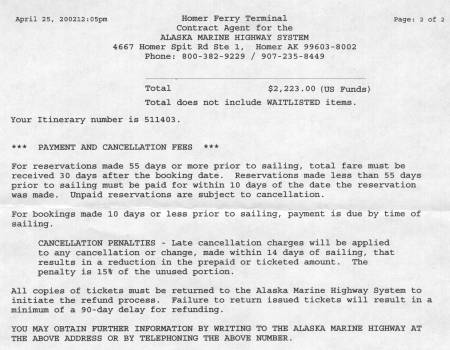
| Alaska Trip 4/25/02 1:21 PM Alaska Ferries 800 382 9229 William and Patricia Payne Pat in Homer $1408 payment due 24th of May to Alaska. Columbia Leave bellingham Friday June 14, 2002 6 pm 3 pm check-in No cabins available - Will take first available ____________________________________________________________ Taku Leave Ketchikan Wednesday June 19 8:45 pm check in 6:45
pm Passenger Ketchikan and Juneau will cost $83.00 for Adult
(12+) ____________________________________________________________ Malaspina Leave Juneau Sunday June 23 7:00 am check-in 5 am Juneau and Haines will cost $26.00 for Adult (12+) each Sunday June 23 ____________________________________________________________ Kennecott Leave Haines Sunday July 7 8:30 am check-in 6:30 am $136 passenger |