Explaination
- The OSI Model stands for the �Open Systems Interconnectivity� Model. A reference model for networking protocol to develop standards for Data Networking, which facilitates multivendor equipment interoperability.
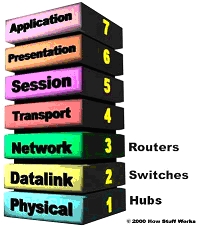 A situation arose in the early days of networking, that many different vendors sold various types of hardware or software. That could not speak/ connect to each other.
So� the ISO (International Standards Organisation), set about to produce a standard that everybody could use.
Hence the OSI Model.
The model has 7 Layers, Physical, Datalink, Network, Transport, Session, Presentation and Application. (1-7).
A situation arose in the early days of networking, that many different vendors sold various types of hardware or software. That could not speak/ connect to each other.
So� the ISO (International Standards Organisation), set about to produce a standard that everybody could use.
Hence the OSI Model.
The model has 7 Layers, Physical, Datalink, Network, Transport, Session, Presentation and Application. (1-7).
A good acronym for remembering this model is, "Please Do Not Throw Sausage Pizza Away" (Bottom Up)
Or "All People Seem To Need Data Processing" (Top Down)
Each layer has its own function and is governed by separate Protocols (guidelines)
See OSI Protocol Relationship table
The Application Layer
The Apllication Layer supports the components that deal with the communicating aspects of an application. This is the layer closest to the user, supports transfer of information between users, applications programs and devices. Protocols at this layer deal with specific applications for example e-mails (MIME - Multipurpose Internet Mail Extensions).
Other Protocols include
SMTP - Simple Mail Transfer Protocol
POP - Post Office Protocol
FTP - File Transfer Protocol
DNs - Domain Name Service
The Presentation Layer
The Presentation layer deals with the syntax, or grammatical rules, needed for communication between two computers. The Presentation layer converts system-specific data from the Application layer into a common, machine-independent format that will support a more standardized design for lower protocol layers.
The Presentation layer also attends to other details of data formatting, such as data encryption and data compression.
The Session Layer
The Session layer, manages dialogs between two computers by establishing, managing, and terminating communications. The Session layer also can incorporate protocols to resume dialogs that have been interrupted. After a formal dialog has been established, devices recognize a lost connection whenever the connection has not been formally released. Therefore, a device realizes that a connection has been lost when the device fails to receive an expected acknowledgment or data transmission.
The Transport Layer
The Transport layer can implement procedures to ensure the reliable delivery of messages to their destination devices. The term �reliable� does not mean that errors cannot occur; instead, it means that if errors occur, they are detected. If errors such as lost data are detected, the Transport layer either requests retransmission or notifies upper-layer protocols so that they can take corrective action.
The Transport layer enables upper-layer protocols to interface with the network but hides the complexities of network operation from them. Among its functions, the Transport layer breaks large messages into segments suitable for network delivery.
The Network Layer
The Network layer handles communication with devices on logically separate networks that are connected to form internetworks. Because internetworks can be large and can be constructed of different types of networks, the Network layer utilizes routing algorithms that guide packets from their source to their destination networks. For more about routing and routing algorithms, see Chapter 6.
Within the Network layer, each network in the internetwork is assigned a network address that is used to route packets. The Network layer manages the process of addressing and delivering packets on complex networks.
The Data Link Layer
The Data Link layer receives messages, called frames, from upper layers. A primary function of the Data Link layer is to disassemble these frames into bits for transmission and then to reconstruct the frames from the bits received.
The Data Link layer has other functions as well, such as addressing, error control, and flow control for a single link between network devices.
The IEEE 802 standard divides the Data Link layer into two sublayers:
Media Access Control (MAC). The MAC sublayer controls the means by which multiple devices share the same media channel. This includes contention methods and other media access details. The MAC layer also provides addressing information for communication between network devices.
Logical Link Control (LLC). The LLC sublayer establishes and maintains links between communicating devices
The Physical Layer
Although the OSI Physical layer does not define the media used, this layer is concerned with all aspects of transmitting and receiving data on the network media. Specifically, the Physical layer is concerned with transmitting and receiving bits. This layer defines several key characteristics of the physical network, including the following:
Physical structure of the network (physical topology)
Mechanical and electrical specifications for using the medium (not the medium itself)
Bit transmission encoding and timing
Although the Physical layer does not define the physical medium, it defines clear requirements that the medium must meet. These specifications differ depending on the physical medium. Ethernet for UTP, for example, has different Physical layer specifications from coaxial Ethernet
|
|



