Explaination
- So our data begins its journey across the LAN (Local Area Network), this would be fine if the message you are sending was the only one on the network.
This is not so the success of networks depends on their capability to handle large volumes of traffic, travelling both up and down the cables.
Because of this you get Contention or collisions of signals, to put it another way picture a cable as a very narrow road and our messages as two cars travelling down this road in opposite direction, starting at either end.
Somewhere near the middle (depending on the time they started their journey), they will meet.
Unable to pass the passengers or message they carry will not complete their journey.
To try and alleviate this we have CSMA/CD or CSMA/CA both are forms of Contention Protocols.
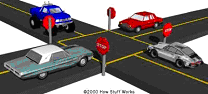
Imagine that each vehicle is a packet of data waiting
For an opportunity to continue on its trip.
CSMA/CD
Carrier Sense Multiple Access / Collision Detection, when a collision occurs, the devices involved cease transmission and resend sometime latter. In order to avoid the same collision happening again, each device involved is made to wait a random time period (we are talking milliseconds here not days).
If a number of retries prove to be unsuccessful, an error message will be reported to the user.
CSMA/CA
To try and improve on CSMA/CD we use Carrier Sense Multiple Access / Collision Avoidance.
The device checks or Polls to see if the route is clear, but unlike the CSMA/CD above CSMA/CA checks its path twice. Once to see if the path is free and a second time before it finally sends its data.
�The Greater the Traffic, The Higher the Frequency of Collisions�
When sending our messages, we may choose several options on the way we send it; these options are categorised by the terms, �Unicast�, �Multicast� and �Broadcast�.
Unicast
A Unicast is a transmission from one node addressed specifically to another node.
Multicast
This is when a node sends a packet addressed to a special group address. Devices that are interested in this group register to receive packets addressed to the group. An example might be sending a message to a particular department at work.
Broadcast
A Broadcast is exactly what it says, a node sends out a packet that is intended for transmission to all other nodes on the network.
|
|



