Unit 2.2
Networks
Some important background
Centralised Systems were the original networks. Because computers were
expensive companies bought one large central computer and many dumb terminals (with no processor), which used the processing power of the
central computer to do their work.
Dispersed Systems were phased in as computers became less expensive.
Each person had their own stand alone machine, with their own software etc.
Distributed Systems replaced dispersed systems because of the problems of having many separate computers
with their own software, data and peripherals.
Advantages of Networks over stand alone computers
* Networks allow data, software and peripherals to be shared.
* Good data integrity is more easily achieved in a network, since there is only one shared copy of each file.
* Networks allow easy and quick communication between users.
* Costs can be reduced, since only one peripheral eg printer can service many computers.
* Hard disk space can be shared
* Frequent data backups can be made.
Local Area Networks (LAN)
A LAN consists of a number of terminals which are close together (usualy in the same building).
These terminals are connected by cables.
There are several common topologies for local networks:
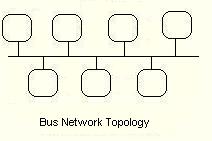
Bus Networks:
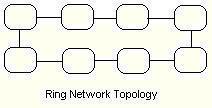
Ring Networks:
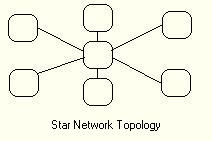
Star Networks:
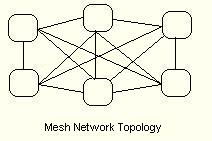
Mesh Networks:
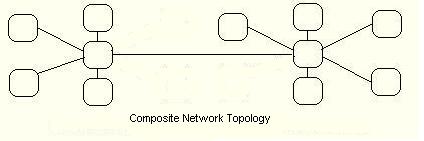
Composite Networks:
Wide Area Networks (WAN)
A Wide Area Network is a number of computer terminals connected over a large geographical area. The computers are connected by some sort of telecommunications link.
There are several types of telecommunications link:
Twisted Pair: Copper cable used in the telephone network.
Coaxial Cable: Well insulated cable that can transmit data at higher speed than copper wire.
Fibre optic cable: Transmits pulses of light, instead of electricity. This makes it faster than copper or coaxial.
Microwave:
Microwave stations cannot be more than 30 miles apart, because of the earth's curvature. Mobile phones use microwave radio links.
Satellite:
Signals are beamed to a geosynchronous satellite which then relays the signal to it's destination.
This is more effective than land based microwave stations, since a greater area is covered.
The best known WAN is the internet
Network Resources
There are several important network components that you need to know:
ISDN Adapter:
Modem: A modem is a Modulator/demodulator). An electronic device for converting between serial data from a computer and an audio signal suitable for transmission over telephone lines. In one scheme the audio signal is composed of silence (no data) or one of two frequencies representing 0 and 1.
Modems are distinguished primarily by the maximum baud rate they support. Baud rates can range from 75 (7.5K modems) baud up to 56000 (56K modems) and beyond.
Router: On the Internet, a router is a device or, in some cases, software in a computer, that determines the next network point to which a packet should be forwarded toward its destination. The router is connected to at least two networks and decides which way to send each information packet based on its current understanding of the state of the networks it is connected to. A router is located at any gateway (where one network meets another), including each Internet point-of-presence. A router is often included as part of a network switch.
A router may create or maintain a table of the available routes and their conditions and use this information along with distance and cost algorithms to determine the best route for a given packet. Typically, a packet may travel through a number of network points with routers before arriving at its destination.
Fibre Optic Cable: A plastic or glass (silicon dioxide) fibre no thicker than a human hair used to transmit information using infra-red or even visible light as the carrier (usually a laser).
Optical fibre is less susceptible to external noise than other transmission media, carries larger quantities of data and is cheaper to make than copper wire, but it is much more difficult to connect. Optical fibres are difficult to tamper with (to monitor or inject data in the middle of a connection), making them appropriate for secure communications.
Gateway: A gateway is a network point that acts as an entrance to another network. On the Internet, a node or stopping point can be either a gateway node or a host (end-point) node. Both the computers of Internet users and the computers that serve pages to users are host nodes. The computers that control traffic within your company's network or at your local Internet service provider (ISP) are gateway nodes.
Firewall: a firewall is a software or hardware barrier to keep destructive forces away from your data and programs. It filters the information coming through the Internet connection into your private network or computer system. If an incoming packet of information is flagged by the filters, it is not allowed through.
CD Server: A server which contains a CD drive which can be accessedd by any other authorised terminal on the network. This allows software to be installed from a single CD to any machine in the network.
Proxy Server: a proxy server is a server that acts as an intermediary between a workstation user and the Internet. It provides security, administrative control, and a caching service. A proxy server is associated with or part of a gateway server that separates the network from the outside network and a firewall server that protects the network from outside intrusion.
Hub: In general, a hub is the central part of a wheel where the spokes come together. The term is familiar to frequent fliers who travel through airport "hubs" to make connecting flights from one point to another. In data communications, a hub is a place of convergence where data arrives from one or more directions and is forwarded out in one or more other directions. A hub usually includes a switch of some kind. (And a product that is called a "switch" could usually be considered a hub as well.) The distinction seems to be that the hub is the place where data comes together and the switch is what determines how and where data is forwarded from the place where data comes together. Regarded in its switching aspects, a hub can also include a router.
Switch: In telecommunications, a switch is a network device that selects a path or circuit for sending a unit of data to its next destination. A switch may also include the function of the router, a device or program that can determine the route and specifically what adjacent network point the data should be sent to. In general, a switch is a simpler and faster mechanism than a router, which requires knowledge about the network and how to determine the route.
Bridge: In telecommunication networks, a bridge is a product that connects a local area network (LAN) to another local area network that uses the same protocol (for example, Ethernet or token ring). You can envision a bridge as being a device that decides whether a message from you to someone else is going to the local area network in your building or to someone on the local area network in the building across the street. A bridge examines each message on a LAN, "passing" those known to be within the same LAN, and forwarding those known to be on the other interconnected LAN (or LANs).