 |
| Hildegard von Bingen (1098-1179) |
 |
| Barbara Strozzi (1619-1677) |
 |
| Johann Sebastian Bach (1685-1750) |
| Wolfgang Amadeus Mozart (1756-1791) |
 |
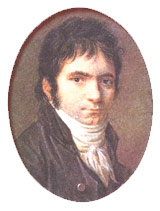 |
| Ludwig van Beethoven (1770-1827) |
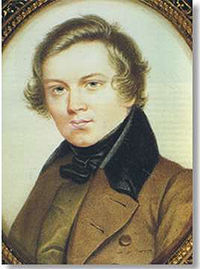 |
| Robert Schumann (1810-1856) |
| Franz Liszt (1811-1886) |
| Richard Wagner (1813-1883) |
| Johannes Brahms (1833-1897) |
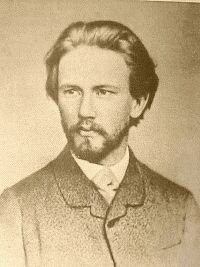 |
| Pyotr Ilyich Tchaikovsky (1840-1893) |
| Modest Mussorgsky (1839-1881) |
 |
| Charles Ives (1874-1954) |
 |
| Antonio Zacara da Teramo (ca. 1370-1415) |
| Meet the cast a dollop of historical information for the curious |
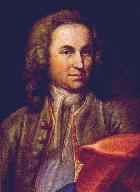
| Despite his current fame and popularity, Bach didn't leave posterity a ton of anecdotes as did some 19th-century composers. Reconstructing a sense of his personality has to rely on what he did leave: a ton of music and a ton of kids (20 with only 2 wives!). He was a smart kid, won a scholarship for school, picked the lock on his brother's music chest, always showed an interest in music. Of course for a Bach it was expected: his family's musical involvement went back five generations. After school, Bach got a job as organist and teacher in Arnstadt, getting into a street brawl after he insulted a bassoonist. He changed towns/jobs numerous times in his life (only changed wives once - because the first one died); although when trying to change jobs from Weimar to C�then, he was thrown in jail for demanding release from his contract. He finally settled in Leipzig, where he wrote a multi-movement cantata every week! Despite the hard work, Bach also seemed to be the family man, writing instructive musical works for his children, gathering music for his wife to play, and recruiting kids to help him copy parts. In general, his music betrays his spirituality, intellect, and sense of fun. |
 |
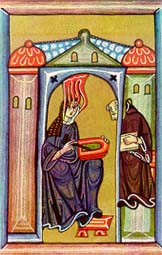
| Hildegard is usually listed as "saint, theologian, mystic, author, healer" with composer somewhere down the line. Artist should be in there as well - the painting here is a self portrait, illustrating her divine inspiration. Actually her divine visions began at age 3, but she never got around to telling anyone about them until years later. At 8 she went to an anchorage under a woman named Jutta, who gave her religious training. Thirty years later, she succeeded Jutta and became anchoress of the new convent. At age forty-two Hildegard had a vision of God, which she claimed allowed her to understand the meaning of religious texts. She received Papal approval for her writings Scivias. In addition to writing on religious topics and philosophy, hildegard penned two works more scientific in nature, covering topics as diverse as healing herbs to sex. Her famous musical/morality play Ordo Virtutum may have been performed by the women in the convent she established at Regensburg, thus the roles for 17 women (the virtues) and one man (the devil who can only grunt/yell). It is now generally recognized that her visions were owing to the migraines she suffered. In recent times Hilegard the visionary has received a revival in interest from new age groups. |
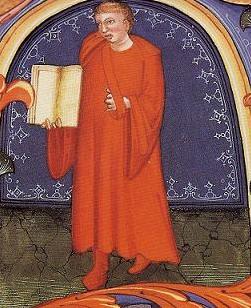
| Who? He lists his full name in episode 2, but that doesn't help you. Teramo is a small town just east of Rome, and from there Antonio somehow made it to the big city itself where he worked as papal scribe and member of the chapel. He was known for his singing and composing, but at least one document remarks that he was very short and had only ten digits between his hands and feet! (This portrait, from a contemporary manuscript, shows his unusual hands.) His secular and religious works also betray a certain disdain for regularity: his Latin ballata Sumite Karissimi includes tricky word games, and if Ciaramella boasts some of the bawdiest lyrics in the early period, it still doesn't beat his mass movement nicknamed the Credo Scabroso, which is based on one of his own secular songs. At the text "in carnatus est de Spiritu Sancto" Zacara inserts music from the song whose original lyrics translate to "I scratch like a mangy cur, but I have no scab." |
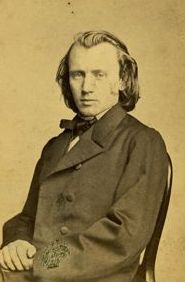
| Brahms's first biographer lays on the melodrama when writing of his early life: he was born in the slums of Hamburg, made fun of by other kids, and when the family ran out of money, he played piano in brothels. (Scholars debate the brothels, but they all agree that he always held very ambiguous views towards women, often stereotyping him as a bourgeois misogynist.) At 20 he escaped, on tour with a violinist, and he soon met the Schumanns. Robert declared him a genius "like Minerva sprung fully armored from the head of Kronos." But crisis came with Robert's suicide attempt and hospitalization- to help matters, Brahms fell madly in love with Clara (14 yrs older!). They never married, but remained friends for life. Brahms continued composing with jobs here and there, but his big breakthrough came with the premiere of his German Requiem in 1868. Now a star, he settled in Vienna and finally finished his first symphony in '76, which prompted Wagner to start writing angry diatribes against him. If always ironic, he turned downright grumpy in old age, still unmarried and displeased with the music world. Fortunately, he did not live to see what happened to music in the 20th century. |
| He might be your quintessential German Romantic. He was always interested in music, but his mother convinced him to study law. That lasted about a year before he quit and resolved to become a concert pianist. Unfortunately a strange hand injury (from a mechanical device he created) cut short his career before it began. Meanwhile he had fallen in love with Clara Wieck, his piano teacher's daughter, who did become a successful concert pianist. Her father objected: Robert was too old (9 years), a good-for-nothing composer, and he was just plain odd. The couple took the case to court and won, marrying in 1840. They lived happily, mostly - Robert composed all types of music and wrote in his journal Neue Zeitschrift f�r Musik (until 1844), and Clara continued her career as pianist and mom (7 kids!). But in 1854, Robert's mental condition, never stable, deteriorated and he tried to kill himself by jumping into the Rhine river. He was saved, but spent the last two years in an asylum. Clara never remarried. |
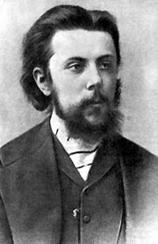
| Mussorgsky's parents called him Modest (an unusual Latinate name), in hopes that he would survive unlike their first two children, conventionally named Alexei. (His older brother Filaret also lived). The family was part of the Russian gentry, with some 27,000 acres to their name. Unfortunately the emancipation of the serfs in 1861 threw the family into such financial straits that Modest wound up working in the Forestry section of the Ministry of State Domains. He was always an outsider - even friends like Balakirev called him an idiot behind his back. But he was an avid reader and enjoyed philosophy -even conducted historical research for his opera Khovanshchina. His personality type may have been laid back and accomodating, but he was stubbornly original in his music. He was never famous in his day, and he lived poor and unmarried (scholars argue he was gay but there are no affairs of any kind on record). His one constant friend in life - alcohol - eventually got the better of him, and he died at 42. Luckily, his friends preserved his music and devoted their efforts to making it popular. |
| A Tchaikovsky biography could be subtitled "Pathetique," as is his last symphony. From his unhappy boarding school days to the death of his beloved mother when he was 14 to his lifelong struggle with homosexuality and mysterious death, Tchaik had had it tough. One of 6 children, he went into the civil service, living the carefree, nihilistic life. At 22 he joined the Russian Musical Society and began composing; within 3 years he was music theory prof at the Moscow Conservatory. He thought of marrying the soprano D�sir�e Art�t, but luckily she married another while on tour. During the 70s Tchaikovsky's reputation grew but so did his troubles: he married a former pupil - a crazy nymphomaniac who threatened suicide if he didn't. After 9 weeks he tried standing in a river in hopes of catching pneumonia. (He only got a cold.) They separated and Tchaikovsky found a savior in Natasha von Meck, a rich, lovestruck widow who patronized him - on condition that they never meet! He toured Europe conducting his works, but problems in the '80s: he found himself attracted to his teenaged nephew. Scholarly debate surrounds their relationship, and also Tchaik's death: did he catch cholera from unboiled water, or did he poison himself on the orders of a peer committee? Tragic in either case. |
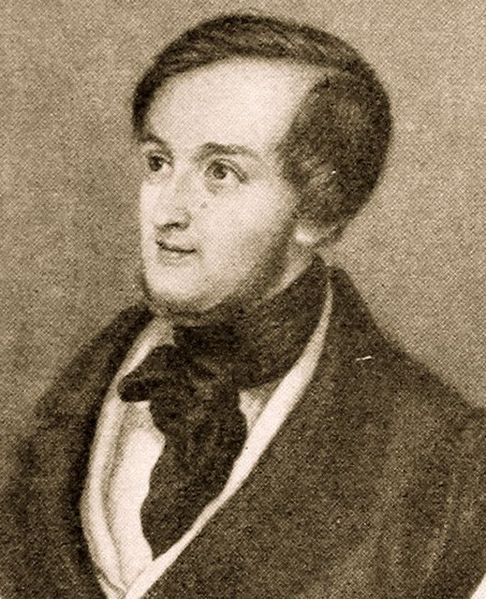
| Wagner led a long and adventure-filled life. At least he thought so - his autobiography is roughly 900 pages long. When he heard Beethoven's 9th symphony at 15, he decided to become a great composer. He never got significant formal training, and was not proficient at any instruments, but that never stopped him. In 1834 he married, and the couple moved from town to town running up debts as Wagner hoped one of his operas would make a hit. They settled in Dresden, but Wagner sided with the revolutionaries in 1848 and had to flee the cops! Hiding out in Z�rich for years, Wagner was free develop his philosophical ideas in writing. He also had an affair with Mathilde Wesendonck the wife of his patron, and was forced to leave. Meanwhile he and Liszt had formed the New German School, dedicated to freeing music from old forms like the symphony. Wagner worked on his music-drama tetrology (Der Ring Des Niebelungen) - his ideal of a total artwork - while he was patronized by Ludwig II of Bavaria through the '60s. He also divorced Minna and married Liszt's daughter Cosima (yet another scandal). For the Ring, he had a theater built in Bayreuth, and the work became a smash cult hit in 1876. Egotism, womanizing, anti-semitism aside, Wagner's influence on music history can't be denied. |
 |
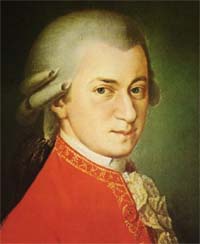
| Johannes Chrysostomus Wolfgangus Gottlieb (Amadeus) Mozart is often portrayed in pop culture as the eternal child. He had a good sense of humor, and an obsession with puzzles, word games, and all things scatalogical. A prodigy, Mozart toured Europe as a child and even proposed to Marie Antoinette while in France. Scholars argue that his childhood boughts of rheumatic fever returned and killed him at 35. But those 35 years were filled to the brim. Already composing as a child (wrote his first opera at 12), he worked under pressure from his careerist father and maintained a tense relationship with the man. In Salzburg young Mozart secured a job with the archbishop, until the man had him kicked out - literally, on the ass! Mozart meanwhile fell in love with a singer, but eventually wound up marrying her sister Constanze. In 1781 he moved to Vienna where he taught piano lessons and finally won a job at the court. The legend of Salieri poisoning him is not true, but he did endure resistance at the court from the Italian establishment. Mozart is credited with pioneering the modern piano concerto form, and for mastering music in all genres. |
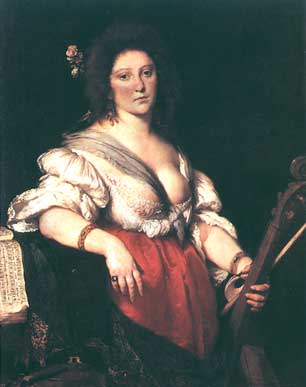
| The adopted (possibly illegitimate) daughter of 17th century poet and playwright Giulio Strozzi, Barbara studied music and and singing under Venetian master Francesco Cavalli. She was so successful in her singing career that Cavalli dedicated two books of songs to her, and she not only sang for the elite Accademia degli Unisoni, but also suggested the topics for which the men would debate. Barbara was also the composer of a number of dramatic songs, duets, and madrigals. Many of her solo pieces take ironic musical twists and turns that follow the Marinist conceits of her adopted father's poetry which she set. Although many of the songs are about love gained and lost, some are quite comical and make light of the follies of love (from a woman's point of view), especially her "Voglio si, vo cantar" from L'astratto. As we will see from the sitcom, Barbara is a spirited, quick witted woman whom we depict as a bit highly sexualized. Well, she did have four illegitimate children, what else would you expect? |
 |
| Charles Ives belongs in a category of his own when it comes to the world of composers. Most significantly, Ives was an insurance salesman, which means he was actually had money, unlike other musicians. Money provided Ives with the opportunity to compose music the way he wanted to, with lots of discordant sounds and polymeters. Many people wonder how Ives could have conceived of such music. We must look to his father for such an explanation. George E. Ives served as a bandmaster in the Civil War, and his sense of music was consequently affected. He taught young Charles to play each hand on the piano in a different key and to play each hand in a different meter. I think we all know what that led to! On a side note (no pun intended), Ives loved to support the younger avant-garde musicians. West-coast composer Henry Cowell held a place among Ives beneficiaries, that is until he was arrested for fellating another man, at which point Ives promptly cut him off. Hmmm |
 |
 |
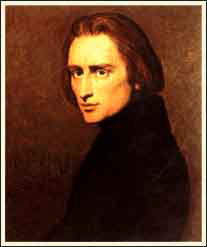
| Liszt is famous for his virtuosic piano playing and not so virtuous personal life. Rumours of his affairs were greatly exaggerated, though, and he had two long love affairs that defined much of his life. Young Liszt was recognized as a prodigy wherever he went; his father moved him from Hungary to Vienna for more training, and then to Paris where he took the city by storm, hailed as another Mozart. However after hearing Paganini he locked himself away to practice, emerging as the lean mean virtuouso known today. At 24 he ran away to Italy with Marie D'Agoult with whom he had three children. In the early 1840s he was the star of Europe and traveled everywhere, much to D'Agoult's dismay. After an unpleasant breakup he settled with the Russian princess Carolyne Sayn-Wittengstein in Weimar, where he conducted the orchestra and promoted Wagner operas, . His relationship with Wagner soured when Wagner began an affair with Liszt's married daughter Cosima. Liszt finally moved to Rome where he took minor orders and began writing more religious music. Though he continued teaching (once threatened by a gun-wielding student), he lived more peacefully at the end of his life, until a fall down the stairs gave him pain and hallucinations. His late experimental works are some of the most modern of the nineteenth century. |
| Want more information? Ask Naxos Main Episode One |
| Eh.. you already know about him... |