 |
|
|
|
|
|
|
|
|
|
|
|
|
|
|
|
|
|
|
|
|
|
|
|
|
|
|
|
|
|
|
|
|
|
|
|
|
|
|
|
|
|
|
|
|
|
|
|
|
|
|
|
|
|
|
|
School & Other Programs |
|
|
|
 |
|
|
|
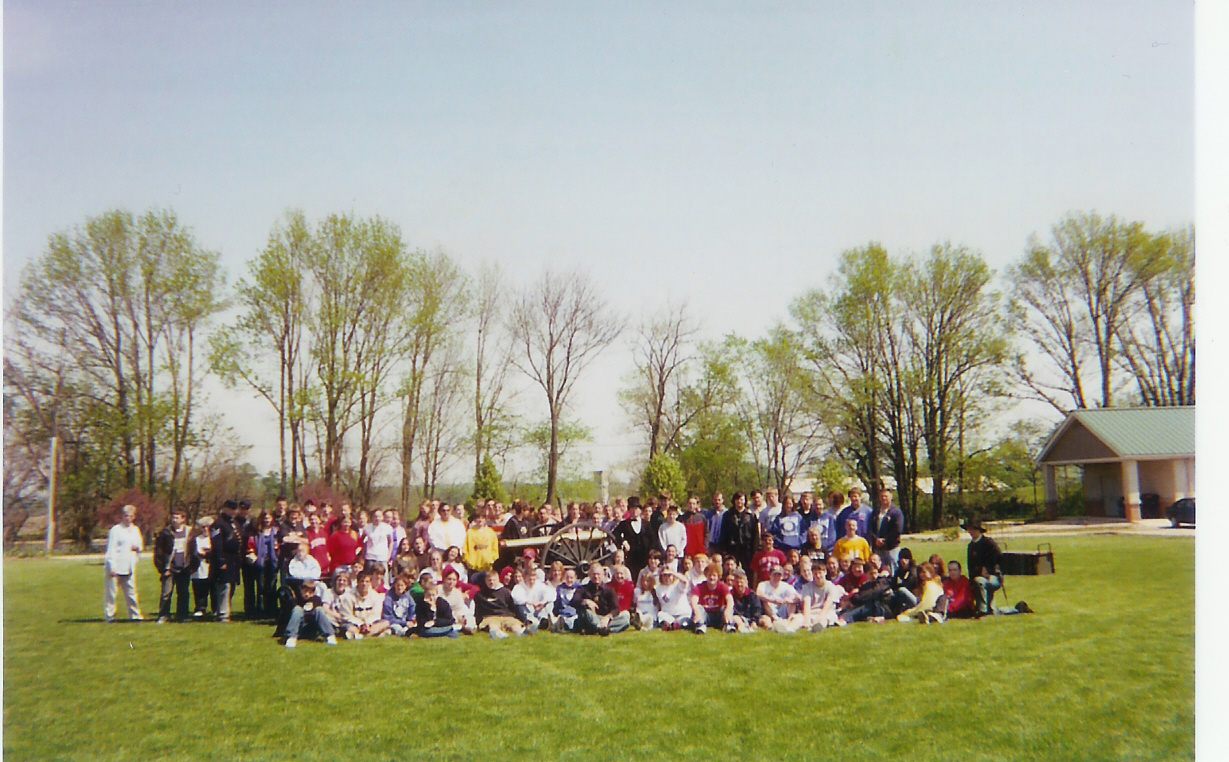
The 121st Ohio and the 8th Grade Class of Highland Middle School, Sparta, Oh. surround the James during a school program. |
|
|
|
One of the core missions of the 121st Ohio is the education of the public. To that, we are proud to offer a variety of programs, presentations and displays to the general public, especially to our local schools. With so many Civil War enthusiasts, who have spent years and decades researching the conflict, we have a lot of knowledge that you can not find in any single book. And with our personal experiences in reenacting, we can offer a unique perspective. We own many reproduction items for displays that allow for visual and hands-on learning. This page shows a few examples of what we can do for you. |
|
|
|
We appreciate that teachers don't always have the time or resources to offer their students a more in-depth study into the Civil War. That is why we have different programs to fit the needs of teachers and schools but still offer so much more than the average school book or even more in-depth projects. We come in full uniforms with equipment, weapons, and individual personal items that the soldiers carried that were not standard army issue.
Our focus is not on the war in general, that we leave to the teachers, but specifically on the life and experiences of the Ohio soldier. The topics we can cover are:
1. uniforms and how they changed over the course of the war,
2. weapons: how they were used and how the advancement in military technology made the war so devestating,
3. life in camp, which includes:
a. tents
b. rations & cooking
c. sanitation and disease
d. what they carried on the long haul (personal items, ect.)
e. pay, gambling and how they entertained themselves,
4. battle flags,
5. music,
6. army organization and tactics. |
|
|
 |
|
|
|
|
|
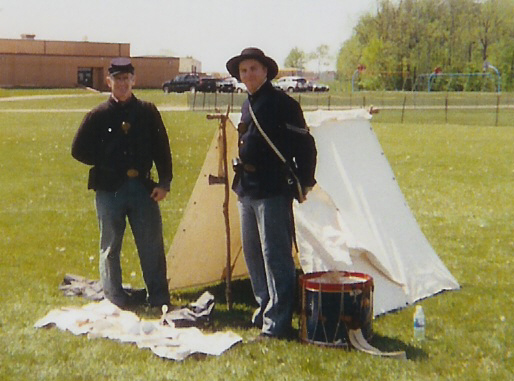
Mic Szabo & Jared Reagh stand at their station on "Camp Life." Highland Middle School, 2007. |
|
|
|
|
|
|
How much time can this all take? Well, that's up to you. We can fit into a single class period or we can be there the full day. Just remember: the less time you can give us, the less information we can give your students. Here are some presentations we have used for various needs. |
|
|
|
Straight Lecture: |
|
|
|
I guess that you call this our basic package. If you have a single group or are really restricted on time, this is the one you might consider. It takes only one to two reenactors, who come in to display their items and attempt to cover as much of the above as possible, again, focusing on the soldiers and not the war itself. Again, we will fit our presentation into your time schedule. |
|
|
|
The Time Line: |
|
|
|
The Time Line is very similar to the Straight Lecture, good for a single group and can be restricted within about a single class period. In this we bring about four reenactors, a presenter and three representing different periods of the army. We start with a pre-Civil War Regular Army soldier, and he, in what we call a first-person impression (acting as a person from that time), describes his uniform and equipment and then progress to Early War Ohio Militia and finally Mid to Late War soldier. This is generally more uniform and equipment focused, with fewer information about "camp life," but again, the less time we have the less information we can give you. |
|
|
|
The Round Robin: |
|
|
|
The Round Robin is probably our best school presentation, but it involves the most people and requires quite some time and cooperation on the part of the school. The students are divided into groups, generally by class, (but this is entirely up to you,) and rotate around to different stations. Each station has a particular focus, such as uniforms, weapons, camp life, ect., ect, and the group will move to one another until they have gone to each one. It's efficient and able to get a lot of information. The number of groups and what the stations are are up to you (though we will give our suggestions), but generally each station should have at least a standard class period. This generally uses the largest number of reenactors and sometimes the number of stations can be limited to the numbers we are able to achieve. |
|
|
|
 |
|
|
Infantry Additions |
|
|
|
|
|
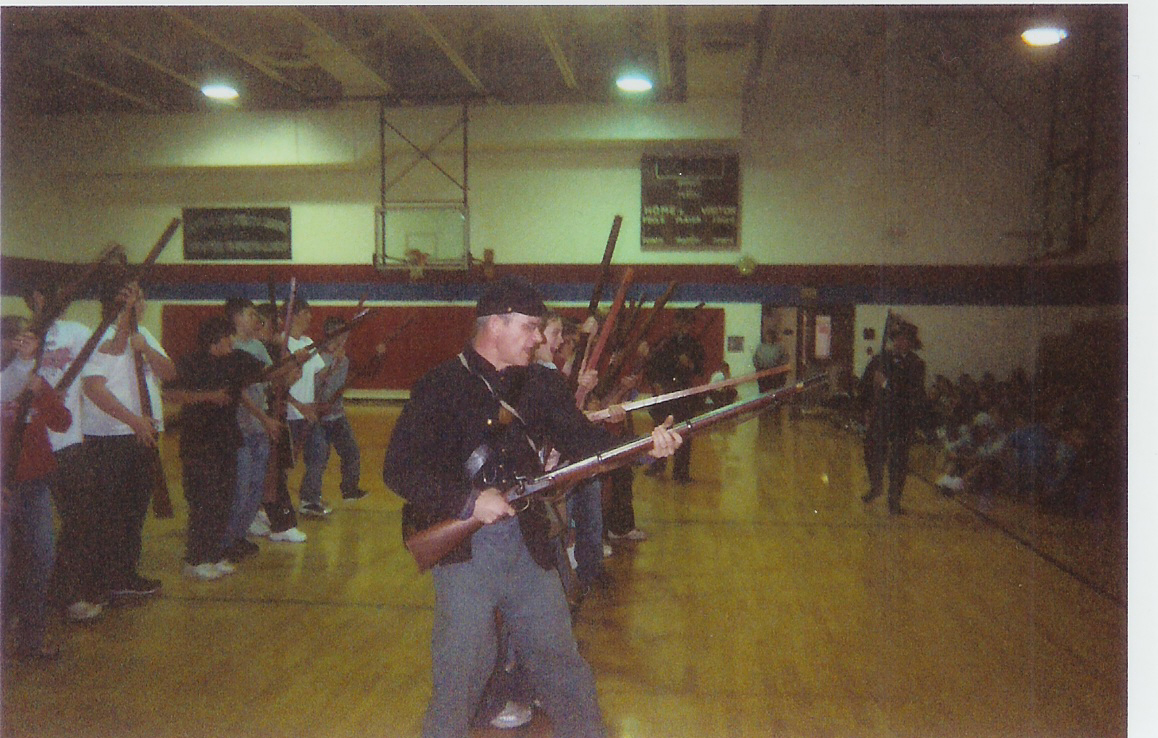
Some things can not be confined to inside the classroom, and with that we have infantry demonstrations that can futher show how the Civil War soldier was trained and operated on the field of battle. We perform the "School of the Soldier," and bayonet drill,which shows how the soldier was trained to handle and load his weapon. We have firing demonstrations to how the soldiers delivered their fire, as well as a comparison between the weapons used at the time and the weapons for which the tactics were developed. (We do need the cooperation of the school for any and all firing demonstrations.) |
|
|
|
|
|
We can also show how a company maneuvered on the field. Since we can get about five to six reenactors (remember: these are volunteers and these are the prime working hours) having us perform the company movements alone does not give anyone an idea how these troops marched and the formations they created. In this, we need some student participation. We have a couple dozen wooden replica muskets that we use for |
|
|
|
|
|
|
Students "charge bayonets" with our wooden muskets during a "School of the Soldier" drill. |
|
|
|
|
|
hand-to-hand demonstrations that students can use. (We only want students who are interested in performing the drill. We want no goof-offs or students who do not want to perform. We reserve the right to throw any student "out of the ranks.") We'll take the students first through the "School of the Soldier," and then through the different company formation used on the battlefield. We march them around in front of the other students, with our soldiers serving the posts of sergeants and corporals. These are things that the students will remember years after they have moved on. |
|
|
|
 |
|
|
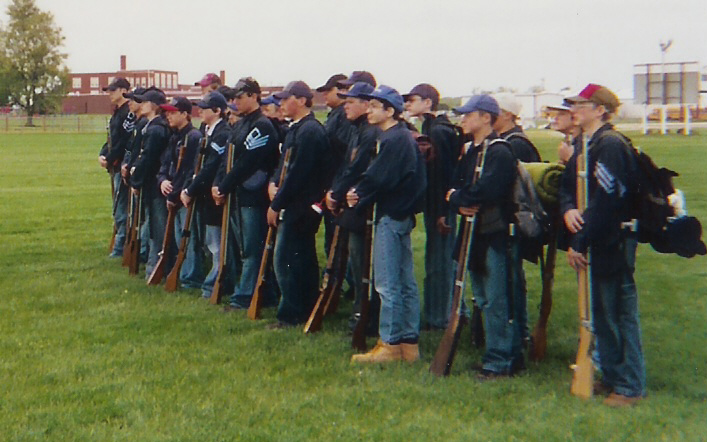
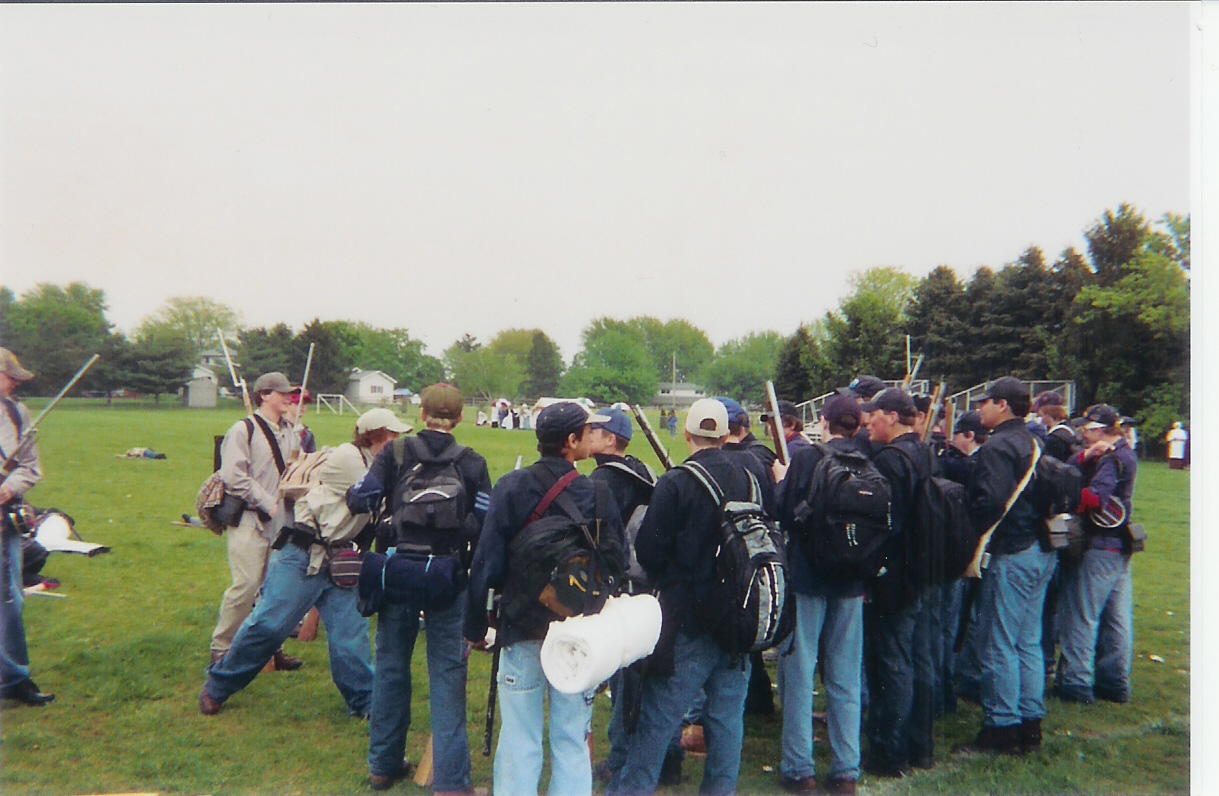
One school, Liberty Benton Middle School near Findley, Ohio, went so far as to have their students make uniforms, equipment, and muskets. The teachers divided them into companies, and the students elected their own sergeants and corporals. We came up several months in advance of the event to train the NCO's and those NCO's went back to train their companies. They learned to fight in their formations and handle their weapons, and on the event day, the students fought a mock battle, under the direction of our soldiers. Here, if just for a brief moment, they got to be reenactors themselves! We are willing to work with you on |
|
|
|
|
|
 |
|
|
|
|
whatever ideas or things you want covered. The things here presented on this page are only ideas that we have done in the past and that have worked well with us. Certainly if you have other plans or needs, we are willing to discuss them with you and let you know what we are capable of. |
|
|
|
|
|
|
|
|
The Federal Battalion, Liberty Benton Home Guard, stands at "In place, Rest," preparing to go to battle. |
|
|
|
|
|
|
We know what the first thing that is going through your mind. With all these reenactors, uniforms, equipment, and time, how much is this going to cost us? We know of a single reenactor that charges nearly $200 for just a glimpse of what the 121st can offer your class. We, however, for all of the above, do not charge a dime. This is a free program. Our men are volunteers, using their personal time and personal property to share the history of the Civil War with your class. We know how schools are straped for time and reasorces, so we offer ourselves at a resource to you. In order to |
|
|
|
|
The Liberty Benton Home Guard finishes the last remains of the rebel army. |
|
|
|
|
|
|
marshall the proper forces, we do ask that you provide us six weeks prior notice of your event. These programs are not solely for schools. Donations are accepted. |
|
|
|
Want our cannon? Click here! |
|
Home |
|
Contact us! |
|
|
|
|
|
Back to Program Index |
|
|
|
|
|
|
|