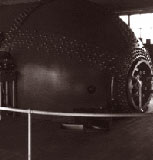
Death on The Nile
Extract from the personal notes of Mr. Hendrick Vorster.
9th August 1924
A few days ago, I returned from a remarkable journey undertaken with several other members of the League. Together, we crossed the burning desert with an extraordinary guide; experienced intrigue, treachery and even murder; probed the very secrets of time and space; found new friends in unexpected places; narrowly escaped alive from an abandoned military base; found another piece of the strange key that Cranbury set us on the trail of; and quite possibly caused the destruction of the ancient towns of Sodom and Gomorrah.
To continue my previous style, I shall essay this report as a discursive narrative rather than try to keep to the simple linear path of events; it seems that this will become something of a habit with my writing!
It was at the start of July that I first became involved in this particular episode of the League's work, although Lady Evelyn Herbert, Miss Sarah Hunter-Fitzsimmons, Mr. Jack Flynn, Mr. Morton Braddock and Mr. Chester Slim had been in Egypt since late March, as has already been told in the account Two Shorten the Road.
Whilst the five members involved in those events celebrated the release of Mr. Flynn and debated how they should pursue the spike which Lord Carnarvon had retrieved from the tomb of King Tutankhamun but which had subsequently been lost, I was working at my desk in London .
It was July 1st; half-way through the year, and auditing the semi-annual accounts of a number of moderately-sized financial institutions had left me both mentally drained and physically restless - in other words in the perfect state to readily undertake the unexpected opportunity for adventure with which I was about to be presented.
The door to my office opened and someone walked in, followed by my protesting and flustered secretary. So unexpected was this intrusion that it was several seconds before I recognised my visitor to be Miss Amy Fawcett. Without preamble, she dropped a folded piece of paper on my desk and started to speak. "I'm just far too busy to sort them out; you'll have to do it. The new admissions need all my time. Hah! as if I can just fly off to Egypt at the drop of a hat - it's too much. There's the new manuscript; I can't leave it to Humphreys..." And, still muttering to herself, she turned on her heel and marched out, leaving me watching after her with my mouth open.
After a few seconds, I pacified my outraged secretary and carefully lifted the piece of paper which Miss Fawcett had delivered. It was a thick piece of unlined paper about 7" by 5", folded into quarters and with the name "Miss Amy Fawcett" written on the outside in blue ink. Holding it by the corners, I unfolded the paper to reveal a large white sun at the top of the page, above the following, alarming, message:
YOUR FRIENDS IN EGYPT ARE IN DANGER.
HELP WILL COME TO THEM ON THE DAWN OF THE FIFTH DAY
AT THE SPICE MARKET ...with the last line in a different coloured ink.
My course of action was clear. Though I had no idea what was meant by "your friends in Egypt", nor what kind of danger they were in, this was clearly a plea for help, and one that would not find me wanting.
Since this was clearly League business, my first act was to send a telegram to Miss Darling at Michaelmas Hall and enquire if she knew whom the note could refer to. She quickly replied, informing me that Lady Evelyn, Miss Hunter-Fitzsimmons, Mr. Slim and Mr. Braddock had travelled to Cairo to rescue Mr. Flynn from an Egyptian gaol. Whether they had been successful or not, Miss Fawcett's note indicated that they remained in danger and I determined to travel to Cairo myself to provide what assistance I could. When I expressed this sentiment, Miss Darling arranged for a bankers' draft to be made available to secure travelling funds.
|
There is always something of a lull in the financial markets in July and August as a number of the larger investors decamp to Nice or New York for the summer. Since I had completed my work at Behrens' somewhat ahead of expectations, I had little difficulty in obtaining permission for a short holiday. Accordingly, I wrote a short note to my dear Hilary, asking her to pack me a few essentials for an urgent business trip. I then sent a telegram to Lady Evelyn at the Mena House Hotel in Cairo, which Miss Darling had told me was the intended residence of the would-be rescuers. Finally, I contacted the London offices of both Peninsular and Orient and Cunard to determine what vessel I should book passage on.
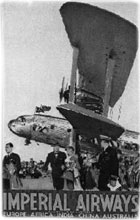
Imagine my consternation when I was told that although a number of ships were scheduled, none would be able to deliver me to Alexandria in less than nine days. If I intended to reach Cairo in time to help my friends overcome whatever danger they were in, I should have to instead entrust myself to the dubious machinery of Imperial Airways. |
I would hasten to point out here that I do not have an irrational fear of flying; in fact, I have a very rational fear of flying which can be put down to one simple fact - a fifteen ton contraption of fabric, wood and metal held together with wire and chewing gum simply should not be able to fly; and often enough to be alarming, it isn't!
Nonetheless, I had no other option if I intended to be in Cairo on the dawn of the fifth day and it can be taken as an indication of how thoroughly I have embraced the virtues of my adopted nation that my upper lip was as stiff as could be hoped for as I descended from my car the next morning at Croydon Aerodrome and waved farewell to Hilary.
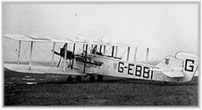 Hadley Page w8b
 |
I have never had the pleasure of travelling to Croydon before, but I will bear the elegant curves of Georgian houses, spacious parks and tree-lined avenues in mind for a picnic in future years; I imagine that Croydon will become something of a centre for the artistic and literate society of Britain in years to come - our very own Boulevard St. Michel. |
| Croydon Aerodrome, however, is not a pleasant sight, comprising a number of unlovely, low buildings with flat roofs and broad expanses of glass. I had just entered one of these when I suddenly saw a familiar figure. Sitting in what looked to be a remarkably uncomfortable chair was Professor Edward Jacobs, reading through a sheaf of papers on his knee. Of course, I greeted him, and the professor said that he was just returned from a conference in Switzerland where he had delivered an acclaimed paper based on the fifteenth century document he had been bequeathed in Sir Cranbury's will. |
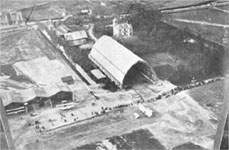 Croydon Aerodrome
 |
In turn, I explained my purpose in being at the Aerodrome and asked if he could spare a few days to help out. Apparently, university students are not expected to attend lectures during the summer months and Professor Jacobs proved to be both willing and able to accompany me to Cairo.
I would never describe myself as a nervous flyer. The word 'nervous' does not do justice to my state of mind as we were strapped and buckled into flimsy chairs in something referred to as a Handley Page W.8b
and my attempts to think about something else, anything else, were not helped by Professor Jacobs'innocent interest and delight in every aspect of the flight preparations, which he seemed determined to share with me.
As we bumped over the grass, slowly gathering speed, I felt Professor Jacobs stiffen in his seat and exclaim, "Good heavens!". This was alarming enough for me to open my eyes, and I followed his gaze through the window to see the figure of a man who stood, watching the aeroplane depart. Despite the warmth of the day, the man was dressed in a black great coat, black bowler and dark, smoked-glass spectacles. As I looked questioningly at the professor, he turned to me and said, "That's one of the chaps who tried to steal Eddie's car after the race!"
* * *
For me, the next three days passed in the discomfort of hours spent in a noisy and cramped space whilst in the air and experiencing infuriating delays and inexplicable rushings whilst on the ground. Professor Jacobs proved to be an excellent travelling companion; the hours flew by (if you will pardon the pun) as he described the minutiae of his work in terms which left me fascinated but sadly no more comprehending.
During our journey, the professor admitted some perplexity - unable to satisfy himself as to how a paper written some four centuries ago should not only include detailed and apparently accurate descriptions of the structure of atoms to a degree which has only recently been matched by modern science, but should also suggest behaviour which was impossible to determine at the date the paper was written but which is borne out by experimentation in his laboratory. The mysterious metal plate recovered from behind Lady Charteris' house proved to be strangely light, like the odd 'spike' artefacts the League was set up to investigate, and to create some sort of electrical or magnetic field (or possibly both - it was a lengthy and uncomfortable journey).
Professor Jacobs has kindly offered to supply technical notes in an appendix to this journal and I refer interested readers to those in their pursuit of understanding.
Sensing my nervousness every time we left terra firma , Professor Jacobs attempted to enlighten me as to the principles behind our flight as a way of alleviating my discomfort; his endeavours were unfortunately fruitless since I found his discourse to be mostly incomprehensible but scattered with worrying phrases such as "angle of attack" and "stall speed".
At the risk of another pun, I will conclude my description of our journey to Cairo by saying that my fears proved groundless and as the sun was sinking in the west on the evening of July 5th we landed without mishap in a dusty field outside the city. Without difficulty we flagged a hantour and ordered the driver to take is to the Mena House Hotel. With a flick of his whip we set off and made our way through the narrow, thronged streets of Cairo. I found myself fascinated by the ancient mosques, crowded souks and slowly subsiding tenements that we passed by, all densely packed with crowds and lit but dimly by the setting sun. Suddenly, we realised that we had left the city proper and were now travelling through smaller and less well-kept houses, heading towards the riverbank.
Assuming that we were, as foreigners,quite literally being taken for a ride, the professor and I became quite loud in our insistence that the driver should turn back to the city and take us to the Mena House Hotel, but this caused a great deal of gesticulating and a torrent of Arabic in response. Our driver seemed to think we needed to go to the Pyramids, and to do that we would have to cross the Nile. Only after our discussion attracted the attention of a passing local who spoke both Arabic and English did we learn that the Mena House Hotel is actually in Gizeh rather than Cairo, built only ¼ mile from the pyramids themselves. With our new understanding, we thanked our interpreter and waved our driver on.
We crossed the Nile on a low bridge and I saw the fabled Nile for my first time. Unfortunately, I also smelled it. As the wheels of our carriage rumbled across the wooden planking of the bridge, the bloated carcase of some animal drifted by below us. A note in my Baedeker's had mentioned that anyone who bathed in the Nile was bound to return to Cairo; looking at the filthy water, I doubted that such a bather would ever be fit to leave.
Professor Jacobs and I arrived at the Mena House Hotel after the sun had set, so we could see little of the pyramids except the flickering light of torches where brave or foolhardy visitors climbed their sandstone bulk in the night. After presenting ourselves at the front desk and asking after Lady Evelyn, we were treated handsomely by the staff and told that her ladyship was out with her friends but was expected back later. My suspicions about the reliability of the international telegram service outside Europe were confirmed when I asked if Lady Evelyn had received my telegram and was told that it had indeed arrived before the professor and myself, but only by a matter of hours and that Lady Evelyn hadn't picked it up yet.
In fact, Professor Jacobs and I had barely had time to refresh ourselves and make a start on a late supper when Lady Evelyn, Miss Hunter-Fitzsimmons, Mr. Flynn, Mr. Slim and Mr. Braddock all came into the bar, having been told by the desk porter that we were there. We were relieved to see that they all looked happy and healthy - obviously, the danger we had come to warn them of had not yet made itself felt.
I explained to the four recent arrivals why it was that Professor Jacobs and I had felt it necessary to come to Cairo and showed them the note that Miss Fawcett had dropped on my desk. We agreed that we would be at the Spice Market the next morning, waiting to see who would contact us.
Over a cocktail or two, Lady Evelyn, Miss Hunter-Fitzsimmons, Mr. Slim and Mr. Braddock told the professor and I what they had been doing since the delivery of Mr. Flynn from gaol.
Only that morning, a letter had been delivered to Lady Evelyn at the Mena House Hotel bearing the following, handwritten content [sic throughout]
Dear Lady Evelyn,
I pleading your help me. I very scared for my sons, as their father die. It concern your father finds in Luxor.
Please to meet me tonight at Church of St. Sergius at 10 'o'clock.
Yours, very your friend,
Elena Hasan
It will be recalled by my readers that the antiquity dealer through whom Lord Carnarvon used to dispose of his finds was a certain Yusef Hasan and that he was the last known owner of the strange metal 'spike' found amongst King Tut's grave goods. Despite knowing that in all probability it would prove to be a trap, the five League members agreed to visit St. Sergius' that evening to learn more.
St. Sergius', or Abu Serga as the natives call it, is one of the oldest churches of Cairo, having been built in the 4th century over a cave where the Holy Family allegedly stayed whilst fleeing Herod's wrath. As the sun sank behind the distant pyramids, the narrow building was thronged with a Coptic congregation. After waiting for only a few minutes, Lady Evelyn and her companions were approached by a short, veiled woman who quietly asked them to follow her back to her house.
This proved to be a small but clean building amongst ten thousand just like it, with dogs, cats, children and chickens scattered amongst the shuttered rooms within. Offering her guests tea, their host lifted her veil and in halting English introduced herself as Elena, wife of the late Yusef.
In a few short sentences, Elena confirmed what the Leaguers already knew; M. Maspero had taken a bundle of papyri from King Tutankhamun's treasures and had thrust the rest of the box at Lord Carnarvon; later he had regretted this uncharacteristic generosity and had approached Yusef to purchase the 'spike' from him; Yusef had refused to sell and M. Maspero changed tactics to threaten rather than bribe; Yusef remained unwilling to part with the spike and was soon thereafter found floating in the Nile; the police claimed that he had been drinking and had simply fallen in, but Elena knew her husband for a good Christian who would not have drunk alcohol on the Sabbath.
Recently, Elena herself had been approached by agents of M. Maspero who had threatened both her and her sons if she refused to give up the spike. She had no idea where the spike might be, and was worried for the safety of her family. She knew of no friends or hiding places where her husband might have hidden the item, and the only document she had found which was out of the ordinary was a single sheet which showed a large image of a stylised sun, rendered in some white, waxy material.
At Elena's urging, the Leaguers made a thorough search of her house whilst she packed some clothes preparatory to travelling to her sister's house in Karnak. Having confirmed that there was nothing amongst Yusef's belongings, Lady Evelyn had her father's driver, Imran, take Elena and her sons to the railway station and then return to ferry the Leaguers to Yusef's shop.
Despite the fact that they were led by Mr. Braddock's, whose ability to uncover secrets is little short of miraculous, their investigations had turned up nothinng by the time they were drawn from their searching by a disturbance at the front door where a native was drunkenly shouting.
After a few confused minutes, Lady Evelyn calmed the man by showing him Elena's letter, whereupon they learned that the new arrival was Abdul who had been Yusef's assistant and who had believed that the intruders in his late employer's shop were more of M. Maspero's agents. Learning the truth, Abdul became very friendly and showed the Leaguers a secret panel in the loft which led to a hidden room. Although the missing box of funeral jewellery taken from King Tutankhamun's tomb was there, there was no sign of the missing 'spike'. Somewhat dejectedly, the five rejoined Imran and returned to their hotel where they found Professor Jacobs and I waiting for them.
Before retiring to bed for our early start the next day, the professor gave Miss Sarah-Fitzsimmons a key which Sergeant Baxter had found inside her aeroplane whilst working on it. Miss Sarah-Fitzsimmons told us that before her father had mysteriously disappeared (during an experimental flight taken as part of the secret military Operation Velvet), he had told her that he had left her something inside her aeroplane but that she had never been able to find it.
|
Six of us were at the Spice Market for the quarter past six sunrise the next morning, wondering who might contact us; Mr. Flynn having left the hotel early that morning to look for M. De'Lacy in Cairo. After a short but anxious wait, it was almost an anticlimax when a hooded, dark-robed native nodded briefly at us, pulled up his sleeve to reveal a white sun tattooed above the wrist, and beckoned us into a nearby coffee house.
Once we were all settled around a small table in the smoky interior of the coffee house, the Arab introduced himself to us as Ahmed al-Hamdi, a representative of the Order of the White Sun. |
He made no effort to conceal his dislike of the British whom he clearly considered to be unwanted invaders of his land, but admitted that the Order felt that it owed Miss Fawcett a debt of honour for her assistance in destroying the re-animated mummified monster in the cellars of the British Museum. As a payment of that debt, which the Order now considered paid, the Order as willing to offer us some help.
Ahmed told us that the Order of the White Sun had been established many years ago to control knowledge of the power of the Black Sun sigil and prevent it falling into the hands of people who might misuse it. The Black Sun gives the wielder power over a man's soul and "a man's soul should be his own to command".
Ahmed made us aware that the Order had been keeping an eye on the activities of the Crimson League ever since they became aware of our interest in the Black Sun. He asked us if we knew what we were doing in gathering the strange metallic 'spikes' together and we had to admit that we didn't. Ahmed then said that the opening of King Tutankhamun's tomb had started a chain of events with potentially dangerous and unforeseen consequences that we had involved ourselves in.
We asked Ahmed if he could tell us anything about the spikes and he replied that although his people had tales about them, which they told over their camp fires, he claimed to be unable to remember them. This may have been the truth, but I believe that he simply refused to tell us anything which might be of assistance in an attempt to discourage us from continuing our work.
Since Yusef had left a paper adorned with a White Sun amongst his personal effects, we had realised that he must have been in contact with the Order. When we asked Ahmed about this, he admitted that they had been approached by Yusef who had asked them what he should do with the one given to him by Lord Carnarvon. Reluctant to take it themselves, the Order had suggested that Yusef hide the item again and the latter had then laughed and said that he would hide it "under the very nose of my enemy".
We asked if the Order of the White Sun could tell us anything about M. Maspero and why he wanted the spike. Ahmed told us that M. Maspero is a member of an evil occult group called the Inscribers who seek to gain power; whether he is the leader of the group or just a powerful local member is not known.
Having now volunteered all the information he was happy for us to know, and evidently growing uncomfortable with our questions, Ahmed rose to his feet and swept out of the coffee house, leaving us with a final admonition that we should not continue with our investigations and should leave Egypt as quickly as possible. Only Miss Hunter-Fitzsimmons seemed sad to see him go.
Discussing what we had learned, we left the coffee house a few minutes later and emerged blinking into the early morning dazzle and busy crowds of the spice market. A few seconds later, the throng fell silent and parted to reveal seven men dressed in desert robes and an air of menace. As they saw us, they reached for their yataghans and moved unhurriedly towards us. It was with some difficulty that we persuaded Mr. Braddock that discretion would be the better part of valour and that we should simply leave. Imran provided us with the means to make a hasty departure and we quickly returned to the Mena House.
During the morning, Mr. Flynn had located M. De'Lacy who had not taken Mr. Slim's advice to leave town. With some exertion, Mr. Flynn had obtained answers for several questions, the most important of which was that M. Maspero was seeking the spike from Yusef because it was mentioned in the papyri he had taken from King Tutankhamun's tomb. Given what we learned about M. Maspero after returning to England (which I will mention at the end of this report), we may have the opportunity to investigate what is written on these papyri ourselves.
We had been told that Yusef had hidden the spike under the nose of M. Maspero; in Cairo, that implied that it was either in his house or somewhere in the National Museum of Antiquities of which M. Maspero was the Director. After some discussion, we decided to go to the Museum first. With seven of us, we had to hire a taxicab to follow Imran across the Nile and into central Cairo.
The automobiles dropped us outside the magnificent neoclassical building that houses M. Auguste Mariette's collection and we immediately found ouselves in a crowd of native workmen carrying boxes, crates, tables, chairs, carpets, cutlery, crockery and all manner of goods in and out of the main doors. Mr. Slim recognised one of the overseers of this work and approached him to introduces us to Mr. George Mountebank, Curator of the Middle Kingdom Collection and a regular at his bar.
Mr. Mountebank seemed genuinely pleased to see us and invited us into his small and over-full office to share a glass of limon , delegating his duties to an assistant. Our host explained that the Museum was hosting a gala evening that night to unveil some important new statues rescued from Tanis, an ancient city north east of Cairo where myth had the Hebrews enslaved by the Egyptians and which some rumours give as the hiding place of the Ark of the Covenant. Most of Cairo society would be in the Museum tonight and although Mr. Mountebank was too busy with preparations to be able to give us a tour at the moment, he pressed invitations upon us to come to the celebrations as his guests; an invitation that we were glad to accept.
After Mr. Mountebank had left us to return to his supervising of the placing of the new discoveries, we had a quick look around a few of the exhibits in case we could see anything that looked like the funerary goods from Lady Evelyn's picture. Most of the museum was cordoned off behind rails to discourage casual browsers and although there was much of interest in the display cases we could reach, none looked like the metallic spike which we sought.
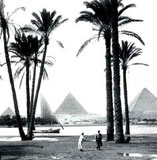 Nile & Pyramids
|
We gathered on the pavement outside the museum to discuss whether or not we should go to M. Maspero's house which is in Gizeh, near the pyramids and not far from our hotel. Mr. Flynn recalled that M. De'Lacy had said that M. Maspero was at home in Paris at the moment. Mr. Slim returned to his friend's office in the Museum and confirmed this with Mr. Mountebank. With M. Maspero out of the country, this seemed like a good opportunity to visit his house, even if it were unlikely that Yusef had been able to hide anything there. |
On the way to Gizeh, we agreed that Lady Evelyn would lead our group and would call at M. Maspero's house since he was ostensibly a friend of her late father's. Having thus prepared our cover story, we were quite sure of being invited indoors to partake in refreshments. Since this was the first visit to Egypt for several of our group, we elected to first go to the pyramids and see these ancient wonders. My own thoughts are that the pyramids are vastly impressive, rising in immense bulk and antiquity from the tawdry, dusty beggars and remaining aloof as if thinking "I have seen Kings and Queens, Emperors and conquerors come and go; these too will pass". They are so old and so alien to normal human experience that they send a shiver down the spine by their simple presence and I can understand Flaubert describing them as 'something terrible'.
One of our reasons for visiting the pyramids was that the paper which Professor Jacobs had received from Sir Reginald's will was folded to look like a large pyramid and a small pyramid aligned along one edge; since the Gizeh Plateau has pyramids both great and small, he wanted to see if we could find anything significant in the spot where the pyramids lined up like his paper. We didn't.
However, we were now dusty and thirsty enough to be convincing when we called at M. Maspero's house for refreshments. The French houseboy who answered our knock was very polite and apologetic at the absence of his master and graciously invited us into the courtyard of the house whilst he went to prepare drinks and damp cloths. Several members of our group are sufficiently au fait with archaeological finds as to know that many of the beautiful items that decorated M. Maspero's house should have been in the museum.
Small ornaments and statuettes jostled for space on bookcase shelves and mantlepieces; colourful kilim and carved wooden pieces hung on the walls; a richly-painted mummy case patterned with constellations of gold studs lay open in the study. It was the later that drew me away from the courtyard and into the shadowy interior of the house - I wanted to be sure that the mummy case was empty after the occurrences in the cellars of the British Museum. |
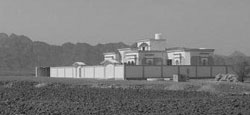
Masperos Residence
in Giza |
The main feature of M. Maspero's study were the Christian icons which rested on every shelf and hung on every wall. I pulled idly at the drawers in the heavy oak desk which stood in one corner, and confirmed my suspicion that they were locked. Mr. Braddock, who had followed me into the study, showed no compunction in putting his baseball bat to use in gaining access to the contents; I don't know how he managed to achieve this without leaving a mark on the wood, but he did. Mr. Braddocks disappointment that the drawers held nothing but papers was quite apparent and he left the study to see what the others were doing.
Amongst the various bills, receipts and postcards of a questionable nature, I found three letters which I quickly read through before returning to the desk. The first was an invite to the Tanis Collection Opening at the Museum tonight. The second was a letter from Professeur Alfonse Colbert, Directeur of the College de France, 11 Place Marcelin Bertholot, dated April 12th and asking M. Maspero to return to Paris to present diplomas to the graduating students in August.
The third was by far the most interesting, since it confirmed M. Maspero as an agent of the sinister "Inscribers". Of necessity I paraphrase the original French, but the gist of the letter was:
My dear Scribe,
I greet you in the name of our God.
It is important to retrieve the object for our society. Don't forget what happens to those who forget their duty. Remember Mr. Anstruther. We await you in Paris.
I hope our God helps you.
The Professor
Whilst I was thus occupying myself in M. Maspero's study, Professor Jacobs had taken Mr. Flynn's jocular advice that "the treasure is always under the altar and there's always a vampire in the cellar" and gone looking for either a cellar or an altar. As events transpired, he managed to find both.
In the corridor which led from the courtyard to the kitchen, the professor discovered a narrow doorway that led to a steep flight of steps leading down into the cool beneath the house. Carefully descending, he tugged a curtain aside to reveal a chapel hidden in the depths of the earth, with pews, nave, aisle and a bible on a lectern. The only thing to distinguish this cellar from any other small French church was the two wooden mummy cases which stood like guards at the end of the aisle.
It was whilst looking at these painted cases that Professor Jacobs made the discovery that led to us fleeing M. Maspero's house. As he approached them, the professor found himself standing in a pool of some sticky liquid; a liquid that looked dark red in the candlelight. Professor Jacobs cautiously opened the right-hand case and had something of a shock when the brutally murdered body of M. De'Lacy fell at his feet.
Mr. Braddock found the cellar in time to help Professor Jacobs restore M. De'Lacy's corpse to its hiding place, and to purloin the sacramental wine, before we all met in the courtyard. The professor told us what he had discovered in the cellar and we decided that it was time for us to leave. As we hurried to the door, we heard feet descending from the upper-story and turned to see two figures in the heavy hooded robes of monks coming towards us along a short corridor. We wasted no time in leaving the house and returning to our hotel.
Although the Mena House Hotel is most renowned for its proximity to the pyramids, I can personally vouch for the excellence of the lunches it offers its guests. During the meal, we discussed what we should do; as promised, Cairo is beginning to seem uncomfortably dangerous. We agree that if the spike is in the Museum of National Antiquities, and if we are able to obtain it tonight, we should not delay in leaving Egypt, and to that end we asked the maitre d'hotel to reserve places for Professor Jacobs and Mr. Slim on the scheduled flight to Cyprus and to book passage for me on the Cunard liner from Alexandria back to London; Lady Evelyn, Mr. Braddock and Mr. Flynn would travel with Miss Hunter-Fitzsimmons in her private aircraft.
We passed the afternoon in conversation and in quiet contemplation of the endless Arabian desert. Miss Hunter-Fitzsimmons took the opportunity to obtain suitable evening wear for the reception thie evening; Lady Evelyn and such gentlemen as are concerned about these matters were already provided for.
Champagne, canapés and the glitterati of Cairene society awaited us at the Mueum of National Antiquities. Politicians, bureaucrats, businessmen and representatives from foreign embassies mingled, drank and laughed at one another's jokes, clearly far more interested in each other than in the splendid remains which surrounded them. Lady Evelyn, clearly at home in such company, took Miss Hunter-Fitzsimmons under her wing. After a few minutes pointless talking with people I don't remember, we split up to have a closer look at the museum exhibits.
As we approached the tomb of M. Auguste Mariette, M. Maspero's predecessor and influential enough to be commemoratively buried within the building he designed, Mr. Braddock suddenly recognised one of the three Arabian men looking furtive nearby as Abdullah Saïd, "He does what I do; he's not as good at it as me but he's one of the best nonetheless."
One of the three arabs had a chisel and was working away at the decorative stonework on M. Mariette's tomb. He stopped for a moment when challenged by Mr. Braddock, but then went back to scraping away at the carvings until I reached out and pulled his arm away. In the ensuing fracas, Mr. Flynn, Mr. Braddock and I are able to occupy the arabs whilst Professor Jacobs reaches through the newly-created hole and pulls something out of the tomb.
Hearing the noise of our altercation, the museum guards arrived en masse and, eager to prove their assiduity in front of the gathered notables, led us all away to the mueum offices, Leaguers and arabs together. Despite the protestations of our innocence provided by Lady Evelyn and Mr. Slim, the guards refuse to release us and even Mr. Montebanke refuses to get involved in what he explains has become a police matter. When the police arrive, they prove more than willing to haul us off to gaol until they are shown the damage done to M. Mariette's tomb and the contents of Lady Evelyn's purse. Eventually, we are released with nothing worse than bruising and warning not to disturb the peace again.
Outside, in the relative cool of the Cairo night, we eagerly examine the item that Professor Jacobs' discovered; it's the lost spike. This one bears ancient Egyptian designs such as the Eye of Horus and a seated Anubis. We return to our hotel, elated by our success.
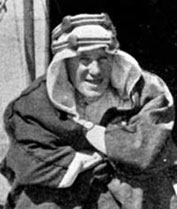
T. E. Lawrence |
Naturally enough after our exertions, we repaired to the hotel bar for a celebratory drink, but our incipient revels were interrupted before they began by the approach of a man who although North European in appearance, wore the robes and head-dress of a desert arab. With a grin and a twinkle of blue eyes, he bowed deeply to Mr. Slim who greeted him with a cry of "Ned!" and introduced us all to Mr. T. E. Lawrence, more commonly known as Lawrence of Arabia.
Mr. Lawrence told us that we were all in serious danger and that we would not be able to take our planned journeys our of Africa the next day; he would take us out himself by an altogether different route, but we would have to leave immediately and only carrying the essentials. He revealed that he was a friend of the missing Commander Hunter and that he would now take us to the last place he had been seen - the Dead Sea Base. Mr. Lawrence tells us that he had also been a friend of the late Lord Arthur Christian, and that he receognised some of us from that gentleman's funeral. |
Mr. Slim and Mr. Braddock offered to remain in Cairo and leave a false trail. Whilst the rest of us hurriedly packed, Mr. Flynn (who is always ready to travel at a moment's notice) sent a carefully-worded telegram to the other members of the League to inform them of our retrieval of another of the mysterious spikes and of our intended destination.
It took some time to load our packs onto the camels that Mr. Lawrence had provided for us, but long before midnight we crossed the Nile and headed north east, away from Cairo and into the desert.
Travelling in the desert was something I thought I had stopped doing many years ago, but like riding a bicycle, it is something you never seem to forget. People have said that camels are the most obstinate, uncomfortable and recalcitrant animals in the world; this being my first and only contact with the animals, I can neither confirm nor deny this assertion, but under the ministrations of Mr. Lawrence, these camels proved as tractable as the best horses I ever rode into the Kalahari. |
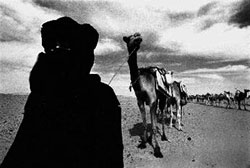
Muffled Against The Dust
|
With Mr. Lawrence's leading us, we travelled during the early morning and later afternoon so as to avoid the heat of the day as far as possible, whilst retaining light enough to ride safely. The temperature in the early afternoon regularly reached over 100F and it was dangerous to do anything except sit under makeshift shelters until the sun slid down the sky. We rode with white djellabas and head-dresses like Mr. Lawrence's to deflect as much of the sun's heat away as possible and with soft cloths drawn across our faces to cut the dust.
During the evenings, the dry sand does not hold the heat and we rely on heavy robes and a campfire for warmth. Although Mr. Lawrence is reluctant to tell us about his exploits in the desert, he is more than willing to tell us the folk tales of the indigenous people and sing their songs; honesty forces me to admit that the latter are incomprehensible and almost interminable.
We had all become somewhat acclimatised to the heat of Egypt during our stay in Cairo, but the moisture we had benefitted from whilst living next to the Nile disappeared into the unending sand as we journeyed east and dehydration became the biggest threat.
We didn't travel far the first day, and stopped for an early camp some few miles south of the small village of Bilbeis so as not to leave too obvious a trail for anyone following us. Poor Mr. Flynn, he must hate it so. If I had been hunted some 12 days and nights through these sands I too would loath the desert. The next day was our first full day in the saddle and the irregular roll of our mounts quickly stirred a nagging ache in muscles which had been stretched by the unaccustomed exercise of the previous day. We waited out the heat of the day in the ruins of the Temple to Bast at Bubastis, south of the implausibly named village of Zagazig. By sunset we reached the village of Al 'Abbasa where Mr. Lawrence knew a family who provided us with fresh dates and water.
During the next day, we reached the Suez Canal where it flows into Lake Timsah, named for the large but mostly indolent crocodiles which line its bank. Mr. Lawrence led us north along the edge of the immense waterway until we reached the village of Al Ballah which boasts a ferry, less popular than that at Qantara. Crossing such a width of water in such a small boat with such ill-at-ease animals as camels is not something I would wish to repeat again and I am sure we would not have been able to do it if Mr. Lawrence had not insisted on being present on each crossing to calm the animals.
Having now crossed over into Sinai, we saw the nature of the land change dramatically. No longer did we rise and drop on waves of sand, although Mr. Lawrence told us that these continued to the north, along the Mediterranean coast; now we scambled over broken rocky hills split by gorges full of grey gravel. It is easy to see why this land is described in the Bible as the 'great and terrible wilderness' through which Moses led the newly-liberated Hebrews from Egypt. After three days among these drab, hot, dry rocks, we would all have benefitted from divine manna ourselves.
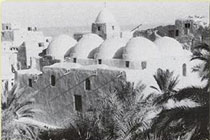 St. Mercurius Monestary
 |
Our pace was much slower on this surface as we often had to backtrack from uncrossable gorges to find easier ways down. Horses would have been unable to cope with such terrain and I appreciated the wisdom of Mr. Lawrence's uncomfortable choice of mount. He told us that once we had crossed the central heights around Bir Gifgafa, we would swing north and enter the sand once again, but for now we would remain in this stony wilderness since he had some people he wanted us to meet. |
We understood his comment that evening as we approached the high granite walls of a Coptic monastery dedicated to St. Mercurius. We were welcomed by the abbot, Father Brassius, who clearly knows Mr. Lawrence well, and invited to spend the night in the monastic guest house. The church which formed the heart of the monastery was very large and very impressive in an austere way, much bigger than the local congregation would seem to warrant. Like many Coptic churches in eastern Egypt, this one was built over a cave where the Holy Family hid as they fled Herod's wrath.
After we had washed and been given a meal, the Abbot Brassius showed us his greatest treasure - a library containing several hundred religious texts written by 12th century Armenians and 14th century Alexandrians. On the wall a large picture hung, showing eight strange figures stood around a shape that might have been a circular doorway. The thing that really caught our attention, though, was that the doorway and door were marked with several black sun images. The picture also showed writing which we could not read but which looked familiar from the League's work.
When we asked the abbot about the image, he said that it was ancient and represented something called the "Gateway to Heaven"; no-one at the monastery could read the inscription and they did not know what it meant. Both Professor Jacobs and I made what copies we could of the writing and the professor tried to copy the images; my artistic ability limited me to simply making a textual description of the figures. Moving round the doorway in an anticlockwise way from the bottom left, there were:
• a classical angelic figure, albeit somewhat less well-dressed than most angelsseem to be and emphatically female
• a male figure with wings or feathers extending from the ends of his sleeves
• a bat-winged figure
• a large, black flame with a red eye in the middle of it
• a skeleton carrying a hooked knife and with clawed feet
• an oriental man with long robes and a narrow belt elaborately folded into a large butterfly
• a European dragon
• a hairy (or quickly-moving) figure looking down
The doorway was circular, surmounted by a plain black sun over a scallop shell with ribbons; a line of black suns continued to both sides. The door, like the doorway, was circular and seemed to be split vertically into two pieces with a semicircular handle just over half-way up each door. Two pairs of parallel wavy lines (possibly representing water) marked the outer edge of the doors. There was a large black sun indicated in the very centre of the doors with a large white eight-pointed asterisk in the middle.
Since the League is looking for eight metallic spikes that fit together, as we discussed this image amongst ourselves over the next few days, we came to two main conclusions.
• The eight figures may well represent the guardians of the eight spikes or people interested in them.
• When fitted together, the eight spikes will make a flanged shape that may well act as a key if fitted into an eight-sided keyhole like that marked in the centre of the Gateway to Heaven.
Professor Jacobs and I sat up late into the night discussing the monastic legends and tales with the few monks who spoke English. The Egyptian name for St. Mercurius is Abu Seifein, meaning 'two swords',since St. Michael appeared and gave him a glowing sword when he fought the Berber invaders in Cappadocia in the third century. During his service with the Roman army, he encountered a tribe of cynocephali or dog-headed men, whom he converted to Christianity. These creatures fought alongside St. Mercurius in some of his battles. Condemned as a Christian by the Roman Governor, Mercurius was tortured with fire and whip, but his blood was spilled so freely that it put the fires out and Mercurius was miraculously healed every night. In the end, the Governor ordered his execution.
Resupplied by the generous monks, our group departed at sunrise the next morning, and climbed through the dusty grey rock hills and up towards the Khatmia Pass, which we finally crossed the next day to start a slow but continuous descent that would continue until we reached the Dead Sea some seventeen days later. |
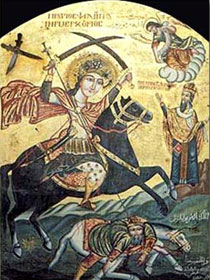
The Saint With Two Swords
|
The next day we passed south of the village of Bir Gifgafa and turned on to a more northerly route. Two days later, we entered a field of dunes that stretched thirty miles to the Mediterranean coast to our left. Three days later, as we were thinking about stopping for the evening, Mr. Lawrence suddenly pointed at a high bank of dunes ahead of us and shouted "Get to that!" before wheeling his camel round to encourage Professor Jacobs' mount, which had taken to lagging behind the rest of the group.
Looking round for some explanation for Mr. Lawrence's apparent alarm, I could see a low, dark cloud on the western horizon; a sandstorm. Despite Mr. Lawrence's efforts, the wind caught us before we could reach the shelter of the dunes and we had to stop and protect ourselves as well as we could in the open. We took water, blankets and shovels from the saddles and dug shallow trenches in the sand.
For the next six hours we huddled half-smothered under blankets alone or in pairs, unable to hear anything over the roar of wind-driven sand. We were so tense that as soon as the wind dropped, we all fell asleep and remained like that until dawn. Mr. Lawrence was first to awaken, as usual, and had gathered the camels together before the rest of us arose.
During the next day's travel, we discussed what we should do with the spike that Professor Jacobs recovered; until we knew what they were for we were reluctant to link the pieces together more than had already happened. We agreed that we should take out yet another safety deposit box when we return to England.
After a further four days travelling through the inhospitable sandy wastes, Mr. Lawrence rode ahead to the top of the next dune, looked around him at the identical dunes which spread to the horizon, and nodded with obvious satisfaction.
As we joined him, he told us that we had just crossed from the Sinai Desert to the Negev Desert; we forbore to ask him how he knew.
Our journey turned even more to the north and the oppressive temperatures were moderated by a breeze from the eastern edge of the ocean. We continued our slow descent for a further day and a half until, as the sinking sun threw our shadows hundreds of feet across the dunes, we saw a figure sat on a camel some distance ahead of us, a long rifle in his lap. |
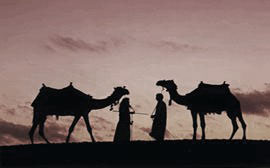 The Bedouin Greet Mr. Lawrence
 |
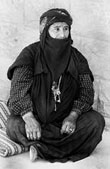
Bedouin Chief |
Our momentary alarm was eased by Mr. Lawrence who spurred his camel to a trot and bellowed a greeting across the sands. Turning in his saddle, Mr. Lawrence shouted back to us, "They are my friends. Bedouin. Hospitality is a religion with them. We'll eat well tonight!" And this proved to be correct as we were escorted to a small tented camp where we were provided with water in which to wash, food, drink, music and pleasant company throughout the evening. It was delightful although I couldn't understand a word of what our hosts said and had to rely on Mr. Lawrence all evening for his services as an interpreter. |
As the evening continued, I noticed that a number of the young bloods of the tribe continually looked in our direction; one fellow in particular took pains to preen himself whilst looking to see that we were watching him. With a quiet laugh, Mr. Lawrence explained that this was the chief's son who had taken something of a fancy to Lady Evelyn, redheads being something of a rarity in the desert. The easiest way to avoid what could have become an uncomfortable situation was for Professor Jacobs to present himself as Lady Evelyn's betrothed. When Mr. Lawrence explained the situation to the chief, the latter delightedly offered the professor the traditional betrothal gift of three camels to represent Health, Fortune and Happiness.
In the morning, our hosts graciously gave us clean clothes and provisioned our camels for our continued journey. For years I have read about the predations of these wild folk upon their settled neighbours, but I can with honesty say that I have stayed with members of no race, tribe or nation that has been so unstintingly generous and less seeking of reward for its kindness.
With the three spare mounts provided by the Bedouin chief, and the steady downhill trend of the route, our speed increased and only two days later Mr. Lawrence told us that we would reach the Dead Sea Base the next day; he went on to say that we should be cautious since it was two years since he had last been here, when he had met Commander Hunter, and he didn't know what kind of welcome we might expect from the British military who ran the base.
A recapitulation for my readers of what little we knew: Commander Hunter had been working on a secret British military operation called Project Velvet which ostensibly had the intention of making an aeroplane invisible. The engine of this aeroplane was marked with a black sun and sounded the same as the one installed in Mr. Braithwaite's car by Sergeant Baxter.
The military had told Miss Hunter-Fitzsimmons that her father had died in a crash, but this was not supported by the strange ribbon-like thing that she had received in Sir Reginald's will; Professor Jacobs helped prove this to be some sort of flexible wax cylinder, capable of recording sound and playing it back later. This particular ribbon held what seemed to be a real time report of Commander Hunter's last flight - one that ended in a very strange place; in some other time or place.
When Miss Hunter-Fitzsimmons had pursued enquiries at the other military base at the Dead Sea, she had been warned off in no uncertain terms.
One final piece of information that Mr. Lawrence gave us was that the base was not always visible; a strange effect like that which produces mirages seemed to hide the base except at dawn when its location was shown by a strange shimmer. Dutifully up before light, we were all stood on a ridge of dunes as the sun rose behind us to blaze for a moment off some metallic surface hidden in the dunes.
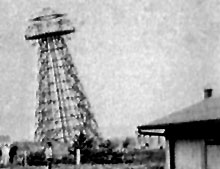
It took us over an hour to ride across the desert to where we had seen the reflection and Miss Hunter-Fitzsimmons wasn't the only one to stand in her saddle and scan the sands ahead as we rode. As we approached, two great dark metal lattices seemed to rise from the sands like eighty-foot high metal toadstools. Closer, and we could see another two towers set behind the first pair and together marking the four corners of a rectangle that covered twenty or thirty acres. Finally we crossed the last dune and saw the whole base comprising two very large buildings that Miss Hunter-Fitzsimmons said were aircraft hangars, three runways, several large workshops, offices and barracks. Surrounding the base were a number of large concave mirrors on angled frames.
We hadn't been challenged as we approached, and we could now see why. The entire base was empty, abandoned. When Mr. Lawrence had last visited, hundreds of people had lived here; now, sand piled against the buildings showed that no-one had been here for over a year. With considerable care we moved down to the front gate and made sure that it wasn't electrified. The guard room was empty. The various papers, pamphlets and posters my military experience had led me to expect were all gone although the standard British Army cork board still hung behind the door with its official quota of pins. An uncomfortable-looking upright chair stood behind a small table that held a telephone apparatus and a list of telephone numbers but it proved to have no connection when I lifted the receiver.
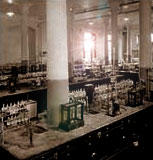
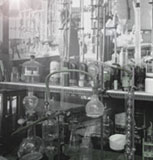
Professor Jacobs, who has been unable to take his eyes from the huge metal towers, eagerly led me to the room from which the tower rose. The door was unlocked. Within were several huge machines that the professor described as 'van der Graaf generators' but he was too enthralled by them to heed my questions as to what they did, how or why. We could hear a faint hum from the machines but nothing moved. Despite this, or perhaps because of it, we felt somewhat uncomfortable near the machines and moved away to a nearby door which led deeper into the building. We had to force the door open to gain access and found ourselves in a series of large rooms furnished with heavy tables, tall stools, gas fittings, sinks with taps; all the usual paraphernalia of a laboratory but with no contents of any interest.
Miss Hunter-Fitzsimmons led Lady Evelyn and Mr. Flynn into one of the barracks and after some searching found her father's name on one of the lockers; suddenly she realised the purpose of the key that her father had hidden in her aeroplane and that Sergeant Baxter had found and given to Professor Jacobs to pass on to her. With a barely-trembling hand she fitted the key to the lock and swung the door open. Inside was an old pair of boots and a book - an archaeological and historical atlas of the Holy Land.
We regrouped outside a small building that Professor Jacobs identified as the generator room. It was heavily locked. With a warning not to let the professor turn anything on until we had an idea of what it might do, Lady Evelyn and Miss Hunter-Fitzsimmons went to the base offices whilst Mr. Flynn investigated the aircraft hangars, discovering two heavy transport aeroplanes, both fuelled and ready to fly.
Although the base offices had clearly been thoroughly emptied at the time of the evacuation, careful searching turned up two pieces of paper which had been overlooked; the texts of these are appended below but the gist of them was that the experimentation had proved very dangerous and that the entire base had been relocated to southern Greenland after the sad loss of Commander Hunter. |
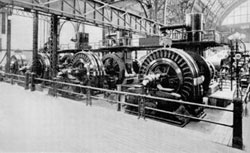
Sizeable Electrical Generators
|
Professor Jacobs admitted to me that he could make little sense of how the machinery worked or what it was intended to do, beyond generating a very powerful electromagnetic field and somehow focussing it with the array of mirrors to a point above the centre of the base. The only way to learn more would be to turn the machines on;something that he was more than willing to try but that I thought ought to wait until we had looked around more. As we went to join the others in the base offices, the professor cast several (perhaps even 'longing') glances at the heavy-duty switches on the wall.
Two of the offices still bore nameplates; the largest office we could find had apparently been that of Commander Carmichael and an adjacent one had been the office of Professor Daniel Rathbone, one of Professor Jacobs' colleagues from when he had worked on Project Velvet.
We regrouped to discuss our few findings and to try to understand what the military had been trying to achieve. We believe they were working to extend the original aims of Project Velvet - making an aircraft invisible - to somehow transport people through manipulation of something Professor Jacobs called "the space-time gravitational continuum". Or something else. Maybe.
Most alarmingly, one of the papers implies that if Mr. Braithwaite's car travels too fast without the proper fuel supply, the engine may reach out through the body of the vehicle to find its own fuel; and we suspect that the 'fuel' mentioned has something to do with the bottled souls which have been such a feature of recent League activity. This latter is admittedly something of a surmise rather than being deduced from explicit mention, but we believe it should at least be mentioned to Mr. Braithwaite.
Having found all that we could, we deliberated what our next step should be. This took a long time. Professor Jacobs was eager to start up the machines so as to know what they did. Miss Hunter-Fitzsimmons was willing to follow any path that could possibly help her find her father. .
Lady Evelyn and myself argued for caution and further investigation before we did anything risky and potentially irreperable, but it had been clear from the outset that logical argument would deter neither Professor Jacobs nor Miss Hunter-Fitzsimmons.
As a compromise, we agreed that Lady Evelyn, Mr. Lawrence and myself would retire into the desert to what we hoped would be a safe distance whilst the professor would experiment with the machines accompanied by Miss Hunter-Fitzsimmons and a concerned Mr. Flynn. We would take the spike that Professor Jacobs had found, along with his notebook and final instructions from Miss Hunter-Fitzsimmons, the professor and Mr. Flynn in case they were unable to rejoin us after their experiment. |
|
So it was that Lady Evelyn, Mr. Lawrence and myself rode out into the sands until only the tops of the aircraft hangars and the strange towers could be seen over the dunes. There we dismounted and stood gazing back to see what would happen. Professor Jacobs has written an excellent account of the events that he experienced alongside Miss Hunter-Fitzsimmons and Mr. Flynn, and there is no value in me attempting to repeat it here. Suffice it to say that the members of the League barely escaped with their lives and seem to have learned nothing of use.
The large aircraft seemed to stagger in the air before climbing clear as the military base below it was consumed in unearthly electrical fire. After looping up in the turbulent air, it steadied and levelled-out before starting a slow circle of the ruined base. As the last of the four exploded towers sank to the earth, the aircraft swung towards us and started to glide down for a landing on the sand.
We were glad to realise that the large transporter was easily able to carry all of us and that we would not have to ride back out of the desert, though Professor Jacobs was clearly unhappy to leave his three camels behind. Mr. Lawrence assured us that the animals would be able to make their way to a nearby oasis where they would be claimed by the next bedouin to travel that way; he accepted Miss Hunter-Fitzsimmons' offer of a lift to Alexandria.
We left Alexandria early on the morning of 4th and after a long but fortunately uneventful back to England, landed on 7th in time to have a self-congratulatory meal at Barribault's on Piccadilly.
Extract from “On Velvet Wings – The Collected Journals of Professor Edward Jacobs”.
... On hindsight activating the Dead Sea Base’s Tesla towers was perhaps a touch foolhardy, although I hope it can be understood that I couldn’t resist seeing the “Velvet” effect in person (and I secretly hoped that we may even open a portal allowing us to visit wherever/whenever poor Commander Hunter had found himself). I would like to think it was altruism on my part to aid Sarah in her search for her father, but once again it was truly my own curiosity that unleashed those fearful energies that day.
Mr Vorster, Mr Lawrence and Lady Evelyn retired to a distance of three miles to observe developments outside the “Velvet” field that we would be creating. Despite my warnings of the potential dangers, Jack and Sarah both insisted on staying with me to help observe any effects generated within the field.
We had readied one of the transport planes that we had found in the deserted base’s hangars and it sat on the end of the runway ready for a swift exit if required Although unsaid, I’m sure both Sarah and myself knew it was really there in case we successfully opened a portal and we needed an aircraft to traverse it.
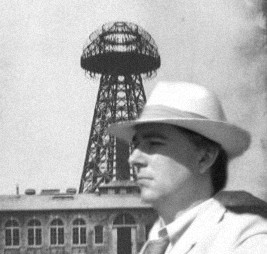
| I felt light-headed and almost giddy as I pulled the first lever and triggered the first of the mighty underground electrostatic generators (although whether this was due to excitement, the intense electromagnetic radiation or the peculiar reduced gravity we had experienced since we had entered the base, I wasn’t sure). The ground shivered, and in my mind’s eye I could see the vast underground boilers releasing their steam and whirling the vast turbines ever faster, charging the immense Tesla towers. Once it appeared that we had achieved full power (and with no visible effects reported by Jack or Sarah) I began working my way through the remaining five levers, waking each of the sleeping generators beneath the desert’s surface. The ground and air throbbed as the power built, the Tesla towers began soundlessly discharging huge purple/white lightning bolts into the sky and the air seemed to thicken. |
 |
As the fourth lever clicked home the ground seemed to jolt beneath my feet. Gravity appeared to be increasing and it was becoming more and more difficult to breath. In fact, time seemed to be slowing and I surmised that we must be experiencing a form of time dilation. This is probably where I should have stopped, where the very fabric of the universe was warning me I was pushing things too far.
Outside the Tesla towers crackled and shone with energy, discharging their unique lightning between themselves and the four large hyperbolic mirrors that were also positioned around the perimeter of the base. Engaging the fifth lever and generator resulted in another jolt, a further slowing of time and the previously raw stream of electrostatic energy formed into an almost coherent, continuous stream, crackling from the Tesla towers to the mirrors and converging on a point high above the centre of the base.
Comparing timings with Mr Vorster it appears as if this is when the base successfully entered the “Velvet” envelope and vanished from view. However inside the base we had no inkling of this.
With still no sign of the expected portal and no indication we had at least partly achieved our goal, I pulled the final lever into place. Another subterranean power source roared into life and I felt the ground hammer into my feet. I almost choked on the greasy air as I slowly made my way to the door of the power station and looked out and up at that which I had unleashed.
From the focal point of the mirrors a huge pillar of the purple/white fire surged silently into the heavens. No matter how high you gazed it seemed to reach ever higher. I could imagine it piercing the atmosphere of our tiny world and burning out into the infinity of the universe. I don’t know how long the three of us stood transfixed by the sight. Only when a purple lighting bolt tore up the ground several feet away did I realise where I was. The air was thicker still; I gasped and gulped, forcing the oxygen into my lungs and with mounting horror realised that soon we wouldn’t be able to breathe. I had to shut this thing down.
Taking all my strength, I turned through the thickened atmosphere back towards the power station and watched fascinated as slowly undulating tongues of flame reached out for me. It was an incredible thing to watch, though it took me a few seconds to realise that I was seeing a building exploding at an incredibly slow speed. The power station had gone, and so had my chance of stopping this monstrous creation. All that was left was escape.
The three of us plunged towards the aircraft through the swirling nightmare of time, gravity and lightning I had unleashed. We ran through thick air, thin air, fast time and slow time, a peculiar run of fits and starts as the unearthly lightning tore apart the ground around us. The Tesla towers started tumbling, discharging their own wild energy wherever they chose. Even as the towers fell the fiery column of energy could still be felt above us, our shadows dancing ahead of us in its coruscating light.
After what seemed like an age we reached the plane, but the electrics were dead. Whatever odd field we found ourselves in had a similar effect to the strange events at Lady Violet’s residence the previous year. No time to ponder on that, though - Jack and I each grabbed a crank handle and were out in the unearthly storm once more cranking the four engines of the transport plane into life.
With all engines churning Jack and I fell, exhausted, through the open door of the aircraft as the plane began thundering down the runway. A swift jog to the right to avoid a large hole that a lightning strike had created and Sarah heaved the plane into the sky as the last Tesla tower crashed down behind us. The column of energy flared and the base vanished in a huge ball of fire that bubbled its way up through the atmosphere creating an unusual, almost tree-like cloud. The superheated shock wave of the base’s explosion slammed into the plane and it was only due to Sarah’s piloting skill that I am still here to write this now.
On our return home I learnt that the Dead Sea Base was located on the site of the ancient cities of Sodom and Gomorrah. Given the time distortion effects that we had experienced within the “Velvet” field, my blood started to run cold as I considered the possible implications...

< BACK