 The First World War & After
The
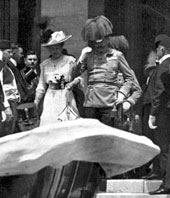
catalyst for the Great War, which broke out in the summer of 1914
was the assassination of Archduke Ferdinand, heir to the Austro-Hungarian
empire in Sarajevo, by the Black Hand. When Austria-Hungary demanded
Serbia hand over members of The Black Hand, a group of Serbian
nationalists, the King Peter of Serbia refused and appealed to
Russia for support.
However the origins of the First World War are found in the 19th
century due to the alliances which emerged in response to Germany
and Italy's development into nation states. Two power blocks formed,
the Triple Alliance between Germany, Italy and Austria-Hungary,
known as the Central Powers, and the Triple Entente between France,
Britain and Russia, known as the Allies. |
 |
When Austria-Hungary
declared war on Serbia, Russia declared war on Austria-Hungary and
Germany declared war on Russia and France. Germany followed the Schlieffen
Plan, which stated that as it would take time for Britain and Russia
to mobilise Germany should invade France quickly through the Low Countries
and defeat France before having to fight Britain or Russia. Britain
declared war on Germany August 4th 1914, the day that Germany invaded
Belgium. In practice both Britain and Russia mobilised far quicker
than Germany expected and facing the British Expeditionary Force in
Flanders at the Battles of Mons and Marne, the German army chose to
dig themselves in, rather than retreat and trench warfare was born.
On the 19th October Turkey joined a naval offensive against Russia
and revealed that the Ottoman empire was also a secret member of the
Central Powers. Due to the large number of colonies, the war was fought
on many fronts and was truly the first world war. For example Britain's
army included troops from Canada, India, South Africa, New Zealand,
Rhodesia and Australia.
Other countries
were more reluctant to go to war. Although part of the Triple Alliance,
Italian public opinion was so against entering the war that initially
Italy remained neutral. However fearing an attack by its former allies
Italy secretly negotiated with Britain and declared war on Austria-Hungary
in 1915 in return for financial aid and territorial expansion after
the war. In Greece public opinion was again anti-German, but King
Constantine was pro-German. The Prime Minister resigned when the King
refused to aid the Allies, but was re-elected with a landslide victory
in 1915 and immediately mobilised the Greek army. However after inviting
the Allies to use Greece as a landing base the King dismissed him.
So he went to Crete, formed a revolutionary government and raised
an army to march on Athens. In 1917 King Constantine was deposed and
Greece declared war on the Central Powers.
Portugal
declared their support for the Allies and in 1916 ordered their navy
to seize German ships, provoking Germany to declare war, but most
of the fighting took place on the border between Mozambique and German
East Africa. The United States entered the war finally in April 1917.
While opinion was against Germany, President Wilson was reluctant
to embark on a European war that was costing so many lives. However
the sinking of the Lusitania, a civilian ship which broke international
agreements, by German U-boats in May 1915 with the loss of 128 American
lives turned public opinion to the pro-war lobby. However it was strengthened
by the announcement of a new submarine offensive by Germany and the
Zimmerman telegram, intercepted by Britain, which proposed a treaty
between Germany and Mexico that finally pushed the US into war. However
they did not declare war on Austria-Hungary until December 1917.
The Allies
also included Romania, Montenegro, Belgium, Serbia and Poland.
Trench
Warfare
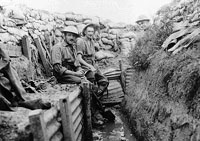 |
Trench
warfare was unpleasant to say the least. The Germans had built
their trenches on the high ground so the Allies had to take the
low, and frequently waterlogged, ground. Although the British
Expeditionary Force had been founded in 1909 as a force prepared
to enter any foreign war and this was boosted by around 3 million
volunteers, by 1916 it was realised that there would need a lot
more new men, particularly as stories of life in the trenches
were reaching home, and conscription was introduced for all men
aged 18-45. Initially only unmarried men were drafted, but by
1918 married men as old as 50 were being conscripted. |
| Life
in the trenches held many hazards, aside from snipers or going
over the top. These included trench foot, lice, poison gas and
shell shock. However most men did not spend long in the trenches.
An example is my grandfather, who ran away from school 3 times
when he was 17 to join up. As he had an education he was commissioned
as an officer. He received his commission on 12th March 1917,
by the 17th he was at the front and on the 22nd he was captured
and marched down to Southern Germany, where he was held prisoner
until liberated by the Americans in 1918. |
 |
He kept
a diary and the day he was captured contains hourly entries, ending
with: 4pm ran out of ammunition so surrendered. He was the only man
alive by the time he was captured.
Trench
warfare was bloody and usually consisted of battles lasting several
weeks or months, with only a few kilometres gained by either side.
The need for constant action in the Western front was partly due to
pressure from France to take the heat off them, further south. Typically
there would be several days of shelling prior to an offensive to weaken
the enemy and break through the wire and guns in front of their trenches,
which would be followed by a human offensive early in the morning.
This was the case with the Battle of the Somme, however the shells
had not cut the wire and Britain suffered 58 000 casualties on the
first day.
The
Flu Pandemic
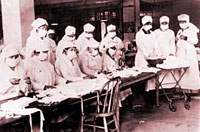 |
In
Spring 1918, another threat hit the world in the shape of the
Spanish Flu. Soldiers in the trenches, weakened by weeks of malnourishment
and the wounded were among the first victims, but soon the virus
had spread. In May 1918 the first cases were reported in Glasgow
and killed over 228 000 people in the next few months (the highest
mortality rate since the cholera epidemic of 1849). In the US
450 000 people had died by December 1918. |
It is estimated
that globally 70 million people died of the flu and more people died
in India, the worst hit country with c16 million deaths, from the
flu than the entire number of people killed in the fighting during
the war. However other diseases were also rife among the soldiers,
one of my great uncles died on bubonic plague in Malta on his way
home.
The
War by Air
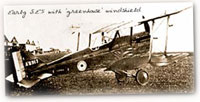 |
In
1914 the UK had only 110 airplanes, but 1918 the RAF had been
formed. The war is characterised by ace pilots, celebrated for
their number of victories. In Germany the Red Baron, von Richthoffen
held the record. In Britain it was Mick Mannock. Notably in Britain
the pilots were not allowed to wear parachutes, although almost
all other countries issued them. This was in spite of a new design
built by Calthrop before the war and tested at Farnborough. |
The reason
given was "It is the opinion of the board that the presence of
such an apparatus might impair the fighting spirit of pilots and cause
them to abandon [the more valuable] machines which might otherwise
be capable of returning to base for repair." In response to this
Mick Madden always took a revolver with him in case his plane caught
fire and then he could finish himself off, rather than burn. When
Mannock was finally hit, from ground fire returning home over the
trenches his body was found some 250 yards from his plane, it appears
he jumped.
The
Impact of The War
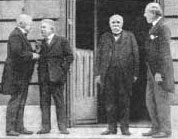
| The
Treaty of Versailles was signed by a conference of 32 world leaders,
representing 75% of the world's population. However negotiations
were dominated by the five countries who defeated the Central
Powers: France, Britain, US, Japan and Italy. The Versailles Treaty
saw the creation of the League of Nations, an international alliance
designed to prevent any such tragedy ever happening again. The
terms for the Central Powers were harsh, particularly for Germany,
who was forced to accept guilt for starting the war and provision
was made for the trial of the former Kaiser. While Germany only
signed the treaty under protest and the US congress refused to
ratify it, many people in Britain were angry that the Kaiser was
never tried. |
 |
The Great
War changed the world geography. The Austro-Hungarian and the Ottoman
empires were broken up, with many Eastern European states gaining
temporary independence, and the Arab states being divided among the
victors. The Kaiser of Germany abdicated, the Greek King Constantine
abdicated and the Russian royal family were first deposed, then executed.
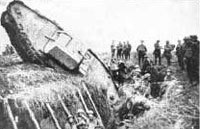
The majority of industrial land in northern France and Germany was
destroyed after years of shelling. Tanks and airpower became the new
staples of war and European cities were attacked from the air for
the first time.
For further
information look at Encyclopaedia
of the First World War. A web site designed for schools with lots
of details such as life in the trenches, the air war and the VADs.

< BACK
by Kirsten

