 1920s Costume Guide
Ladies
The 1920s saw a much freer style of dress than before the war. Gone
was the corset, though fashionable young women tried toflatten their
chests with rubber and cotton bust flatteners to conform to the slim
and sporty silhouette the new style demanded, and smoothed their hips
with a supportive long length suspender belt from waist to thigh.
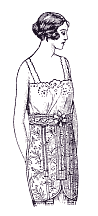
Underwear looks largely like a more practical and more supportive
version of combinations, made in pastel coloured satin and silk, lightweight
camiknickers gave a feminine edge to the new boyish chic. For nightwear
satin and silk pyjamas were popular. Housecoats were worn, which were
ornate versions of our dressing gowns. Flesh coloured fake silk stockings
were worn for all occasions. From 1923 anything Egyptian in style
was very stylish, with glamorous guests even arriving at parties in
a sarcophagus!
 Make
up was worn fairly commonly by the fashionable, dark eyes and red
lips, though a darker or less subtle red than we would be used to.
Popular were shiny eyes, created by smearing vaseline or greasepaint
on the top lid. Hair was almost universally bobbed, either straightened
or waved. However a few women kept their hair long and tied it in
a neat chignon at the back of their neck, with waves kept in place
with brilliantine around their face, or tried the double bun effect
later popularised in Science fiction.
Make
up was worn fairly commonly by the fashionable, dark eyes and red
lips, though a darker or less subtle red than we would be used to.
Popular were shiny eyes, created by smearing vaseline or greasepaint
on the top lid. Hair was almost universally bobbed, either straightened
or waved. However a few women kept their hair long and tied it in
a neat chignon at the back of their neck, with waves kept in place
with brilliantine around their face, or tried the double bun effect
later popularised in Science fiction.
 Day
Wear
Day
Wear
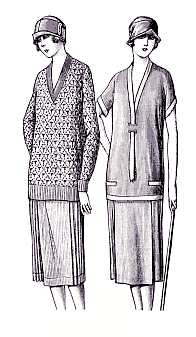
For daywear, dresses and suits often had drop waists, a straight bodice
and a slightly flared or pleated skirt, although highwaists continued
during the first half of the decade and often dresses were waistless.
Skirt length varied from ankle length in 1921 to just below the knee
in 1925 and stayed knee length or around mid-calf length for most
of the decade. Vogue described skirt lengths in 1923 "Skirt lengths
vary not only according to what designer creates them, and what lady
wears them but also according to the hour of the day when they are
worn". Trousers were only really worn by the daring for sports
as plus fours and jodhpurs or for pyjama style lounging at home. Both
dresses and suits were popular for day wear, usually with many trimmings,
such as fur cuffs, collar and hem, or swags around the dropped waist.
Shawl and sailor collars were popular. For sport and leisure ladies
dressed much more practically than before. A set of tweeds, with a
low-waisted, pocketed jacket and plus fours were popular for the country
and light coloured unadorned tennis dresses for the summer. Coats
were long, and matched the silhouette of the dress, with a side fastening
and an elaborate, often shawl, collar. Fairly plain colours were favoured
for day wear, such as navy blue, chocolate brown and sage green, with
cream and pastels for leisure and summer wear. It is also the era
of the woolly pully, a handknitted delight with v neck reaching to
mid thigh.
 Evening
Wear
Evening
Wear
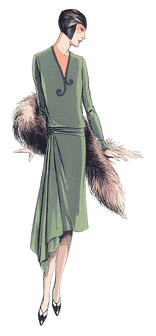
Evening dresses had a very similar silhouette, with the drop waist
and often floaty fabric but they were also very ornate. Grecian-style
drapes on the shoulder or around the waist, handkerchief hems and
elaborate beading and lace were popular. Fabrics were silk, satin,
crepe de chine, georgette and chiffon in pastel colours of mint green,
gold, pink, pale orange, lilac and black for the daring! Colours became
brighter as the decade progressed, In the early twenties the arrival
of the ballet Russe with designs by Bakst popularised rich oranges
and violets . Smoking clothes, usually some sort of pyjamas combined
with a headscarf, were worn by more flamboyant ladies, With outrageously
long cigarette holders darling.
Accessories
What really makes a 1920s outfit is the accessories. For day these
include hats, whether picture for summer, cloche for every day or
berets for winter wear; elaborate reticules and beaded bags, gloves
for evening and day, fur stoles and silk wraps, ostrich feather fans,
head bands and tiaras for evening and shoes with louis heels. Ladies
almost always had something on their heads, even if it was just a
scarf and of course strings of beads. Umbrellas and parasols were
needed depending on the weather.
Gentlemen
 Gentlemen's
fashion in the 1920s lies somewhat half way between the 1890s and
the 1950s. The fashion is again for a slim silhouette and menswear
is mostly fitted. For nightwear both the nightshirt and striped pyjamas
were popular, with a dressing gown. Men's underwear looks like exactly
the same sort of thing they wore for bathing: a vest and long shorts
all-in-one in either wool or cotton. Gentlemen's hair was short, parted
in the centre or the side or brushed back and held in place with hair
cream. Gentlemen were mostly clean shaven, or wore a small moustache.
Gentlemen's
fashion in the 1920s lies somewhat half way between the 1890s and
the 1950s. The fashion is again for a slim silhouette and menswear
is mostly fitted. For nightwear both the nightshirt and striped pyjamas
were popular, with a dressing gown. Men's underwear looks like exactly
the same sort of thing they wore for bathing: a vest and long shorts
all-in-one in either wool or cotton. Gentlemen's hair was short, parted
in the centre or the side or brushed back and held in place with hair
cream. Gentlemen were mostly clean shaven, or wore a small moustache.
Day
Wear
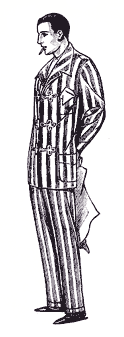
For day the three-piece suit rules, though the jacket is fitted so
that it goes in slightly at the waist, and can be either single or
double breasted. Trousers are slim-fitting and may have a turn up,
and will always have a needle-sharp crease down the centre front.
Shirts at the start of the decade have separate collars and may be
turned down or up (older gentlemen wear them up, younger chaps wear
them down), but by the end the collars are attached and are long and
pointed and turned down. Suits come in many styles and colours, navy
blue wool for the town, grey and brown stripes for the city, brown
and black checks for the country. For summer the blazer and a light
pair of linen trousers reign supreme. For sporting wear the Norfolk
suit is still de rigeur, with its plus fours, belted waist and 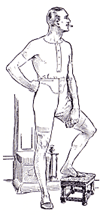 matching
cap. This suit was as good for a round of golf, as it was decimating
the local grouse population. Coats were long, made of wool and double
breasted. Oxford bags, a voluminous trouser worn like jogging bottoms
by the undergrads at the University enjoyed a brief vogue with the
younger set.
matching
cap. This suit was as good for a round of golf, as it was decimating
the local grouse population. Coats were long, made of wool and double
breasted. Oxford bags, a voluminous trouser worn like jogging bottoms
by the undergrads at the University enjoyed a brief vogue with the
younger set.
Evening Wear
For evening gentlemen still wear tails and white or black tie, depending
on the occasion, with their hat and cane if dining out or attending
the theatre. However the dinner suit was becoming acceptable, though
it is a slimmer and longer cut than is popular today. Generally it
looks like a 1970s dinner jacket, but with a slim collar. It doesn't
have any buttons, but has one fastening like a morning coat, which
holds the two sides together. After dinner gentlemen could change
into their smoking jacket. Stripy Pyjamas and a luxurious dressing
gown to finish the evening.
Accessories
Gentlemen of course always had their hats: bowlers for the city, caps
for the country, boaters for the summer and for everything else the
trilby. Other accessories include gloves, umbrellas and canes, pocket
watches and driving goggles. Shoes were plain lace ups, with gaiters
for the country or riding boots. Ties are worn rather than cravatsand
the way one ties ones tie may speak volumes about the wearer! No gentleman
will be seen without a small, yet exquisite and perfectly fresh buttonhole.
 <
BACK
<
BACK
by Kirsten & Jema

