When suggesting beginner birds for people I talk to, I usually suggest a budgie or a cockatiel. Both are very easy to care for, are small and not too much of an investment and don�t live a terribly long time, so if you feel you�ve made a mistake, it is not a lifetime mistake. Being a beginner myself, I would certainly never suggest that anyone go from a budgie to a macaw or African grey. How do you learn how to take care of a more demanding, longer-living parrot? Where are the parrots that are in-between the tiny, easy-going budgie and the emotionally demanding Cockatoo? Try one of the three P�s � Parrotlet, Poicephalus, or Pionus, the intermediate parrots. While not rare, they are not generally as well known by the public as are Budgies, Cockatiels, Cockatoos, etc.
Why do I call these three intermediate? Well, they don�t cost a ton of money, unless you get a rare species or color. They don�t live for 80 years, 20 to 40 is more like it IF you feed them the proper combination of 1/3 pellets, 1/3 fresh fruits & veggies, and 1/3 seed. They are a bit more demanding and require you to study a bit and hone your bird keeping skills, but they aren�t large enough to eat you or the couch, so are safe for less experienced owners. Come with me and take a look at these three endearing, mostly sweet, and highly intelligent species.
THE PARROTLET (FORPUS):
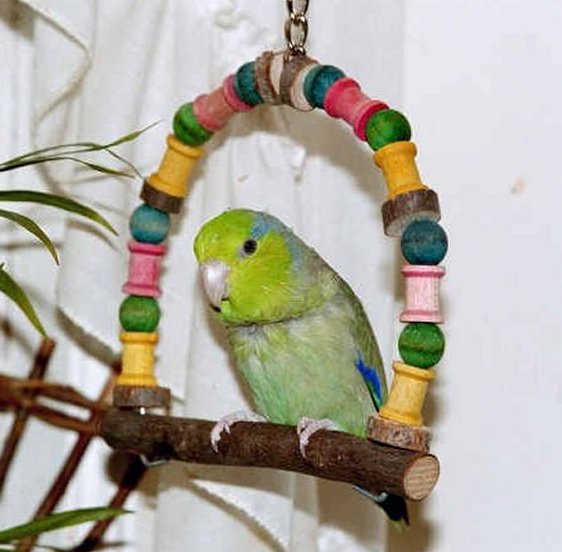
Let�s start out with the smallest, but by no means the easiest, the Parrotlet. These diminutive little Psitticines are a dwarfed version of their larger cousin, the Amazon. They are mostly green in color with varying amounts of yellow and blue markings and are indigenous to the Central and South America. The most common species you find in aviculture is the Pacific Parrotlet, but others are available (Green-rumped, Blue-winged, Mexican, Spectacled, and Yellow-faced). Most are sexually dimorphic, so you can tell male from female by looking. The tiny Parrotlet (4.5 to 5 inches) would be an ideal first bird, except for their intelligence and their boldness. These are NOT birds you can buy, put in a cage and forget about. They are extremely assertive and interactive and need lot of love and attention from their owners. A lot of them tend to bond to one person. They can be nippy and even though they haven�t the strength to demolish your finger like a larger parrot, bites from their sharp little beak can be irritating - so early and consistent training is a must in spite of their diminutive size. I know. I have one named Kiwi and I spoiled him rotten because he was so tiny. Not a good idea. Their closest living relative is the much larger Amazon, and Parrotlets need to be raised with most of the same rules as an Amazon or you could have a tiny terror on your hands. They must also always be supervised around other birds because of their fearlessness which can result in their attacking a much larger bird and being injured or killed.
Like Amazons, Parrotlet can be great talkers - not all Parrotlets, just like not all Amazons, but you have a good chance of having a talker if you buy a Parrotlet. Their vocabulary won�t be as extensive and their voices not as clear - they sound like tiny computers talking, but they are definitely not noisy by parrot standards. If you�ve ever been in a room with a gorgeous umbrella cockatoo, you know how ear-piercing their screams can be. While this is not a problem to a lot of parrot-lovers, it is to others, especially if your neighbors are within earshot, as in an apartment situation. Parrotlets just cannot get that loud. Most of the time you won�t hear them at all. They can scream when having a temper tantrum, but having such a tiny voice, you can still watch TV over it � I have!
Being tiny, the Parrotlet is less expensive to own, they don�t destroy toys, and can live in a smaller cage than most of their larger cousins. They do need plenty of toys and swings to keep them busy as they are very smart and fairly playful. A play stand would be ideal for their acrobatic natures. Most of all they need you � your love and attention are very necessary to their continued existence. As I said, this is not a bird to be ignored. The most negative aspect of these little guys is that they need to be in a home with supervision. A lot of Parrotlets never live out their lifespan, not because of illness (they are unusually hardy) but because of their tiny size. They are often the victim of household accidents. This probably wouldn�t be the pet for rowdy children, or for someone who demands complete docility. In spite of the negatives, which are few, these little guys can be equally as satisfying a pet as the larger Amazons with 1/10 the cost and trouble. Their devotion to their owner is only surpassed by the loving cockatoos. |