THE ST. VINCENT AMAZON
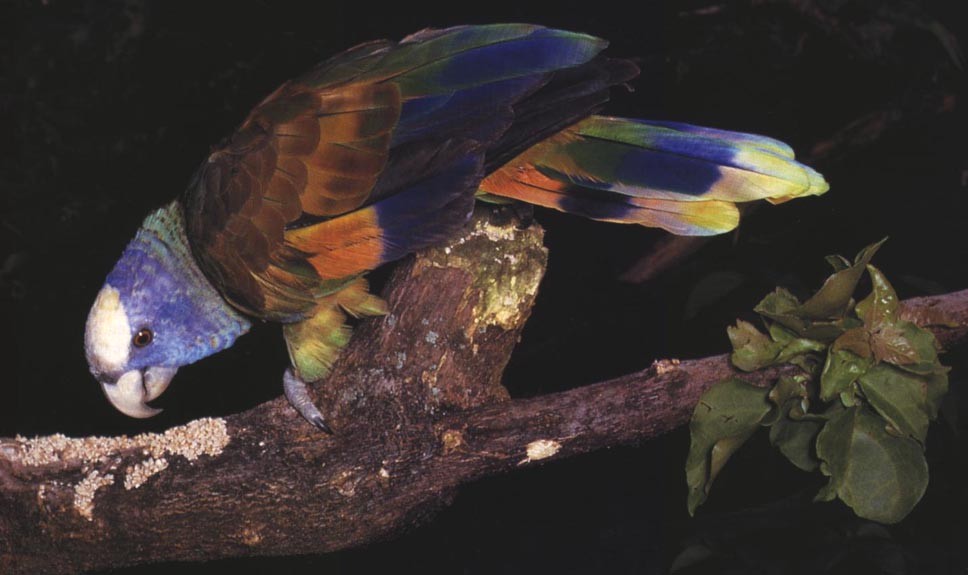
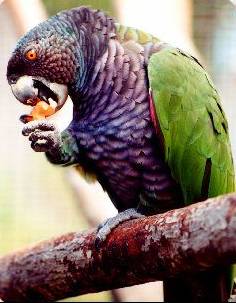
Did I say the Imperial Amazon was the largest and most beautiful bird in the genus Amazona? Well I lied. It is the largest, but �most beautiful� would depend on whether you prefer a lighter or darker bird. The St. Vincent Amazon, native to St. Vincent Island in the Lesser Antilles and its national symbol, should be called The Rainbow Amazon. Its forehead is white fading to shades of blue on the cheeks and shades of green, yellow, orange, copper and blue mixing on the wings, back and tail. The tail when flared has bronze, green & yellow stripes. It is truly a spectacular bird. It is about 16 inches long and like the Imperial a wide-bodied bird.
The St. Vincent Amazon is mostly confined to the central valleys of the tiny island. Like the Jaco and the Sisserou, it prefers to nest high in the forest canopy and lays three large white eggs that incubate for 26-28 days. The chicks leave the nest in 12-14 weeks. They travel in family groups eating fruits, seeds, vegetation and nuts.
Sadly, like the other two jewels, this one is endangered. Its story is much the same, predation, hunting, stolen for illegal trade, and the greatest impact to the species, habitat destruction. The government of St. Vincent�s has finally gotten behind the conservationists as it realizes that the 500+ birds that remain in the wild is an alarmingly small number. They have imposed fines on hunters and poachers, begun education programs and most importantly created a nature reserve to protect the nesting sites and create a sanctuary for their beloved national symbol.
In spite of all the efforts of conservationists and governments, these beautiful Amazons have been reduced to such small populations, that there is still the threat of extinction due to natural occurrences such as hurricanes and volcanic eruptions. To prevent the complete extinction of these species and in an attempt to keep enough birds to be reintroduced into the wild the Rare Species Conservatory Foundation and other conservation groups on the islands and in the U.S. have captive breeding programs. The RSCF has a facility in southern Florida that houses these critically endangered Amazons as well as other endangered flagship birds, mammals and small primates. Hopefully, these efforts and along with educating the public about habitat protection for all species and some good luck, none of these birds will disappear from the wild in our lifetime. A world without these Crown Jewels of the Caribbean is inconceivable and again I would like to quote author Mark Carwadine as I have in previous articles:
�Every animal and plant is an integral part of its environment... If they disappear, so could many other species. And conservation is very much in tune with our own survival. Animals and plants provide us with life-saving drugs and food, they pollinate crops and provide important ingredients for many industrial processes�.
�There is one last reason for caring, and I believe that no other is necessary. It is certainly the reason why so many people have devoted their lives to protecting the likes of rhinos, parakeets, kakapos, and dolphins. And it is simply this: the world would be a poorer, darker, lonelier place without them.�
|