| The Beautiful Hawk-headed Parrot A Taxonomic Anomaly |
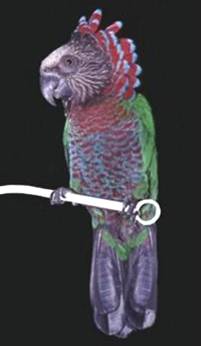
| Nothing is as intriguing to me as a species that is the ONLY member of its genus. OK, I�m a bit odd, but there are very few species that don�t have any �cousins� in the same genus. The genus Amazona, for instance, has many cousins, the Orange Wing Amazon, the Red Lored Amazon, the Lilac-crowned Amazon, etc. The genus Deroptyus contains only one species, Deroptyus accipintrinus, the Hawk-headed Parrot. I first saw one of these beauties in a parrot shop on Johnson Drive about 2 � years ago. He looked like a normal, though pretty parrot until I walked very close to him. Startled by this very unattractive creature invading his territory he turned to protect it and fluffed out all his feathers and raised his war bonnet to intimidate me with his ferocious size and attitude. Instead I was captivated and released an exclamation of awe tinged with laughter. There he stood, this tiny South American warrior, in all his brilliant, bonneted splendor. OK, I am rambling, but ever since then I�ve kept this memory of the strange and beautiful parrot. Then the other day I remembered that incident at the same time I was sitting near a computer and this is what I discovered. To say that hawk-headed parrots are endangered, is an understatement to the extreme. There are two sub-species, Deroptyus accinpintrinus and Deroptyus accinpintrinus fuscifrons. The differences in the two sub-species are slight. The buff-crowned (Deroptyus a. accipintrinus) is the smaller and more numerous of the two. It has whitish streaked feathers on the tops and sides of its head and the forehead is a dusty white. This is the bird most often seen in captivity. D. a. fuscifrons is larger, has a darker crown and its colors are brighter. Deroptyus a. fuscifrons is much rarer in captivity because it is from Brazil and the exportation of Brazilian wildlife has been banned. This ban has not saved the Brazilian hawk-head however because of massive deforestation and ever-increasing human population. There are tiny groups of a. fuscifrons in captivity. The Rare Species Conservatory Foundation (mentioned in my previous article on endangered Amazons), has two pairs of undetermined age, estimated between 30-50 years old, but they have yet to reproduce successfully in captivity. With less than 12 birds left in the wild, the future of the fuscifrons sub-species is very bleak indeed. Hawk-heads are distributed throughout a large portion of South America. They are found in Colombia, Ecuador, Peru, Venezuela, Guyana the northwestern portion of the Brazilian Amazon Rive basin. They do not however live in large groups, preferring to live in pairs or in small groups up to twenty. They spend most of their day in the treetops and fly low through the forest, not above the trees. Like most other parrots they nest in tree cavities, but unlike most other parrots they also can be found roosting in tree hollows at night while other parrots are content with a sheltered limb to roost on. They eat mostly fruit especially that of the palm tree plus berries, nuts, and seeds. In appearance, the hawk-headed parrot challenges the cockatoos of Australia for an amazing feather arrangement. They are the only parrot in South American that has a moveable ruff. The scalloping in the Hawk-head�s headdress is similar to that on the crest feathers of many hawks, thus the name. The colorful ruff, that can be raised, resembles nothing so much as an American Indian war bonnet. The feathers of the ruff are brightly banded with red and blue and make a spectacular and intimidating display when the parrot is angered or alarmed. This along with side-to-side swaying and very loud vocalizations is bound to scare off most predators or interlopers. The head is dark, surrounded by this mane, and the body is mostly green with some red and blue, especially on the tips of tail feathers, which are a brilliant blue. It is about 14 inches long and male and female are indistinguishable in appearance. If wild caught, these birds do not make good pets. In the wild they are extremely territorial and will pick a fight to the point of carelessness. When trappers use a call bird to lure other parrots down, they come down to investigate and socialize and are caught. The hawk-head comes down to fight and defend it territory and is so intent on murdering the interloper that they are easy prey for the trappers. On the other hand, domestic handfed birds are gregarious, outgoing and playful. Originally called hawk-headed caiques, they have a lot of the same clownish personality. They learn to speak easily and well and are usually able to say hello by the time they are two months old. They are much like an Amazon, but without the bite and unpredictability of Amazon temperament. Their call is loud and raucous and somewhat similar to that of a seagull. Because of their energy, pet Hawk-heads need a relatively large cage (minimum size is 30� wide X 24� deep). Bigger is even better as they prefer to fly from perch to perch instead of climbing like most of their parrot kin. An improper diet can lead to health and behavior issues, so read up if you are thinking about buying a hawk-head. Hawk-heads have proven to be quite a challenge to aviculturists. The first successful captive breeding occurred at the Brookfield Zoo in Chicago in 1965. Not enough is known about their breeding habits and in captivity mate aggression is a serious problem. Many experienced aviculturists have lost a mate of either sex. It isn�t always the males that do the killing. They may be unreliable parents and must not be disturbed when on the nest. They usually lay two eggs but rear only one chick. More must be learned of their behavior in the wild before captive breeding becomes easy. Their rarity in the wild, along with the difficulty of breeding in captivity, is the cause of their high cost as pets. Prices can range from $1,800 to $2,400 if you can find a breeder in your area at all. Currently, there are no coordinated conservation programs for either subspecies of this unusual and magnificent parrot. This is one of the reasons the Rare Species Conservancy has chosen the Hawk-headed parrot as one of its �flagship species�. These �flagship species� are chosen because humans prize them for one reason or another and they get more public attention than some of the less glamorous species that live in their ecosystem. By saving the habitat for them, it is saved for all the other forest creatures that live in that area. The permanent allocation of land through a national park or wildlife preserve is the first step in saving the hawk-head. Only through habitat protection can the hawk-headed parrot and all its neighbors in the forest be protected and preserved for future generations to enjoy in the wild. For more information & color photos see: www.oldworldaviaries.com www.rarespecies.org |
 |