
"This is what is written: The Christ [Messiah] will suffer and rise from the dead on the third day, and repentance and forgiveness of sins will be preached in his name to all nations, beginning at Jerusalem."
Jesus (Luke 24:46,47)
To all who received him (Jesus), to those who believed in his name, he gave the right to become children of God - children not born of natural descent, nor of human decision or a husband's will, but born of God. (John 1:12-13)
Jesus declared, "I tell you the truth, no one can see the kingdom of God unless he is born again."
"How can a man be born when he is old?" Nicodemus asked. "Surely he cannot enter a second time into his mother's womb to be born!"
Jesus answered, "I tell you the truth, no one can enter the kingdom of God unless he is born of water and the Spirit. Flesh gives birth to flesh, but the Spirit gives birth to spirit. You should not be surprised at my saying, 'You must be born again.' The wind blows wherever it pleases. You hear its sound, but you cannot tell where it comes from or where it is going. So it is with everyone born of the Spirit." (John 3:3-8)
"Just as Moses lifted up the snake in the desert, so the Son of Man must be lifted up, that everyone who believes in him may have eternal life"
Jesus (John 3:14-15)
"I will sprinkle clean water on you, and you will be clean; I will cleanse you from all you impurities and from all your idols. I will give you a new heart and put a new spirit in you; I will remove from you your heart of stone and give you a heart of flesh. And I will put my Spirit in you and move you to follow my decrees and be careful to keep my laws."
The Sovereign LORD (Ezekiel 36:25-27)
Central to & foremost in all our thinking must be the fact of God's love for all people, and that He wants us all to be a part of His kingdom when it comes in its fullness at the second coming of Jesus. God wants us to experience abundant life - a life free from oppressive powers and structures, and free from bondage to sin - and though this will only occur totally once the kingdom comes, we can in this age experience the power of the kingdom and live according to its values and thus begin living in the fullness of life which God had always intended for people.
Thus in summarising the life of Jesus, we can say that He came to announce, teach concerning, model, and make possible entry (through His faithfulness, death, & resurrection) into the Kingdom of God.
Now Jesus said that the only way for us to be able to enter His kingdom is to first be born again (cf John 3:3). This alpha step deals with just how a person comes to new birth.
The normal Christian birth is a fourfold package, normally in this order:
|
1. Repentance towards God |
|
â |
|
2. Faith in Christ |
|
â |
|
3. Baptism into the Name of Jesus |
|
â |
|
4. Spirit filling |
(Note that in the NT, the Gentiles often experienced 4 before 3, and 4 seemed to be intricately connected with 2, and often 1 also. I suggest that people experiencing 3 first will have 'complications' in their 'birth process'! )
Repentance essentially involves acknowledging that God is right; agreeing with God that your own ways have been corrupt and that you need Him and His power in your life (cf 2 Cor 7:9,10). This is the essence of confession, and is associated with a sense of conviction birthed by the Holy Spirit. That conviction has to find a place of solace & refuge; people need somewhere to go. And that somewhere is not in the Law, not in doing good works, not in being religious, but Jesus Christ Himself! We need to have faith in Him, that is, to believe what He said about Himself, that in His death and resurrection we have forgiveness of sins and now are totally acceptable to God, being 'washed clean'.
However, a person does not repent, that is, 'turn around and have a change of mind', without some prompting ordained by the Holy Spirit. It is always in response to the person 'hearing' the appropriate word from God for them (see "Helping others to be born again" later), either in a dream, vision, a still small inner voice, from a book, from the Bible, from creation itself (cf Romans 1:19-20), or from another person who has been sent by God to proclaim that word, all within the context of realising that one's own life somehow is missing 'fullnes of life'. As the apostle Paul outlined, Sending à Preaching à Hearing à Believing à Calling on the Name of the Lord à Salvation (Rom 10:10-15).
Now in our lives there may be many sinful activities which we need to turn away from and over which God will continually convict us of by His Holy Spirit so that we can thereafter grow up into ever more freedom, but there comes a once off decision in life in which we repent with a capital R: in which we make a decision to truly renounce our old way of living and wish to say publicly that we desire to die to that old way of life and wish to be identified with Jesus and the lifestyle He espouses, the lifestyle of the kingdom of God which not only is the best lifestyle, but also gives God the glory. This decision is publicly expressed in the act of baptism, in which one identifies himself/herself with Jesus' own death on the cross and His own resurrection to new life.
In response to such a decision, God 'comes to the party' and imparts His own gift to you individually, namely the promised Holy Spirit (cf Acts 1:9; 2:38,39), who is given for a twofold purpose.
Firstly, as part of the process of the Holy Spirit coming to reside within you, the spirit aspect of yourself is (re-)[?]created (cf 2 Cor 5:17; Hebrews 12:9). An aspect of our being (which was either dead, or 'shrivelled up', or for which there was always room) suddenly comes alive with the presence of the Holy Spirit, giving rise to the possibility of a new relationship with God as our heavenly Father. (Note that demon possession occurs most probably when a person opens themselves up to receiving an evil spirit in this realm of their being). Since Jesus said that His words were spirit and they were life (John 6:63), there is every reason to believe that what is actually happening is that when we exercise faith in God's word, we 'come alive' in our inner selves, because our heart takes into itself the life-giving word of God. When we act in unbelief, we are in fact having faith in 'the devil's words', and since he only comes to steal, kill, and destroy, it is no wonder we end up dying 'internally / spiritually'.
Secondly, the Holy Spirit resides within you so that you now have your own personal counsellor, adviser, and helper, just as Jesus was when He was on earth with the disciples back then, and who also empowers you with abilities or 'gifts' to fulfill His purposes on earth.
Thus we can see that receiving the Holy Spirit is essential to living out a lifestyle in accordance with the values of God's Kingdom, and as we 'walk in the Spirit', that is, listen to and obey His promptings, our minds will be renewed and we will really live life to the full! (Right belief determines right behaviour). Sometimes the Holy Spirit is given in response to faith before baptism is underwent, and sometimes it is afterwards in response to another Holy Spirit filled person praying for you - it all depends on what God's plan is for you - and the evidence that we have received the Holy Spirit is that we are able to speak in tongues &/or are able to rejoice greatly in God and praise Him, both being accompanied with the ability to call God 'Father'.
Having said the above, we can piece together other reasons from Scripture as to why we need new birth, and thus come up with a model of the human condition.
Firstly, Paul says that the flip side to God's desire for us to experience life to the full is that those who live according to the fallen evil desires of the flesh cannot inherit the kingdom of God (Galatians 5:21), because God is light and in Him there is no darkness at all (1 John 1:5); God hates sin and sin cannot stand in His presence.
Secondly, Paul describes sin as a 'principle', or 'virus', that lives within our flesh (Romans 7:20), and that is why we die physically (Romans 8:10). This sin principle is intricately connected to acquisitiveness or covetousness (cf Romans 7:7,8), rooted firmly in just fulfilling the desires of the flesh or 'stomach' (Philippians 3:19) apart from reason and concern for others. Thus there is a direct link between 'sin' and 'fulfilling the desires of the flesh' (cf James 1:14-15). Sin only comes into existence when we fulfill our fleshly desires with no reference to what is for the good of others - ie selfishness versus love - and it doesn't require a command to define what that good is (cf Romans 5:12-14). Furthermore, once it has come into existence, being a mind-state actively fed by our flesh desires, it can only be destroyed through 'death' and renewing of the mind.
Thirdly, it seems that our bodies were always subject to decay, or entropy, since creation, and that the tree of life was originally given as some sort of antidote to this physical decay (Genesis 2:9; Genesis 3:22).
This being said, we can posit that whilst God was responsible for the principle of death, we cannot say that He was responsible for our 'fall', where our consciences were awakened to the experiential knowledge of good and evil (Genesis 3:7,22). For although God gave the command to not eat, it seems that He also had endowed Adam with the ability to exercise faith, that is, to believe or not believe His word. God created Adam with the ability to choose, to have faith, to obey - that is, with a free will. It seems that He also had endowed Adam with the Holy Spirit (cf Genesis 2:7 and John 20:22) When Adam was offered the forbidden fruit by his wife, he had the choice to listen to God or listen to his wife, and he chose the latter. That was sin. It was at that point that I would say he "grieved the Holy Spirit" who had been given to him, suffering the pain of death in his spirit (note that the text does not say specifically that he 'died spiritually' or that the Holy Spirit was taken from him), and was also then kicked out of Eden and no longer able to eat of the tree of life, thus condemned to physical death.
In summary, then, I would say that the first humans were created as soulish creatures in physical bodies subject to decay, but also designed to be endowed with the Holy Spirit, given when God pleased (cf John 3:5-8), so that when it came to decision making in their wills they would also be able to 'consult God' and make decisions based on faith instead of just fulfilling the desires of the body! They also had access to the tree of life so that the decay principle within them could be overcome. Hypothetically also, their children would also have had the same 'composition', and it still would have been God's prerogative as to when He would have filled them with His Spirit.
But once Adam knowingly transgressed what He knew to be true, a new situation dawned. Whilst humans still had exactly the same composition as Adam, they no longer had access to the tree of life, thus being condemned to physical death from birth, and it also seems that God only chose to impart His Holy Spirit on select individuals as part of His great purpose. But since Jesus Christ and His resurrection, ascension, and pouring out the Spirit, it has been God's will that the Holy Spirit is given to all who call upon the name of God for salvation. Now we are restored to a state exactly like Adam, able to walk in His Spirit and thus experience an inner fullness of joy, yet still subject to physical death - but that will be overcome finally when Christ returns!
Thus the necessity of new birth is that it "completes our creation", enabling us to walk with God and thus also with others. And as we abide in the Holy Spirit we don't fulfill our bodily desires in a purely selfish fashion as we used to previously. It is only at our deaths and/or when Jesus returns that there will be a new body, transformed, and no longer subject to decay, and the Holy Spirit within us is the guarantee that this will happen (cf Eph 1:13,14). (Note that Jesus expected Nicodemus, as a teacher of Israel, to understand this spiritual dynamic in human existence - see John 3:9-10)
The following table 'Dimensions of Life' serves as an excellent summary of just what the human condition is.
Dimensions of Life
|
GOD'S DESIGN |
ACTIVE PRINCIPLE |
MANKIND'S PROBLEM |
CHRIST'S PROVISION |
|
SPIRIT Hebrews 4:12 |
GOD'S WORD |
DEATH BY SIN |
REBIRTH BY SPIRIT |
|
SOUL MIND WILL EMOTIONS |
DECISIONS BY FAITH |
DARKENED / BLINDED |
SPIRITUALLY RENEWED |
|
BODY SIGHT HEARING FEELING TASTE SMELL |
MEANINGFUL SERVICE |
DECAY |
REWARDING LIFE, |
(A table prepared by John Bell, Way of Life Ministries)
Further reflection on the above leads me to posit something more concerning the nature of the human spirit and will. Based on God's great command to us to love Him with all our heart, soul, and strength indicates most probably that the terms 'heart', 'spirit', and 'will' are interchangeable. This would then makes excellent sense of Ezekiel 36:26-27, where somehow God's Spirit comes in to be an 'energetic friend' of our wills, helping us to choose from our heart His ways. If this division of humankind is correct, it would therefore mean that our soul really only comprises the mind and emotions, and that our hearts or wills are the spirit aspect of our being, becoming hardened or 'dead' as we disobey the word given to us!! Consider the following diagrams:
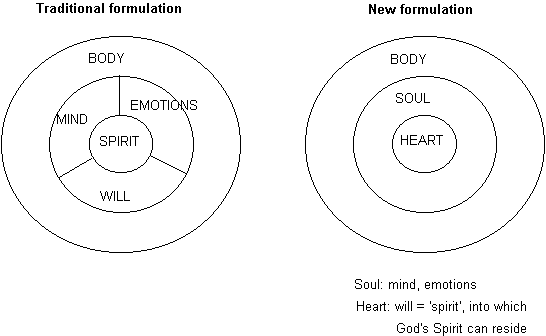
From this we can see that our "heart" is what makes us different from the animals. Moreover, the way God has designed us is that the soul resides in the body, and the heart within the soul. Or, putting it in computer terms, our bodies are the hardware, the soul is the software, and the heart is the ...... (artificial) intelligence???? (The fact that I am struggling for a complete analogy here shows me that a computer can never be 'human'!) So what makes us truly human is our wills, our hearts, our spirits. This is the 'image of God' stamped on us.
In reflecting on this, we can thus begin to understand more clearly what the Apostle Paul means when he exhorts us to "walk in the Spirit": I believe that what He is saying is that at the core of our beings, from our hearts, let us choose to make decisions which are in accord with the Spirit of God who comes to reside in us in a special way after we are born again (cf Revelation 3:20); let us walk in harmony with what He wants us to do. And if we do that, we can be sure that we won't do anything stupid, or destructive, or unwholesome. Wow!
Helping others to be born again
Now in the process of becoming born again as already described, the key element from a human perspective is what word from God shall we as Christians preach or communicate such that the listener will 'hear' and thus repent.
Whilst not diminishing the work of the Holy Spirit, of whom we are told that He will inspire us at the right times with the right words to say and the right actions to perform, and whilst also not diminishing the ability of the hearer to reject a word for them (as Jesus said "He who has ears to hear, let him hear"), we are able to examine the Scriptures to discern how the Holy Spirit acted on different occasions, thus discerning more effective from less effective ways of helping another person come to repentance.
Whilst the overall message to be preached is the good news that the Kingdom of God is here, and the kernel of the message to be communicated to all nations is repentance and forgiveness of sins in the name of Jesus because Christ died for our sins and was raised from the dead on the third day, this all, however, must be done in the context of how much the hearer already understands of the Gospel and what issues may be blocking that person from 'hearing' and thus believing the Gospel.
When we turn to the New Testament (NT) we can find a number of models of Gospel presentation, along with the 'results' of this preaching, to help us in our own day discern how to preach the Gospel. The following tables show us how the Gospel was preached pre- and post- Pentecost (being a succinct summary of the way Jesus and the apostles dealt with specific people groups):
Pre- Pentecost
|
Hearers |
Message / Approach |
Result |
|
Normal Jews - under Roman occupation and burdensome religious duties |
"The Kingdom is here! .... Come to me, & I will give you rest ....but expect my values and mission to be different to what you thought!" Miracles and demonstrations of compassion to demonstrate the presence of the Kingdom. |
Many followers to begin with, but as the implications of following became harder, many turned away. |
|
Samaritans - hated by the Jews |
Break down 'Jewish cultural & religious barriers' and demonstrate convincing proof that the Messiah was actually this Jesus. |
Many believed. |
|
'Religious elite Jews' |
Show them that they are actually hindering people from entering the Kingdom, having misunderstood the OT message. Refer them to OT prophecies as proof. |
Interested from a distance, but most strongly rejected Jesus' claims. |
Post- Pentecost
|
Hearers |
Message / Approach |
Result |
|
Normal Jews - under Roman occupation and burdensome religious duties |
Explain, with help of OT prophecies, that God has actually made this Jesus, who was crucified but raised to life again, both Lord and Christ, and the promised Holy Spirit has now been given. In response people need to repent, have faith, be baptised, and they will receive the Holy Spirit. |
Many believed and were baptised. |
|
Fanatic Jews |
Convince from OT that the suffering but resurrected Jesus is the promised Messiah. |
Continued to strongly reject Jesus' claims. |
|
Gentiles - God fearers |
Present Jesus, His life's ministry, death, and resurrection, as the context for preaching Him as Judge but also Saviour. Also demonstrate the values and power of the kingdom through love and miracles. |
Totally accepted the message. |
|
Gentiles - idolatrous |
Establish a right concept of God, humanity, their inter-relationship, judgement, and resurrection, into which Jesus as Judge and Saviour is preached. Plus miracles in demonstration of the presence of the Kingdom. Also demonstrate the values and power of the kingdom through love and miracles. |
Some rejected, some showed further interest, and a few believed and became followers. |
|
Gentiles - informed politicians |
Explain systematically the big picture of what God is up to in the world, integrating your own testimony. |
Being either afraid of the message, or just curiously interested, they remained uncommitted. |
These tables show us that Jesus and the apostles were lead by the Holy Spirit to preach according to how much the hearers already knew of the biblical meta-narrative, and to act in ways which would tangibly demonstrate the presence of the Kingdom. For example, note how in the above the Jews did not need it to be explained that the Messiah would be both Judge and Saviour, but that the Gentiles did need that aspect of the messianic mission explained. Furthermore, note that miracles were not done as 'show acts', but were rather demonstrations of compassion and responses to seeds of faith.
In the above we can also note the range of different responses depending on how much the hearers were truly God-fearing or not in their hearts, and that God seems to allow people time to change and grow in their outlook towards Him. This 'process of change' has been codified to some extent by James F. Engel:
The Engel Scale
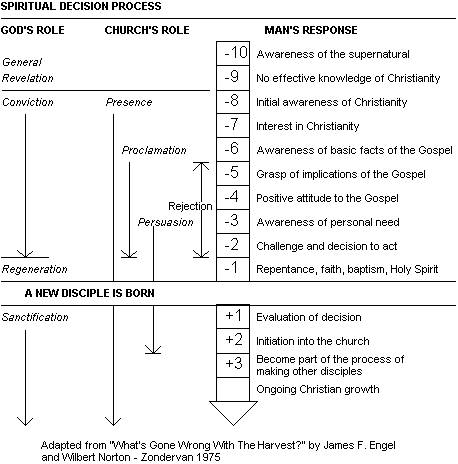
Combining all the above information, it seems that a good way to communicate the 'appropriate word of God' is to first of all assume nothing and be prepared to start at the bottom. Secondly, we must realise that it is not just what we say that will lead a person to repentance, but also our actions and lifestyle (as we noted earlier, when Jesus came to earth he had a holistic ministry - not only teaching but also modelling and living congruently to what He proclaimed). This can be done through what are Four Basic Evangelistic Steps in the context of a Spirit-Soul-Body Dynamic.
Before outlining these basic steps on evangelism, we should remember that evangelism begins with a revelation of the nature and character of God. The fundamental evangelistic questions are:
What is God like?
What is the nature of His relationship with the world?
And if we want to know what God is like, we look at the cross.
And if we want to understand the cross, we need to look at the Trinity.
With this in mind, let me present the essential four steps in leading someone to faith in Christ:
Four step evangelistic process |
(Short form) |
|
(1) Do you believe God exists? (the God of the Bible) |
(1) God of Bible exists? |
|
(2) Do you acknowledge the fact that you are a sinner, and realise that you cannot get rid of the guilt of this sin by yourself? |
(2) Sinner? |
|
(3) Do you believe that, out of God's great love for you, Jesus came in space, time, & history |
(3) God loves you? |
(4) Will you bow to this God and accept what Christ did as for you, personally & individually, taking your deserved punishment? |
(4) Turn from your sins to God, ask for forgiveness, bow to Jesus & make Him Lord of your life |
(Note that as an evangelist, one must be prepared in love to give cognitive reasons for each of the four steps and be able to address people's questions. This is what is called apologetics, and is addressed under 'Spirit-Soul-Body Dynamic' later.)
Step four will normally involve the hearer praying a prayer out loud similar to the following. In doing so they would be fulfilling Romans 10:9-13.
A prayer for salvation:
After this, it is appropriate to pray for the person, asking God to fill them with the Holy Spirit and to release His power within them.
Then it is appropriate to rejoice, because this person is being born again!!
Thereafter, there is no reason to withhold water baptism from them. A suggested baptismal formula is as follows: 'In the name of the Father and of the Son and of the Holy Spirit I baptise you into the Lord Jesus, into His death, his burial, and his resurrection.' After this it is again appropriate to lay hands on them, asking God to fill them with the Holy Spirit, especially if the signs of speaking in tongues, or great rejoicing in God and praising Him, accompanied with the ability to call God 'Father' have not yet been evident (note that a person is not 'properly' born again until this spontaneous spiritual speech is evident).
However, there are many things that can block a person from responding positively to each of these four steps. That's why we now need to look at the what I call the Spirit-Soul-Body Dynamic in helping someone give their allegiance to Christ.
As outlined earlier, a completed human being comprises three essential elements: a spirit, a soul (consisting of mind, will, and emotions), and a body (having senses of sight, hearing, touch, taste, and smell). The following diagram indicates how it is that God relates to us and we to God, and can be easily expanded to indicate how we communicate with each other as humans and how other forces in the spiritual realm can interface with us.
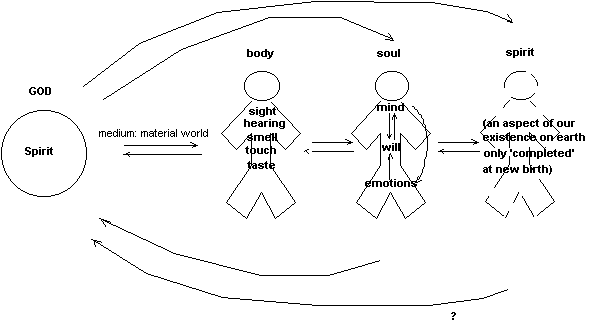
In the nature of how God created us, it is our wills that are at the centre of our beings and that ultimately must be brought to make a decision for Christ. In helping a person come to this decision, there are many players/factors, none of which should be underestimated or neglected:
|
God - Father Christians- prayers / intercessions - preaching the Word |
Unsaved - mind Demonic - blinding |
For a truly comprehensive approach at seeing someone come to faith, it stands to reason that the whole of the person should be addressed in helping them come to a decision with their will, as the following diagram indicates:
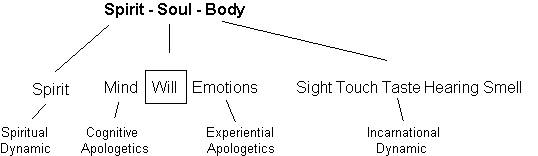
These aspects we will now begin to explore.
Spiritual Dynamic
In John 15:18 to 16:16 Jesus gives a good outline for us of the role of the Holy Spirit in helping people come to faith. In essence, Jesus said that the Holy Spirit would continue to be a witness to the person, teaching, and work of Jesus in the world, and that the disciples also would be such witnesses (cf John 15:26-27).
However, the role and work of the Holy Spirit varies depending on which type of person He is addressing. To the oppressed and those enslaved under the burden of sin, the Holy Spirit first plays a revelatory role, to make Christ 'clear' and to show that Christ is the 'way out'. It is only when a person refuses to listen to this revelation, and "doesn't hear", and makes wrong judgments about the person and work of Christ, that the Holy Spirit takes on a convicting role, being an advocate for Jesus against those wrong judgements. This is the context we find in John 16:8-11, where the "world" which needs convicting by the Holy Spirit is the Jewish leadership which rejected Christ.
So we can clearly see that apart from our own preaching and giving testimony to the truth concerning Jesus, the Holy Spirit is also at work along side us, even before us. But whilst we cannot predict the working of the Spirit - it is like the blowing of the wind (sometimes it is dead calm and other times it blows hard!) - we can pray for God to act by His Spirit to help people be set free. But how should we pray in order to be co-workers with God's Spirit?
Apart from ignorance, people may not be believing the truth about Jesus and the Gospel because of three things:
a) rebellion, stemming from pride and unbelief
b) false beliefs and thought structures (cf 2 Corinthians 10:4,5)
c) Satanic blinding (cf 2 Corinthians 4:3,4)
Therefore, we can pray that:
a) the Holy Spirit will convict them of their rebellious attitudes, unbelief, and pride
b) the Holy Spirit will tear down the false beliefs and thought structures
c) Satan will be bound and stopped from blinding their minds, in Jesus' name.
We also need to pray, as the apostle Paul requested, that:
d) the Holy Spirit will open a door for us to preach the message (Colossians 4:3)
e) we also may preach it clearly (Colossians 4:4)
f) the Holy Spirit would give us the very words to preach on each occasion (Ephesians 6:19).
It is also quite amazing to notice the power and effect of actually praying with a person who is not yet a believer, if they will allow you to do such, praying for them and also asking God to bless them. Apart from the fact that they sense you really do care, it allows the person to actually enter into your own personal relationship with God, thus bringing them into contact with God in a second-hand but very real way. I have personally noticed on a number of occasions how blessed and different the other person feels after I have prayed, with them often remarking that they felt different whilst I was praying for them. Perhaps it also relates to the what Jesus said in John 6:63 " ... The words I have spoken to you are spirit and they are life".
Cognitive Apologetics
Cognitive apologetics falls within the realm of a Christian reasoning the Word, focussing it on the mind and will of the unsaved person, whilst relying on the Holy Spirit to apply what is being said to their minds and binding demonic 'confusion tactics' etc. It corresponds to what Aristotle described as the logos factor in effective communication: what we say must make sense, there must be good reasons and sound arguments, and the organisation and language must be clear and understandable.
When it comes to talking or reasoning with people, it must be kept in mind that whether they are redeemed or not, by virtue of creation they are of value and have dignity and worth. Therefore at all stages we need to be affirming them. We need to beware of winning an argument but alienating the people! Successful apologetics occurs when a high relational dynamic is maintained, and we come with a desire to engage the person (over against 'Bible-bashing' or just having a one-way conversation) [see Experiential Apologetics below].
As mentioned earlier, we must be able to give reasonable answers to reasonable questions people may have at each of the four evangelistic steps noted earlier (at this point I would refer the reader to works by Josh McDowell, such as 'Evidence that demands a verdict', for some specific helpful detail). But when it comes to foundational questions about God, the Bible, and why a person should even bother listening to a Christian talk about Jesus, the works of Francis and Edith Schaeffer provide some brilliant apologetic material. Their work has been hammered out on the anvil of hundreds of discussions with questioning people from all over the world. Below I reproduce in short form what I have gleaned as the essence of Schaefferian apologetics, and sense is also an excellent foundation for all philosophic thinking (of which apologetics is a part):
|
Schaefferian apologetics in short The basic quest underlying all questions is really the search for an adequate worldview - ie which system of thought actually corresponds with reality. When a person asks "But is the Bible really true?", we need to take people back a step and help them first to appreciate what the Basic Questions are, and then find what the system taught in the Bible has in the way of answers. Two 'basic questions' must concern us in the first instance, and these deal with explaining: "The Universe and its form" - an amazing jigsaw puzzle"The Mannishness of Man" - personality; people are different from all other things in the world.There are two main alternative worldviews to that which is taught by Christianity: The West has a materialistic view and is non-religious The East has an immaterialistic view and is religious But both are impersonal systems. The result is that, in both the West and East, men and women are seen as abnormal aliens to the way things really are. In Eastern terms they are spoken of as maya or illusion. But the facts are that none of us actually live, or desire to live, our lives in that fashion. Therefore both of these systems are false, not being true to reality. Only Christianity truly accounts for personality, because it begins with the Infinite-Personal God. |
We can see that Schaeffer latched onto the truth that life is found not in practising a religion but in living congruently to a true worldview. And it is exactly at this point that we have rich entry points for speaking with people about the Gospel, because hardly anyone has even given thought as to what worldview they actually have, let alone bothered to investigate whether it is true to reality and actually will enable them to live life to the full! (Note: the modern secular mind is so 'fragmented'. Consider the popular expressions of worldview - art, music, film, literature - and you will see just what a mish-mash is out there!)
And when talking about 'truth' let us be clear what we mean here. Firstly, whilst we cannot know anything exhaustively, we can know it truly. That is, just because we cannot know something or someone exhaustively does not mean that I do not truly know it or them!
Secondly, truth cannot be relative; the laws of non-contradiction apply to reality. Consider the statement "My truth is my truth; your truth is your truth". This cannot hold true in reality, as can be clearly demonstrated by the following opposites: "My truth is I want to rape; your truth is you don't want to be raped". In this case it is not an issue of truth any more, but one of power.
Thirdly, the truth of a statement needs to be weighed against an 'undeniability test' (a test for truth) and an 'unaffirmability test' (a test for falsehood). Take, for example, the issue of my existence. While my own existence cannot be logically proven, it is nevertheless existentially undeniable. That means I cannot deny my existence without affirming it at the same time. As another example, just because something can be stated, it does not necessarily follow that the statement is true. "I cannot speak a word of English", may be passionately stated, but it cannot be affirmed at the same time.
This all allows us to say a final word on whether truth as a category really exists. In the post-modern world in which we exist today, many claim that there is no such thing as truth that corresponds to reality. But applying the above tests reveals that the statement defeats itself, because it implies that it is not reflective of reality!!
(For an extended treatment, see "Can Man Live Without God" by Ravi Zacharias, Word, 1994)
So, in helping another person to see whether their own worldview or religious or philosophical system is true, we need to help them examine and discern what it says about:
1. Origins - "where do we and this universe come from?"
2. Condition /State - "what is the present state of people and the universe?"
3. Salvation - "how will/can this present state be improved?"
4. Destiny - "what is the whole end purpose or goal of everything?"
And each of those four factors must be critiqued at five levels (sources of credibility):
1. Metaphysical critique (what are the origins?) cf Job chapter 38
2. Historical critique (did it happen?) cf Acts 17:31
3. Experiential critique (is it applicable?) cf Acts 9:22
4. Pragmatic critique (does it work for me?) cf John 9:25
5. Community critique (does it work for the community?) cf Acts 16:30-31
Correspondence (statements correspond to fact) and coherence (all the facts form a cohesive system) tests must apply over these five areas. As Schaeffer discerned for himself, only the Christian system as presented in the Bible and exemplified in the life of Jesus fully fits the bill. Our task as Christian apologists is to help others also come to the same conclusion, and to do so our apologetics must function philosophically at three levels:
1. the level of logical persuasion (that which can be demonstrated by argument)
· can I defend what I believe - is it logically tenable?
2. the level of experiential relevance (that which can be tested and illustrated by life)
· if everyone gave themselves the prerogatives of my philosophy, would there be harmony in existence - is it livable?
3. the level of prescriptive mandates (that which can be applied to others)
· do I have the right to make moral judgements in the daily matters of living - is it transferable?
With all these foundations laid, there should (hopefully) be intellectual space in the hearer to actual 'hear' what the Bible has in the way of answers.
Experiential Apologetics
As noted above under Cognitive Apologetics, when talking with people it must be done in an atmosphere of love and acceptance. It is no good winning an argument if the people are alienated, and so a genuine relational dynamic should be maintained.
It corresponds to what Aristotle described as the ethos and pathos factors in effective communication. Concerning ethos, a person must be able to sense that the communicator is a person of intelligence, character, and good will, and that they are informed, moral, and interested in their welfare. Concerning pathos, the listener will be able to sense if the communicator is identifying with their emotional state and relating to him/her at that entry level, and not being manipulative. Note that the ethos of the communicator is often known through their attempts at connecting with the pathos of the hearer.
This is especially important when dealing with cynical people for example, because underneath there is often a lot of hurt in them. We need to handle people with care and treat them with integrity and respect. Often as an evangelist you have to first 'cop a lot of crap' from people, and be around long enough, until they get deep down and they reveal the heart of the issue for them. Communication, or engagement, is to bring out commonality, hurts, and questions. We need to couple our attention to people's needs with probing, sensitive, sensible questions as we put ourselves in the world of somebody else in an appropriate way.
All this we see this beautifully and perfectly illustrated in the life of Jesus. Consider His approach in dealing with Zaccheus, the man ostracised from his fellow 'respectable' Jews not only perhaps because of his short stature but definitely because he was a tax collector for the Romans (cf Luke 19:1-9). The first thing Jesus did in response to seeing Zaccheus' desire to see Jesus was invite Himself to dinner at his house! It was in the context of this utmost sign of acceptance and solidarity that Zaccheus was opened up from within to be able to hear and respond to Jesus, and we read that it was in the process of the meal unfolding that he was transformed, giving his wrongly acquired wealth away.
The above tells us that how we experience the messenger is just as important, if not more so, than the message itself. Sometimes it is the experience of the message, registered by our emotions, that gets through our mental defences more than the actual spoken word, and that therefore challenges us to consider the cognitive word once again. And this is important, because ultimately for a person to live in harmony within himself/herself, thoughts held in the mind should be congruent with the decisions made in the will. Else there is cognitive dissonance leading to stress.
Incarnational Dynamic
And there can be no Emotional Apologetic without there first being the presence of the messenger. The word 'incarnate' means to 'embody in flesh'. God became flesh and modelled what He was on about, and God wants us to continue to embody His message, being His hands and feet. The listener should be able to see, hear, and touch, the content of the message, and in so doing becoming aware that perhaps this is something which they should really take on board for themselves.
A person hearing, seeing, reading about great works done in the name of Jesus can often not help but want to know more. We see this again in the life of Jesus - the miracles he did as physical demonstrations of the presence of the Kingdom drew a hearing from many people. And today the same. Our deeds, whether miraculous on par with those of Jesus, or perceived as miraculous by those around us (eg reaching out a hand in love to someone who thought they were beyond love), can influence and bless people more than we know.
And it is this last point which must not be overlooked. The greatest miracle anyone can perceive is the reception and participation in true love. God is love, and when God became flesh in the life of Jesus, love became flesh, and people were converted. People were attracted by Jesus' great miracles, but they were converted and began to worship Him when they experienced His love and grace (consider Luke 7:36-50). And Jesus prays that His followers will continue to be the visible manifestation, the enfleshment, of love.
"I pray also for those who will believe in me through their message, that all of them may be one, Father, just as you are in me and I am in you. May they also be in us so that the world may believe that you have sent me. I have given them the glory that you gave me, that they may be one as we are one: I in them and you in me. May they be brought to complete unity to let the world know that you sent me and have loved them even as you have loved me."
Jesus (John 17:20-23).
As someone has said: "There is no conversion without there first being incarnation".
To be an effective evangelist to see people genuinely born again into the Kingdom of God, one needs to know the following:
a) the four basic evangelistic steps
b) a prayer to pray for conversion, and then asking for the filling of the Holy Spirit
c) apologetic issues at each of the four steps
d) awareness of different cultural / knowledge contexts for preaching the gospel, and what not to assume
e) how prayer, fasting, and spiritual warfare comes into play, along with the moving of the Holy Spirit.
f) conversation starters / openings
g) the importance of living a life of integrity
And finally, referring back to the earlier tables of pre- and post- Pentecost preaching models, we can now attempt to expand them to include the different types of people we encounter today:
Post- Pentecost, year 2002 AD
|
Hearers |
Message / Approach |
|
Middle Eastern - Islamic |
Emphasising the positives of their God-fearing lifestyle, begin to break down Western-Christendom barriers to accepting Jesus as Messiah, as well as how their own book contradicts the message of the Torah, OT, and Injil with respect to the necessity of a sacrifice for sins, culminating in the death of Jesus. |
|
Westerner - Sacramentalised but not Evangelised |
Present Jesus, His life's ministry, death, and resurrection, as the context for preaching Him as Judge but also Saviour, and refer to the necessity of living by and being filled with the Holy Spirit. |
|
Westerner - 'Christian-memory' |
(see 'Four Basic Evangelistic Steps' & 'Spirit-Soul-Body Dynamic') |
|
Westerner - Atheistic |
(see 'Four Basic Evangelistic Steps' & 'Spirit-Soul-Body Dynamic') |
|
Easterner - Hindu, Buddhist etc |
(see 'Four Basic Evangelistic Steps' & 'Spirit-Soul-Body Dynamic') (Note that Saivite Hindus, and many of the Eastern religions, have many stories, illustrations, & parables that can be redeemed and given 'fullness of meaning' within the historical Christ narratives. Many Easterners truly are seeking to be freed from 'ego', selfishness, 'the flesh' so as to please God - we can offer them certainty and power through the death & resurrection of Christ!) |
|
other ... |
(see 'Four Basic Evangelistic Steps' & 'Spirit-Soul-Body Dynamic') |