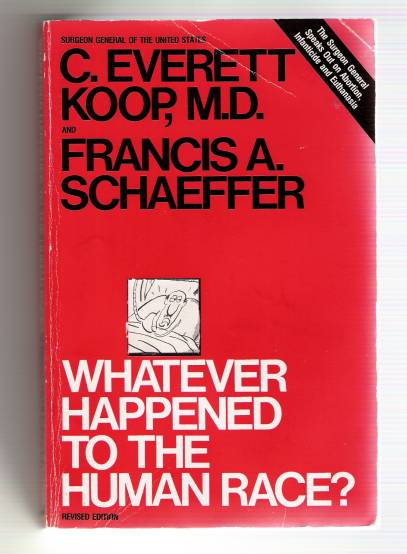
Whatever Happened to the Human Race?
Revised Edition
Copyright ©1979, 1983 by Francis A. Schaeffer and C. Everett Koop.
Chapter Four
(pages 78-113)
The Basis for Human Dignity
Used by permission of Crossway Books, a division of Good News Publishers, Wheaton, Illinois, 60187,
www.gnpcb.org
I hope this chapter blesses you as much as it does me, and helps you answer the question, "Why Should I Believe?"
Introduction
Materialistic Humanism: The World-View of Our Era
The Search for an Adequate World-View: A Question of Method
How Do We Know We Know?
The Meaninglessness of All Things
The Relativity of Morals
Relieving the Tension in the West
Relieving the Tension in the East
Reason Is Dead
Long Live Experience!
The New Mysticism
The Unveiling of Truth
The Personal Origin of Man
Freedom Within Form
The Importance of Genesis
Notes
Introduction
So far in this book we have been considering an evil as great as any practiced in human history. Our society has put to death its own offspring, millions upon millions of them. Our society has justified taking their lives, even claiming it a virtue to do so. It has been said that this is a new step in our progress toward a liberated humanity.
Such a situation has not come out of a vacuum. Each of us has an overall way of looking at the world, which influences what we do day by day. This is what we call a "world-view." And all of us have a world-view, whether we realize it or not. We act in accordance with our world-view, and our world-view rests on what to us is the ultimate truth.
Materialistic Humanism: The World-View of Our Era
What has produced the inhumanity we have been considering in the previous chapters is that society in the West has adopted a world-view which says that all reality is made up only of matter. This view is sometimes referred to as philosophic materialism, because it holds that only matter exists; sometimes it is called naturalism, because it says that no supernatural exists. Humanism which begins from man alone and makes man the measure of all things usually is materialistic in its philosophy. Whatever the label, this is the underlying world-view of our society today. In this view the universe did not get here because it was created by a "supernatural" God. Rather, the universe has existed forever in some form, and its present form just happened as a result of chance events way back in time.
Society in the West has largely rested on the base that God exists and that the Bible is true. In all sorts of ways this view affected the society. The materialistic or naturalistic or humanistic world-view almost always takes a superior attitude toward Christianity. Those who hold such a view have argued that Christianity is unscientific, that it cannot be proved, that it belongs simply to the realm of "faith." Christianity, they say, rests only on faith, while humanism rests on facts.
Professor Edmund R. Leach of Cambridge University expressed this view clearly:
Our idea of God is a product of history. What I now believe about the supernatural is derived from what I was taught by my parents, and what they taught me was derived from what they were taught, and so on. But such beliefs are justified by faith alone, never by reason, and the true believer is expected to go on reaffirming his faith in the same verbal formula even if the passage of history and the growth of scientific knowledge should have turned the words into plain nonsense.
78
So some humanists act as if they have a great advantage over Christians. They act as if the advance of science and technology and a better understanding of history (through such concepts as the evolutionary theory) have all made the idea of God and Creation quite ridiculous.
This superior attitude, however, is strange because one of the most striking developments in the last half-century is the growth of a profound pessimism among both the well-educated and less-educated people. The thinkers in our society have been admitting for a long time that they have no final answers at all.
Take Woody Allen, for example. Most people know his as a comedian, but he has thought through where mankind stands after the "religious answers" have been abandoned. In an article in Esquire (May 1977), he says that man is left with:
... alienation, loneliness [and] emptiness verging on madness.... The fundamental thing behind all motivation and all activity is the constant struggle against annihilation and against death. It's absolutely stupefying in its terror, and it renders anyone's accomplishments meaningless. As Camus wrote, it's not only that he (the individual) dies, or that man (as a whole) dies, but that you struggle to do a work of art that will last and then you realize that the universe itself is not going to exist after a period of time. Until those issues are resolved within each person - religiously or psychologically or existentially - the social and political issues will never be resolved, except in a slapdash way.
Allen sums up his view in his film Annie Hall with these words: "Life is divided into the horrible and the miserable."
Many would like to dismiss this sort of statement as coming from one who is merely a pessimist by temperament, one who sees life without the benefit of a sense of humor. Woody Allen does not allow us that luxury. He speaks as a human being who has simply looked life in the face and has the courage to say what he sees. If there is no personal God, nothing beyond what our eyes can see and our hands can touch, then Woody Allen is right: life is both meaningless and terrifying. As the famous artist Paul Gauguin wrote on his last painting shortly before he tried to commit suicide: "Whence come we? What are we? Whither do we go?" The answers are nowhere, nothing, and nowhere. The humanist H. J. Blackham has expressed this with a dramatic illustration:
On humanist assumptions, life leads to nothing, and every pretense that it does not is a deceit. If there is a bridge over a gorge which spans only half the distance and ends in mid-air, and if the bridge is crowded with human beings pressing on, one after the other they fall into the abyss. The bridge leads nowhere, and those who are pressing forward to cross it are going nowhere....It does not matter where they think they are going, what preparations for the journey they may have made, how much they may be enjoying it all. The objection merely points out objectively that such a situation is a model of futility.
79
One does not have to be highly educated to understand this. It follows directly from the starting point of the humanists' position, namely, that everything is just matter. That is, that which has existed forever and ever is only some form of matter or energy, and everything in our world now is this and only this in a more or less complex form. Thus, Jacob Bronowski says in The Identity of Man (1965): "Man is a part of nature, in the same sense that a stone is, or a cactus, or a camel." In this view, men and women are by chance more complex, but not unique.
Within this world-view there is no room for believing that a human being has any final distinct value above that of an animal or of nonliving matter. People are merely a different arrangement of molecules. There are two points, therefore, that need to be made about the humanist world-view. First, the superior attitude toward Christianity - as if Christianity had all the problems and humanism had all the answers - is quite unjustified. The humanists of the Enlightenment two centuries ago thought they were going to find all the answers, but as time has passed, this optimistic hope has been proved wrong. It is their own descendants, those who share their materialistic world-view, who have been saying louder and louder as the years have passed, "There are no final answers."
Second, this humanist world-view has also brought us to the present devaluation of human life - not technology and not overcrowding, although these have played a part. And this same world-view has given us no limits to prevent us from sliding into an even worse devaluation of human life in the future.
So it is naive and irresponsible to imagine that this world-view will reverse the direction in the future. A well-meaning commitment to "do what is right" will not be sufficient. Without a firm set of principles that flows out of a world-view that gives adequate reason for a unique value to all human life, there cannot be and will not be any substantial resistance to the present evil brought on by the low view of human life we have been considering in previous chapters. It was the materialistic world-view that brought in the inhumanity; it must be a different world-view that drives it out.
An emotional uneasiness about abortion, infanticide, euthanasia, and the abuse of genetic knowledge is not enough. To stand against the present devaluation of human life, a significant percentage of people within our society must adopt and live by a world-view which not only hopes or intends to give a basis for human dignity but which really does. The radical movements of the sixties were right to hope for a better world; they were right to protest against the shallowness and falseness of our plastic society. But their radicalness lasted only during the life span of the adolescence of their members. Although these movements claimed to be radical, they lacked a sufficient root. Their world-view was incapable of giving life to the aspirations of its adherents. Why? Because it, too - like the society they were condemning - had no sufficient base. So protests are not enough. Having the right ideals is not enough. Even those with a very short memory, those who can look back only to the sixties, can see that there must be more than that. A truly radical alternative has to be found.
But where? And how?
The Search for an Adequate World-View: A Question of Method
Before we consider various possibilities, we must settle the question of method. What is it we are expecting our "answer" to answer?
There are a number of things we could consider, but at this point we want to concentrate on just two. The first is what we will call "the universe and its form," and the second is "the mannishness of man." The first draws attention to the fact that the universe around us is like an amazing jigsaw puzzle. We see many details, and we want to know how they fit together. That is what science is all about. Scientists look at the details and try to find out how they all cohere. So the first question that has to be answered is: how did the universe get this way? How did it get this form, this pattern, this jigsawlike quality it now has?
Second, "the mannishness of man" draws attention to the fact that human beings are different from all other things in the world. Think, for example, of creativity. People in all cultures of all ages have created many kinds of things, from "High Art" to flower arrangements, from silver ornaments to high-technology supersonic aircraft. This is in contrast to the animals about us. People also fear death, and they have the aspiration to truly choose. Incidentally, even those who in their writings say we only think we choose quickly fall into words and phrases that only make sense if they are wrong and we do truly choose. Human beings are also unique in that they verbalize. That is, people put concrete and abstract concepts into words which communicate these concepts to other people. People also have an inner life of the mind; they remember the past and make projections into the future. One could name other factors, but these are enough to differentiate people from other things in the world.
What world-view adequately explains the remarkable phenomenon of the distinctiveness of human beings? There is one world-view which can explain the explain the existence of the universe, its form, and the uniqueness of people - the world-view given to us in the Bible. There is a remarkable parallel between the way scientists go about checking to see if what they think about reality does in fact correspond to it and the way the biblical world-view can be checked to see if it is true.
Many people, however, react strongly against this sort of claim. They see the problem - Where has everything come from and why is it the way it is? - but they do not want to consider a solution which involves God. God, they say, belongs to "religion," and religious answers, they say, do not deal with facts. Only science deals with facts. Thus, they say, Christian answers are not real answers; they are "faith answers."
This is a strange reaction, because modern people pride themselves on being open to new ideas, on being willing to consider opinions which contradict what has been believed for a long time. They think this is what "being scientific" necessitates. Suddenly, however, when one crosses into the area of the "big" and most basic questions (like those we are considering now) with an answer involving God, the shutters are pulled down, the open mind closes and a very different attitude, a dogmatic rationalism, takes over.80
This is curious -first, because few seem to notice that the humanist explanations of the big and most basic questions is just as much a "faith answer" as any could be. With the humanist world-view everything begins with only matter; whatever has developed has developed only within matter, a reordering of matter by chance.
Even though materialistic scientists have no scientific understanding of why things exist, nor any certain scientific understanding of how life began, and even though this world-view leaves them with vast problems - the problems Woody Allen has described of "alienation, loneliness [and] emptiness verging on madness" - many modern people still reject at once any solution which uses the word God, in favor of the materialistic humanist "answer" which answers nothing. This is simply prejudice at work.
We need to understand, however, that this prejudice is both recent and arbitrary. Professor Ernest Becker, who taught at the University of California at Berkeley and San Francisco State College, said that for the last half-million years people have always believed in two worlds - one that was visible and one that was invisible. The visible world was where they lived their everyday lives; the invisible world was more powerful, for the meaning and existence of the visible world was dependent on it. Suddenly in the last century and a half, as the ideas of the Enlightenment have spread to the whole of Western culture, we have been told quite arbitrarily that there is no invisible world. This has become dogma for many secular people today.
Christians try to answer prejudices like these by pointing out that the biblical system does not have to be accepted blindly, any more than the scientific hypotheses have to be accepted blindly. What a scientist does is to examine certain phenomena in the world. He then casts about for an explanation that will make sense of these phenomena. That is the hypothesis. But the hypothesis has to be checked. So a careful checking operation is set up, designed to see if there is, in fact, a correspondence between what has been observed and what has been hypothesized. If it does correspond, a scientist accepts the explanation as correct; if it does not, he rejects it as false and looks for an alternative explanation. Depending on how substantially the statement has been "verified," it becomes accepted as a "law" within science, such as the law of gravity or the second law of thermodynamics.
What we should notice is the method. It is rather like trying to find the right key to fit a particular lock. We try the first key and then the next and the next until finally, if we are fortunate, one of them fits. The same principle applies, so Christians maintain, when we consider the big questions. Here are the phenomena. What key unlocks their meaning? What explanation is correct?
We may consider the materialistic humanist alternative, the Eastern religious alternative, and so on. But each of these leaves at least a part of these most basic questions unanswered. So we turn to examine the Christian alternative.
Obviously, Christians do not look on the Bible as simply an alternative. As Christians we consider it to be objectively true, because we have found that it does give the answers both in knowledge and in life. For the purposes of discussion, however, we invite non-Christians to consider it as an alternative - not to be accepted blindly, but for good and sufficient reasons.
But note this - the physical scientist does something very easy, compared to those who tackle the really important and central questions for mankind. He examines a tiny portion of the real world - a leaf, a cell, an atom, a particle - and, because these things are not personal and obey very precise laws, he is able to arrive at explanations with relative ease. C. F. A. Pantin, who was professor of zoology at Cambridge University, once said: "Very clever men are answering the relatively easy questions of the natural examination paper." This is not to disparage physical science. It works consistently with its own principles of investigation, looking further and further into the material of the world around us. But it only looks at part of the world. As Professor W. H. Thorpe of Cambridge University says, it is "a deliberate restriction to certain areas of our total experience - a technique for understanding certain parts of that experience and achieving mastery over nature."
We are not then moving from definite things to indefinite things, when we look at those aspects of our experience which are more central than the study of an individual physical thing such as a leaf, a cell, an atom, or a particle. Rather, we are turning from a small part of reality to a larger part of reality. Picture a scientist for a moment: he is looking at a particular detail and carrying out his scientific investigation according to the recognized procedures. We have already discussed the method he uses to find the answers. Now we need to draw back and consider the whole phenomenon we are looking at, that is, the scientist carrying out his experiment. When the scientist is seated at his desk, he is able to find answers to his questions only because he has made two colossal assumptions about his situation, in fact about the entire world. He is assuming first of all that the things he is looking at do fit together somehow, even if some areas - such as particle physics - cannot at this time be fitted into a simple explanation. If the scientist did not assume that the things he is studying somehow fit together, he would not be trying to find an answer. Second, he is assuming that he as a person is able to find answers.
In other words, the big questions constitute the very framework within which the scientist is operating. To quote Thorpe again, "I recently heard one of the most distinguished theoretical scientists state that his own scientific drive was based on two fundamental attitudes: a conviction of his own responsibility and an awe at the beauty and harmony of nature." So we have to resist any suggestion that to be involved in answering the big questions is somehow to be getting further and further away from "the real world."
The opposite is the case. It is as we come to these big questions that we approach the real world that every one of us is living in twenty-four hours a day - the world of real persons who can think and so work out problems such as how to get to the other side of town, persons who can love, persons who can make moral decisions. These are, in other words, the phenomena which cry out for an adequate explanation. These are the things we know best about ourselves and the world around us. What world-view can encompass them?
C. S. Lewis pointed out that there are only two alternatives to the Christian answer - the humanist philosophy of the West and the pantheist philosophy of the East. We would agree. We agree, too, with his observation that Eastern philosophy is an "opposite" to the Christian system, but we shall look at that later. For the present our attention is directed toward the materialistic world-view of the West.
From time to time we read in the press or hear on the radio that an oil tanker has run aground on rocks and that the crude oil is being driven by the wind and currents onto an otherwise beautiful coast. We can picture the problem of humanism in that way. There is a rock on which all humanist philosophy must run aground. It is the problem of relative knowledge and relative morality or, to put it another way, the problem of finiteness or limitation. Even if mankind now had perfect moral integrity regarding the world, people would still be finite. People are limited. This fact, coupled with the rejection of the possibility of having answers from God, leads humanists into the problem of relative knowledge. There has been no alternative to this relativity for the past 200 years, and there can be no alternative within the humanist world-view. That is what we want to show now.
How Do We Know We Know?
During the early stages of modern philosophy (as distinguished from medieval philosophy) - that is, around the seventeenth century in Europe - the question that was troubling philosophers was this: how do we know that we know?
The early modern scientists had made advances in the physical sciences by rejecting previous human authority. For example, they rejected much of what had been inherited from the science of the Middle Ages. At that time, investigation had been governed and restrained by the concepts of Aristotle. In the field of astronomy, this had meant that the Ptolemaic system held sway. Suddenly, observations were made which cast doubt on that entire system of understanding the heavenly bodies. The result was, of course, the Copernican revolution: the discovery that the sun does not move around the earth but, rather, the earth around the sun. Thus, a general attitude was developed toward the ideas which had prevailed till then. The scientists said, "We must not accept the ideas passed down to us or derived from various previous authorities. We must start from scratch and simply observe the world and see how it works. Otherwise, we may be hampered from seeing what is there."
The early modern scientists did not, however, reject the knowledge that God gave in the Bible as they rejected previous human authority and opinion. For example. in Novum Organum (1620) Francis Bacon wrote: "To conclude, therefore, let no man out of weak conceit of sobriety, or an ill applied moderation, think or maintain that a man can search too far of be too well studied in the book of God's word, or in the book of God's works."81 "The book of God's word" is the Bible. "The book of God's works" is the world which God has made.
Modern scientists in general lived, thought, and worked in the framework of rejecting human authority, while respecting what was taught in the Bible in regard to the cosmos - right up to the time of Michael Faraday and James Clerk Maxwell in the second half of the nineteenth century.
The philosophers (and later the materialistic scientists) went further. Their error was to confuse the escape from past human authority (which was indeed confining) with putting man at the center and rejecting God's authority as well. They wanted to reject all outside authority. They wanted to establish everything only on human observation. That was how the question of epistemology (how we know we know) became so important in modern philosophy. It has remained so right up to our own day.
The philosopher who first raised these questions was Rene Descartes (1596-1650). Descartes wrote in Meditations on First Philosophy:
How often it happened to me that in the night I dreamt that I found myself on this particular place ... whilst in reality I was lying on my bed! At this moment it does seem that it is with eyes awake that I am looking at this paper .... But in thinking over this I remind myself that on many occasions I have in sleep been deceived by similar illusions, and in dwelling carefully on this reflection I see so manifestly that there are no certain indications by which we may clearly distinguish wakefulness from sleep that I am lost in astonishment. And my astonishment is such that it is almost capable of persuading me that I now dream.
82
Here is the modern epistemological problem expressed three centuries ago! All knowledge comes through the senses, but how can we rely on our own senses? Sometimes, as in dreaming, we seem to be experiencing things very really, yet the reality is only in our heads.
We are reminded of the 1966 film by Michelangelo Antonioni called Blow-Up, in which one of the central issues was this same question. A photographer had taken a picture of a murdered man in a park in London and then became uncertain whether this was, in fact, part of reality or an experience of fantasy similar to a drug trip. Within the humanist world-view there is no final way of telling. And Antonioni ends his film by making the point graphically. Tennis players play the game without a ball. The invisible "ball" goes back and forth and the spectators watch its "path" from side to side until finally the "ball" (which does not exist) goes out over the surrounding wire and "falls" at the photographer's feet. He pauses for a moment, uncertain about what he should do. (Is observation simply a matter of the majority? Does the reality of things come from the general agreement in society and nothing more?) Then the photographer stoops down, picks up the "ball," and throws it back onto the court. Here, depicted brilliantly, is the problem of any system which builds its epistemology on man alone. This film was a philosophic statement of the period in which we are living.
Take another example out of the history of this new approach in philosophy, that of David Hume (1711-1776). In 1732 he shocked the world with A Treatise of Human Nature. John Locke (1632-1704) had already denied the concept of "innate ideas" of right and wrong; that is, Locke denied that these ideas are inherent in the mind from birth. This had troubled many. Then Hume burst on the scene with a challenge which went further.
What was most startling was his progression beyond skepticism concerning God and other things of the "invisible world" to a skepticism about the visible world as well. Among other things, he questioned the concept of causality. That is, Hume challenged the notion that there is a reality in the external world which leads us to speak about one thing as being the cause of another. When we see a tree bending and swaying and its leaves falling to the ground and racing off across the field, we naturally speak of the wind as causing this phenomenon. Hume challenged this.
Following on from Locke, who said that all knowledge comes only from the senses, Hume argued that causality is not perceived by the senses. What we perceive are two events following closely upon each other. It was custom, he argued, which led us to speak in terms of causality, not any objective "force" working in the things themselves. Anyone can see where this thinking leads, and it was so understood at the time. If causality is not real, science becomes impossible - for what scientists are doing is tracing the path of cause and effect from one event to the next.
A modern British humanist, Kathleen Nott, has written perceptively about Hume in Objections to Humanism (1967): "Among great philosophers, Hume ... hung his nose as far as any over the nihilistic abyss."
83 This is right. Hume was questioning the most basic elements of our experience. Yet he was trying to be consistent to his presuppositions (that is, his starting point). Where did this lead him? To a skepticism about knowledge itself. Hume wrote designedly against the Christian world-view which prevailed in England at the time. He wanted to dismantle the system of ideas which came out of the Bible, of a God before whom man was responsible, of people being more than matter, of a life after death which seemed to defy all natural law. Where he ended, though, was with uncertainty even about the ordinary things of life. As Kathleen Nott continues: "Hume's philosophizing was indeed a radical skepticism, which left no convincing logical grounds for believing that anything natural, let alone supernatural, was there at all."84
But there is something even more striking about Hume. Skepticism was the direction in which his philosophy led him; yet he was not able to live with it himself. He "hung his nose over the nihilistic abyss" - and we can picture him standing on the edge and peering over - but what then? Nott says he "withdrew it sharply when he saw the psychological risks involved." Hume himself said in A Treatise of Human Nature (Volume I):
Should it be asked me whether I sincerely assent to this argument which I have been to such pains to inculcate, and whether I be really one of those skeptics who hold that all is uncertain ... I ... should reply ... that neither I nor any other person was ever sincerely and constantly of that opinion ... I dine, I play backgammon, I converse and am merry with my friends; and when, after 3 or 4 hours amusement, I would return to these speculations, they appear so cold and strained and ridiculous that I cannot find in my heart to enter into them any further. Thus the skeptic still continues to reason and believe, though he asserts that he cannot defend his reason by reason; and by the same rule, he must assent to the principle concerning the existence of body, though he cannot pretend, by any argument of philosophy, to maintain its veracity.
85
We believe there are only two basic alternatives in the search for the source of knowledge. One is that a person attempts to find the answers to all his questions alone. The other is that he seeks revealed truths from God. We shall come to the second later. Now we are looking at the former, and we are suggesting that this is the basic problem with which all humanistic systems must wrestle: the problem of knowledge.
We could go into many other details concerning the subsequent history of the ideas we have dealt with, including in particular Immanuel Kant (1724-1804) and his own "Copernican revolution" in philosophy and also the developments surrounding Ludwig Wittgenstein (1889-1951) and linguistic philosophy in the twentieth century. We shall stop here, partly to keep the discussion of modern philosophy from becoming too technical, but mainly because the basic difficulties had already been expressed within a century of the birth of modern philosophy.
Starting with himself, a person cannot establish an adequate explanation for the amazing possibility that he can observe the world around him and be assured that his observations have a correspondence with reality. The problem is not just that a person cannot know everything. The need is not for exhaustive knowledge; the need is for a base for any knowledge at all. That is, even though we know we cannot exhaustively perceive even the smallest things in our experience, we want assurance that we have really perceived something - that is "perception" is not simply an "image" in our brain, a model or symbol of reality which we have projected out from ourselves. We want to know that we have had a real contact with reality. Even Hume had to admit that his philosophizing did not make sense, that it did not fit into his own experience of the world. On the humanist side this is the great tension - to have no reason for reason and yet at the same time to have to live continuously on the reality of reason.
At this point, someone is bound to ask, "But why is it necessary to have an `adequate explanation' for knowledge?" Agreeing that Descartes, Hume, and others could find no theoretical base which tied in with their experience, isn't it sufficient to just reason? Probably many of you have been wanting to ask this, as you have followed along. It is a good question, for the bulk of the world never bothers about the issues which Locke, Hume, and others like them raised. Most people simply live, going about their daily lives, never troubling themselves about reality and fantasy, the subject and the object, and so on. And we are not suggesting that their experience in itself is invalid, as if to imply that they are not perceiving and knowing the universe around them. They are. What we are saying is that - whether they know it or not - their experience is possible only because they are living in the universe the Bible describes, that is, in a universe which was created by God. Their internal faculty of knowing was made by God to correspond to the world and its form which He made and which surrounds them.
If, however, we attempt to bypass the question, "Why is it possible for man to have knowledge in this way?" we must then remember the other two great problems any system which starts only from man. Recall the illustration of the oil tanker and the rock. The rock is the problem of knowledge which we have been considering. That is the central problem. But there are two forms of pollution which flow from the broken ship of knowledge: first, the meaninglessness of all things and, second, the relativity of morals.
The Meaninglessness of All Things
An overwhelming number of modern thinkers agree that seeing the universe and man from a humanist base leads to meaninglessness, both for the universe and for man - not just mankind in general but for each of us as individuals. Professor Steven Weinberg of Harvard University and the Smithsonian Astrophysical Observatory has written a book entitled The First Three Minutes: A Modern View of the Origin of the Universe (1976). Here he explains, as clearly as probably anyone has ever done, the modern materialistic view of the universe and its origin.
But when his explanation is finished and he is looking down at the earth from an airplane, as Weinberg writes, "It is very hard to realize that this all is just a tiny part of an overwhelmingly hostile universe ... [which] has evolved from an unspeakably unfamiliar early condition, and faces a future extinction of endless cold or intolerable heat. The more the universe seems comprehensible, the more it also seems pointless."86
When Weinberg says that the universe seems more "comprehensible," he is, of course, referring to our greater understanding of the physical universe through the advance of science. But it is an understanding, notice, within, a materialistic framework, which considers the universe solely in terms of physics and chemistry - simply machinery. Here lies the irony. It is comprehension of a sort, but it is like giving a blind person sight, only to remove anything seeable. As we heard Woody Allen saying earlier, such a view of reality is "absolutely stupefying in its terror, and it renders anyone's accomplishments meaningless."
So, to the person who wants to be left alone without explanations for the big questions, we must say very gently, "Look at what you are left alone with." This is not merely rhetoric. As the decades of this century have slipped by, more and more have said the same thing as Steven Weinberg and Woody Allen. It has become an obvious thing to say. The tremendous optimism of the nineteenth century, which stemmed from the Enlightenment of the eighteenth century, has gradually ebbed away.
If everything "faces a future extinction of endless cold or intolerable heat," all things are meaningless. This is the first problem, the first form of pollution. The second is just as bad.
The Relativity of Morals
The material universe in itself gives no basis for values. Those who begin with the material universe can describe but they can never define. They can speak only in the indicative, never in the imperative. They can describe, for example, what physical strength involves and how it works physiologically, but from the material universe alone they cannot derive any idea as to how strength ought and ought not to be used. The most they can do is argue that certain moral systems have been worked out through the passage of time on the basis of "social contact." This is what we call the 51 percent view of morality - the majority has thought such and such is a good way to operate and so it becomes "morality." What confusion! What disaster! With this view any action can be justified, and our own very recent history has given us appalling examples.
Aldous Huxley said it all clearly in the thirties in his brilliant little novel Brave New World. In it he pictures a society which has reversed the morality of the present, especially in the area of sexual relationships. Faithfulness within a unique love relationship becomes "evil"; promiscuity becomes "good."87
Here then is the humanist dilemma. They have to generate the answers to the big questions, but out of their own limited experience they can know nothing with certainty. If we were to add up the thinking of all of mankind, we would still have only limited knowledge. Truth with a capital T - explanations which would be true for all time and all people - would be impossible.
What is left, therefore, is "relative" truth, and with relative truth, relative morality. Given time, even the "certainties" of our ethical systems can be undone - the bills of rights, the charters of freedom, the principles of justice, everything. Aleksandr Solzhenitsyn understands this not only as a theoretical problem of a humanistic philosophy. He has suffered under its implications. He writes:
Communism has never concealed the fact that it rejects all absolute concepts of morality. It scoffs at good and evil as indisputable categories. Communism considers morality to be relative. Depending upon circumstances, any act, including the killing of thousands, could be good or bad. It all depends upon class ideology, defined by a handful of people .... It is considered awkward to use seriously such words as good and evil. But if we are to be deprived of these concepts, what will be left? We will decline to the status of animals.
We in the West must understand that it is not only Iron Curtain countries who operate on the basis of relative morality. Now the West does, too. The materialist world-view has dominated the thinking of the West just as much. Therefore we can expect to see the same inhumanity here, just as Solzhenitsyn has warned. We must not sit back and think, It could never happen here. Worse still, we must not be confused into thinking the issue is principally or only military or economic power. The issue is more subtle, more immediate, a cancerlike growth which is in our midst right now - the materialist philosophy which underlies the Western humanistic world-view. Marx may have proposed an economic system different from our own, but we have shared his basic world-view.
The greatest dilemma for those who hold this world-view, however, is that it is impossible to live consistently within it. We saw how this was true of David Hume. Likewise the playwright Samuel Beckett can "say" that words do not communicate anything - and that everything, including language, is absurd - yet he must use words to write his plays, even plays about meaninglessness. If the words that Beckett uses did not convey meaning to his hearers, he could not say that everything, including words, is meaningless.
The list of contradictions can be extended endlessly. The truth is that everyone who rejects the biblical world-view must live in a state of tension between ideas about reality and reality itself.
Thus, if a person believes that everything is only matter or energy and carries this through consistently, meaning dies, morality dies, love dies, hope dies. Yet! The individual does love, does hope, does act on the basis of right and wrong. This is what we mean when we say that everyone is caught, regardless of his world-view, simply by the way things are. No one can make his own universe to live in.
The reason for this, as we have said all along, is that the individual is confronted with two aspects or reality that do not basically change: the universe and its form and the mannishness of man. Humanists argue that everything is finally only matter or energy and end up with no answers to the big questions. They arrive at only meaninglessness, relative morality, relative knowledge. But humanists actually live as if there is meaning and real morality. They act, for example, as if cruelty is not the same as noncruelty, or justice the same as injustice. Also, humanists do have knowledge, knowledge of a world in which causality is real and science is possible.
Exactly the same dilemma exists with the other main alternative to Christianity: the philosophies of the East. Despite their many differences, all of these philosophies flow out of the view that ultimately everything is impersonal. The universe we are experiencing, the Eastern philosophers say, is simply an extension of God, but - and here we need to be careful - they do not mean that God is personal. "God" means the "impersonal everything," which has no final distinctions. So, within this view, the solution is to say we must get rid of those aspirations that are personal, those things that make us seem to be independent entities, entirely independent selves. Such an idea is maya, that is, "illusion."
In the Eastern thinking, the only reality is one beyond all distinctions and therefore impersonal: no "male" or "female," no "you" or "me," no "good" or "evil." It is important to note that Eastern thinkers come to exactly the same place as those who begin by saying that everything is matter or energy. At first the two positions sound very different, but they result in the same final position.
And so we ask again: Can a person espousing this Eastern world-view live consistently with it? In his 1974 book Zen and the Art of Motorcycle Maintenance, Robert M. Pirsig relates an interesting anecdote. The author, who calls himself Phaedrus in the story, studied philosophy at Benares University for about ten years. He tells how his time there came to an end.
One day in the classroom the professor of philosophy was blithely expounding on the illusory nature of the world for what seemed the fiftieth time and Phaedrus raised his hand and asked coldly if it was believed that the atomic bombs that had dropped on Hiroshima and Nagasaki were illusory. The professor smiled and said yes. That was the end of the exchange.
...Within the traditions of Indian philosophy that answer may have been correct, but for Phaedrus and for anyone else who reads newspapers regularly and is concerned with such things as mass destruction of human beings that answer was hopelessly inadequate. He left the classroom, left India and gave up.
88
There are, then, only two main alternative world-views to Christianity, both of which begin with the impersonal. The West has a materialistic view and is nonreligious. The East has an immaterialistic view and is religious. But both are impersonal systems. This is the important point; by comparison, their differences pale into insignificance. The result is that, in both the West and the East, men and women are seen as abnormal aliens to the way things really are. In Eastern terms they are spoken of as maya or illusion; in Western terms, as absurd machines.
Relieving the Tension in the West
In both the East and the West, however, there are attempts to relieve the tension of seeming to be nothing, while in fact being something very real - a person in a real world which has a definite form. On the materialist side, Sir Julian Huxley (1887-1975) has clarified the dilemma by acknowledging, though he was an atheist, that somehow or other - against all that one might expect - a person functions better if he acts as though God exists. "So," the argument goes, "God does not in fact exist, but act as if He does!" As observed by the Norwegian playwright Henrik Ibsen (1828-1906) in The Wild Duck: "Rob the average man of his life-illusion, and you rob him of his happiness at the same stroke." In other words, according to Huxley, you can function properly only if you live your whole life upon a lie. You act as if God exists, which to the materialist is false. At first this sounds like a feasible solution for relieving the tension produced by a materialist world-view. However, a moment's reflection shows what a terrible solution it is. You will find no deeper despair than this for a sensitive person. This is no optimistic, happy, reasonable, brilliant answer. It is darkness and death.
Another way the tension is relieved is through the theory of evolution, the idea that by chance there is an increasing advance. People are given an impression of progress - up from the primeval slime and the amoeba, up through the evolutionary chain, with life developing by chance from the simple carbon molecule to the complex, right up to the pinnacle, mankind.
This is not the place to discuss evolutionary theory, but it surprises us how readily people accept it, even on the scientific side, as if it had no problems. There are problems, even if these are not commonly realized or discussed.89 The primary point we are interested in, however, is not evolution itself but the illusion of "progress" which has been granted by it. By chance, this amazing complexity called "man" has been generated out of the slime. So, of course, there is progress! By this argument people are led into imagining that the whole of reality does have purpose even if, as we have said, there is no way that it really can have purpose within the humanistic world-view.
Evolution makes men and women feel superior and at the top of the pile, but in the materialistic framework, the whole of reality is meaningless; the concept of "higher" means nothing. Even if, within the humanist world-view, people are more complex than plants and animals, both "higher" and "lower" have no meanings. We are left with everything being sad and absurd.
Thus, the concept of progress is an illusion. Only some form of mystical jump will allow us to accept that personality comes from impersonality.90 No one has offered to explain, let alone demonstrate it to be feasible, how the impersonal plus time plus chance can give personality. We are distracted by a flourish of words - and, lo, personality has appeared out of a hat.
Imagine a universe made up of only liquids and solids, one containing no free gases. A fish is swimming in this universe. This fish, quite naturally, is conformed to its environment so that it is able to exist quite happily. Let us suppose, then, that by blind chance (as the evolutionists would have us believe) this fish developed lungs as it continued swimming in this universe without any gases. The fish would no longer be able to function and to fulfill its position as a fish. Would it then be "higher" or "lower" in its new state with lungs? Obviously it would be lower, for it would drown.
In the same way, if a person has been kicked up from the impersonal by chance, those things that make him a person - hope of purpose and significance, love, notions of morality and rationality and beauty - are ultimately unfulfillable and are thus meaningless. In such a situation, is man higher or lower? Mankind would then be the lowest creature on the scale, the least conforming to what reality is. Thus we see how hopeless is the illusion of meaning or purpose as derived from evolutionary thought.
Relieving the Tension in the East
Within Eastern thinking, attempts to relieve the tension have been made by introducing "personal gods." To the uninitiated these gods seem to be real persons; they are said to appear to human beings and even have sexual intercourse with them. But they are not really personal. Behind them their source is the "impersonal everything" of which they are simply emanations. We find a multitude of gods and goddesses with their attendant mythologies, like the Ramayana, which then give the simple person a "feeling" of personality in the universe. People need this, because it is hard to live as if there is nothing out there in or beyond the universe to which they can relate personally. The initiated, however, understand. They know that ultimate reality is impersonal. So they submit themselves to the various techniques of the Eastern religions to eliminate their "personness." Their goal is to achieve a state of consciousness not bounded by the body and the senses or even by such ideals as "love" or "good."
Probably the most sophisticated Eastern attempt to deal with the tension we are considering is the Bhagavad-Gita. This is a religious writing probably produced around 200 B.C. in India. It has been the inspiration for multitudes of Hindus through the centuries and most notably for Indian spiritual and political leader Mahatma Gandhi. In it the individual is urged to participate in acts of charity. At the same time, however, the individual is urged to enter into these acts in "a spirit of detachment." Why? Because the proper attitude is to understand that none of these experiences really matter. It is the state of consciousness that rises above personality which is important, for personality is, after all, an abnormality within the impersonal universe.
Alternatively, the East proposes a system of "endless cycles" to try to give some explanation for things which exist about us. This has sometimes been likened to the ocean. The ocean casts up waves for a time, but the waves are still a part of the ocean, and then the waves pull back into the ocean and disappear. Interestingly enough, the Western materialist also tries to explain the form of the universe by a theory of endless cycles. He says that impersonal material or energy always exists, but that this goes through endless cycles, taking different forms - the latest of which began with the "big bang" which spawned the present expanding universe. Previously, billions and billions of years ago, this eternal material or energy had a different form and had contracted into the heavy mass from which came the present cycle of our universe. Both the Eastern thought and the Western put forth this unproven idea of endless cycles because their answers finally answer nothing.
We have emphasized the problems involved in these two alternatives because they are real. It is helpful to see that the only serious intellectual alternatives to the Christian position have such endless difficulties that they actually are nonanswers. We do it, too, because we find people in the West who imagine that Christianity has nothing to say on these big issues and who discard the Bible without ever considering it. This superior attitude, as we said earlier, is quite unfounded. The real situation is very different. The humanists of the Enlightenment acted as if they would conquer all before them, but two centuries have changed that.
One would have imagined at this point that Western man would have been glad for a solution to the various dilemmas facing him and would have welcomed answers to the big questions. But people are not as eager to find the truth as is sometimes made out. The history of Western thought during the past century confirms this.
Reason Is Dead
The hallmark of the Enlightenment had been "Reason Is King." The leading thinkers had consciously rejected the need for revelation. As Paul Hazard in European Thought in the Eighteenth Century says, they put Christianity on trial.91
Gradually, however, the problems of this enthronement of human reason emerged. The reason of man was not big enough to handle the big questions, and what man was left with relative knowledge and relative morality. The noose around the humanist's neck tightened with every passing decade and generation.
What would he do?
Ironically, even though the basis of the humanists' whole endeavor had been the central importance of man's reason, when faced with the problems of relative knowledge and relative morality they repudiated reason. Rather than admit defeat in front of God's revelation, the humanists extended the revolution further - and in a direction which would have been quite unthinkable to their eighteenth-century predecessors. Modern irrationalism was born.
We could go back as far as Immanuel Kant (1724-1804) in philosophy and to Friedrich Schleiermacher (1768-1834) in theology. Modern existentialism is also related to Søren Kierkegaard (1813-1855). However, our intention here is neither to go into the history of irrationalism, nor to examine the proponents of existentialism in our own century, but rather to concentrate on its main thesis. It is this that confronts us on all sides today, and it is impossible to understand modern man without understanding this concept.
Because we shall be using several terms a great deal now, we would ask the reader to attend carefully. When we speak of irrationalism or existentialism or the existential methodology, we are pointing to a quite simple idea. It may have been expressed in a variety of complicated ways by philosophers, but it is not a difficult concept.
Imagine that you are at the movies watching a suspense film. As the story unfolds, the tension increases until finally the hero is trapped in some impossible situation and everyone is groaning inwardly, wondering how he is going to get out of the mess. The suspense is heightened by the knowledge (of the audience, not the hero) that help is on the way in the form of the good guys. The only question is: will the good guys arrive in time?
Now imagine for a moment that the audience is slipped the information that there are no good guys, that the situation of the hero is not just desperate, but completely hopeless. Obviously, the first thing that would happen is that the suspense would be gone. You and the entire audience would simply be waiting for the axe to fall.
If the hero faced the end with courage, this would be morally edifying, but the situation itself would be tragic. If, however, the hero acted as if help were around the corner and kept buoying himself up with this thought ("Someone is on the way!" - "Help is at hand!"), all you could feel for him would be pity. It would be a means to keep hope alive within a hopeless situation. The hero's hope would change nothing on the outside; it would be unable to manufacture, out of nothing, good guys coming to the rescue. All it would achieve would the hero's own mental state of hopefulness rather than hopelessness.
The hopefulness itself would rest on a lie or an illusion and thus, viewed objectively, would be finally absurd. And if the hero really knew what the situation was, but consciously used the falsehood to buoy up his feelings and go whistling along, we would either say, "Poor guy!" or "He's a fool." It is this kind of conscious deceit that someone like Woody Allen has looked full in the face and will have none of.
Now this is what the existential methodology is about. If the universe we are living in is what the materialistic humanists say it is, then with our reason (when we stop to think about it) we could find absolutely no way to have meaning or morality or hope or beauty. This would plunge us into despair. We would have to take seriously the challenge of Albert Camus (1913-1960) in the first sentence of The Myth of Sisyphus: "There is but one truly serious philosophical problem, and that is suicide."92 Why stay alive in an absurd universe? Ah! But that is not where we stop. We say to ourselves - "There is hope!" (even though there is no help). "We shall overcome!" (even though nothing is more certain than that we shall be destroyed, both individually at death and cosmically with the end of all conscious life). This is what confronts us on all sides today: the modern irrationalism.
Long Live Experience!
Another way to understand all this is to say that modern man has become a mystic. The word mystic makes people think immediately of a religious person - praying for hours, using techniques of meditation, and so on. Of course, the word mysticism includes this, but modern mysticism is different in a profound way. As the late Professor H. R. Rookmaaker of the Free University of Amsterdam said, modern mysticism is "a nihilistic mysticism, for God is dead."
The mystics within the Christian tradition (Meister Eckhart in the thirteenth century, for example) believed in an objective personal God. But, they said, though God is really there, the mind is not the way to reach Him. On the other hand, modern mysticism comes from a quite different background, and this we must be clear about.
When modern philosophers realized they were not going to be able to find answers on the basis of reason, they crossed over in one way or another to the remarkable position of saying, "That doesn't matter!" Even though there are no answers by way of the mind, we will find them without the mind. The "answer" - whatever that may be - is to be "experienced," for it cannot be thought. Notice, the answer is not to be the experience of an objective and supernatural God whom, as the medieval mystics thought, it was difficult to understand with the mind. The developments we are considering came after Friedrich Nietzsche (1884-1900) had celebrated the "death of God," after the materialist philosophy had worked its way throughout the culture and created skepticism about the supernatural.
The modern mystic, therefore, is not trying to "feel" his way to a God he believes is really there (but whom he cannot approach by way of the mind). The modern mystic does not know if anything is there. All he knows is that he cannot know anything ultimate through the mind. So what is left is experience as experience. This is the key to understanding modern man in the West: Forget your mind; just experience! It may seem extreme - but we say it carefully - this is the philosophy by which the majority of people in the West are now living. For everyday purposes the mind is a useful instrument, but for the things of meaning, for the answers to the big questions, it is set aside.
"Whatever Reality may be, it is beyond the conception of the finite intellect; if follows that attempts at descriptions are misleading, unprofitable, and a waste of time." That is a quotation from a modern Buddhist in the West. The secular existentialists may seem a long way from such an Eastern formulation about reality, but their rejection of the intellect as a means of finding answers amounts to the same thing. That is what the existentialist "revolt," as it has been called, is. It is a revolt against the mind, a passionate rejection of the Enlightenment ideal of reason. As Professor William Barrett of New York University has put it: "Existentialism is the counter-Enlightenment come at last to philosophic expression."93
The way to handle philosophy, according to the existential methodology, is not by the use of the mind that considers (impersonally and objectively) propositions about reality. Rather, the way to deal with the big questions is by relying only on the individual's experience. That which is being considered is not necessarily an experience of something that really exists. What is involved is the experience as an experience, whether or not any objective reality is being experienced. We are reminded of our imaginary hero who said, "Help is coming," and therefore kept himself going, even though he had no reason to think any help existed. It is the experience as the experience that counts, and that is the end of it.
There are, of course, some valuable insights in what the existentialists have said. For one, they were right to protest against scientism and the impersonalism of much post-Enlightenment thought. They were right to point out that answers have to be "lived" and not just "thought." (We will say more about this in Chapter 6.) But their rejection of the mind is no solution to anything. It seems like a solution but is in fact a counsel of despair.
Having started with the apparently different positions of the Buddhist and the secular existentialist, we should now look at the culture at large. One of the "cultural breakpoints" was Haight-Ashbury in the sixties. There the counterculture, the drug culture, was born. Writing about the experience of Ken Kesey and his Merry Pranksters in the early days of Haight-Ashbury, Tom Wolfe says,
Gradually the Prankster attitude began to involve the main things religious mystics have always felt, things common to Hindus, Buddhists, Christians, and for that matter Theosophists and even flying-saucer cultists. Namely, the experiencing of an Other World, a higher level of reality....
Every vision, every insight...came out of the new experience....And how to get it across to the multitudes who have never had this experience for themselves? You couldn't put it into words. You had to create conditions in which they would feel an approximation of that feeling, the sublime kairos (italics added).
Do you see what is involved here? We can agree this represents a wild-fringe element of the counterculture which is already behind us. But we must understand that the central ideas and attitudes are now part of the air we breathe in the West. "Every insight ... came out of the new experience." Experience! - that is the word! And how to tell it? "You couldn't put it into words."
The New Mysticism
What about the spread of Eastern religions and techniques within the West - things like TM, Yoga, the cults? We have moved beyond the counterculture of the sixties, but where to? These elements from the East no longer influence just the beat generation and the dropouts. Now they are fashionable for the middle classes as well. They are everywhere.
What has become important is not whether there is anything that causes an experience, but just the experience as such. What about modern theology in the churches? It is the same thing. Maybe the terminology is "Christian," but the ideas are on the other side - experience is the important thing, not propositions about reality, about God, about salvation and all the rest. It does not matter if anything exists that has caused or conforms to the experience.
What about the sudden growth of interest in UFOs and UFOlogy? Even though not a scrap of evidence exists to support Erich von Däniken's "scientific" theories about spacemen who visited earth in the distant past, millions of people have been taken with these assumptions. He has given his ideas an aura of scientific plausibility, plenty of technical jargon, photographs, and so forth, and because this is a "scientific age," people are impressed. But the real evidence is unconvincing. Is there conscious life in other parts of the cosmos? We do not know. If there is, it would pose no problem for Christianity. Still, at this time there is no proof at all that this is the case. Why then do people accept it? We suggest it is part of the swing to the irrational.
People are hungry for something which will give them hope in life. They are tired of the empty platitudes that politicians and many theologians have made: endless exhortations to be good, to be good, to be good! They are also afraid. Things really do seem hopeless, even on the level of everyday life with its threats of a lower standard of living, of a growing authoritarianism, of famine and ecological disaster, of devastating war. And they are looking for any answer. So the UFOs are messengers of a friendly race from another planet. "Do not fear - the Force is with you!" - to borrow from a current science-fiction film. And so people believe it irrationally. If they used their minds, they would see no evidence for friendly people from outside. But the feeling of experience as they read about this or see it on a screen is enough. It does not matter whether there is any reality to it.
What about the growth of occultism, witchcraft, astrology? Is it simply economics that has put the signs of the zodiac in shops from one end of our society to the other? In part it is economics, but, once again, the real reason is deeper. People are looking for answers - answers they can experience.
What about those who take drugs as a means of "expanding their consciousness"? This, too, is in the same direction. Your mind is a hindrance to you: "Blow it"! As Timothy Leary put it in The Politics of Ecstasy (1968): "Our favorite concepts are standing in the way of a flood tide two billion years building up. The verbal dam is collapsing. Head for the hills or prepare your intellectual craft to flow with the current." So we see again the rejection of the mind. The verbal dam, the concepts, the intellectual craft? These must be bypassed by the "new man."
Wherever we look, this is what confronts us: irrational experience. We must be careful not to be bewildered by the surface differences between these movements. We are not saying they are all the same. Of course there are differences. The secular existentialists, for example, disagree with one another. Then, too, secular existentialists differ with religious existentialists; the former tend to be pessimistic, the latter optimistic. Some of the movements are serious and command our respect. Some are just bizarre. There are differences. Yet, all of them represent the new mysticism!
The problem with mysticism of this sort is, interestingly enough, the same problem we considered earlier in relation to all humanistic systems. Who is going to say what is right?
As soon as one removes the checking mechanism of the mind by which to measure things, everything can then be "right" and everything can also be "wrong." Eventually, anything and everything can be allowed! Take a simple example from life: If you are asking for directions in a city, you first listen to the directions your guide is giving and then you set off. Let us say the directions are: "Take the first turn on the right, called Twenty-fourth Street; then the next turn of the left, called Kennedy Drive; and then keep going till you come to the park where you will see the concert hall just past a big lake on your right." Armed with there directions, you go along - checking up on what you have been told: "Yes, there is Twenty-fourth Street. Yes, there is Kennedy Drive," and so on.
In other words, you are not just told words; you are able to see if these words relate to the outside world, the world you have to operate in if you are going to get from A to B. This is where your mind is essential. You can check to see if the information you have been given is true or false.
Imagine, on the other hand, that someone said, in answer to your request for directions, "I don't know where or what B is. It is impossible to talk about a `concert hall.' What is a `concert hall' anyway? We can only say of it that it is the `Unknowable.'" How completely ridiculous for you to be told, "Go any way - because this is the way"!
The trick in all these positions is to argue first of all that the End - Final Reality - cannot be spoken of (because it cannot be known by the mind) and yet to give the directions to find it. We should notice, however, that in this setting we can never ask questions ahead of time about the directions we receive. They are directions only for blindfolded experience, the blind "leap of faith."
We cannot ask, "How will I know that it is truth or that it is the divine I am experiencing?" The answer is always, "There is no way you can be told, for it is an answer beyond language, beyond categories, but take this path [or that one, or another one] anyway."
Thus, modern man is bombarded from all sides by devotees of this or that experience. The media only compound the problem. So does the commercialism of our highly technological societies. The danger of manipulation from these alone is overwhelming. In the absence of a clear standard, they are a force for the control of people's minds and behavior that is beyond anything in history. In fact, there are no clear standards in Western society now; and where there is an appearance of standards, very often there is insufficient motivation to lean against the enormous pressures. And why? In part, at least, because there is an inadequate basis for knowledge and for morality.
When we add to this that modern man has become a "mystic," we soon realize the seriousness of the situation. For in all these mystical solutions no one can finally say anything about right and wrong. The East has had this problem for thousands of years. In a pantheistic system, whatever pious statements may be made along the way, ultimately good and evil are equal in God, the impersonal God. So we hear Yun-Men, a Zen master, saying, "If you want to get the plain truth, be not concerned with right and wrong. Conflict between right and wrong is the sickness of the mind."
Society can have no stability on this Eastern world-view or its present Western counterpart. It just does not work. And so one finds a gravitation toward some form of authoritarian government, an individual tyrant or group of tyrants who takes the reins of power and rule. And the freedoms, the sorts of freedoms we have enjoyed in the West, are lost.
We are, then, brought back to our starting point. The inhumanities and the growing loss of freedoms in the West are the result of a world-view which as no place for "people." Modern humanistic materialism is an impersonal system. The East is no different. Both begin and end with impersonality.
We have looked at reasons for concluding not merely that these world-views are uncomfortable because they lead to inhumanity, but because they are false. They do not fit into what we know best about ourselves and our environment. Ours is a universe which contains real personality. Neither the universe nor this personality is illusory. We will turn now to the Bible's claim to be the reliable source of information about the universe and mankind. But first, there are two very important introductory comments.
The Unveiling of Truth
The famous Hindu writer and statesman Sarvepalli Radhakrishnan once wrote, "The altars erected to the unknown gods in the Graeco-Roman world were but an expression of man's ignorance of the divine nature. The sense of failure in man's quest for the unseen is symbolized by them. When asked to define the nature of God, the seer of the Upanishad sat silent, and when pressed to answer claimed that the Absolute is silence."
By contrast, the Apostle Paul, speaking in the context of the very same altars to unknown gods in Athens, said, "...Now what you worship as something unknown I am going to proclaim to you" (Acts 17:23). And again, writing to the Corinthians not far away, "However, as it is written: `No eye has seen, nor ear has heard, no mind has conceived ...' but God has revealed it to us ..." (1 Corinthians 2:9,10). This claim is common to the whole Bible. God has not waited for us to stumble to Him in the dark (which would be impossible anyway), but has revealed Himself to us. The word revelation in Greek is apokalupsis which means literally "unveiling"; so God has "unveiled" to us the things we could not know because of our finiteness and sin.
This revelation or unveiling to finite and sinful people is the Bible as the written Word. This is the claim of the whole Bible. Moreover, through the Bible we learn of the life and teaching of the Second Person of the Trinity, who became man at a point in history and so became the Living Word of the Godhead: "For in Christ all the fullness of the Deity lives in bodily form" (Colossians 2:9).
In this claim the dilemma of all humanistic systems is overcome at a stroke. The infinite God has spoken. None of the many finite attempts to define truth, doomed to failure as we have seen, is necessary. God has communicated to man, the infinite to the finite. God has communicated, in addition, in words that are understandable to us. The One who made man capable of language in the first place has communicated to man in language. Also, God has communicated truth about both spiritual reality and physical reality, about both the nature of God and the nature of man, about both events in past history and events in the future. Where all humanistic systems of thought are unable to give an adequate explanation of things, the Bible as God's statement is adequate.
It is equally important to note that the Bible's answer does not have to be believed blindly. There are good and sufficient reasons for seeing that it is true. It is the key that fits into the lock of what we know best about ourselves and the universe around us.
To change the metaphor: Imagine a book which has been mutilated, leaving just one inch of printed matter on each page. Although it would obviously be impossible to piece together and understand the book's story, few people would imagine that the printing which was left on those one-inch portions had come together by chance. However, if the torn pieces of each page were found in a trunk and were added in the right places, then the story could be read and would make sense.
So it is with Christianity. The ripped pages remaining in the book correspond to the universe and its form and to the mannishness of man. The parts of the pages discovered in the trunk correspond to the Scriptures, which are God's propositional communication to mankind. Neither the universe nor personality can give the answer to the whole meaning of the created order. Yet both are important as a testimony in helping us know that the Scriptures, God's communication to man, are what they claim to be. The question is whether the communication given by God completes and explains the portions we had before and especially whether it explains what was open to observation before (though without an explanation), that is, that the existence of the universe and its form and the mannishness of man are not just chance configurations of the printer's scrambled type.
This illustration is important for several reasons. First, it emphasizes that Christians do not start out from themselves autonomously, as the humanists try to do. God gives the pages, and thus God gives the answers.
Second, it helps us see the proper place of man's reason. Just as a scientist does not create the order in the universe but does recognize it, so reason does not create the answer but simply recognizes it. Of course this does not mean that reason will necessarily receive the answer. Each person has to choose to receive God's truth. But God's truth is clear. The individual must acknowledge that he (and mankind) is not autonomous, not the center of all things, and he must acknowledge that he has many times done what he knows to be wrong and thus needs the work of Christ for himself. Those who refuse to back down from the position of autonomy make it impossible for themselves to receive the truth, even though there are good and sufficient reasons for knowing that it is the truth.
The Personal Origin of Man
The Scriptures tell us that the universe exists and has form and meaning because it was created purposefully by a personal Creator. This being the case, we see that, as we are personal, we are not something strange and out of line with an otherwise impersonal universe. Since we are made in the image of God, we are in line with God. There is continuity, in other words, between ourselves, though finite, and the infinite Creator who stands behind the universe as its Creator and its final source of meaning.
Unlike the evolutionary concept of an impersonal beginning plus time plus chance, the Bible gives an account of man's origin as a finite person make in God's image, that is, like God. We see then how man can have personality and dignity and value. Our uniqueness is guaranteed, something which is impossible in the materialistic system. If there is no qualitative distinction between man and other organic life (animals or plants), why should we feel greater concern over the death of a human being than over the death of a laboratory rat? Is man in the end any higher?
Though this is the logical end of the materialistic system, men and women still usually in practice assume that people have some real value. All the way back to the dawn of our investigations in history, we find that man is still man. Wherever we turn, to the caves of the Pyrenees, to the Sumerians in Mesopotamia, and even further back to Neanderthal man's burying his dead in flower petals, it makes no difference: men everywhere show by their art and their accomplishments that they have been and have considered themselves to be unique. They were unique, and people today are unique. What is wrong is a world-view which fails to explain that uniqueness. All people are unique because they are made in the image of God.
The Bible tells us also, however, that man is flawed. We see this to be the case both within ourselves and in our societies throughout the world. People are noble and people are cruel; people have heights of moral achievement and depths of moral depravity.
But this is not simply an enigma, nor is it explained in terms of "the animal in man." The Bible explains how man is flawed, without destroying the uniqueness and dignity of man. Man is evil and experiences the results of evil, not because man is non-man but because man is fallen and thus is abnormal.
This is the significance of the third chapter of Genesis. Some time after the original Creation (we do not know how long), man rebelled against God. Being made in the image of God as persons, Adam and Eve were able to make real choices. They had true creativity, not just in the area we call "art" but also in the area of choice. And they used this choice to turn from God as their true integration point. Their ability to choose would have been equally validated if they had chosen not to turn away from God, as their true integration point, but instead they used their choice to try to make themselves autonomous. In doing this, they were acting against the moral absolute of the universe, namely, God's character - and thus evil among people was born.
The Fall brought not only moral evil but also the abnormality of (1) each person divided from himself or herself; (2) people divided from other people; (3) mankind divided from nature; and (4) nature divided from nature. This was the consequence of the choice made by Adam and Eve some time after the Creation. It was not any original deformity that made them choose in this way. God had not made them robots, and so they had real choice. It is man, therefore, and not God, who is responsible for evil.
We have to keep pointing out, because the idea is strange to a society by which the Bible has been neglected or distorted, that Christianity does not begin with a statement of Christ as Savior. That comes later in its proper setting. Genesis 1:1 says, "In the beginning God created...." Christianity begins with the personal and infinite God who is the Creator. It goes on to show that man is made in God's image but then tells us that man is now fallen. It is the rebellion of man that has made the world abnormal. So there is a broken line as we look back to the creation of man by God. A chasm stands there near the beginning, the chasm which is the Fall, the choice to go against God and His Word.
What follows from this is that not everything that happens in the world is "natural." Unlike modern materialistic thought on both sides of the Iron Curtain, Christianity does not see everything in history as equally "normal." Because of the abnormality brought about by man, not everything which occurs in history should be there. Thus, not all that history brings forth is right just because it happens, and not all personal drives and motives are equally good. Here, then, is a marked difference between Christianity and almost all other philosophies. Most other philosophies do not have the concept of a present abnormality. Therefore, they hold that everything now is normal; things are now as they always have been.
By contrast, Christians do not see things as if they always have been this way. This is of immense importance in understanding evil in the world. It is possible for Christians to speak of things as absolutely wrong, for they are not original in human society. They are derived from the Fall; they are in that sense "abnormal." It also means we can stand against what is wrong and cruel without standing against God, for He did not make the world as it now is.
This understanding of the chasm between what mankind and history are now and what they could have been - and should have been, from the way they were made - gives us a real moral framework for life, one which is compatible with our nature and aspirations. So there are "rules for life,' like the signs on cliff tops which read: DANGER - KEEP OUT. The signs are there to help, not hinder us. God has put them there because to live in this way, according to His rules, is the way for both safety and fulfillment. The God who made us and knows what is for our best good is the same God who gives us His commands. When we break these, it is not only wrong, it is also not for our best good; it is not for our fulfillment as unique persons made in the image of God.
Freedom Within Form
We should not allow ourselves to hurry past this point, because it is of tremendous importance in relation to the problems we outlined in the first three chapters of this book. Knowing what is right and wrong, we have a way to have order and freedom simultaneously. It is relatively easy to attain order in society and not have any freedom. There are plenty of examples of that today. Likewise, it is easy to practice freedom without any order. There are examples of that, too, in the Western societies most of us live in. But how do we get both together? That is the problem.
The Bible gives a world-view that provides order and yet at the same time freedom. God's rules are like a perimeter fence. We must stay within that fence if we are to avoid getting messed up. But inside the fence we have an almost endless variety of possibilities for freedom. These touch every area of human life.
A good example is the pursuit of science. The Christian world-view gives us a base for science, yet (since we are made in the image of God) a freedom to pursue science. The birth of modern science is generally conceded to be heavily indebted to the Christian world-view. The Bible tells us that the universe is ordered, because God made it to cohere in all sorts of amazing ways. At the same time it tells us that we are persons. We are able to know what is around us; the subject can know the object.
It may seem rather obvious to say we can know what is around us, for everyone lives like this, day in and day out. We drive the car, use the stove, and so forth. Even though we cannot completely know any single detail of what is around us, we can still have accurate knowledge. This is what makes science possible, too. But, for the materialistic philosophers, this is still a problem.
Why is it that the noises we make from our mouths, for example, "cat," "dog," "glass," "hand," have a correspondence with objects in the outside world? That is the problem with which modern philosophers are still struggling. But within the Christian view the answer is simple and obvious: the world was made that way in the first place. Without the Bible's answer of a personal God who had made the universe - and at the same time persons within it to have relationship with what has been made - people can still know the objects, but they do not know why they can know them.
The Importance of Genesis
So the Bible is the key to understanding the universe and its form and the mannishness of man. Without this key our observations are out of perspective; we do not know what we are looking at. This being the case, our conclusions about what we are seeing can be massively in error.
Unless we are told about our beginnings, we cannot make sense of our present history. And secular study is incapable of doing that. This is not to say that the study of history and science is irrelevant or useless, but when secular study is finished, the most important questions are left unanswered. It can tell us much of patterns and statistics, but not the reason or meaning or significance of it all. Twentieth-century people know something exists, but have no way of saying what that something amounts to.
This is where the early chapters of Genesis are so important. These chapters give the history that comes before anything that secular historians have been able to ascertain, and it is this presecular history which gives meaning to mankind's present history.
Some people mistakenly believe that one can "spiritualize" away the history of the first chapters of Genesis and that this will make no difference. They argue that these chapters are not history but something like parables. This type of thinking depreciates the factual content, which gives information about history and the cosmos. Those who do this sometimes imagine that doing this makes little or no difference. But it changes everything. For these chapters tell us the why (the significance and meaning) of all the subsequent history which historians can know through their investigations. These chapters tell us also the why of our own personal history.
For this reason we can say that in this sense the early chapters of Genesis are more important than anything else we could have. They are the very foundation on which all knowledge rests. So we learn from them that before the creation of the universe, the infinite-personal God existed and that He created the universe (the space-time continuum) by choice, out of nothing. The Creation was not without a cause.
The infinite-personal God was its cause. He chose to create, He willed to create, and "it was" - it came into being.
You are worthy, our Lord and God,
to receive glory and honor and power,
for you created all things,
and by your will they were created
and have their being.
Revelation 4:11
As we have seen already, we learn also about the fact that man was made "in the image of God," a person, and that then there was a space-time Fall.
All the information given by the Bible flows out of the information given in the early chapters of Genesis. If we are to understand the world as it is and ourselves as we are, we must know the flow of history given in these chapters. Take this away and the flow of history is lost. Take this away and even the death of Christ has no meaning.
So the Bible tells us who we are and who other people are. It tells us how people are differentiated from all other things. We do not need to be confused, as is much of modern mankind, about people's distinction from both animal life and the complicated machines of the second half of the twentieth century. Suddenly people have unique value, and we can understand how it is that each of us is different as a person.
Furthermore, we can see that all people are similarly to be distinguished from non-man and that therefore we ourselves must look on others as having great value. Anyone who kills a person is not killing just another member of the same biological species, but one of overwhelming value, one made in the image, the likeness, of God.
Any person, no matter who he or she is - a stranger or a friend, a fellow-believer or someone who is still in rebellion against God, anyone of any age, before or after birth - any and every person is made after the likeness of God.
Each man, woman, and child is of great value, not for some ulterior motive such as self-gratification or wealth or power or a sex object or "the good of society" or the maintenance of the gene pool - but simply because of his or her origin.
This flow of history that springs from Genesis has implications for every aspect of our lives. Each of us stands in the flow of history. We know our origin - a lineage more ancient than the Queen of England's or the Pilgrim Fathers'. As we look at ourselves in the flow of space-time reality, we see our origin in Adam and Eve, and we know that God has created every human being in His own image.
Notes
78. "When Scientists Play the Role of God," London Times, November 16, 1978.
79. H. J. Blackham, et al., Objections to Humanism (Riverside, Connecticut: Greenwood Press, 1967).
80. We would like to include a word about rationalism. The Enlightenment was a revolution in thought which took place in the eighteenth century in Europe. One of its main ideas was that man is autonomous; that is, man starts out from himself and measures all things by himself. Thus, there was no place for revelation. The philosophers felt that reason (man's) should be supreme, rather than any communication from God.
Looked at from this viewpoint, this movement is called rationalism. This word means that its proponents assumed that man (though finite and limited) can begin from himself and gather all the information needed to explain all things. Rationalism rejects knowledge outside of man himself, especially any knowledge from God. Rationalism led naturally to the present predominant world view we have described at the beginning of this chapter: that is, materialism (only matter exists) or naturalism (no supernatural exists).
Having this as their world view, the rationalists had increasingly no place for things which were said to be "supernatural," such as miracles, the raising of the dead, and Christ's Transfiguration. These things were, therefore, first said to be beyond knowledge and thus of little of no value. Later they were arbitrarily said to be impossible. This view did not come because of scientific facts, but was rooted in the rationalist world view which they accepted.
Influenced by this thinking, the philosophers and rationalistic theologians made a division in the Bible between those things which fitted in with their rationalistic ideas and those which did not. Their attitude can be summed up simply: God cannot be known as One who acts in history. Therefore, they tried to divide the Bible roughly into natural and supernatural parts. They felt that the supernatural parts were unworthy to be accepted by "modern man," that they belonged necessarily to the realm of primitive superstition, that there was nothing objectively true about them.
An example of one who took this approach is the German scholar David Friedrich Strauss who wrote The Life of Jesus in 1835. In it he said that most of the material in the Gospels is "mythical." Speaking of the Transfiguration, he wrote, "It is impossible to maintain this historical, supernatural interpretation which the New Testament sanctions." So what he proposed was a thoroughgoing demythologizing of the Gospel story. The real history, he said, had to be separated from this mythology.
Strauss was not the first scholar to state such opinions, but you can see from the date of The Life of Jesus - 1835 - that the revolution took place a long time ago. The movement as a whole has been called "religious liberalism," because of its "free" approach to the Bible. It grew in momentum during the nineteenth century, and its assumptions are still the assumptions of many scholars in the Protestant world today and of an increasing number of Roman Catholic theologians, too.
What is most disturbing about this approach to the Bible is not that it disagrees with past traditions, but rather that it claims to be "scientific." We must be clear that Christianity has nothing to fear from modern science. Indeed, Christianity was instrumental in the origin of science. Tradition and authority should not be just blindly accepted, but examined to see if the things previously believed are indeed true. What is dangerous is the misuse of the claim to be "scientific." We do not think it is too strong to speak of this as "deception."
By using the word scientific, the religious liberalists gave the impression of the same type of certainty and objectivity that had become accepted in regard to the physical sciences. Using this claim, they proposed their various theories of how the Bible had actually come into existence, and on the basis of these theories altered the teaching that Christians had previously accepted. They rejected the Bible's accounts of miracles, such as the feeding of the 5,000 or Jesus' walking on the water. But they went much further than that. For example, they rejected the idea of a coming judgement for mankind, of salvation through the substitutionary work of Christ, of the divinity of Christ, of the Resurrection, of the Virgin Birth, and so on. What was left was a religion of morality, called by some the "Religion of the Sermon on the Mount" (though this itself was a serious misrepresentation, for the Sermon on the Mount, as well as teaching a very high moral code, also teaches quite explicitly such things as future judgement by Jesus Himself).
To ordinary people, these developments were bewildering. However, for many the radical conclusions of the scholars seemed to be irresistable, for they were presented as the result of careful and objective scientific scholarship. To disagree with the scholars was to be obscurantist. To maintain the traditional ideas simply indicated a refusal to follow the truth wherever the truth led.
From where we stand today, it is easy to see how naive these views really are. For what has happened since that time is, first, that the internal weaknesses of the so-called scientific theories have become apparent. Second, literally tons of archaeological materials have been unearthed from the periods and the geographic locations covered by the Bible. Archaeology as a science has made huge strides in the last hundred years.
The scholars fail at this point because they are not scientific enough! They have fallen into the same trap which they accuse those who preceeded them of falling into - of bringing preconceived ideas about God's revelation to bear on the discipline of biblical criticism. Because of their world view they refuse to accept the possibility that God could have communicated to man in such a way that what is contained in the Bible is reliable. They caricature this idea with such terms as the "dictation theory of inspiration." By this they act as though the scholars through the centuries (who have held that God has given us truth through the Bible) have taught (and must teach) that God used the human writers of the Bible like typewriters, simply typing out what He wanted man to understand. But, while some may have taught the dictation theory of inspiration, it was not the generally held concept.
The generally held concept was that God used people in the writing of the Bible without destroying their individuality and their significance. What they finally wrote, however, was what God knew was necessary for people to have as a written authority. Each writer was "himself," so to speak, but as each wrote - in a different style from others, in a different historical context, in different literary forms, and sometimes in different languages - he was led by God to write what God intended to be written. Thus, truth was given in all the areas the Bible touches upon.
The critics have continued the tradition received from the last century, which argued that God could not work into the world supernaturally. As Strauss said, "It is impossible to maintain as historical the supernatural interpretations the New Testament sanctions." Strauss was correct on one point here. What the New Testament (including the teaching of Christ) teaches about the supernatural happenings in observable history is exactly what Strauss and the other liberal theologians have denied.
It is this sort of thinking which still underlies so much liberal scholarship. Why is it impossible, for example, for God to have effected the Virgin Birth when Jesus was born? After all, since God designed the birth process in the first place, why can He not in one case interrupt the normal action of cause and effect that He created and initiate something different? In the same way, if God created everything at the beginning, why can He not also give life to the dead and raise up Jesus' body from the tomb? The only reason these things and others like them are so categorically denied is that the rationalist or naturalist world view has already been accepted.
When you hear people being critical about the Bible, remember that what seems to be scientific is not always so, and what are claimed to be the "assured results of scholarship" are not always so assured.
Let us give a recent example relating to the dating of the New Testament documents. For over a hundred years the ideas has circulated among many scholars that the documents of the New Testament (or most of them) could not have been written at, or soon after, the time of Jesus' ministry. These scholars suggested in some cases that the Gospels were written about 150 years later and were therefore quite unreliable. In the same way, it was common for scholars to suggest that letters supposedly written by Paul or Peter of John were not written by them but by unknown writers who used the apostles' names many years after they died to gain acceptance for what they had written.
A New Testament scholar, the ex-Bishop of Woolwich, John Robinson, now dean of Trinity College, Cambridge, has written a book called Redating the New Testament (1976). What is striking is that previously this author had taken a very "liberal" position. At the outset of his book on the dating of the New Testament, he says he first began to question the late dates assigned to the New Testament writers when he realized how "much more than is generally recognised, the chronology of the New Testament rests upon presuppositions rather than facts." And he quotes the following from a letter from a famous New Testament scholar, C. H. Dodd: "I should agree with you that much of this late dating is quite arbitrary, even wanton, the offspring not of any argument that can be presented."
81. Francis Bacon, The New Organon and Related Writings (Indianapolis: Bobbs-Merrill, 1960).
82. Rene/ Descartes, Meditations on First Philosophy (Indianapolis: Bobbs-Merrill, 1960).
83. H. J. Blackham, et al., Objections to Humanism (Riverside, Connecticut: Greenwood Press, 1967).
84. Ibid.
85. David Hume, A Treatise of Human Nature (New York: E. P. Dutton, 1956).
86. Steven Weinberg, The First Three Minutes: A Modern View of the Origin of the Universe (New York: Basic Books, 1976).
87. Aldous Huxley, Brave New World (New York: Harper & Row, 1932).
88. Robert M. Pirsig, Zen and the Art of Motorcycle Maintenance: An Inquiry Into Values (New York: William Morrow, 1974).
89. Two important arguments for Charles Darwin (1809-1882) and those he convinced have now been almost totally abandoned by evolutionists. The first involves vestigial organs, which (it was supposed) had served useful functions in an earlier stage of man's evolutionary development, but which later became literally useless by the changes brought about through natural selection. Vestigial organs are like crutches one uses after being injured in an accident. They serve a purpose for a time, but when the leg is better the crutches are no longer needed. Certain organs were said to be "vestiges," that is, leftovers from a previous stage in evolution. The simple problem with the argument is that as medical science has developed, most of these organs have been found to serve useful functions in the body.
A second important argument for Darwin and those he convinced is the dictum that "ontogeny recapitulates phylogeny." This idea is that the human embryo goes through the stages of evolution inside the mother's womb, resembling at one stage the fish and so on. The better we understand the embryo, however, the more dubious this argument is seen to be.
Yet, even if these two arguments have been largely given up, many still place their faith in the theory of an unbroken line from the molecule to man by chance. However, they are faced in modern discussions with at least two problems. First, the more fossil evidence we find, the more apparent it becomes that there have always been distinct breaks in the fossil record. Darwin admitted that the paleontological evidence in his day was slender, but, he said, as more is discovered the new evidence will support the hypothesis. This just has not happened.
The evidence of preman is sketchy, and recent discoveries in Africa and elsewhere have generated some difficult new problems in this area. But it is not just the so-called missing links between man and preman that constitute the problem, but all the missing links, right down the whole line. Not only are links missing; the chains themselves are missing. If one removes the speculative guesses, rather than links of different chains leading from simple to more complex organisms, one finds virtual explosions of mature life forms at different periods in geological time and many simple forms of life that remain unchanged for several millions of years up to their extinction or even to today.
The second major difficulty for today's evolutionist is that there is no sufficient mechanism to explain how lower life forms can be transformed into higher ones, no matter how much time is allowed. Natural selection cannot bear this weight. Current genetic theories seem even to point to natural selection as working against the direction of evolution. Despite the unlikely possibility of mutations that are advantageous, natural selection seems to simplify the genetic endowment of any group rather than lead it to higher orders of complexity.
90. Pierre Teilhard de Chardin (1881-1955) is an example of this. He was a member of the Jesuit order and a French paleontologist and philosopher. His approach to evolution was an attempt to solve these problems through the use of mystical language, which did justice to neither clear Christian teaching nor scientific thought.
91. Paul Hazard, European Thought in the Eighteenth Century: From Montesquieu to Lessing (Magnolia, Massachusetts: Peter Smith).
92. Albert Camus, The Myth of Sisyphus and Other Essays (New York: Alfred A. Knopf, 1955)
93. William Barrett, Irrational Man: A Study in Existential Philosophy (New York: Doubleday, 1958), p. 248.