|
LAZURITE (LAPIS LAZULI)
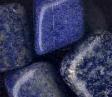
SCIENTIFIC INFORMATION: Lazurite is a silicate of sodium calcium and
aluminum, with some sulfur. It is a member of the sodalite group. It's
chemistry is (Na, Ca)8(Al,Si)12O24(S,SO)4. The color ranges in shades of
blue from violet blue and azure blue thru greenish-blue. Lazurite is
distinguished from sodalite by its deeper color and fine grain. It is
also softer and lighter in weight than lazulite. It is dull to greasy
and the streak is pale blue. The hardness ranges between 5 and 5-1/2.
ENVIRONMENT: Crystals are rare. It is usually granular, compact,
massive. It forms in association with pyrite, calcite, and diopside in
hornfels of contact metamorphic rocks. The opaque, vivid blue, light
blue, greenish-blue, or violet-blue stone, consisting largely of
lazurite but with appreciable amounts of calcite, diopside, and pyrite, is a
rock called [lapis lazuli.] The stone is usually veined or spotted. Its
value depends largely upon excellence and uniformity of color and absence of
pyrite, although some purchasers prefer lapis with pyrite.
OCCURRENCE: Lazurite is a rare mineral in North America, but it does
occur on Italian Mt. in the Sawatch Mts. of Colorado; on Ontario Peak in the
San Gabriel Mts., Los Angeles Co., and in Cascade Canyon in the San
Bernardino Mts., San Bernardino Co., California. The finest lapis lazuli
has come from Badakshan in Afghanistan, and less valuable material has come
from Russia and Chile.
NAME: The name is from the Arabic [lazaward], "heaven," which was also
applied to sky-blue lapis lazuli.
2618
LEGEND and LORE: Lapis Lazuli was a favorite stone of the ancient
Egyptians. In the past Lazurite has been burned and ground to form the
pigment "ultramarine." It was consider an aid to childbirth, and has
long been associated with altered states of consciousness and trance
work. Lapis is sometimes designated as a birthstone for December,
although turquoise is most common.
MAGICAL PROPERTIES: To quote Cunningham: "This stone is used in rituals
designed to attract spiritual love. Take an untumbled piece of lapis
with a sharp edge. Empower the stone and a pink candle with your need
for love. Then, using the lapis lazuli, carve a heart onto the candle.
Place the stone near the candleholder and burn the candle while
visualizing a love coming into your life." Actually, the most important
magical aspect of lapis is it's ability to strengthen psychic awareness.
Cunningham says "Despite its somewhat high price, lapis lazuli is one
stone every stone magician should own and utilize."(2)
HEALING: This stone is used at the Ajina, the Brow Chakra. It's related
gland is the pituitary. The pituitary gland is also referred to as the
"master gland" because it regulates all of the others. This location is
also the center for the eyes, ears, nose and brain.
PERSONAL EXPERIENCE: I don't often use Lapis for physical healing,
unless I feel that there is a "link" between what is manifested as
disease, and some conflict of the "higher self". I have used it for
brain disorders (tumors, inflammation, etc.) More often, I use it in
layouts where the client is trying to achieve an altered state of
consciousness. |
LEPIDOLITE
SCIENTIFIC INFORMATION: Lepidolite a potassium, lithium, aluminum
fluorsilicate mica. Its chemistry is complex: K(Li,Al)3(Si,Al)4O10-
(F,OH)2. It is pink, lilac, yellowish, grayish white or a combination of
all of these. The streak is colorless. It is one of the softer stones,
with a hardness of 2-1/2 to 3.
ENVIRONMENT: Lepidolite is confined to granite pegmatites, where it
occurs either as fine-granular masses near the core of the pegmatite or
as stubby or tabular crystals in cavities. It is commonly associated
with microcline, quartz, and tourmaline
OCCURENCE: Large fine masses of lepidolite have been mined at the
Stewart Pegmatite at Pala, and superb sharp crystals have been obtained
from the Little Three Pegmatite near Ramona, both in San Diego Co.,
California. It has also been mined in substantial amounts in several New
England states and in the Black Hills of South Dakota.
NAME: The name comes from the Greek [lepidos], meaning 'scale', in allusion
to the scaly aggregates in which the mineral commonly occurs.
LEGEND and LORE: Lepidolite is a stone that could certainly be considered
"new age" in the sense that it is just now coming into recognition by
healers and magicians. There is no "past lore" on this stone, to the best of
my knowledge. Part of this may be due to the fact, that it is native
to the United States.
MAGICAL PROPERTIES: "This stone soothes anger, hatred or any other negative
emotion. To quiet the entire house, place lepidolite stones in a circle
around a pink candle." (2)
HEALING: Lepidolite is also know as the "Dream Stone". It will protect the
individual from nightmares, especially those caused by stress or an upset in
personal relationships. It can be used in the same types of circumstances as
Kunzite, namely for manic depression or schizophrenia.
PERSONAL EXPERIENCE: This is one of the most soothing and relaxing stones
I've ever held. It is a beauty to look at, and calms the mind enabling it to
concentrate on the TRUE source of a problem...instead of running around in
frantic circles accomplishing nothing. The more rubellite in the stone, the
better it will help the heart and mind work together.
NOTES: Lepidolite has been used as a source of lithium. The above
description of the appearance of this stone may be deceiving, as I found
Cunningham's to be, also. All of the specimens of this stone that I have
seen so far have been grey to a pale lavender grey with "sparkles" of the
lithium mica embedded in it. The heart-shaped cabuchon that I have
also has very distinctive crystals of rubellite (pink tourmaline) and veins
of white running through it. I was originally looking for a MUCH
brighter lavender stone. It is unusual, also, to find specimens that are cut
and polished. Usually the stone is too "crumbly" to take a good polish.
However, it is equally handsome in rough form.
|
MALACHITE

SCIENTIFIC INFORMATION: Malachite is a basic copper carbonate. It's
chemistry is Cu2CO3(OH)2. It ranges in color from emerald green thru
grass green to shades of silky pale green. The streak is light green.
It's hardness is 3-1/2 to 4. Crystals are rare. Most gem specimens
display distinctive concentric colorbanding; (alternating dark green and
light green bands.)
ENVIRONMENT: Malachite is a secondary copper mineral and develops in the
zone of alteration in massive, lode, and disseminated hydrothermal
replacement deposits. Associated minerals are azurite, limonite, and
2621
chalcopyrite.
OCCURENCE: The copper mines at Bisbee, Chochise Co., Arizona, are famous for
their fine specimens of massive malachite and pseudomorphs of malachite
after azurite. Mines at Morenci in Greenlee Co., and at Globe
in Gila Co., Arizona, have yielded beautiful malachite specimens, of which
some consist of alternating layers of green malachite and blue azurite. Fine
malachite has also come from copper mines in California, Nevada, Utah,
Pennsylvania, and Tennessee.
NAME: The name is from the Greek [moloche], "mallow," an illusion to the
mineral's leaf-green color. Malachite is used as an ore of copper and as a
gemstone.
LEGEND and LORE: It is said that if malachite is worn, it will break into
pieces to warn the wearer of danger.
MAGICAL PROPERTIES: Used to direct power towards magical goals.
Protective, especially towards children. According to Cunningham, "Small
pieces of malachite placed in each corner of a business building or a small
piece placed in the cash register draws customers. Worn during business
meetings or trade shows, it increases your ability to obtain good deals and
sales. It is the salesperson's stone." (2)
HEALING: If the malachite is of the blue-green variety, it can be associated
with the Sacral Center, or Splenic Chakra (Svadisthana). Here, it's energy
branches to the left, to the spleen. (It is intended in this position for
those who are celebate.) In addition, if it is grass-green, it can be used
at the Lumbar/Solar Plexis Center. "When the malachite is placed at the
solar plexus and a piece of green jade is placed at the heart center and a
double-terminated quartz crystal is placed between them, people may remember
events that have been blocked for years. They may cry or scream. As these
buried emotions are brought to the surface and released, a great weight is
lifted and they soon feel renewed." (3)
PERSONAL EXPERIENCE: I am very careful about using Malachite. It has been my
experience that the emotions that it releases can be very
powerful, to the point of overwhelming some people. On the other hand, if
the individual is ready to deal with them (in a "growth" period) it may work
out just fine. You could "balance" the emotional content with a pink stone
(such as rose quartz) to cut down some on the intensity.
A few years ago, I broke my arm. To do so, I damaged the muscles and nerves
in my wrist. I was in a lot of pain, and was searching for what I could do
to help the situation. During a journey, I saw malachite, so I found a
malachite heart which I held in the palm of the broken arm while meditating.
I got a lot of relief from it. Now, if the wrist acts up, I use the heart,
taped over the wrist area when I go to bed at night. It seems to help quite
a bit. I now recommend malachite for nerve/muscle damage with some success.
(4) |