
| Name/notes | Range/notes |
| MGM-51 Shillelagh Missile (3 ft and 10in long weighing 58 pds) Could destroy any tank. | A minimum range of 3,000 meters. The Maximum range is 4,000 meters |
| M-49 anti-tank tracer round | 7,450 meters |
| Canister or "shot shells" | 7,450 meters |
| M409 HEAT | 800 meters |
| White Phosphorus | 7,450 meters |
Despite the high-tech abilities of this mammoth gun
it was dangerous to it's crew. The crew needed to spend approximately 10
seconds bracing before firing. If this was not done the consequences were
severe. The gun swivels with the force of the blast and the tank can be
displaced several meters. The commander suffers from a powerful blow to
the ribs and for the gunner things are even worse. The recoil of the gun
could give a black eye to the gunner and if he forgot to take his hand
of the traversing wheel his wrist would be forcefully broken. The vehicle's
missile system is broken 33% of the time and the laser finder also has
a chance of being damaged beyond the repair capabilities of the crew if
the gun is fired. For those willing to fire a second round they would often
find a melting residue of combustible casing to deal with. If another
round was loaded, the burning casing could cause it to fire prematurely.
In light of these side effects the crew would've felt safer firing the
7.62 mm coaxial MG or the .50 Caliber MG in the Commander's position.
It is important to note however that this complicated
missile system is relatively easy to aim, a gunner merely has to put the
target in his sites and fire, data is feed in-flight to the missile by
an infrared sensor. The name "sudden death" fully applies to a missile
that has a velocity of 1,881 ft per second. Under ideal conditions
a 90% accuracy rate can be achieved.
Between 1965 and 1970 over 1,700 of these war dogs
rolled off the assembly line. First, they formed armored Calvary squadron's
in airborne, armor, and infantry divisions. This new weapon was integrated
into many armored cavalry regiment's reconnaissance platoons. It replaced
either a recon variant of the M113 and the M48 in some units(3). Within
a year it had been deployed to Europe, Korea, and Vietnam.
Lessons were learned quickly on the Vietnam battlefield.
The Sheridan lacked the power to crash through the jungle recklessly like
an M48. Instead, the vehicle was used more effectively in ambush, recon,
airmobile and convoy duty.
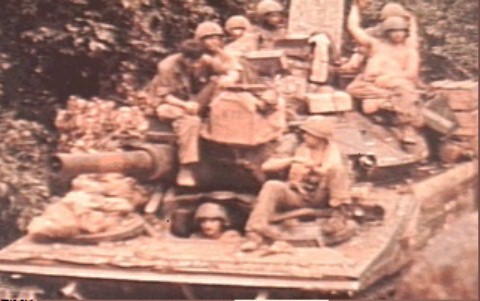
In country; a Sheridan's crew often loaded the vehicles
exterior with fuel , smoke grenades and strapped on ammunition. Sometimes
they lashed on a storage basket like the kinds found on must shopping
carts! The American flag was displayed on the vehicles antenna. The vehicle
also tended to carry a stretch of chain-length fencing to protect
it's thin armor from RPG attacks at night. Wire-mesh was also used to protect
the lights and the driver's position. The commander's position usually
received further shielded as well.

Name: M551 "Sheridan"
Type: Air-Mobile Assault Tank
Dimensions: Length 6.299m, Width 2.819m, Height 2.94m
Weight: 34,826lb (loaded) 29,896lb (unloaded)
Crew: 4
Vehicle Range: 600 km
Engine: Detroit Diesel 6VT53T developing 300 hp at 2,800 rpm.
Max. Speed: 70 km/h (5.8 km/h water)
Fording: Amphibious
Vertical Obstacle: .8 m
Gap Crossing: 2.5 m
Armament: 1 x 152mm gun/missile launcher, 1 x 7.62mm co-axial
MMG, 1 x 12.7mm HMG AA gun, 4 smoke
dischargers on either side of the turret.
Load: 10 Shillelagh missiles, 20 conventional rounds, 3,080 rounds
of 7.62mm, and 1,000 rounds of 12.7mm
I'll add more specifications as soon as I get my hand on Jane's. The
next page contains emails I recieved from a Driver of the Sheridan in Vietnam.
His accountant is awesome please read: