Philippine Combat Aikido Federation
Parañaque Chapter
Recognized by Philippine Combat Aikido Federation, Inc.
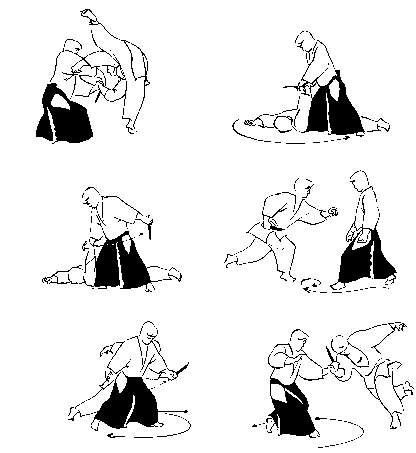
The similarities between the two arts fall into these categories: mentality, alignment, connection, timing, distance, hips, and the state of the body. The mentality in which a technique is executed is similar because a practitioner must give up his life mentally before he is attacked. He must obtain this state so he is able to feel and become one with the opponent.
It is the state of not consciously thinking, the Japanese call it mushin (no mind). Aikido and karate principles are employed within very similar parameters. In both styles, an individual must be able to move in the most efficient and economical way without any external power or resistance. The mind, body and hips all move as one unit, driven by incredible internal feeling and spirit. Uyeshiba had a saying to describe this experience: "My opponent cannot take my power away because I do not use any."The person who can acquire this "no power" state will achieve more speed. He may train for many years to become a split second faster, but in martial arts, a split second can mean the difference between life or death.
What happens when one faces an opponent of equal physical and technical ability? What will be the deciding factor at this level of combat? The answer is the mind - the most important factor of all. One who has polished his mind and made it like a brilliant illuminating crystal, with no mental blocks, will have the edge. To achieve this state, the individual must pass through any influencing barriers of pain, emotion, fear, and insecurity.
His training will have been some of the most rigorous and disciplined of its kind. He must experience hell in his training so he can appreciate heaven. The individual with the mental edge knows and senses in his mind that he has beaten his opponent even before the engagement has begun. Why is it so difficult for the majority of martial artists to integrate and harmonize various principles? An individual must have the mental capacity to filter out unrealistic concepts and theories in his training.
He must have good senior students and instructors to guide him. But most of all he must rely on himself to see the truth in his technical and mental applications of technique and life.
(About the Author: Tom Muzila is a high-ranking black belt under Tsutomu Ohshima in Shotokan Karate of America. This article appeared in Black Belt Magazine, April 1988.)
[Previous] [First Page]

Note: best viewed at 800x600 resolution.
Send mail to [email protected] with questions or comments about this web site.
Copyright © 2000 Philippine Combat Aikido Federation - Parañaque Chapter
