|
DLP™ technology
is a display solution that uses an
optical semiconductor to manipulate light
digitally.
|
|
|
At the heart of
every DLP™ projection system is an optical semiconductor
known as the Digital Micromirror Device, or DMD
chip, which was invented by Dr. Larry Hornbeck of Texas
Instruments in 1987.
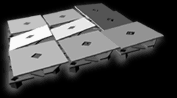
The DMD chip is probably the world's most
sophisticated light switch. It contains a rectangular
array of up to 1.3 million hinge-mounted microscopic
mirrors; each of these micro-mirrors measures less than
one-fifth the width of a human hair, and corresponds to
one pixel in a projected image.
When a DMD chip is
coordinated with a digital video or graphic signal, a
light source, and a projection lens, its mirrors can
reflect an all-digital image onto a screen or other
surface. The DMD and the sophisticated electronics that
surround it are what is called Digital Light
Processing™ or DLP technology.
|
 |
|
|
A DMD panel's
micro-mirrors are mounted on
tiny hinges that enable them to tilt either toward the
light source in a DLP™ projection system (ON) or away
from it (OFF)-creating a light or dark pixel on the
projection surface.
The bit-streamed image code entering the
semiconductor directs each mirror to switch on and off
up to several thousand times per second. When a mirror
is switched on more frequently than off, it reflects a
light gray pixel; a mirror that's switched off more
frequently reflects a darker gray pixel.
In this way, the mirrors
in a DLP™ projection system can reflect pixels in up to
1,024 shades of gray to convert the video or graphic
signal entering the DMD into a highly detailed grayscale
image.
|
|
|
The white light generated by the lamp in a
DLP™ projection system passes through a color wheel as
it travels to the surface of the DMD panel. The color
wheel filters the light into red, green, and blue,
from which a single-chip DLP™ projection system can
create at least 16.7 million colors. And the
3-DMD chip system found in DLP Cinema™ projection
systems is capable of producing no fewer than 35
trillion colors.
The on and off states of each micro-mirror
are coordinated with these three basic building blocks
of color. For example, a mirror responsible for
projecting a purple pixel will only reflect red and blue
light to the projection surface; our eyes then blend
these rapidly alternating flashes to see the intended
hue in a projected image.
|
|
|
1-CHIP DLP™ PROJECTION SYSTEM
|
|
|
|
Televisions, home
theater systems and business projectors using DLP™
technology rely on a single DMD chip configuration like
the one described above.
White light passes through a color wheel
filter, causing red, green and blue light to be shone in
sequence on the surface of the DMD. The switching of the
mirrors, and the proportion of time they are 'on' or
'off' is coordinated according to the color shining on
them. The human visual system integrates the sequential
color and sees a full-color image.
|
|
|
3-CHIP DLP™ PROJECTION
SYSTEM
|
|
|
|
DLP™
technology-enabled projectors for very high image
quality or high brightness applications such as cinema
and large venue displays rely on a 3-DMD-chip
configuration to produce stunning images, whether moving
or still.
In a 3-chip
system, the white light generated by the lamp passes
through a prism that divides it into red, green and
blue. Each DMD chip is dedicated to one of these three
colors; the colored light that each micro-mirror reflects
is then combined and passed through the projection lens
to form a single pixel in the image.
|
|
|