
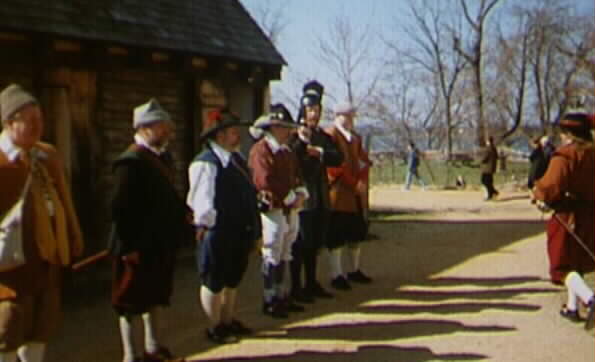
 From the moment of landing in 1634 at what was to become St. Mary's City, the colonists were on their own for defense against Indian, pirate, or Spaniard. With no regular troops in the colony, every man from 16 to 50 years of age was automatically a part of the militia. With the governor as commander, and officers of experienced "gentlemen," the farmers and artisans became citizen-soldiers in a way never experienced "at home," in spite of the county-trained band system current in England.
Each man was to bring with him
- a musket
- 10 pounds of powder
- 40 pounds of lead
- a sword
- a bandolier
- and slow match for his primitive firearm
The militiaman received no uniform, but appeared for muster or campaign in whatever clothing he owned. Officers and those who had served in such places as the Netherlands or Ireland wore any pieces of uniform or armor they had retained for use in the colony.
Clothing required for a man coming to the colony included
- 2 Monmouth (knit) caps
- a suit of canvas
- a suit of frieze
- a cloth coat
- 3 shirts
- 3 pairs of stockings
- 6 pairs of shoes
- 3 falling bands (collars)
- a dozen "points" to secure sleeves to doublet and doublet to breeches
Training was intensive or law according to conditions, ranging from muster "every fortnight" when under threat of attack to a casual annual inspection of arms in periods of peace. The ideal was 4 musters per year, with "battle readiness" the responsibility of a Muster Master.
Pay for active service was in tobacco or substitute labor. The Muster Master received 4 pounds of tobacco per year for "every taxable person inhabiting within the Province." On at least one campaign in 1619 against "salvages" on the Eastern Shore, each musketeer received 100 pounds of tobacco per month - or another man to tend his plantation. This latter acknowledged his primary role as family farmer.
In 1637 an "Act for Military Discipline" was passed, providing a charter for the St. Marie's Citty unit, setting out procedures for musters and establishing penalties for lack of cooperation.
While Indians in the immediate area were friendly, those from further afield were not, leading to many raids and skirmishes in the early decades. While the musket was the major arm against salvages, the pike saw action against fellow Englishmen.
- Virginians
- In 1634 Virginians, who had received Kent Island from King James, disputed Lord Baltimore's grant from King Charles in a war which saw the first naval battle in America.
- The pirate, Ingle
- In 1643, angered by a dispute with St. Mary's citizens, but using the rising tide of civil war in England as an excuse, the pirate Ingle seized the colony for plunder, to be displaced two years later by the militia-including men from both Maryland and Virginia.
- Puritans
- In 1655 Puritan settlers, invited into the colony, refused to take the oath to Lord Baltimore as being "Popish." The resulting Battle of the Severn saw St. Marie's Militia decimated by superior numbers and infilading fire from Puritan ships. It was not until 1657 that this dipute was settled and religious tolerance restored.
Photo Gallery
Follow the continuing saga of the modern-day St. Marie's Citty Militia through photos of our reenactments.
Home
Return to our main page.
This website was created by M.J. Marlow as a tribute to the St. Marie's Citty Militia. It is not to be construed as the "official" website for our unit. If you would like to contact the web designer, send an email message to [email protected]