 |
| Please Don't wake me. No, don't shake me. I'm only molting.... |
| Well, if you have noticed that your crab is acting a little lazy recently and you are worried that he might be dying, don't worry too much before you know some other facts. While your sickly acting crab may in fact be unhealthy, there is also the possibility that he is getting ready to molt. Hermit crabs have a rigid exoskeletal structure and as such they cannot grow larger while wearing it. Thus, every once in awhile, hermit crabs will molt. Information suggests that they molt about every 18 months, with younger ones molting more frequently and older crabs molting less often. Molting is a process by which crabs will shed their rigid exoskeleton and form a new, slightly larger, one. During this time, crabs will also begin to regenerate their lost limbs. Don't expect your crab to grow immensely in one molt however, they get larger slowly. So, as you can see, molting is an important time for hermit crabs. Molting is also then a very stressful time for crabs and they need some special care when they are molting. This special care involves isolation, rest, and proper calcium. |
| While your crab is molting, he is without his protective exoskeleton and as such is very soft and susceptible to injury. Set up a smaller version of your crabitat, complete with food, gravel or sand bottom, water dish, and sponge. In addition, leave plenty of shells in there for your molting crab to look at should he decide to change into a larger shell. |
| Isolation - |
| Rest - |
| Because molting is a very stressful event for your little crab, don't stress him out more by constantly picking him up, moving him around, or spraying him with water. Just leave him to do his thing and hopefully all will be well in the end. |
| Calcium - |
| In order for a hermit crab's body to re-harden after it has shed its exoskeleton, the crab requires plenty of calcium. During molting, the crab has one extra, natural, source of calcium provided for him in the form of his shed exoskeleton. Yes, that is right... the crab will eat its own exoskeleton and as such you should LEAVE IT WITH HIM. Don't throw away this valuable nutritional supplement that will help your crab to build a healthy new exoskeleton. In addition, calcium enriched sand or broken pieces of cuttlefish bone can act as further sources of calcium, presented with the exoskeleton. |
|
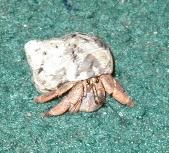 |
| Ahab (left) and Jasper (right), the two of our crabs that have molted since we have had them. Take a look at a few of their pictures. Click the molting link above the pictures. |
 |
|