| |
WIRELESS NETWORKS - Internet of Everything | |
| WIRELESS AD-HOC NETWORKS (WSNs, WNSNs, MANETs and VANETs)
A Wireless Ad hoc networks (WSNs, VANETs, MANETs) are self-organizingnetworks that are created from distributed autonomous nodes without wired infra-structure. These nodes operate cooperatively to achieve specific tasks and monitorphysical or environmental conditions. The development of these networks is moti-vated by unlimited applications such as health care, biomedical, environmental,industrial and military applications. A wireless ad-hoc network is a decentralized type of wireless network. In this typeof network, each node participates in the routing process by forwarding data to other nodes according to the network connectivity [1]. There are three main categories of wireless ad-hoc networks: WSNs, MANETs and VANETs. All of which use wireless communication mechanisms. VANET = Vehicular Ad-hoc Network- Vehicles and roadside units are nodes of vehicularcommunication system that provide different warnings and road information. The communication mechanisms of WNSN can be classified into four categories: - Molecular (or chemical) - Electromagnetic - Nano-mechanical - Acoustic WNSNs are initially designedto be deployed in closed areas, such as a human or animal body.
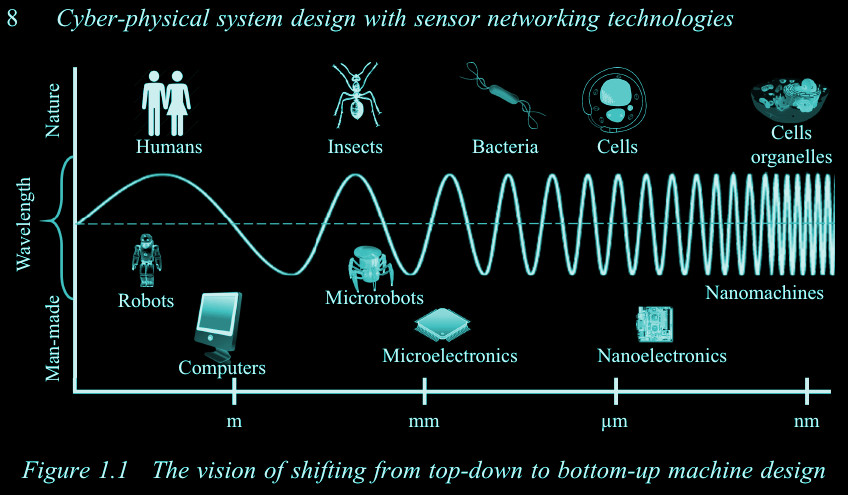
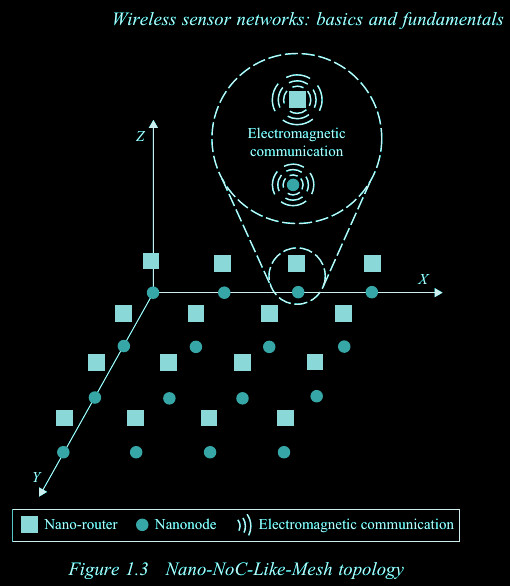
1. WIRELESS SENSOR NETWORKS (WSN) The wireless sensor network (WSN) is a particular type of ad-hoc network, inwhich nodes are ‘smart sensors/devices’. These devices are equipped withadvanced sensing functionalities (thermal, pressure, acoustic), a small processorand a short-range wireless transceiver. In this type of network, sensors exchangeinformation in order to build a global view of the monitored region, which is madeaccessible to the external user through one or more gateway node(s). Sensor net-works are expected to herald a breakthrough in the way natural phenomena areobserved: the accuracy of the observation will be considerably improved, leading toa better understanding and forecasting of such phenomena. A sample application scenario could be asituation in which a WSN is used to monitor a vast and remote geographical region;in such a way, abnormal events (e.g. a forest fire) can be quickly detected. In thisscenario, smart sensors, each equipped with a battery and significant processingand wireless communication capabilities, are placed in strategic positions – forexample, on the top of a hill or in locations with a panoramic view. Each sensorcovers an area of a few hectares and can communicate with other sensors in thevicinity. The sensor node gathers atmospheric data (e.g. temperature, pressure,humidity, wind velocity and direction) and analyzes the make-up of the atmosphereto detect particular particles (e.g. ash). Furthermore, each sensor node is equippedwith an infrared camera, which is able to detect thermal variations. Every sensorknows its geographic position via localization algorithms [4], expressed in terms ofdegree of latitude and longitude. This can be accomplished either by equippingevery node with a GPS receiver, or, since in this scenario sensor position is fixed,by setting the position in a sensor register at the time of deployment. Periodically,sensors exchange data with neighboring nodes in order to detect unusual situationsthat could be caused, for instance, by the start of a fire (e.g. temperature at a sensoris much higher than that of its neighbors). These routine data are aggregated and propagated throughout the network andcan be gathered by the external operator (e.g. a park ranger equipped with a portable device) to collect atmospheric data (e.g. to checkthe air quality). In addition, WSNs are deployed widely in various applications such as struc-tural health monitoring [5] and monitoring of the agricultural environment [6]. Forexample, Hwang et al. [6] discuss how WSN-based sensors are used to collectenvironmental and soil information on the outdoors and to collect location infor-mation using GPS modules for producers. WSN technology has also been used forhabitat monitoring [7]. In fact, habitat and environmental monitoring represent animportant class of sensor network applications. Furthermore, WSNs offer greatpromise for information capture and processing for military and defense applica-tions. The military is using this concept rigorously for their advancement in warfareand in the field [8]. A WSN is typically composed of nodes with the same features.Typically, the number of nodes composing a WSN is quite large, ranging from afew tens to thousands of nodes that are dispersed in a relatively large geographicalregion, so that 1-hop communication between nodes is, in general, not possible. 2. WIRELESS NANOSENSOR NETWORKS (WNSN) A Wireless Nanosensor Network (WNSN) is a network of tiny, wireless sensor devices (nanosensors) that can be used to gather and transmit data over a short range. These networks have potential applications in areas like health monitoring, biomedical research, and environmental sensing.(https://link.springer.com/article/10.1007/s11277-021-08171-2) In 1959, Richard Feynman, the Nobel Laureate physicist, in his famous lectureentitled ‘There’s plenty of room at the bottom’, described for the first time how themanipulation of individual atoms and molecules would give rise to more functionaland powerful devices [23]. This was the vision of many researchers who werewilling to explore matter at the nanoscale. For example, Akyildiz et al. [23] havestated that nanomachines could be classified into two categories: those that mimicexisting electro-mechanical machines and those that mimic the nanomachines ofnature (e.g. molecular motors). In addition, nanomachines are assumed to be mobile and rapidly deploy-able. Therefore, ad-hoc communication mechanisms are required to allow theseentities to exchange sensed information between each other and with external units. In this research direction, nanotechnology has emerged as a field of manip-ulating individual units at the atomic or molecular level. According to the USNational Nanotechnology Initiative, nanotechnology is a research field for manip-ulating matter with at least one dimension sized from 1 to 100 nanometers. At thisscale, a nanomachine can be considered as the most basic functional unit. Nano-machines are tiny components consisting of an arranged set of molecules, which areable to perform very simple computation, sensing and/or actuation tasks [25]. Nano-machines can be further used as building blocks for the development of more complexsystems such as nanorobots and computing devices such as nano-processors, nano-memory or nano-clocks [23]. More than half a century later, nanotechnology is pro-viding a new set of tools to the engineering community to control entities at the atomicand molecular scale. Nanomachines should have a sensing ability that is capable of sensing eventswithin the environment and propagating these to other members of the WNSN.To perform these functions, it must have units that act as sensor, power supplier,processor, storage unit and communicator [24]. Applications: The potential applications of WNSN are unlimited. We classify them into four groups: biomedical, environmental, industrial and military applications. Here are some of the envisaged applications: immune system support, bio-hybrid implants, drug delivery systems, health monitoring and genetic engineering.WNSN will be used not only in intra-body but also in industries. MANET is a special form of ad-hoc network that differs from WSNs in respect ofits node mobility features. It is a self-configuring network of autonomous andmobile nodes (devices) that do not rely on a predefined architecture. In a MANET,each node is free to move independently from other nodes and in any direction andat any moment. The nodes communicate with each other via wireless links whilemaintaining their connectivity in a decentralized way. A node frequently changesits links with other nodes without notice, thus routing in such networks is a chal-lenging issue. The main role of each node in a MANET is to continuously maintainthe information required to its own usage as a host and be a router for neighbornodes enabling the information transmission.Combining WSN and MANET technologies provides powerful, mobile andheadline applications in various domains. Much research work has been conducted and has targeted the development ofapplications and prototypes. Among these applications, the MANET principle isapplied for military communication and operations; emergency services (disasterrecovery, policing and firefighting, rescue operations, etc.); commercial and civilianenvironments (e-commerce, vehicular services, sports stadiums, etc.); home andenterprise networking (home/office wireless networking, meeting rooms, personal areanetworks, etc.); education and learning (virtual classrooms, ad-hoc communicationduring meeting, etc.); context-aware services (information services, follow-on service,etc.); and sensor networks (data tracking, movement detection, smart sensors, etc.) [11]. MANET resources are highly crucial for the successful communicationbetween mobile nodes. In situations where both sending and receiving nodes areplaced within the transmission range of each other, communication is possiblethrough a single-hop connection. In all other scenarios where nodes are distanced,the exchange of packets is possible as long as a multi-hop path is available betweenthem. Despite the unique characteristics of MANETs, they share many attributesand operations with other traditional networks [12]. 4. VEHICULAR AD-HOC NETWORKS (VANET) Vehicular ad-hoc networks are a special subclass of MANETs for inter-vehiclecommunication and have a relatively more dynamic nature compared to MANETs dueto the rapid network topology changes. In VANETs, nodes are vehicles equipped withembedded calculators, sensors and wireless communication technologies. UnlikeMANETs, where nodes can freely move in a certain area, the movement of vehicles inVANETs is always at high speed and can be predicted, because it is dependent onstreets, traffic and specific rules. Communication between nodes in VANETs is lessreliable due to the high mobility, dynamic topology and different traffic patternscompared to MANETs [13]. Due to the large requirement of intelligent transportations systems (ITSs),VANET constitutes an emerging branch of wireless ad-hoc network where commu-nication can be conducted between vehicles, vehicle to vehicle (V2V) and/or betweenvehicle and infrastructure (V2I) [14–16]. In a VANET, routingissues and maintaining the communication between vehicles – considering the highlydynamic topology of the network, which is frequently disconnected, and mobilityconstraints – are important challenges. As has been the case in many research works, as well as under real-life drivingconditions, VANET technology may fail to maintain communication connectivityand ensure timely detection of dangerous road conditions when the network densityis low. Since vehicles have high velocity in a VANET, they could be disconnectedfrom each other. Therefore, the density of VANET might be low and not all nodesin the network might receive messages. Combining VANET technology with othertechnologies is one of the options to address this problem. The integration of WSNand VANET overcomes the inherent limitations of using VANET alone [15]. NANO COMMUNICATION MECHANISMS Nanomachines can be interconnected toexecute collaborative tasks in a distributed manner. The resulting WNSNs areenvisaged to expand the capabilities and applications of single nanomachines in thefollowing ways. For example, nanomachines such as chemical sensors, nano-valves, nano-switches, or molecular elevators [27] cannot execute complex tasks bythemselves. The exchange of information and commands between networkednanomachines will allow them to work in a cooperative and synchronous manner toperform more complex tasks such as in-body drug delivery or disease treatments.WNSN will allow dense deployments of interconnected nanomachines. Thus, lar-ger application scenarios will be enabled, such as the monitoring and control ofchemical agents in ambient air. In some application scenarios, nanomachines willbe deployed over large areas, ranging from meters to kilometers. In these scenarios,the control of a specific nanomachine is extremely difficult due to its small size.WNSN will thus enable interaction with a remote nanomachine by means of nano-communication mechanisms. Communication between nanomachines might be designed through electro-magnetic, molecular (chemical), nanomechanical or acoustic communicationmechanisms [27]. In acoustic communication, the transmitted message is encodedusing acoustic energy, i.e. pressure variations. At the nano-level, acoustic commu-nication is mainly based on the transmission of ultrasonic waves. Similar to the com-munication based on electromagnetic waves, the acoustic communication implies theintegration of ultrasonic transducers in the nanomachines. These transducers should becapable of sensing the rapid variations of pressure produced by ultrasonic waves andemitting acoustic signals accordingly. Nanomechanical communications is defined as the transmission of informationthrough mechanical contact between the transmitter and the receiver, i.e. infor-mation flows through the mechanical connection of nanoscale devices. Molecularcommunication-based WNSNs use molecules and their components, such as gapjunctions, receptors and nucleus [29]. Molecular communication between nanos-cale entities occurs in nature; it explains why using molecular communication isparticularly useful. Moreover, the WNSN built upon such naturally occurringphenomena with appropriate instrumentation offers a faster engineering pathway toviable solutions.
Source............................................................... Comparative Study: Future Generation of WirelessTechnology (5G, 6G & 7G)
All IP platform(flat) Nano technology
• Air Quality Measurement • Decision making • Health Monitoring • Feature and facial recognition • Threat Detection
|