STUDENT JOURNAL ENTRIES

Reflective Journals:
Students write about various topics using assigned vocabulary
and verb tenses:
Chris:
Yo voy a gozar a la playa. El fin de semana pasado mis amigos
y yo
fuimos a la playa. Nosotros nadabamos y jugabamos los deportes.
Me
olvide a poner la sombrilla de sol y me quemaba. (el 5 de septiembre,
1997)
Yo no creia que la prueba de espanol fuera la semana pasada.
Fue
posible que Karl recibiera la carta de cumpleanos hacia cinco
meses.
Nosotros dudabamos que nuestro padre diera dinero. Ellos esperaban
que yo no le gustara. Fue importante que tu llevaras ropa ayer.
Era
verdad que nosotros visitamos Busch Gardens. (el 30 de abril,
1998)
Es estupido que mis padres no me compren un coches. Yo soy
responsable y necesito que me compren un coche. Todos mis
amigos tienen coches. Si tuviera 10 mil dolores yo compraria
un coche
de deportes. Yo te dire de mi viaje de adventure Island. El verano
pasado mi amigos y yo visitamos Adventure Island. Nosotros
nadabamos en el agua y montabamos el Tampa Typhoon. Vale la pena
que vaya al adventure Island. Si tuviera todos los dolares en
el mundo,
yo ayudaria a las personas pobres. Yo arreglaria la deuda nacional.
Los
medicos descubririan una cura por cancer y AIDS. Este mundo seria
feliz si yo lo poseiera. Es verdad que yo me enoje escribir en
mi diario a veces.
Yo espero que nosotros escribamos todos los dias. Yo escribiria
un
millon de frases completas (el 6 de mayo, 1998).
Jesse: (Spanish III student to show contrast)
Mi pelicula favorita es Siete. Me gusta incertidumbre. Tambien
me
gusta comedia (el 4 de febrero, 1998).
No hables a mi. Sal con tu hermano. Sacudan uds. la basura hoy.
Haz tu
cosa (el 28 de abril, 1998).
Durante el verano visite a mi familia en Pennsylvania. Vi a mi
abuela y a mi
tia. Fui a un partido de beisbol. Gaste mucho dinero pero
me diverti.
Hicimos una barbacoa y practicamos el atletismo (el 20 de mayo,
1998).
Dialogue Journals:
Students respond to various activities, such as group work,
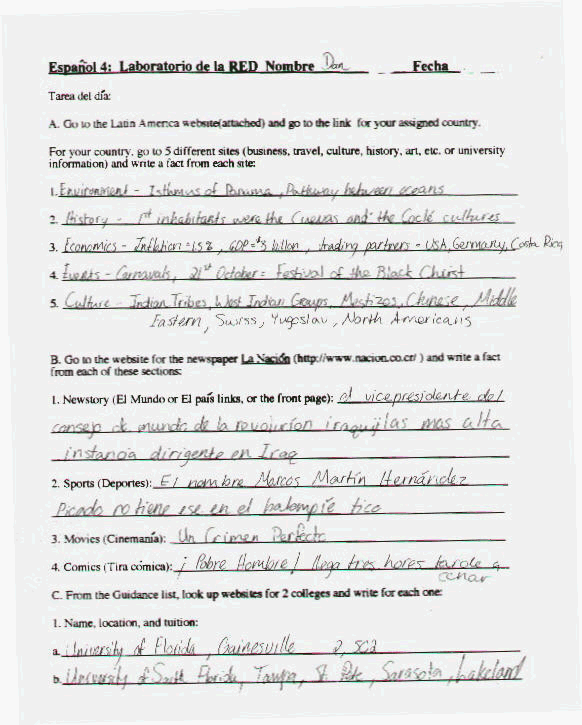
a “Dream House” project, and the Internet lab:
“Mi parte favorito fue el trabajo en grupos.” My favorite part
was
group work. (Jessica)
“Goce trabajar en grupos y hice muchos amigos.” I enjoyed working
in groups and I made a lot of friends. (Sarah)
“Me gusto trabajar en grupos y hablar en espanol.” I liked working
in groups and speaking Spanish. (Colin)
“Me gusto el trabajo de los proyectos. La casa de mis suenos
y el
desfile de moda fueron mis favoritos.” I liked the project work.
My
Dream House and the Fashion Show were my favorites. (Deanna)
“Lo mas divertido fue la casa de mis suenos.” The most fun thing
was My Dream House. (Dan)
“Aprendi como moverse en la red. Descubri nuevas tecnicas. Querre
visitar www.MTV.com y buscar canciones en espanol.” I learned
how to move around on the Internet. I discovered new
techniques. I will want to visit www.MTV.com and look for Spanish
songs. (Jennifer)
“Me gusto la experiencia en el laboratorio de la red porque encontre
la informacion nueva. Gane mucho informacion de la Universidad
de
Louisiana State.” I liked the Internet lab experience because
I found
a lot of new information. I got a lot of information from Louisiana
State University. (Josh)
“Yo supe mas de las fiestas de Espana y Mexico.” I found out
more
about festivals in Spain and Mexico. (Matt)
Vocabulary Journals:
Spanish IV students have a second journal section for
vocabulary where they write five new words and definitions every week.
Some of them also write one or more creative sentences with the new
words.
They can just “flip and pick” different words from the dictionary,
or they can
look up words of special interest to them. The words can be related
to a
general topic or from various areas. In this way students are developing
their
own personalized vocabulary:
“No tontees!” Don’t act foolishly! (Megan)
“La leyenda es que viven en la cueva.” The legend is that they
live
in a cave. (Shannon)
“No creo que ella sea malhumorada.” I don’t think she is moody.
(Katie)
“El matrimonio se casa y hace un lingereza.” The couple gets
married and makes a union. (Chris)
“Dicen que ella es una bruja.” They say that she is a witch.
(Laurel)
Reasons for journals:
I am exploring different ways to use journals not
only as a tool for students to practice their writing skills, but also
to get to
know students better, to help them express their thoughts, and to provide
a
concrete document of their progress in language skills. Writing is
an activity
that can connect many separate and compartmentalized items that students
have been learning: vocabulary, verbs tenses, and miscellaneous grammar.
I
have been looking for a way to bring writing to the forefront in my
Spanish
classes so that students can connect these isolated elements. There
are several
reasons why I am focusing on student journals:
1. Students can creatively express themselves and their ideas.
2. Students can practice new grammatical structures using their
own
vocabulary.
3. I can respond individually to students, which is difficult
in a large
class.
4. Students’ progress can be seen and evaluated for individual
or whole
class help.
5. Students can use critical thinking skills.
6. Students can see correlation between different subject areas:
writing,
English, foreign language, and others.
7. Students have a concrete, individualized sample of what they
have
learned.
8. Journals can be used in conjunction with authentic assessment.
9. Students can communicate with me in writing about personal
concerns as opposed to speaking with me directly.
Improvement:
I asked students what specific skills were improved by
journal writing. The following list summarizes their conclusions:
1. improved sentence structure
2. wrote completed and detailed sentences
3. practiced what was learned in class
4. used a dictionary better
5. expanded and used vocabulary in a practical way
6. experimented with different tenses
7. improved understanding of tenses
8. remembered more verbs
9. learned new ways to say things
10. communicated on a personal level
11. knew corrections before a test
12. improved spelling and grammar
13. organized ideas better
14. got away from direct translation
15. learned everyday conversation
16. became more comfortable with Spanish
17. started thinking more in Spanish
Journal Topics:
Espanol 3
1. My Goals for Spanish 3
2. My Favorite Movie
3. Free Choice using present tense
4. Free Choice using helping verbs “going to + verb” and “just + verb”
5. Free Choice using stem changing and reflexive verbs in present tense
6. My Chores
7. Free Choice using subjunctive mood
8. Free Choice using infinitive, present tense and subjunctive mood
9. The City
10. Free Choice using “por vs. para” - two prepositions for “for, by”
11. Commands Given to Me Frequently
12. Commands Given in Sports and Social Activities
13. Activities I Did Last Week (preterit tense)
14. An Experience From the Past (preterit tense)
15. A Favorite Vacation (preterit and imperfect tenses)
16. Evaluation of My Spanish Class
Espanol 4
1. My Goals for Spanish 4
2. The Person I Admire the Most and Why
3. A Personal Medical Experience
4. Free Choice using doubt / certainty statements (indicative vs. subjunctive)
5. The Ideal (Spouse, Friend, Parent, Teacher, Boss, Coach, or Other)
6. Free Choice using the subjunctive mood
7. Opinions About Clothing and Fashion using the subjunctive mood
8. Free Choice using the present and future tenses
9. Free Choice using special conjunctions with the subjunctive mood
10. Free Choice using different special conjunctions with the subjunctive
11. Free Choice using all subjunctive
12. My Future Plans
13. Free Choice / timed writing in class
14. Free Choice with the imperfect subjunctive
15. Free Choice
16. Evaluation of My Spanish Class
COMPOSICIONES


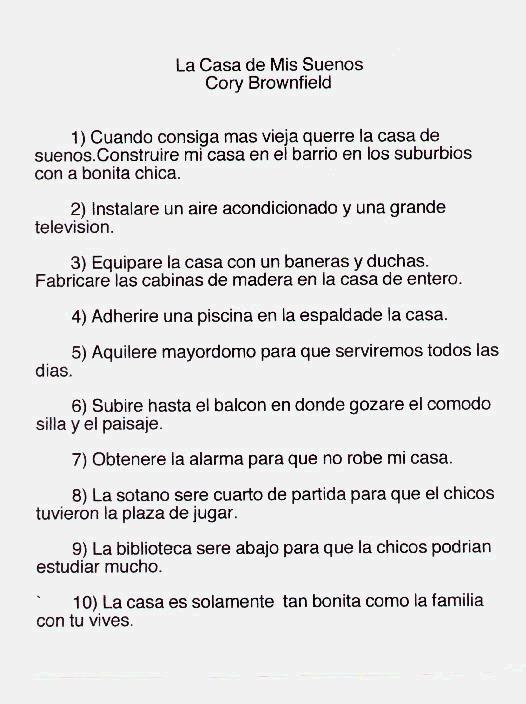
Cory:
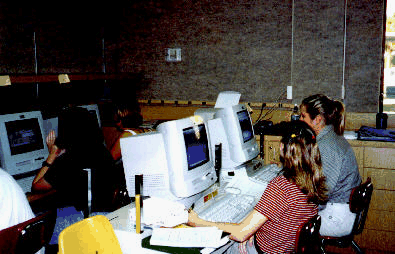
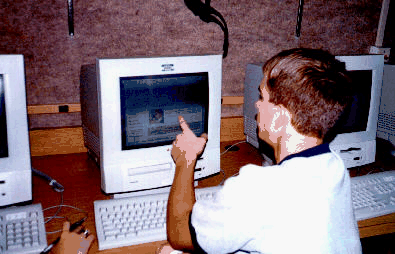
EN EL LABORATORIO DE COMPUTADORAS

UNA AGENTE DE VIAJES EN LA CLASE

UN DRAMA