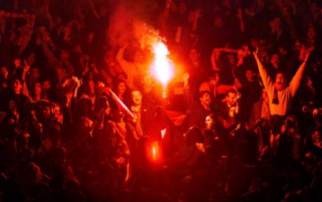
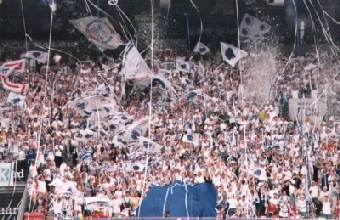
World Cup Soccer Fans
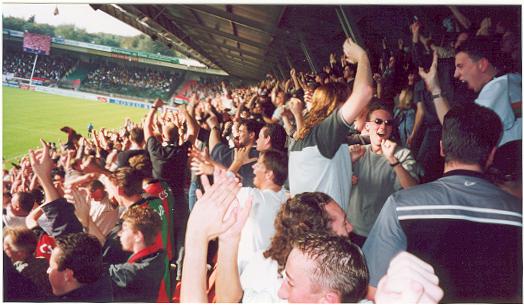
"Soccer is the most popular sport in the world. More people around the world watch it than any other sport.
Soccer began in 1863 in England with the formation of the London Football Association and in 1904, FIFA (Federation Internationale de Football Associations), Soccer's international governing body was formed. In 1930, the first World Cup was held in Uruguay with 13 countries participating (Uruguay beat Argentina 4-2 in the Final) and has been held ever since every four years except the years of the war.
Soccer as a whole is so popular and so many are devoted to it that a war broke out between Honduras and El Salvador because of a World Cup qualifying match. The worst soccer riot in history began when a goal was disallowed in a 1964 Olympic qualifying match in Lima between Argentina and Peru. 309 people were killed with 1000 others injured." (see Resources page)
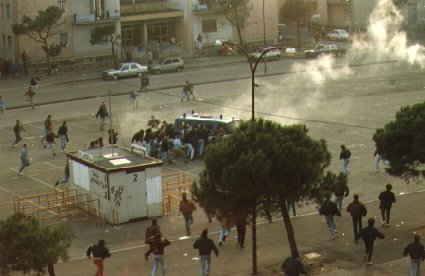
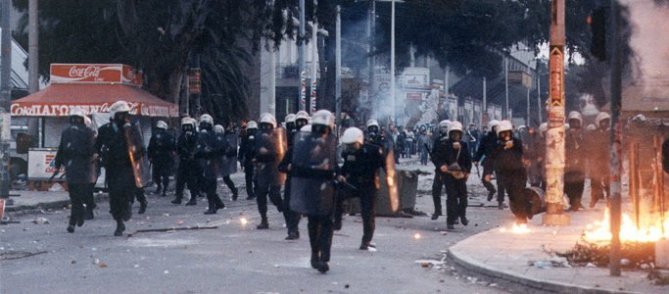
September 1999, Tehran, Iran: A soccer match between two rival main division teams ends in rioting. At the end of the no-score match, fans of opposing teams begin fistfights and then are driven out of the stadium by police. Younger spectators began shouting anti-government slogans; police responded by firing tear gas into the crowd and shots into the air. The rioting spread to the more heavily populated West Tehran, and police called in military forces. Countless spectators were injured, and 300 city buses were damaged in the subsequent riots. No deaths were reported to the international media.
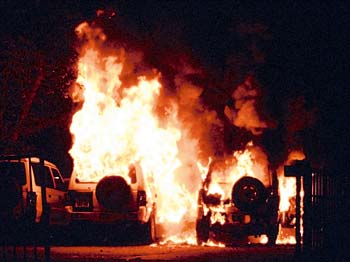
Riots after soccer games are as common in many countries as the ritual of dumping Gatorade on the coach is in America. Often, despite large numbers of casualties and, more often then not, fatalities, these events don't even make major headlines. They're neither a new trend, nor are they by any means limited to one area of the world. While the Irish seem to be the most notorious rioters, particularly ugly riots have broken out recently after World cup games in Iran, Libya, Turkey, and Germany, among others.
These disorganized, seemingly spontaneous examples of collective behavior tend to be a very destructive, often deadly force. Frequent targets of mob violence are innocent bystanders, the police, the press, women, and anyone unfortunate enough to be seen as a common enemy. The crowd is seen as one large, destructive mass, with little or no rational thought. If one were to listen to police reports, the catalyst for riots is often a few "leaders" who organize and instigate rioters.
Gustave Le Bon would tend to agree with the police. In 1895, he explained this phenomena with the idea that although there may not by one true leader in a mob, rioters are susceptible to their ideas. People within an overly excited group (as with soccer fans after an intense match) are vulnerable to the suggestions of a leader. They become "primitive," driven purely by emotion and instinct. Rational thought is lost. They can easily become violent and destructive.
Richard Berk, however, says that it is the sense of power and anonymity that comes with being in a large crowd that gives rise to riots and mobs. In a huge crowd, a person is largely unaccountable for their actions, leading them to do things they might not ordinarily do. It can be a vehicle for expressing frustration towards social situations and other intense emotions.
Soccer fans in Tehran might tend to agree with this; the anti-government chants they taunted the police with after being thrown out of the stadium were the same chants being used in protests on local college campuses. In other places as well, soccer riots tend to occur in areas with hostility towards the government or society in general.
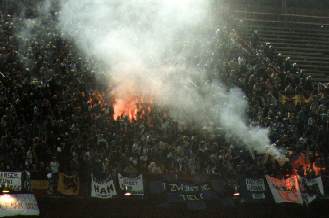
World Cup soccer matches bring together various teams with supporting fans. In a single match where two teams compete, two sets of fans will also compete. Fans for each team in the match will share a common interest such as desire for their country's team to win. Furthermore, the fans for each team are linked by their nationality and in some instances, ethnicity. Thus, it is safe to say, each of the two sets of fans creates two different collective groups. At the end of a soccer match, usually with one team losing, the fans of the losing team most likely experience feelings of a collective loss of national pride, while concurrently the fans of the winning team will have a bolstered national spirit. If any instances create tension between the two sets of collective groups or between the fans and the officials of the match (referees), collective action will likely follow. Because it has become a norm for riots or rowdiness to follow matches, collective groups will have more incentive to ignite collective action.
This page was last
modified on November 26, 2001.
Webpage and layout design by Karen Phan
Class URL = http://www.la.utexas.edu/course-materials/sociology/soc302/smithey/fall2001/index.htm
Mail comments to webmaster
The University of Texas at Austin