|
Australia's
Only |
Colin Firth Down Under | |
 |
Without
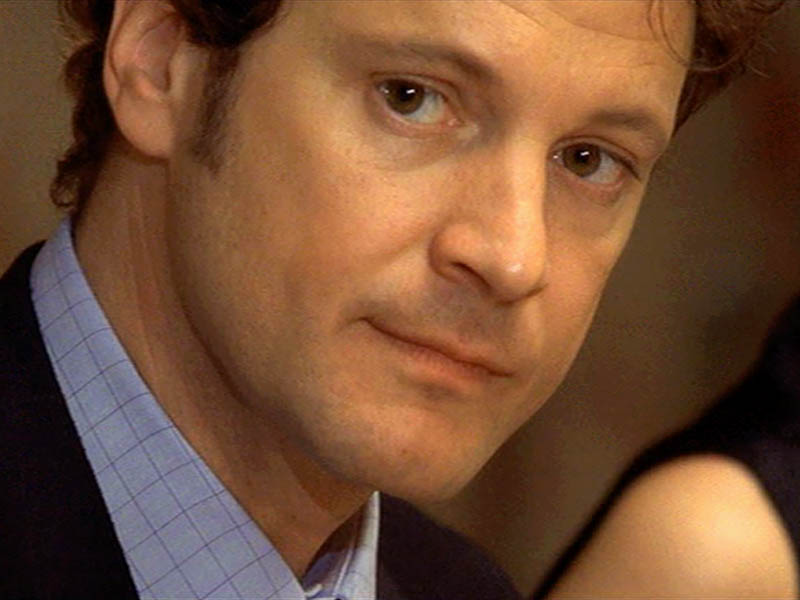
Prejudice Colin Firth may be fixed in the imagination of every woman in the English-speaking world as Mr. Darcy, but he is not one to let that limit his future roles. Susannah Denham finds him spoilt for choice. Colin Firth most emphatically is not Mr. Darcy. Millions may have lusted after him as he strode, be-breeched and immaculate, across the Wiltshire fields, desperately constraining his violent passions, but, if they hope to meet the personification of proud Mr. Darcy in Firth, they will be disappointed. Or will they? Firth in the flesh is much more outgoing a character than Darcy; articulate where Darcy is silent, animated where Darcy is restrained, less sure of who he is, what he wants, where he fits in. He does not want to take his place in the Hollywood firmament which beckons so enticingly - nor to re-enact the Darcy role. 'I'm not going to do that again,' he insists. 'I'm not going to be that again. No, I'd be bored to death." Luckily for him, he is not in a position to have to submit to typecasting. Ever since he was plucked straight from drama school and plunged into the leading role of Guy Bennett in the stage play of Another Country (and later, more attractively to my mind, the enigmatic and intense communist Judd in the film version) he has not wanted for work. 'Acting,' he explains, 'was the first thing I ever got any approval or attention for, and I craved attention." The range and depth of his roles has been astounding, and confirms his status, at 35, as star chameleon among British actors. Take his upcoming parts: at the end of the year, he stars as Nostromo, an insanely vain Italian at sea in the imaginary South American country of Castaguana, in the BBC's adaptation of Conrad's classic novel of American materialism and political corruption. Then he leaps into a flying suit and bleaches his hair to play Geoffrey Clinto (opposite Ralph Fiennes and Kristin Scott Thomas) in The English Patient, Anthony Minghella's film of Michael Ondaatje's Booker-winning novel. From there, he dons the red and white of the dedicated Arsenal supporter to hang out at Highbury with fellow Gunners fans, to play the author in Nick Hornby's Fever Pitch, which he chose above a big-budget Hollywood remake of The Shining. His decision can be put down to a combination of intellectual integrity (his parents are academics; his grandparents were missionaries,) his new relationship with a beautiful 22-year-old Italian, Livia Giuggioli, and a need to leave himself more free time to visit his adored son, Will, five, in Canada, where he lives with his mother, Meg Tilly, Firth's former love and co-star in Valmont. His is a peripatetic life, more so than for most actors, because of a Will. When in London, he lives in a flat in the East End, and wanders around the capital with a greater degree of anonymity than might be expected for the thinking Englishwoman's number one pin-up. This suits him: he is not easy with fame, he is too intelligent to glory in attention. He says he does not always feel he belongs here, or indeed anywhere: 'Wherever I am, people always say, "You're always away." You feel like the invisible man. I'm never here, I'm never there. So where am I?" Colin Firth is no Darcy, but he is a man of deep emotions, which, one senses, he prefer to suppress. Take, for instance, his pronouncements on love: 'Falling in love stops you caring for so many things. I don't enjoy being overwhelmed by someone. I don't often fall hopelessly for someone. I don't need a woman.' True? It is hard to say. Firth comes across as a passionate man, intense, intelligent and funny. Given a choice between Mr. Darcy and the real thing, I'd take Colin Firth any day. Article Courtesy of Harpers and Queen - August 1996. |
