





Selling Education
Business Matters Manitoba
June 2000
Business Matters Manitoba
June 2000
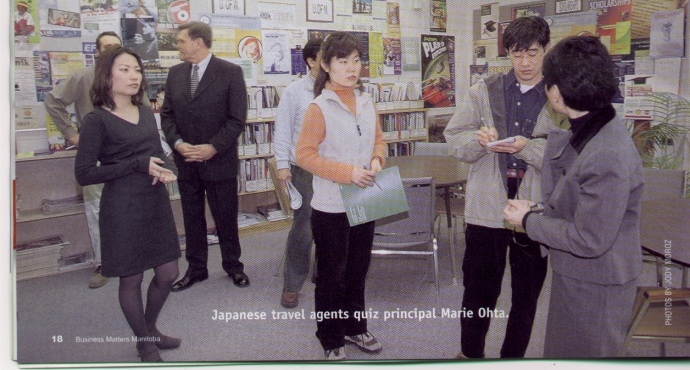
It is an unusually balmy late February day as nine Japanese travel agents file into a conference room in the library of Fort Richmond Collegiate. The Winnipeg high school is just one stop on a whirlwind 'familiarization tour' put on by the Canadian Tourism Commission, Travel Manitoba and Manitoba Education and Training. Marie Ohta - the principal of FRC warmly greets the agents as they seat themselves around a table. She has to quickly explain that while she may look Japanese she is in fact 3rd generation Canadian and knows very little Japanese. She cautions against the perception that all students who appear foreign are from other countries.
"Canada is a very multicultural country," she says.
As the agents tour the school they are keenly interested in the inner workings of the facility and ask many questions.
"Will students have an email address and access to a computer?" asks one. An affirmative answer brings a nod of approval. More questions are asked, and answers are scribbled down quickly in notebooks. A few stop to take pictures. After the tour the agents mill about and offer thoughts on the school and Winnipeg in general.
"It is a very beautiful city," said Rikihiro Nakayama of the International Students Society out of Tokyo. "Very friendly and very comfortable." He went on to add that he would definitely recommend that Japanese students come to Winnipeg.
The Japanese are well known world wide travelers. One of the companies represented on the tour, the Japan Travel Bureau is the largest of it's kind in the world. The student study abroad market is just one slice in a large pie of this bustling industry. And it is a very prosperous slice. Japanese student travel has grown over 130% in the last year alone. Over 5,000 Japanese students representing some 250 schools took part in the ESL (English as a Second Language) and homestay (billeting) programs in Canada last year making the Great White North number four in the world behind the United States, Australia and New Zealand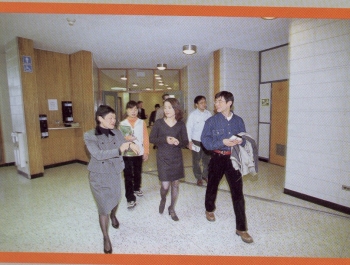 .
.
Jun Saito Sales Manager of the Canadian Tourism Commission based in the Canadian Embassy in Tokyo sees the demand for ESL programs in English speaking countries growing. Especially his country.
"Learning English is important in Japan. In 2002 there will be elementary schools teaching English as well. More schools are looking at going abroad to English speaking countries. And Canada is a safe country, that is very important," said Saito.
Mr. Saito brought nine travel companies on this excursion to Winnipeg and believes that if Manitoba offers quality programs more Japanese students will make Manitoba their destination.
"Unfortunately not many Japanese come to see Manitoba on a sight-seeing tour, they want to see Niagra Falls or the Rockies or Vancouver. So that's why the student market is a bit different. I think it's suitable here," said Saito.
"Vancouver is the main destination," added Keijiro Minami from Nippon Travel Agency. "But the market has become saturated, and there are not enough homestay families for the students. We want to focus more on Central Canada."
The Canadian Federal government's Department of Foreign Affairs and International Trade has estimated that each international student studying in Canada is worth $30,000 dollars to the local economy. With the lucrative commercial education and training sector dramatically transformed as a result of technological advancements and changes in global demand, Canada is hoping to attract more foreign students than ever before. Within Canada, Manitoba is now aggressively marketing itself to become a premier destination for foreign students studying abroad.
The downtown Winnipeg office of Gerald McLeod, Director of International Education for Manitoba Education and Training is in the midst of furious foreign trade activity. The offices of the Department of Industry Trade and Mines is a much different environment than the former public school teacher is accustomed to - education used to have nothing to do with business. But now working hand in hand with other trade departments and taking advantage of their international connections and analysis of foreign markets is part of the job description.
"We're using business terminology more now. It's the education market," said McLeod. Today, the international dimension of education is becoming a major feature of Canada's trade development agenda. Sales of education and training are quickly surpassing some of Canada's more traditional exports. Education has become such a big part of Team Canada trade missions that on the latest mission to Latin America in 1998 education was the third largest sector represented.
"Public education has been seen as a local matter to develop your local population and to put your resources into growing your own people, but now there is a real potential for education services being sold around the world," said McLeod.
Industry in the first world is increasingly becoming knowledge based. English language education is now being marketed like any other commodity. And just like other market driven consumer good, the competition is very fierce.
"English British Prime Minister Tony Blair has made it an economic imperative to corner 25% of the international market by 2010," stated McLeod. Australian Education International has trumpeted the Australian education and training system as a world leader in attracting international students. Nearly ten percent of students enrolled at Australian higher education institutions in 1997 were overseas students. In the United States, a State Department's Bureau of Education and Cultural Affairs survey for 1998-99 counted 491,000 foreign students enrolled at US colleges and universities. A record since foreign enrollment began being monitored in 1949.
According to the National Report on International Students in Canada compiled by the Canadian Bureau for International Education, Canadian universities hosted 35,000 foreign students in 1998/99, while Canadian Colleges added another 17,000. With Canadian post secondary institutions dealing with major government funding cuts these international students provide a much needed boost on the revenue side of things.
"We're investing time money and energy in attracting foreign undergraduate students and the reason we're doing it, just like any other business in the world is because we want to affect our bottom line," said Peter Dueck Director of Enrollment Services at the University of Manitoba. The University of Manitoba had 750 students studying abroad at the Fort Garry campus this year. These foreign students bought books from the bookstore, computers from the computer center and rented rooms in residences. And this is only on campus, it doesn't take into account other expenses which only infuse the local economy with money that normally wouldn't be spent here.
The University of Manitoba's main focus is in attracting foreign undergrad students. (Although other programs are offered in recruitment trips)
"Undergraduate students do us a double service, they fill empty seats and because we are able to charge a 75 percent sur charge - we get more money from them than a traditional Canadian student would have to pay. Their entire tuition is gravy to us because if we didn't have the student we would still be teaching the class and now it's all just all surplus revenue." In the future Dueck would like to see 10% of the students at the U of M hailing from different countries.
The other less tangible benefits of having a foreign presence at U of M were also noted by Dueck.
"If we could simply find those people, excellent students who would raise the academic quality of the classroom, help us to provide a world focus rather than a provincial focus, and provide extra revenue then we're ahead in all counts," said Dueck.
The benefits of having a strong international education program are being recognized by school divisions across Manitoba as well. The Fort Garry School Division has been on the cutting edge in developing an international education program for their public schools. While other divisions may have retired teachers or administrators working part time with limited resources, Fort Garry has a full time director and a full time Homestay coordinator. Started in 1995 to bring an international perspective to their schools by attracting students who wished to study abroad, it was also seen as a way to set the division apart from others in an era of open boundaries. (From March 22 to April 5, 16 students from General Byng Junior High visited various Junior High Schools in Setagaya, Japan. This is the 30th year of the exchange relationship. Vincent Massey Collegiate exchanges with Nodai Dia Ichi High School in Setagaya every second year.) A well organized professional international education program can also propel a school division into the black in a red period of dwindling revenues. Each foreign student pays a $10,000 full year tuition plus a $500 Homestay fee in Fort Garry.(standard right across the province.)
While there are extra ESL classes for these students, school divisions with international education programs are essentially filling empty seats in classrooms. Fort Garry also offers a summer ESL cultural program bringing in revenue during the summer break but in addition providing jobs for ESL instructors and a boost to tourism in the province.
"It's not just us, it's the city, the province and the country benefiting as well," said Brent Poole, Director of the International Student Program in Fort Garry.
Since it's inception Fort Garry's International Student Program has grown from 10 to the present number of 98 international students. The main source of students is Asia, but two years ago Fort Garry ventured into the Central and South American markets. In addition to students from Japan, Korea and Hong Kong there are now students from Mexico, Brazil and most recently Guatemala. "International education is a commodity, it's something you can sell, schools abroad want international opportunities that involve English and involve cultural experiences," said Poole.
The international thirst for English education and training services has prompted Manitoba to accelerate plans for formalizing a governing body to coordinate marketing efforts. The Manitoba International Education Initiative Committee (MIEIC) had its origins as a grassroots adhoc committtee of any Manitoba institution interested in international education. Made up of representatives from the public school system, universities, colleges, Christian colleges and private language schools the MIEIC's focus as of March of last year was to become proactive and push promotion of Manitoba institutions on the international stage. An important aid to MIEIC members is the Canadian Education Center Network which operates 15 offices world wide with the support the Department of Foreign affairs and International Trade, the Canadian International Development Agency and Citizenship and Immigration Canada. Through their offices the CEC coordinate international education fairs and school seminars providing advertising in local newspapers while looking after the little details that may arise when thousands of eager people clamour around booths while flooding through convention centers in search of a quality English education.
So in this age of shopping for an international education, how does Canada and Manitoba stand out from competitors from other English speaking countries? Canada's reputation as a safe, beautiful, clean country is very appealing to students coming from crowded, smog riddled, crime stricken, larger metropolitan areas.
"High school students from Brazil when asked why did you come to Canada, one of them said to me, because Canada is number one in the quality of life index. So we're seen as having an excellent quality of life," said McLeod.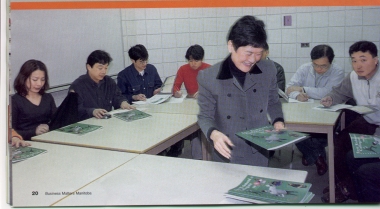
But within Canada how does one recommend Manitoba when there is that extended cold snap we like to call winter?
"The reality is that our winters aren't all that different from Edmonton or Ottawa," said McLeod. "We say it has a cold climate but so do most places in Canada." And Manitoba winters can be sold as an exotic quality to places in the world where snow is something you only see in books or on television.
"We recently took some students to the Festival Du Voyageur and they were thrilled to be standing on a frozen river," said Marie Ohta principal at Fort Richmond Collegiate. "The Mexican students who were here for the first semester had a snowball fight before they left. It will be something they will remember the rest of their lives."
Another Manitoba blessing is the lower cost of living than you would get in other parts of Canada. But this is a tricky area. Students come from various economic backgrounds and those who can afford to study abroad usually have the money to do so.
"Sometimes they want to buy a Mercedes and not a Chevrolet," said McLeod. "So you have to be careful, if you go to some countries and advertise yourself as cheap they wonder why."
Within Canada Vancouver and Toronto are homes to large clusters of ethnic groups. Some students may find this attractive and more comfortable with this cultural safety net, but others are looking to places that have less of a foreign presence where they can be easily immersed in the English language and Canadian culture.
"When a Japanese person goes to Vancouver they can eat at Japanese restaurants, read Japanese newspapers and become part of the large Japanese community. In Winnipeg they don't have that support group and they end up living the experience they came to Canada for," said Gary Gervais of Heartland International English School, a new private English Language School located across from the University of Winnipeg. The recent explosion in international education has allowed Gervais and his partner Rennie Zegalski to open Heartland 10 months ago. Graduates of JET (Japan Exchange Teaching Program) both taught English in Japan for a number of years.
"Japanese people would say to us, you are so lucky you speak English. So many doors are open to you," said Gervais. Zegalski echoed that English is the language of business in an ever expanding global marketplace.
"When you are a young person and looking for success, competence in English is by far the critical factor in being successful. From a business perspective you have to be able to relate, e-commerce is happening through English."
Student recruitment is not the sole focus of commercial international education. Contracts for training and consultation is a developing market all over the world.
"We're talking about earning money outside of the country for our institutions," said McLeod.
The Hong Kong transit authority wanted basic English language training for it's 800 bus drivers to become more friendly for business and tourist travel. The project was tendered across the globe. Argentina is restructuring its whole education system with money from the World Bank and is inviting proposals from interested institutions with services to offer. Developing an enhanced foreign presence will allow Manitoba institutions to involve themselves in these projects.
The Fort Garry School Division is sent two ESL teachers from Manitoba to China this spring for three weeks to offer ESL training for Chinese teachers. Manitoba is already considering an agreement with a province in Chile to provide curriculum consultation and construction expertise in building technical schools.
Aside from the economic benefit that international students provide to the economy there is the educational need to have Manitoba institutions become more international in perspective by offering students the chance to study in foreign countries. Distance education programs would allow Manitoba institutions to provide courses at sister institutions allowing students to travel freely between the two with no interruption in the pursuit of their degrees will gaining invaluable experience along the way.
"In order to participate in the future our students are going to have to have more of an opportunity to study internationally," said McLeod. Today's student must have an international outlook to compete in the rapidly changing economy. Student mobility is becoming a required part of higher education in other parts of the world. "The EU has all kinds of student mobility where students from one country can do part of their training in another member country. And they emphasize international conferences," said McLeod.
Back at Fort Richmond Collegiate Jun Saito is looking forward to the evening when he can sit down with the agents in a more informal setting and gather their impressions. He also says he will follow things up when everyone returns to Tokyo. He is very optimistic. Mr. Saito stresses the importance of building relationships between schools and sees that being done by forging a direct link between Manitoba institutions Japanese agencies.
"This coordinating effort will be the first of it's kind in Canada," Saito said with a smile. He envisions Canada climbing the ladder of international destinations.
"The price isn't much different than Australia and we can beat Australia," said Saito.
"Canada is a very multicultural country," she says.
As the agents tour the school they are keenly interested in the inner workings of the facility and ask many questions.
"Will students have an email address and access to a computer?" asks one. An affirmative answer brings a nod of approval. More questions are asked, and answers are scribbled down quickly in notebooks. A few stop to take pictures. After the tour the agents mill about and offer thoughts on the school and Winnipeg in general.
"It is a very beautiful city," said Rikihiro Nakayama of the International Students Society out of Tokyo. "Very friendly and very comfortable." He went on to add that he would definitely recommend that Japanese students come to Winnipeg.
The Japanese are well known world wide travelers. One of the companies represented on the tour, the Japan Travel Bureau is the largest of it's kind in the world. The student study abroad market is just one slice in a large pie of this bustling industry. And it is a very prosperous slice. Japanese student travel has grown over 130% in the last year alone. Over 5,000 Japanese students representing some 250 schools took part in the ESL (English as a Second Language) and homestay (billeting) programs in Canada last year making the Great White North number four in the world behind the United States, Australia and New Zealand
.Jun Saito Sales Manager of the Canadian Tourism Commission based in the Canadian Embassy in Tokyo sees the demand for ESL programs in English speaking countries growing. Especially his country.
"Learning English is important in Japan. In 2002 there will be elementary schools teaching English as well. More schools are looking at going abroad to English speaking countries. And Canada is a safe country, that is very important," said Saito.
Mr. Saito brought nine travel companies on this excursion to Winnipeg and believes that if Manitoba offers quality programs more Japanese students will make Manitoba their destination.
"Unfortunately not many Japanese come to see Manitoba on a sight-seeing tour, they want to see Niagra Falls or the Rockies or Vancouver. So that's why the student market is a bit different. I think it's suitable here," said Saito.
"Vancouver is the main destination," added Keijiro Minami from Nippon Travel Agency. "But the market has become saturated, and there are not enough homestay families for the students. We want to focus more on Central Canada."
The Canadian Federal government's Department of Foreign Affairs and International Trade has estimated that each international student studying in Canada is worth $30,000 dollars to the local economy. With the lucrative commercial education and training sector dramatically transformed as a result of technological advancements and changes in global demand, Canada is hoping to attract more foreign students than ever before. Within Canada, Manitoba is now aggressively marketing itself to become a premier destination for foreign students studying abroad.
The downtown Winnipeg office of Gerald McLeod, Director of International Education for Manitoba Education and Training is in the midst of furious foreign trade activity. The offices of the Department of Industry Trade and Mines is a much different environment than the former public school teacher is accustomed to - education used to have nothing to do with business. But now working hand in hand with other trade departments and taking advantage of their international connections and analysis of foreign markets is part of the job description.
"We're using business terminology more now. It's the education market," said McLeod. Today, the international dimension of education is becoming a major feature of Canada's trade development agenda. Sales of education and training are quickly surpassing some of Canada's more traditional exports. Education has become such a big part of Team Canada trade missions that on the latest mission to Latin America in 1998 education was the third largest sector represented.
"Public education has been seen as a local matter to develop your local population and to put your resources into growing your own people, but now there is a real potential for education services being sold around the world," said McLeod.
Industry in the first world is increasingly becoming knowledge based. English language education is now being marketed like any other commodity. And just like other market driven consumer good, the competition is very fierce.
"English British Prime Minister Tony Blair has made it an economic imperative to corner 25% of the international market by 2010," stated McLeod. Australian Education International has trumpeted the Australian education and training system as a world leader in attracting international students. Nearly ten percent of students enrolled at Australian higher education institutions in 1997 were overseas students. In the United States, a State Department's Bureau of Education and Cultural Affairs survey for 1998-99 counted 491,000 foreign students enrolled at US colleges and universities. A record since foreign enrollment began being monitored in 1949.
According to the National Report on International Students in Canada compiled by the Canadian Bureau for International Education, Canadian universities hosted 35,000 foreign students in 1998/99, while Canadian Colleges added another 17,000. With Canadian post secondary institutions dealing with major government funding cuts these international students provide a much needed boost on the revenue side of things.
"We're investing time money and energy in attracting foreign undergraduate students and the reason we're doing it, just like any other business in the world is because we want to affect our bottom line," said Peter Dueck Director of Enrollment Services at the University of Manitoba. The University of Manitoba had 750 students studying abroad at the Fort Garry campus this year. These foreign students bought books from the bookstore, computers from the computer center and rented rooms in residences. And this is only on campus, it doesn't take into account other expenses which only infuse the local economy with money that normally wouldn't be spent here.
The University of Manitoba's main focus is in attracting foreign undergrad students. (Although other programs are offered in recruitment trips)
"Undergraduate students do us a double service, they fill empty seats and because we are able to charge a 75 percent sur charge - we get more money from them than a traditional Canadian student would have to pay. Their entire tuition is gravy to us because if we didn't have the student we would still be teaching the class and now it's all just all surplus revenue." In the future Dueck would like to see 10% of the students at the U of M hailing from different countries.
The other less tangible benefits of having a foreign presence at U of M were also noted by Dueck.
"If we could simply find those people, excellent students who would raise the academic quality of the classroom, help us to provide a world focus rather than a provincial focus, and provide extra revenue then we're ahead in all counts," said Dueck.
The benefits of having a strong international education program are being recognized by school divisions across Manitoba as well. The Fort Garry School Division has been on the cutting edge in developing an international education program for their public schools. While other divisions may have retired teachers or administrators working part time with limited resources, Fort Garry has a full time director and a full time Homestay coordinator. Started in 1995 to bring an international perspective to their schools by attracting students who wished to study abroad, it was also seen as a way to set the division apart from others in an era of open boundaries. (From March 22 to April 5, 16 students from General Byng Junior High visited various Junior High Schools in Setagaya, Japan. This is the 30th year of the exchange relationship. Vincent Massey Collegiate exchanges with Nodai Dia Ichi High School in Setagaya every second year.) A well organized professional international education program can also propel a school division into the black in a red period of dwindling revenues. Each foreign student pays a $10,000 full year tuition plus a $500 Homestay fee in Fort Garry.(standard right across the province.)
While there are extra ESL classes for these students, school divisions with international education programs are essentially filling empty seats in classrooms. Fort Garry also offers a summer ESL cultural program bringing in revenue during the summer break but in addition providing jobs for ESL instructors and a boost to tourism in the province.
"It's not just us, it's the city, the province and the country benefiting as well," said Brent Poole, Director of the International Student Program in Fort Garry.
Since it's inception Fort Garry's International Student Program has grown from 10 to the present number of 98 international students. The main source of students is Asia, but two years ago Fort Garry ventured into the Central and South American markets. In addition to students from Japan, Korea and Hong Kong there are now students from Mexico, Brazil and most recently Guatemala. "International education is a commodity, it's something you can sell, schools abroad want international opportunities that involve English and involve cultural experiences," said Poole.
The international thirst for English education and training services has prompted Manitoba to accelerate plans for formalizing a governing body to coordinate marketing efforts. The Manitoba International Education Initiative Committee (MIEIC) had its origins as a grassroots adhoc committtee of any Manitoba institution interested in international education. Made up of representatives from the public school system, universities, colleges, Christian colleges and private language schools the MIEIC's focus as of March of last year was to become proactive and push promotion of Manitoba institutions on the international stage. An important aid to MIEIC members is the Canadian Education Center Network which operates 15 offices world wide with the support the Department of Foreign affairs and International Trade, the Canadian International Development Agency and Citizenship and Immigration Canada. Through their offices the CEC coordinate international education fairs and school seminars providing advertising in local newspapers while looking after the little details that may arise when thousands of eager people clamour around booths while flooding through convention centers in search of a quality English education.
So in this age of shopping for an international education, how does Canada and Manitoba stand out from competitors from other English speaking countries? Canada's reputation as a safe, beautiful, clean country is very appealing to students coming from crowded, smog riddled, crime stricken, larger metropolitan areas.
"High school students from Brazil when asked why did you come to Canada, one of them said to me, because Canada is number one in the quality of life index. So we're seen as having an excellent quality of life," said McLeod.
But within Canada how does one recommend Manitoba when there is that extended cold snap we like to call winter?
"The reality is that our winters aren't all that different from Edmonton or Ottawa," said McLeod. "We say it has a cold climate but so do most places in Canada." And Manitoba winters can be sold as an exotic quality to places in the world where snow is something you only see in books or on television.
"We recently took some students to the Festival Du Voyageur and they were thrilled to be standing on a frozen river," said Marie Ohta principal at Fort Richmond Collegiate. "The Mexican students who were here for the first semester had a snowball fight before they left. It will be something they will remember the rest of their lives."
Another Manitoba blessing is the lower cost of living than you would get in other parts of Canada. But this is a tricky area. Students come from various economic backgrounds and those who can afford to study abroad usually have the money to do so.
"Sometimes they want to buy a Mercedes and not a Chevrolet," said McLeod. "So you have to be careful, if you go to some countries and advertise yourself as cheap they wonder why."
Within Canada Vancouver and Toronto are homes to large clusters of ethnic groups. Some students may find this attractive and more comfortable with this cultural safety net, but others are looking to places that have less of a foreign presence where they can be easily immersed in the English language and Canadian culture.
"When a Japanese person goes to Vancouver they can eat at Japanese restaurants, read Japanese newspapers and become part of the large Japanese community. In Winnipeg they don't have that support group and they end up living the experience they came to Canada for," said Gary Gervais of Heartland International English School, a new private English Language School located across from the University of Winnipeg. The recent explosion in international education has allowed Gervais and his partner Rennie Zegalski to open Heartland 10 months ago. Graduates of JET (Japan Exchange Teaching Program) both taught English in Japan for a number of years.
"Japanese people would say to us, you are so lucky you speak English. So many doors are open to you," said Gervais. Zegalski echoed that English is the language of business in an ever expanding global marketplace.
"When you are a young person and looking for success, competence in English is by far the critical factor in being successful. From a business perspective you have to be able to relate, e-commerce is happening through English."
Student recruitment is not the sole focus of commercial international education. Contracts for training and consultation is a developing market all over the world.
"We're talking about earning money outside of the country for our institutions," said McLeod.
The Hong Kong transit authority wanted basic English language training for it's 800 bus drivers to become more friendly for business and tourist travel. The project was tendered across the globe. Argentina is restructuring its whole education system with money from the World Bank and is inviting proposals from interested institutions with services to offer. Developing an enhanced foreign presence will allow Manitoba institutions to involve themselves in these projects.
The Fort Garry School Division is sent two ESL teachers from Manitoba to China this spring for three weeks to offer ESL training for Chinese teachers. Manitoba is already considering an agreement with a province in Chile to provide curriculum consultation and construction expertise in building technical schools.
Aside from the economic benefit that international students provide to the economy there is the educational need to have Manitoba institutions become more international in perspective by offering students the chance to study in foreign countries. Distance education programs would allow Manitoba institutions to provide courses at sister institutions allowing students to travel freely between the two with no interruption in the pursuit of their degrees will gaining invaluable experience along the way.
"In order to participate in the future our students are going to have to have more of an opportunity to study internationally," said McLeod. Today's student must have an international outlook to compete in the rapidly changing economy. Student mobility is becoming a required part of higher education in other parts of the world. "The EU has all kinds of student mobility where students from one country can do part of their training in another member country. And they emphasize international conferences," said McLeod.
Back at Fort Richmond Collegiate Jun Saito is looking forward to the evening when he can sit down with the agents in a more informal setting and gather their impressions. He also says he will follow things up when everyone returns to Tokyo. He is very optimistic. Mr. Saito stresses the importance of building relationships between schools and sees that being done by forging a direct link between Manitoba institutions Japanese agencies.
"This coordinating effort will be the first of it's kind in Canada," Saito said with a smile. He envisions Canada climbing the ladder of international destinations.
"The price isn't much different than Australia and we can beat Australia," said Saito.