

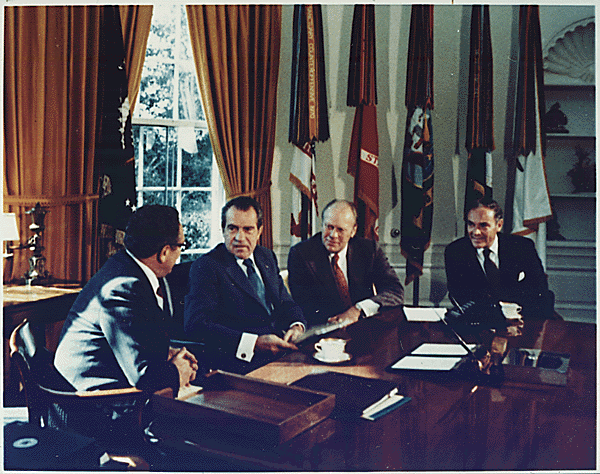
During the Vietnam War, widespread popular protests wracked the U.S., and the chaos didn't end with U.S. withdrawal. As it tried to heal its internal wounds, the U.S. began backing away from its policy of direct confrontation with the Soviet Union. Instead, it applied a new policy, detente, a policy of lessened Cold War tentions. The new policy finally replaced brinkmanship during the presidency of Richard M. Nixon.
President Nixon's move toward detente grew out of a philosophy known as realpolitik, which means " realistic politics." In practice, realpolitik meant dealing with other nations in a practical and flexible manner. Since the U.S. began to contain the spread of communism, the two superpowers both agreed to pursue detente and to reduce tentions.
Nixon's new policy represented a shift for the country. His rise in politics in the 1950s was largely due to his strong anti-Communist position. Later on, he became the first President after the Second World War to visit Communist China.
In February 1972, President Nixon made history again by visiting the Soviet Union. He was also the first President to went to Soviet and had talks with the Soviet President Brezhnev. After a series of meetings called the Strategic Arms Limitation Talks(SALT), Nixon and Brezhnev signed the First SALT Treaty. The treaty had improved U.S. relations with Soviet Union.
In 1975, 33 nations joined the U.S. & the Soviet Union to sign a commitment to detente & cooperation, the Helsinki Accords.
Nixon was the devoter who improved U.S. relations with China & Soviet Union. However, the new policy also decreased tentions and aggressions between countries. Meanwhile, the Cold War seemed to thaw.