


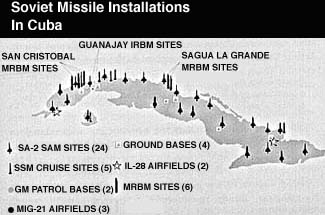

The failed Bay of Pigs invasion convinced the Soviet leader, Nikita Khrushchev, that the U.S. would not resist Soviet expansion in Latin America. So, in July 1962, Khrushchev secretly began to build 42 missile sites in Cuba.
In October, an American spy plane discovered the sites. The President of the U.S., John F. Kennedy, declared that missiles so close to the U.S. mainland were a threat. He demanded that the Soviets remove the missiles. He also announced a blockade of Cuba to prevent the Soviets installing more missiles.
Nevertheless, Cuba was deeply involved. Kennedy's demand for the removal of the Soviet missiles put the United States and the Soviet Union on a collision course. U.S. troops were ready to invade Cuba. People around there began to fear the standoff would lead to a nulear war. Fortunately, Khrushchev agreed to remove missiles in return for a U.S. promise not to invade Cuba.
The outcome of the Cuban missile crisis left Castro backed Communist revolutions in Latin America and Africa. Thousands of Cubans fought in Angola's war against colonialism in the 1970s. Soviet aid to Cuba, however, ended abruptly with the breakup of the Soviet Union in 1991. This caused a crippling blow to the Cuban economy. The country still suffers a lack of vital supplies. But the aging Castro refuses to adopt economic reforms or to give up power. An equally stubborn United States refuses to lift its trade embargo.
The events of the Cuban Missile Crisis demonstrated the maturity of the U.S. intelligence community. The crucial roles of human intelligence( HUMINT) and photographic intelligence(PHOTINT) in the Cuban Missile Crisis have been known from the beginning. Signals intelligence (SIGINT) also played an important part in managing the crisis.
However, the Cuban Missile Crisis was the closest the world ever came to nuclear war. But, luckily, thanks to the two brave President, John F. Kennedy & Premier Nikita Khrushchev, war was averted. Further negotiations were held to implement the October 28 agreement, including a U.S. demand that Soviet light bombers be removed from Cuba, and specifying the exact form and conditions of U.S. assurances not to invade Cuba.