"Welcome To Kanoya."
Tuesday 9 October. Day 75. Misty early. Warm to Hot. Humid. And in fact there was rain later in the day and evening. At 6-30 a.m. the dormitory lights came back on. Slowly people arose and did their morning things as the ferry steamed south along the wild black cliffs of south eastern Kyushu.
Let's have a brief look at the maps from Multimap (or just scroll past them).
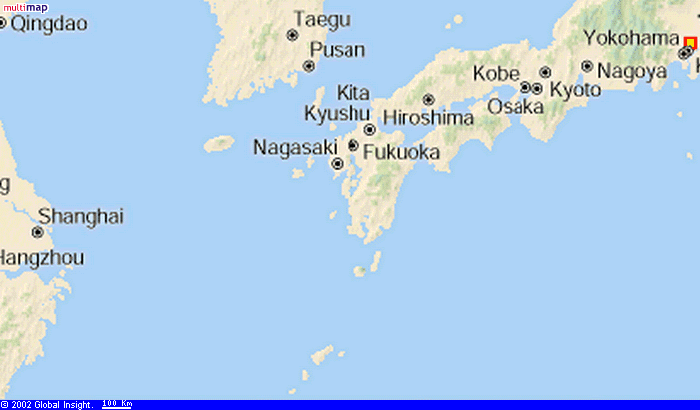
On the upper map you can see Osaka which was our port of departure. If you look a bit to the left you can see the city of Nagasaki indicated. This city is on the island of Kyushu which was our destination.
But Nagasaki is in the north west and we were headed to the port of Shibushi (not shown on this map) in the south east.
Anyway scroll down to the second map.
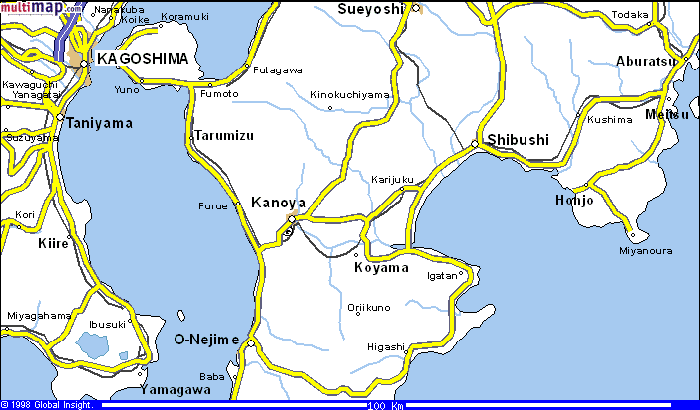
On this map you can see Shibushi, Kanoya,Kagoshima, and lots of other places. Most of the name Kagoshima is actually printed over the active volcano, Sakurajima.The location of the city is shown by tan shading. The area of water to the left of the middle of the map is Kagoshima Bay. The ghost railway line from Shibushi through Kanoya to Kagoshima and the rest of the world is also shown.
A problem with travel to this part of Japan is the paucity of information available in English. But there is a little information and some links to more on the Wikipedia Kagoshima Prefecture page.
Anyway, back to the travels.
We ate a buffet breakfast (1000 yen each). There was a generous selection displayed; but not coming anywhere near the mighty last brunch with the Nakanishi's. I had fruit salad, orange juice, two coffees, garden salad (lettuce, cucumber, tomato), potato and sweet corn salad, ham, omelette (daintily rolled in the Japanese fashion), a small saveloy, some grated daikon (white radish), Japanese pickled vegetables, and a soft bread roll with butter and jam: it sounds like a lot, I know, but, considering the exchange rate, it was important to get value for money, and anyway I felt myself excused by the oft-repeated maxim, "You can't get fat on Japanese food." Colin ate much the same, I think, but chose miso soup and some fishy offerings from the Japanese menu.
The ferry began docking in Shibushi port about a quarter of an hour before we disembarked at 9-00 a.m.
Ritsuko was waiting to meet us. We could see her waiting beside a car parked near the quay. It was Uncle Takao's Mitsubishi Magna Diamante, a very comfortable car.
Ritsuko Shimizu (a twenty one year old university student) had stayed a month with us in Queenscliff during February and March to practise English. Initially this was a great trial for her, because though her diction was excellent and her vocabulary extensive, she could not understand Australian English spoken at conversational speed. And there wasn't a great deal we could say in return in Japanese.
However, we so enjoyed the month that Ritsuko spent with us that we were pleased to have the opportunity to go to "country" Japan to stay in a "small Japanese house" with Ritsuko's family.
The road was interesting. "Golden Rod", very tall and lush, grew by the roadside. I could see fields of soya beans and clumps of yellow nerines. The speed limit was 80 kph, but the road, one lane each way, was busy. There are buildings, industrial, shops, houses, very near the edge of the road. Everyone drove carefully and politely and speeds rarely rose above 60 kph. In one garage or used car or car hire place, I saw a whole row of Mini Minors. Here they wear a "Rover" badge.
In the valleys between mountains the land is perfectly flat. Rice grows and canals or rivers flow. I saw a service station enigmatically sub-titled "Heart And Safety."
After driving for about three-quarters of an hour we reached the suburb, Ueno Cho, where the Shimizu family lived. Ueno Cho is in the semi-rural outskirts of Kanoya. At a small shopping centre, we turned right, off the main road to Kagoshima, into the Shimizu's street. Across the road from the Shimizu house was a field of soba (buck wheat), covered with white flowers. Looking around we could see fruit and flowers being grown on small plots in every direction, soya beans, bananas, cosmos, persimmons with ripe orange fruit (Colin had never seen this fruit before and innocently supposed the ingenious Japanese really had managed cuboid oranges), and mandarins. A few hundred metres uphill, the fields ended and wooded hills began.
Rural Japan has a sub-tropical vegetative beauty that matches the temperate lushness of southern England.
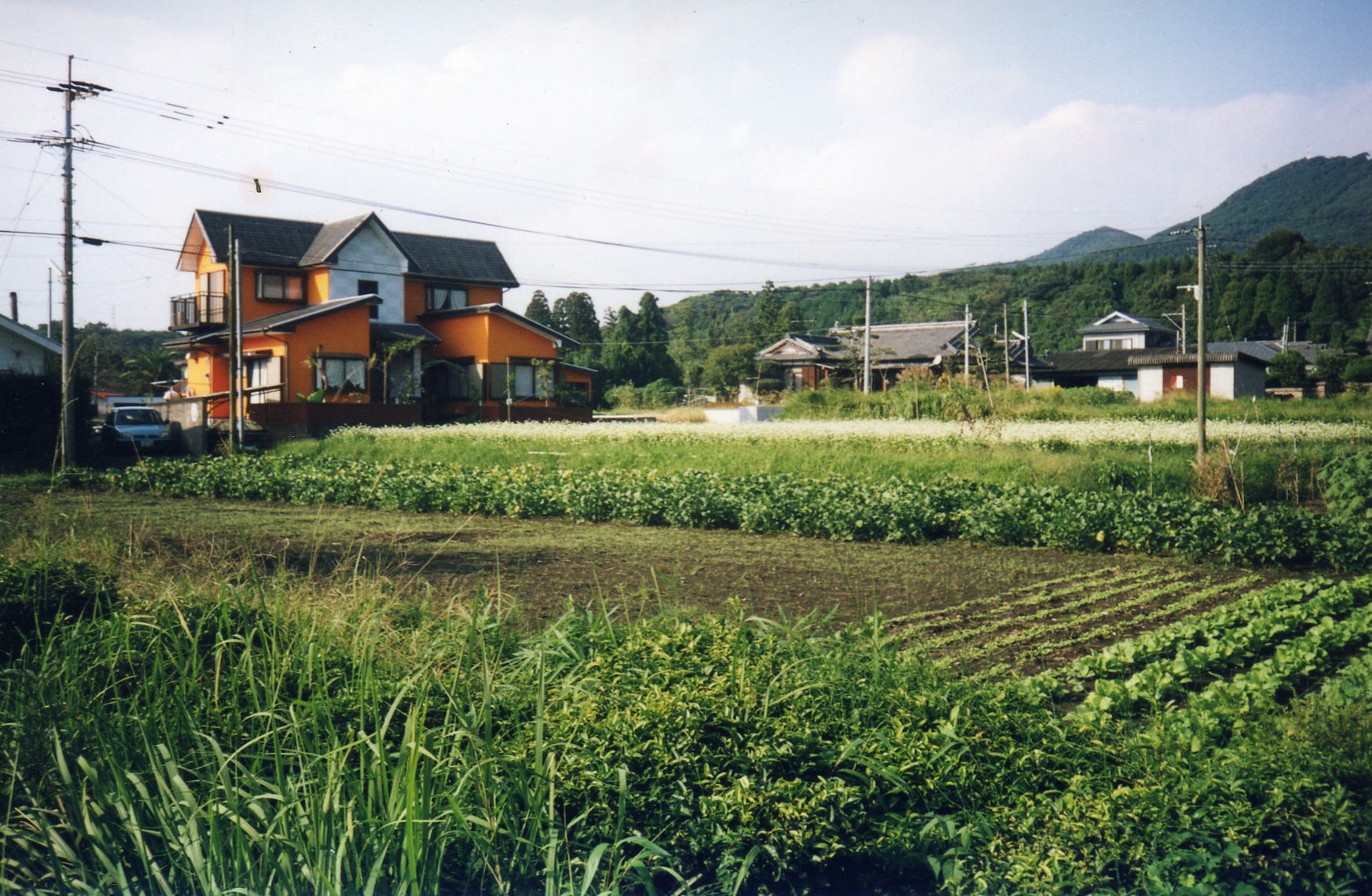
The two-storey Shimizu home had been built only a few years before our visit. A photograph taken across the peanut and soba fields shows two intersecting gable roofs with two skillions at the road facing corners of the building. The north south structure and the skillions were orange. The east west part which included the porch and main entry was light grey. Added to the north end was Toshiharu's snack bar, built from a packing case a Citroen car had been delivered in.
More traditional houses stood in the fields nearby. Ritsuko's parents; father, Toshiharu and mother, Shouko ("ou" is pronounced as is the "o" in "show") welcomed us with green tea and sweet bean buns served in their sitting room. On one wall was a varnished board on which large red letters said,
"Colin and Barbara. Welcome To Kanoya."
Conversation was carried on in a number of ways: through Ritsuko, translating both ways; by Colin's halting efforts in Japanese: the dictionaries, theirs and ours had a lot of use. Toshiharu and Shouko, like all Japanese had learned some English at high school. Sometimes I said something in English and they seemed to understand.
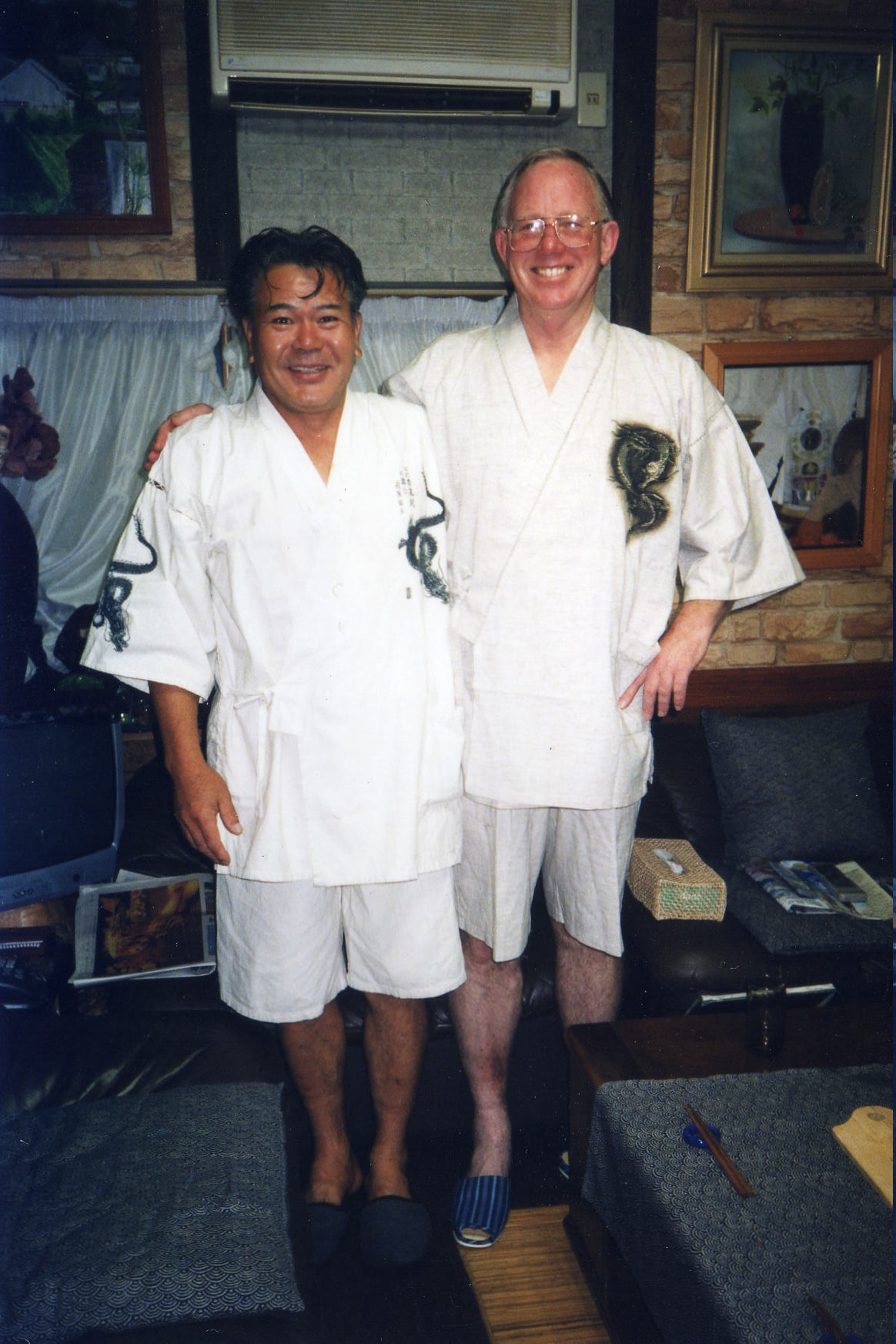
Colin was presented with a two suits of traditional costume and appears in a number of photographs looking truly remarkable. One suit was shorts and a jacket. The jacket was decorated with a large dragon on the back, and a smaller dragon over the left breast.
Lunch! It was rice balls made by Ritsuko, miso soup, and green tea.
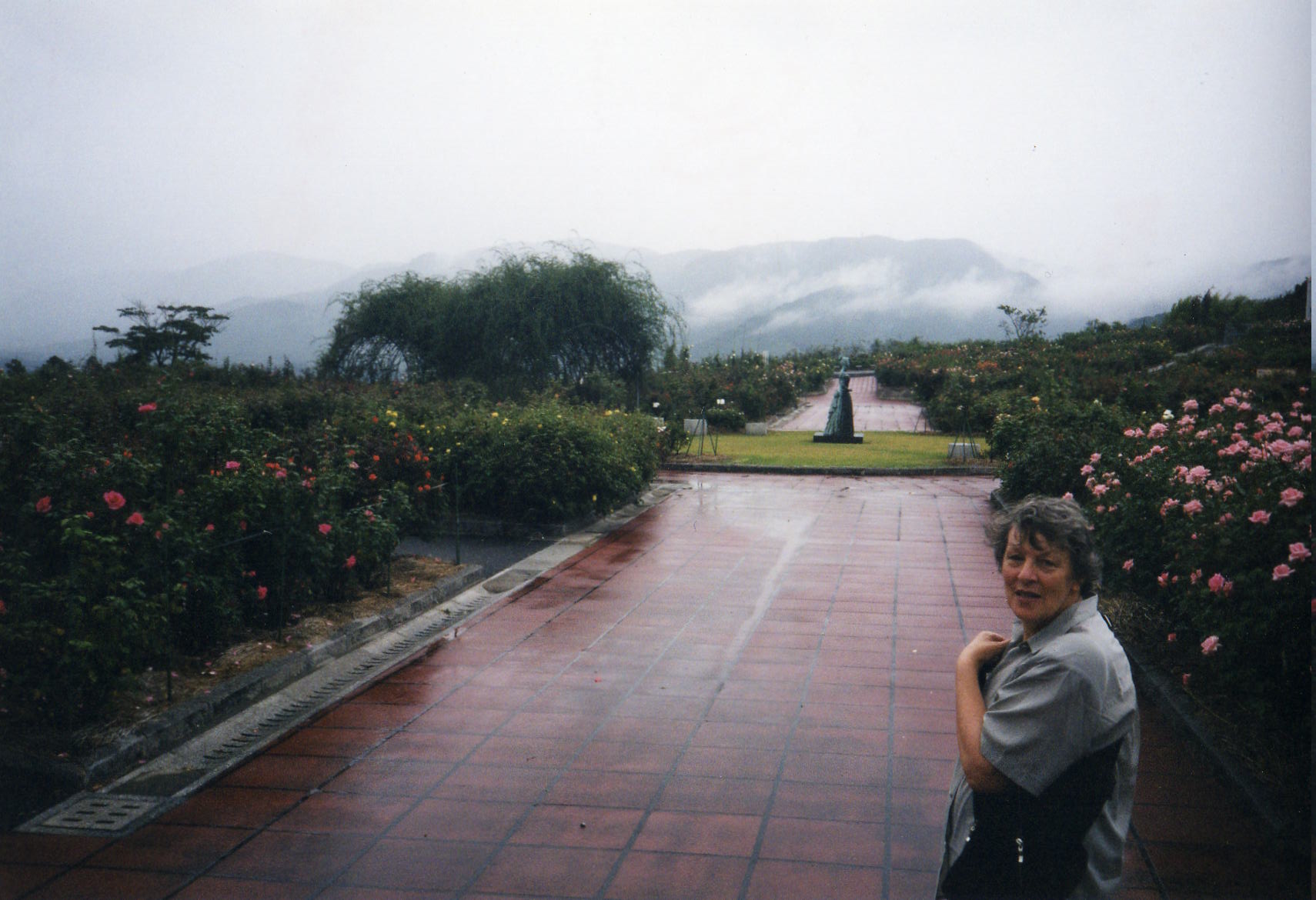
After lunch we drove through the rain to the Kanoya Rose Garden. It was quite warm despite the rain and sheltered by umbrellas, we walked around the gardens.
As well as roses, the magnificent gardens included a kiosk, a belvedere, and a display of retired helicopters. Kanoya has a military airfield and aeroplanes were frequently overhead on practice flights.
The roses were flourishing. This was a surprise, since we were near sea level at a similar latitude to central New South Wales, and we supposed the problems that annoy rose growers in the UK or in southern Australia would flourish here. However, despite the moist conditions, there was no sign of fungus nor of black spot.
The Rose Garden kiosk served a speciality, rose sofuto kuremu. Toshiharu bought everyone a cone. It was delicious: not too sweet; slightly icy. Soft serve ice cream in Japan is absolutely the best.
Back at the house, we showered (it was so good; I was feeling smelly: although it was October and mild to cool in London, here the day temperature was rising into the upper twenties). We sat in the dining room, talked some more. Presently Shouko and Ritsuko prepared and served a splendid tea: Oden, sushi, sashimi; beer and green tea. So much delicious food.
Our efforts with chopsticks caused polite amusement and demonstrations of the right way: we got the food to our mouths somehow. 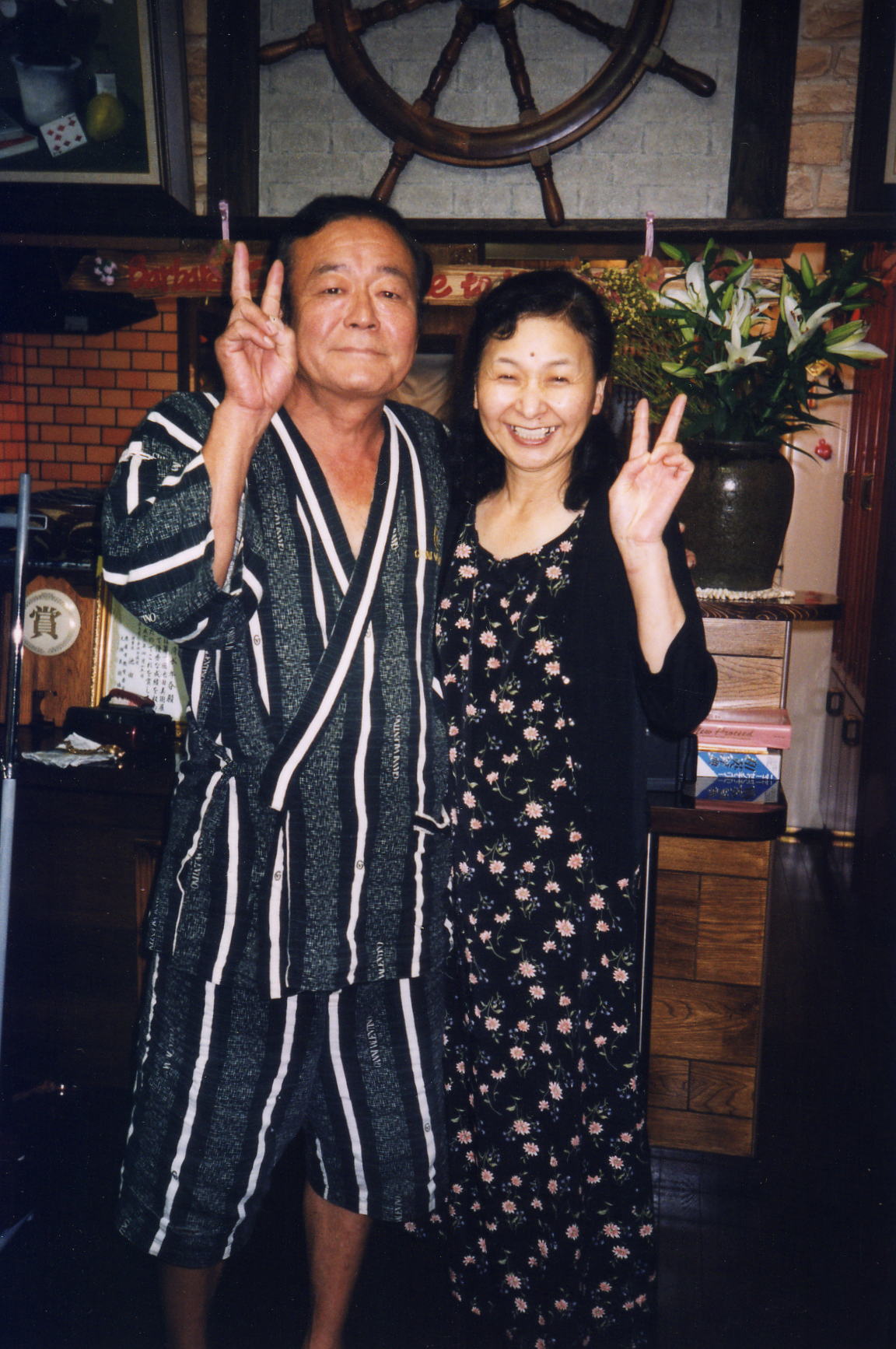
Toshiharu's elder brother, Takao and his wife Kayoko arrived from their house, one of the traditional looking ones, a few hundred metres up the road. They brought two one thousand millilitre cans of Asahi beer; the men had a jolly drinking time. Takao repairs cars and Kayoko is a dance (odori) teacher. Like Shouko and Ritsuko, Takao and Kayoko were both very lean. Toshiharu is more generously fleshed. Toshiharu is a self taught paint artist and the walls were decorated with his landscapes which were photographic in their detail. He sells his paintings and executes concept works for governement authorities.
But at this time of deep economic depression, Toshiharu works with Takao repairing damaged car bodies. Shouko owns a franchised dress shop in a department store in Kanoya. Some of the talk was about Japan's economic crisis and the worsening unemployment.
Momentarily, flash forward two months to the end of 2001. Kayoko lost her job. Shouko lost her shop because the department store closed, bankrupt. The two enterprising women rented an empty shop among the group at the end of their street and opened an "izakaya", a restaurant serving drinks and "pub" food. They are doing very well.
We continued eating (crisps,sugar coated peanuts, peanuts boiled in their shells, bean buns) and drinking green tea while we talked. Bedtime was about 11 pm for us, but even later for the others because they all bathed before bed. Our turn at bathing came before breakfast the next day. We had a futon each on the floor of the tatami room. We were very comfortable.
Sakurajima.