Introduction
The Open Door Policy has been carried out for more than 20 years since
the late 1970's by Deng
Xiaoping. Before Deng's era, China was ruled under the
radical politics-oriented and self-sustained policy by Mao
Zedong, which had China's door closed in front of the foreign countries.
Learned From the failure experiences from Mao's bloody political revolutions,
Deng realized that in order to let China to be modernized, the reforms
should be taken initially on the interest in the economic sector. Deng
started his goal by advocating China to open her door to the rest of the
world, which was the "Open Door Policy".
The selection of the 4 SEZs was based on the following:
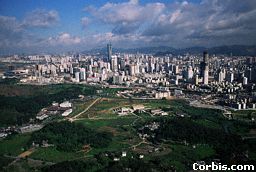
Shenzhen was the first SEZ in 1980 and it had become the focus of
Beijing's efforts to demonstrate the efficacy of its new international
economic policies. It was partly because of its proximity to Hong Kong,
partly because of special assistance from the central government. Before
1980, Shenzhen was an undeveloped town of 20,000 inhabitants. It grew rapidly
once it became a SEZ. Its central location between Hong Kong and Guangzhou
also made it an ideal place to locate industry, light industry, especially
the production of arts and crafts, textiles, footwears, clothing, medicines
and building materials, were important to the city's economy. The number
of manufacturing enterprises increased from 26 in 1980 to 500 in 1984,
and personal income was said to average almost five times that of urban
residents in China as a whole. Shenzhen also supplies food and water to
Hong Kong, which made its position unable to be replaced by any other cities.
Nowadays, Shenzhen has its population around 5 million. The unique geographical,
political and economical advantages of Shenzhen made the city became a
model of the Chinese government to develop the rest of China.
Shenzhen is just next to Hong Kong, this geographically
advantage
allow Shenzhen to has close economic activities
and cultural
exchanges with Hong Kong. The above
picture is the border
of Shenzhen and Hong Kong.
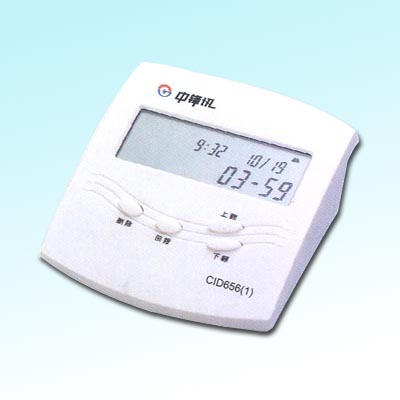
Light industries in Shenzhen produced various
kinds
of products for daily lives which would be
able to
compete with import goods. The lower prices
of products
and high qualities allowed them not only to
survive
in local market, but could also have large
export
volumes to the rest of the world. We could
easily
find products with labels "Made in China"
in many
western countries. This is a Caller-ID display
made
by a Shenzhen telephone manufacturer.
Other opened coastal cities
Besides SEZs, many coastal cities were also designated as opened areas such as Shanghai, Tianjin, Guangzhou and Nanjing. The idea of Deng was to let these coastal areas to have growth first and then the wealth effects would be infiltrated into the inland areas. The decision to open the Chinese coast to foreign investment was motivatecd partly by the success of Shenzhen -- one of the original four SEZs.
Shanghai is the largest and is one of the most important economic coastal cities in China which nowadays has population around 15 million. Shanghai was the first coastal city which open to the western world during the early 20th century. Shanghai is also an international stock exchange market which is competitive to one of the greatest financial center in the world -- Hong Kong. Some foreign banks were allowed to open their branches in Shanghai. Shanghai has the most highly skilled workers in China, and good transportation and communication networks. This beautiful city played an important role in Deng's Open Door Policy since when Deng visited there in the early 1990's, he decided to let this city to regain its "Dragon Head" position of the Chinese economy. After that, Shanghai's economy expanded more than 20% per year.
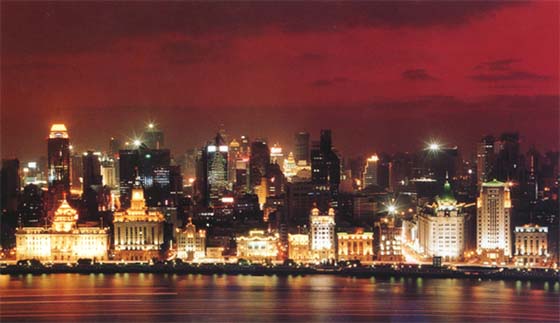
Shanghai was beautifully named as the "Eastern
Paris". It is located
on the East China coast, just to the south
of the mouth of Yangtze River.
Consequences of the Open Door Policy
The Open Door Policy, which encouraged foreign trades and investments, (in 1999, China received almost US$39 billion foreign direct investments) had achieved the desired effect of stimulating China's economic growth during the past two decades. People's living standard was greatly improved, not only on basic essential material products, but also on leisure entertainment and hobbies. For instant, many karaokes were opened in China and the usage of personal computers and the internet were getting much popular from time to time. The Open Door Policy was the only way for China to overcome poverty, backwardness and ignorance caused by China's previous isolation.
However, negative impacts such as serious environmental problems were
caused by the rapid economic developments in China. Industrial wastes
caused severe environmental pollution in the city areas. Water was
polluted by industries such as textile industry. Air pollution was
even worse, (from the pictures of the space satellites, many areas in China
were covered by smog which could not be see clearly) at least five of the
cities with the worst air pollution in the world were in China. Since
nearly all the gasoline in China was leaded and its heavy use in the country,
and 80 percent of the coal wasn't "washed" before being burned, people's
lungs and nervous systems were bombarded by an extraordinary volume and
variety of deadly poisons. One of every four deaths in China was caused
by lung disease, brought about by the air pollution.
Conclusion
Open Door Policy in China was an important stepping stone for China to enter the world economic market. With the attractive low production costs and huge local market, foreign investments were dramatically increased in the last decades in China. Many transnational corporations from the rest of the world (eg. Japanese vehicle manufacturing corporations such as Honda) had their assembly line established in China. New advanced technology was introduced from the other countries and many new jobs were created. The Open Door Policy also more or less led to decentralization of decising-making because market based economic development required that the locus of economic decision-making shift to lower levels of the state. So, it may be said that the econmic development headed by the Open Door Policy will eventually change the political system in China.
Also, China's admission to the World Trade Organization (WTO) in the coming future as an side-product of the Open Door Policy, as well as China has won the right to stage the Olympic Games, would rise the concerns of human rights in China from the western countries. By the way, environmental problems would also be watch out by the Chinese government for China's international image because she is going to host the 2008 Olympic Games.
Despite the problems caused, China certainly could not enjoy the tremendous
economic growth in the past decades without launching the Open Door Policy.
That is, no Open Door Policy, no Modern China.
Related links
 Any questions?
Please contact me at [email protected]
Any questions?
Please contact me at [email protected]