
Eight years ago, the Phoenix area saw a rash of carjackings and increased homicides; Arpaio, 68, a Republican and a career law enforcement official who spent more than two decades with the Drug Enforcement Administration, slid into office vowing to bring order to Dodge. His plan was simple: no more compassion for criminals. He took away their coffee; he took away their cigarettes; he made the men wear pink underwear; he put the women on chain gangs; he housed inmates in tents despite the area's oppressive heat. He deputized "posses" of untrained citizens to harass prostitutes and make arrests. Not surprisingly, it wasn't long before Arpaio was being called "the toughest sheriff in America." And not just by Arpaio himself.
Today at Mountain Pointe High, Arpaio-known everywhere he goes as "Sheriff Joe"-looks like a member of Arizona's leisure class. He is clad in a crisp khaki suit, a canary yellow dress shirt, a broad brownand-gray necktie, and a silver tie pin in the shape of a pistol-"the only gun I ever wear," he declares as he opens the flaps of his jacket, showing the students his unarmed body. Arpaio, who has lost 5o pounds in the past year or so, cuts a pretty fit image, although he says he doesn't exercise because he doesn't have the time. He lost the weight by giving up spaghetti. ("I can't believe I let myself get that fat," he told me earlier. "It doesn't look good on TV.")
Oddly, Sheriff Joe is often described as big and withering, but he is actually about five-feet-eight and physically unimpressive. What is intimidating about Arpaio are his distinctive features. Beneath his dark, well-oiled hair is a fierce, bulldoggish face. His eyes glare behind square metal spectacles. He speaks in a craggy, disgust-filled voice. When he mentions a constitutional lawyer or some "whining" politician, he seems as if he's about to spit. He's also one of those people who likes to pose questions to himself and then answer them. "When I opened Tent City on August 2,1993, I did my press conference at high noon," he says. "Why did I do it at 12 noon? Because it's the hottest part of the day. I wanted all those reporters to suffer and sweat"
Arpaio, whose jails are filled with drug addicts, is virulently opposed to legalizing narcotics. To explain why, he tells the students about the time he spent in Amsterdam while working for the DEA. "I tripped over all these people laying on the streets, and I said, 'What is this?' "he recalls excitedly. "Then I realized they were all junkies! Oh, I shouldn't use the word 'junkies.' I apologize. They don't use junkies' anymore. What are they now... chemical dependents? First it was junkies. Then it was addicts. Now
it's chemical. Anyway, I used to step over junkies in Amsterdam."
As Sheriff Joe rambles on, two of the school's security guards, who have joined us to get a glimpse of their larger-than-life sheriff, begin to giggle. "Hey, you want to come work for me?" he says to the duo. "We're hiring." They just laugh, enjoying Arpaio's bluster.
As for the teacher and me-the other adults in the room-we aren't all that amused by Sheriff Joe's road show, and he begins to pick on us. He keeps calling the teacher "professor" and with a nod in my direction exclaims, "I love it when these reporters try to get me. But I don't prepare my answers. I never prepare. I always have the answer. I can answer their questions in my sleep! I can answer them in two seconds. And I know how these reporters feel. They've got so many sound bites, they don't know which one to use. So they think they got a scoop. They think I only talk to them like that. I talk to everybody like that!"
It might be tempting to dismiss Sheriff Joe as something of a local curiosity were it not for two provocative facts: One, there have been several investigations into the use of "cruel and unusual" punishment and excessive force on Arpaio's watch, including an $8.25 million wrongful-death settlement with the family of a man who, like three-quarters of the sheriff's prisoners, was awaiting trial and presumed innocent. And two, for the past eight years, Arpaio has been Arizona's most popular politician.
A recent Arizona Republic poll put his job-approval rating at 85 percent. A lot of people feel we coddle criminals," observes pollster Bruce Merrill, the director of the state's respected Cactus Poll. "People hear him, and they say, `Goddamn. I'm glad somebody's doing something about this.' I can tell you from a polling point of view that he gets the highest ratings in the state. Every politician in the state seeks his endorsement" In fact, Arpaio may well have put himself in a position to be Arizona's next governor. "With his popularity and his name ID, he'd be a very strong candidate," says Mike Hull, the Republican political operative who ran the Bush primary campaign against John McCain and whose mother, Arizona Governor Jane Dee Hull, can't run for re-election in 2002.
When Arpaio first took office in 1993, he would frequently appear before cameras and microphones and snarl, "Why should our jails be country clubs?" He struck a populist chord, not unlike prosecutor-turned-mayor Rudy Giuliani in New York or wrestler-turned-governor Jesse Ventura in Minnesota. Employing the power of his popularity and attracting all kinds of media attention-Arpaio has managed to outsize, glorify, and aggrandize the sheriff's office beyond anyone's expectations. In reality, the job of sheriff amounts to little more than serving as an adjunct to the court. The sheriff's primary function is to detain people who have been arrested and are awaiting trial. The remaining 25 percent of the detainees are low-level criminals who have been convicted of crimes that carry sentences of less than a year.
Arpaio boasts of having pioneered a law enforcement strategy that will eventually be chronicled in textbooks. The idea is that with the proper mix of publicity and punishing prison conditions, he can spook people sufficiently so they won't commit crimes. As he sees it, the publicity he accrues isn't just self-serving; it also furthers the cause of justice. "I think I've set some kind of standard for the nation," he exults. "Is the publicity good? It's deterrence. If people see pink underwear, hot tents, the chain gang, maybe they won't drink and drive."
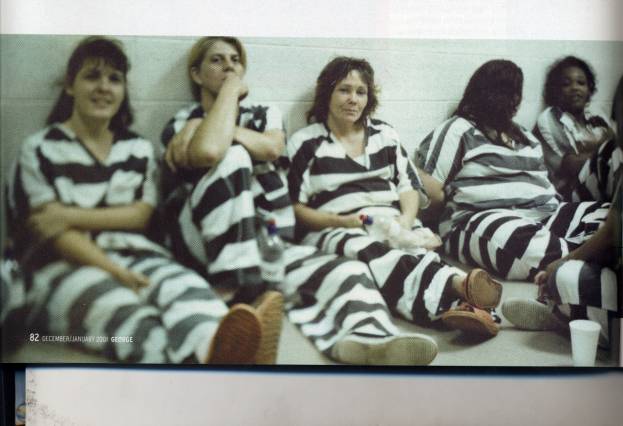
The women parade forward until they pass through a door and step outside into the purple early-morning air. They are dressed in black-and-white-striped uniforms, baseball caps, and green army belts, to which water canteens are attached. One of the women is saddled with a backpack. It's filled with 25 pounds of rocks, and she's going to have to wear it all day because she answered a question about one of the rules incorrectly. Arpaio proudly claims to be "the only person in the history of the world to use a female chain gang."
On this particular day, Sheriff Joe will achieve yet another milestone: His jail population will swell to 7,128, the largest Maricopa County has ever seen. Technically, the county has room for only 5,600 prisoners. He came up with the tent idea in part to deal with overcrowding. He also asserts that tents cost only $100,000 to construct; he says a new prison would have cost $41 million. On top of that, he's been asking almost from the day he took office, "Why should inmates have better housing than our soldiers who fought in the Gulf War?"
All of Arpaio's guests get the tough-guy treatment, whether they've been convicted of a crime or are still presumed innocent. "I'm not running an airline," he says. "I'm not going to serve some steak and some bologna. I don't discriminate." Most inmates work every day. They can't drink coffee or soda. They can't read pornographic magazines. They pay for meals-even for the green bologna sandwiches he some-times serves-and for medical visits.
Those who've been accused of crimes can remain in Sheriff Joe's custody for countless months while awaiting trial. Some are there on charges of drunk driving, others on charges of murder. Many can't afford to pay bail. Currently, Sammy "the Bull" Gravano, who was arrested in February for running an ecstasy drug ring out of Phoenix, is one of Sheriff Joe's more notorious pretrial inmates. ("I'm making him wear a bulletproof vest," Arpaio says of the Bull, who ostensibly still has a Mafia hit on his head. "He's not going to die in my jail.") Those awaiting trial are housed in jail. Those who have actually been convicted get the tents.
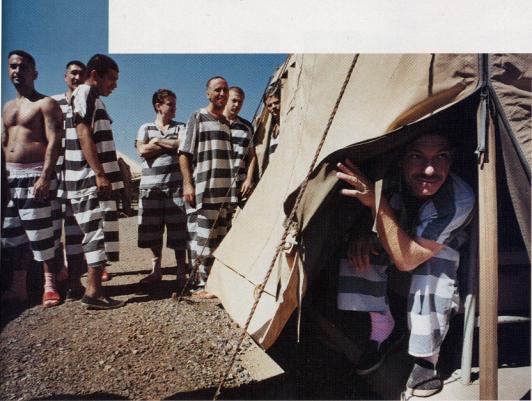
Sheriff Joe's Tent City is located near a trash dump and holds about 1,400 inmates. There are mosquitoes and mice, and the tents have holes that allow rain to dribble on the prisoners. Paradoxically, in state prisons, you can smoke, drink coffee or soda, and sleep in an air-conditioned environment with a real roof. One Tent City inmate tells me from her bunk bed, "Next time, I'm going to sure as hell do a bigger crime so I can be sent to state"
Tent City, which consists of 75 green army tents, is divided into three sections by fencing, with razor wire and corrugated-metal walls. One section is a set of tents for women, another is for men, and another is for juvenile offenders (ages 14 to 17). The juvenile area is known as the pup tents. Each tent holds about 20 inmates. If a Tent City inmate violates the rules by, say, getting caught with a cigarette or fighting, he or she is transferred to lock-down in the Durango (men) or Estrella (women) Jail.
When I pay a visit to the men in Tent City, several prisoners approach me and ask if I've seen what lockdown at Durango is all about. They are convinced the sheriff would never let me see it, but in fact he does. The cells are about 8o square feet-the size of a station wagon-and are locked 23 hours a day. There are two bunk beds and a toilet. With open floor space no bigger than a bath mat, in-mates have little choice but to lie on their pillowless beds all day. Four men occupy each cell; for women, it's three to a cell. These conditions have prompted investigations from both Amnesty International and the U.S. Justice Department, which have prodded Arpaio to make concessions, such as promising to reduce excessive force and to improve medical care. But he remains defiant. "Let them sue me," says Arpaio. "Those lawsuits never go anywhere."
To return to Tent City from lockdown, you have to serve on Sheriff Joe's chain gang for 30 days. The chain gang is called "last chance" Inmates who fail the chain gang-say, for picking up a cigarette butt-have to serve the remainder of their time in lockdown. Compared to lockdown, Tent City is Sheriff Joe's Club Med.
Scott Norberg was arrested on the evening of May 31, 1996, for disorderly conduct; he died several hours later in Sheriff Joe's jail, at the age of 32, from strangulation and a broken larynx. Norberg had a history of alcohol and drug abuse. He was allegedly bothering neighbors when he was picked up by a police officer, whom he attacked before he was handcuffed and booked at the Madison Street Jail in downtown Phoenix.
What happened next is unclear-in part because the wrongful-death suit filed by his family was settled out of court before it went to trial (the FBI and county attorney are still investigating). The $8.25 million the family collected is the largest wrongful-death settlement in Arizona history.
In pretrial depositions, some employees and in-mate eyewitnesses said Arpaio's officers used extreme force to control Norberg. They said he was handcuffed, was shocked repeatedly with stun guns, was gagged with a towel, and had his head shoved into his chest. Michael Manning, the family's attorney, says Norberg was punched, kicked, and zapped more than 21 times before he died. Manning calls it "a jailers' riot" and says Norberg's death was followed by an orchestrated cover-up by Arpaio and his employees.
"This office has run so far out of constitutional and moral control it's dangerous," Manning says.
Arpaio continues to scoff at the attention paid to Norberg's death. He says his officers did nothing excessive and the county's insurance company was wrong to settle.
`All they talk about is the Norberg case," he says. "It's one case. They can't find anything else to use to try to destroy this sheriff."
Before Joseph Arpaio became sheriff, he worked as a travel agent. Born on June 14, 1932, he grew up in Springfield, Massachusetts. His mother died during childbirth, and he was raised by his father, who owned three grocery stores, and other family members. On the day the Korean War started, he graduated from high school, turned 18, and joined the army. He left the service three years later as a sergeant and became a police officer in D.C.
Arpaio left Washington in 1957 for a brief stint as a police officer in Las Vegas. Then he became an undercover agent for the Bureau of Narcotics (which later became the DEA). During the next 20 years, he was dispatched to places all over the world for covert operations, including Turkey, Mexico, Panama, Iran, and Iraq. He ended up in Arizona and headed up the region's office until he retired in '82. In his autobiography, America's Toughest Sheriff, and in person, Arpaio likes to glamorize his 32 years of police work: "I've had a great career. I was in the French Connection. I worked with Noriega down in Panama."
In 1992, when Arpaio decided to run for sheriff, he had been retired from police work for a decade. He was processing airline tickets and hotel reservations and driving his wife crazy at her travel agency right up to the moment he had the idea to challenge a Republican incumbent who'd taken a lot of media criticism for inept handling of the office. During the campaign, which Arpaio funded him-self, he promised to run his jail system in such a way that inmates would want never to return.
Back outside Estrella Jail, the chain gang boards a shuttle bus and begins a half-hour trek to the corner of Pecos and Desert Foothills Roads to clear away trash. A pickup truck follows with supplies and a Port-A-Potty. By the time the brigade reaches its destination in the tony township of Ahwatukee, the sky is a soaring blue. The desert landscape is dotted with jagged mountain peaks and three-armed cacti. Even at this early hour, the temperature is in the 90s. Still, if the women weren't on the chain gang, they'd be languishing on their thin mattresses in lockdown. Given the alternative, they prefer the chain gang.
"I like it," announces Kim Nieman as she kicks at rocks with her free foot. "Better than sitting inside all day. I been more places on the chain gang than I ever saw living on the street"
The women are standing around the Port-APotty taking turns using it before they begin hunting for roadside garbage. Since they're tethered to one another, the door to the toilet never closes completely. They apply sunscreen to their faces.
"Who's been on the chain gang the longest?" Officer Loren Chesley my escort, asks the group.
"Me," says Nieman.
"How long?"
"I did 27 days and got kicked off for picking a cigarette butt off the side of the road, and I learned my lesson. Now-"
"They let you back on?" Chesley is incredulous, stunned by this breach of the last-chance code.
Like several others on the chain gang, Kim Nieman, 29, is a heroin addict. Her arms are pock-marked from drug use. She has pink skin, brown oily hair, and only one tooth. She's looking forward to getting out of jail, she says, so she can shoot drugs. She says it's the only good thing she knows.
"I learned my lesson," Nieman says, insisting she would never again risk picking up a butt. "I'm here, and I'm not picking up nothing. And neither is my chain members. I guarantee you that much."
"What about that cigarette in your pocket?" asks Chesley, who is gazing directly at Nieman. The women chained to her grow still.
"I don't have one," Nieman finally responds. Her voice is steady. Suddenly, as it becomes clear the officer was bluffing, the women laugh uproariously.
Sheriff Joe's corner office is located on the nineteenth floor of the Wells Fargo building in down-town Phoenix, and it's as luscious as a caramel apple. It is red-carpeted, appointed with fine leather furniture, and wrapped in a set of panoramic windows. From here, the sheriff can scan the city's splendid horizon and reassure himself that he is fully in charge. In one corner is a television set, and Arpaio is looming over it today. He's showing me a video of himself that he had made last year.
"There I am singing `My Way,' "he says as his rendition of the Sinatra song pours from the speakers. It's his favorite tune, and he wants it played at his funeral. "There I am signing pink underwear.... That's my posse.... There I am with Mike Tyson.... There I am opening Tent City...."
After the video ends, Arpaio bobs across the room and positions himself behind his battleship-size desk and talks about what he's achieved. "I'm saving the taxpayers millions and millions of dollars," he says. "Do people ever talk about that? No!"
One reason may be that it is a somewhat debatable claim. Yes, he's cut costs incrementally by making inmates pay for their food and medical care, but his annual budget has ballooned from $68 million to $125 million (an 84 percent increase at a time when the average number of inmates housed has increased by 45 percent). What's more, the recidivism rate at the county's jails, as determined by a study he commissioned, has not changed since he was elected. That is to say, in spite of all the hard-ships he's doled out to the inmates, they're still committing the same crimes and re-entering his jails as frequently as they always did. Some 68 per-cent of his inmates return for another stay-precisely the same rate as before Sheriff Joe and roughly in line with the national average.
No matter. Arpaio is convinced he'll be appreciated someday-especially for Tent City. He says he is considered a visionary for having the foresight to tackle jail overcrowding before it became a problem. But if his methods are so effective, why haven't others adopted them? This is one question for which Sheriff Joe doesn't have a pat answer.
"Why don't people elsewhere do what I'm doing?" he intones perplexedly. "I don't know.... We get these letters and these phone calls from people saying, 'Sheriff, we wish you were here.' So why don't others use what I've done?... I don't understand it"
After a few seconds of dead air, Sheriff Joe gives up on the question. Instead, he leans forward and asks
me, "Do you want a copy of my book?"
(c) Mark Francis Cohen