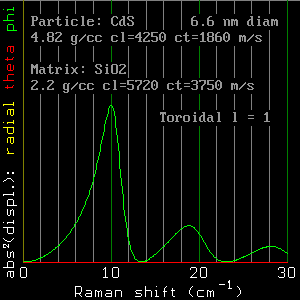
(large peak is rigid libration?)
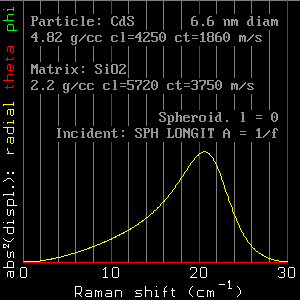
(breathing mode)
| Table I: Complex frequency modes | |||||
| type | l | ν (cm-1) for d=6.6 nm | S | program | method |
| TOR | 1 | 10.6+1.50i | c:\nano\scp77c.cpp | root searcher | |
| TOR | 1 | 0.5+0.07i | c:\nano\scp77.cpp | graphical | |
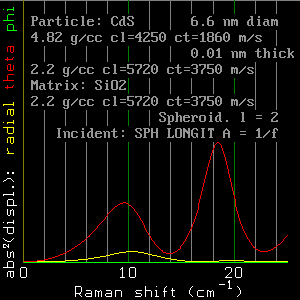
| SPH | 2 | 18.65+2.08i | c:\nano\scp75d.cpp | root searcher | |
| SPH | 2 | 0.87+0.09i | c:\nano\scp75d.cpp | graphical | |
| SPH | 0 | 21.7+3.98i | c:\nano\scp73d.cpp | root searcher |
| Figure 1 | ||
| (a) c:\nano\scp80f.cpp 45a.gif (large peak is rigid libration?) |
(b) c:\nano\scp79f.cpp 45b.gif (breathing mode) |
(c) c:\nano\scp78i.cpp 45c.gif |
|
|
|
|
| Table II: Comparison of approaches A and B | |||||
| approach A | approach B | ||||
| type | l | Re(ν) | Im(ν) | peak ν | HWHM |
| TOR | 1 | 10.6 | 1.50 | 10.0 | 1.5 |
| SPH | 2 | 18.65 | 2.08 | 18.5 | 1.7 |
| SPH | 0 | 21.7 | 3.98 | 20.5 | 4.1 |