Updated: January 23, 2008
Vibrational Mode Lifetime of a Silicon
Nanoparticle Weakly Coupled to a Substrate


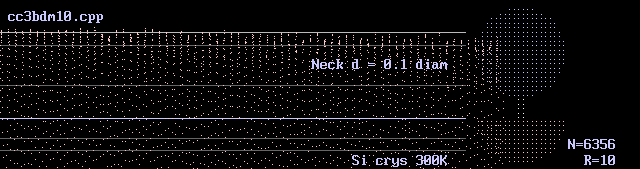
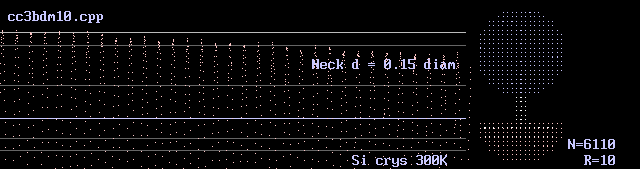
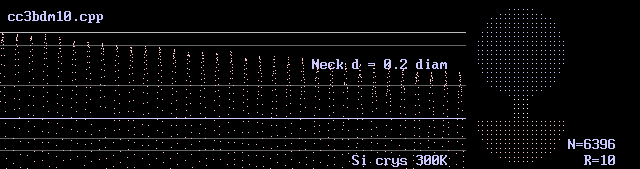
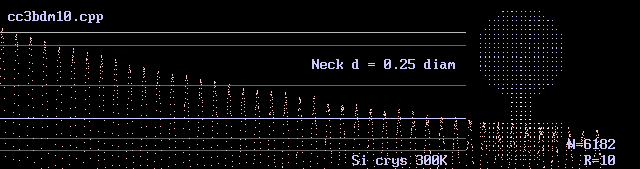
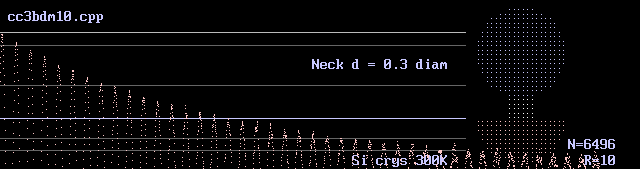
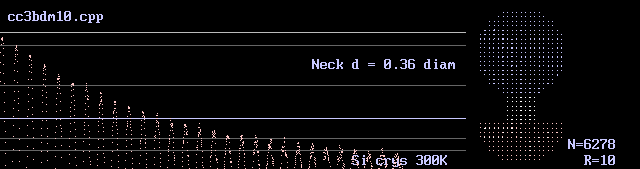
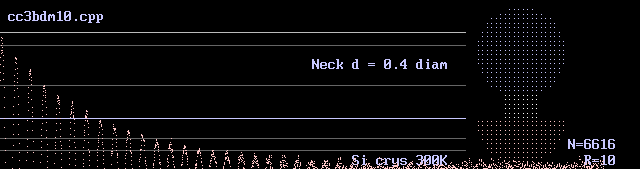
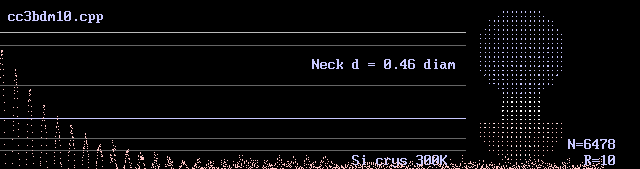
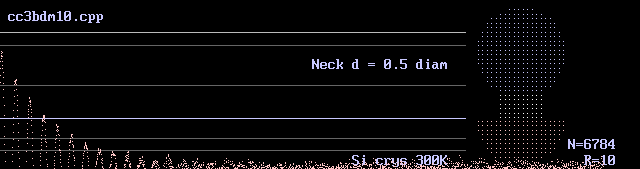
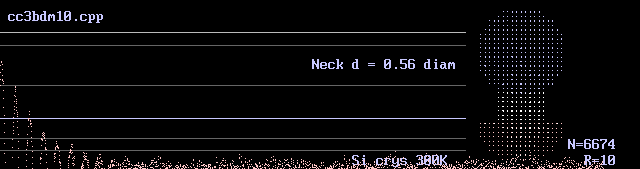
   Consider a spherical nanoparticle of diameter dp. Its elastic properties are those of crystalline silicon at room temperature: C11 = 166 GPa, C12 = 64 GPa, C44 = 80 GPa and ρ = 2.329 g/cc. The nanoparticle is connected by a cylindrical "neck" to a semiinfinite substrate also made of silicon. The neck is of length lc and diameter dc. The normal to the flat surface of the substrate is the [010] crystal direction. The vibrational mode being excited corresponds to dilation along the y-axis. This mode has dimensionless frequency η approximately 2.05, where ω = η Ctran100 / R, where R is the radius of the nanoparticle. Ctran100 is 5840 m/s for silicon, and is the transverse speed of sound along the [100] crystal direction. To determine the damping of this mode, it is first harmonically excited at its natural frequency. The excitation is then stopped and the velocity of one point on the sphere is plotted versus time in Figure 1 below.

Figure 1. Using Borland Turbo C++ program cc3bdm10.cpp
(a) dc/dp = 0.10
(b) dc/dp = 0.15
(c) dc/dp = 0.20
(d) dc/dp = 0.25
(e) dc/dp = 0.30
(g) dc/dp = 0.36
(g) dc/dp = 0.4
(h) dc/dp = 0.46
(i) dc/dp = 0.5
(j) dc/dp = 0.56

Table I
dc/dp Q
0.101360
0.15200
0.20100
0.2534
0.3016
0.3612
0.407
0.464
0.503
0.562.5

   Over this entire range, the data is well fitted by

Q = 0.247 (dc/dp)-3.66

   Extrapolating to the case of dp = 10 nm and dc = 0.5 nm, Q would be 14300.
   This calculation follows an analytical calculation "Phonons in a nanoparticle mechanically coupled to a substrate" by Kelly R. Patton and Michael R. Geller (preprint 2002). Their preprint is on line at: arxiv.org/PS_cache/cond-mat/0202325


Daniel Murray
Associate Professor
Math, Stats & Physics Unit
University of British Columbia - Okanagan
Kelowna, BC, Canada
daniel "dot" murray "at" ubc "dot" ca

For a list of related articles click on the link.

Hosted by www.Geocities.ws

1