Updated: January 23, 2008
l = 2 Spheroidal Mode Vibrational Frequency
of Ni-Ag Core Shell Nanoparticles


.....

   As a double check of my computer program I have recalculated some of the results in a recent paper [Portales et al. 2002 pdf ::]. My calculation includes a surrounding matrix. The earlier calculation [Portales et al. 2002 pdf ::] does not include a matrix, but rather assumes zero force boundary conditions. To obtain their results, I use a matrix material with very low density (0.125 g/cc) and low speed of sound (vl=1000 m/s and vt=300 m/s). In the case where the nanoparticle is assumed to be a hollow shell, I place the same low density soft material inside.

    For the silver (Ag) I assumed a molecular weight of 107.87 g/mole and a density of 10490 kg/m3. So one mole occupies 10.27 cm3. I used a Poisson ratio of ν = 0.37, so that Ct / Cl = 0.4542. (Since Ct/Cl = sqrt((1-2ν)/(2-2ν)) ) I used Cl = 3595 m/s and Ct = 1633 m/s.

    For the nickel (Ni) I assumed a molecular weight of 58.69 g/mole and a density of 8908 kg/m3. So each mole occupies 6.59 cm3. I used a Poisson ratio of 0.31, so that Ct / Cl = 0.525. I used Cl = 5720 m/s and Ct = 3000 m/s.

   Here is an illustration of how I work out the inner and outer radii, as well as the shell thickness to use: In the case of Ni0.75Ag0.25, the material is 75% nickel atoms and 25% silver atoms. Suppose for simplicity there are 3 moles of nickel and 1 mole of silver. Then the volume of nickel is (3 moles)(6.59 cm3/mole)=19.77 cc and the volume of silver is (1 mole)(10.27 cm3/mole)=10.27 cc. The total volume of the nanoparticle is 19.77+10.27 = 30.04 cc. Thus, the nickel takes up 19.77/30.04 = 0.658 of the total volume. Since volume scales as radius cubed, the radius of the inner nickel sphere is 0.6581/3 = 0.870 times the outer radius. For the sample used by Portales et al. the diameter of the particles was 2.3 nm in this case. So the outer radius is 2.3 nm / 2 = 1.15 nm. This makes the radius of the inner nickel sphere (1.15 nm)(0.870) = 1.000 nm. The thickness of the silver shell is then 1.15 nm - 1.000 nm = 0.15 nm.

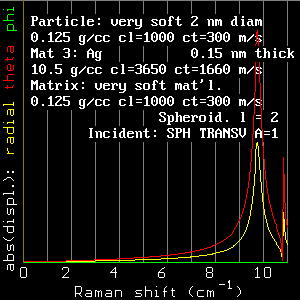
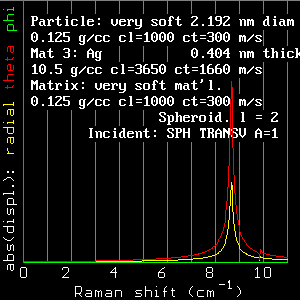
Figure 1: Free Ag shell model (hollow sphere made of pure Ag) (C++ listing: scp70k4.c)
(a) Ni0.75Ag0.25
diameter = 2.3 nm
outer radius = 1.150 nm
inner radius = 1.00 nm
shell thickness = 0.150 nm
Portales et al pdf :: calculated peak at 10.0 cm-1
(b) Ni0.5Ag0.5
diameter = 3.0 nm
outer radius = 1.50 nm
inner radius = 1.096 nm
shell thickness = 0.404 nm
Portales et al calculated peak at 8.7 cm-1
(c) Ni0.25Ag0.75
diameter = 2.8 nm
outer radius = 1.40 nm
inner radius = 0.784 nm
shell thickness = 0.616 nm
Portales et al calculated peak at 11.2 cm-1
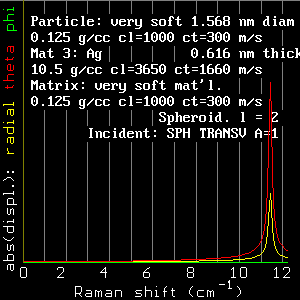
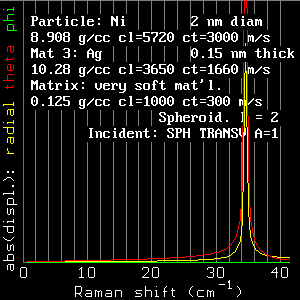
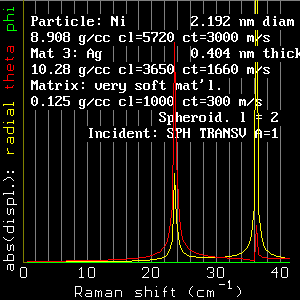
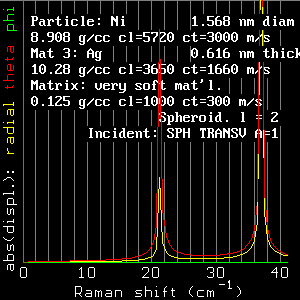
Figure 2: Core-shell Model (shell of pure Ag surrounding pure Ni core) (C++ listing: scp70k5.c)
(a) Ni0.75Ag0.25
diameter = 2.3 nm
outer radius = 1.150 nm
inner radius = 1.00 nm
shell thickness = 0.150 nm
Portales et al pdf ::(their Table I) calculated peak at 34.5 cm-1
(b) Ni0.5Ag0.5
diameter = 3.0 nm
outer radius = 1.50 nm
inner radius = 1.096 nm
shell thickness = 0.404 nm
Portales et al (their Table I) calculated peak at 24.1 cm-1
(c) Ni0.25Ag0.75
diameter = 2.8 nm outer radius = 1.40 nm
inner radius = 0.784 nm
shell thickness = 0.616 nm
Portales et al (their Table I) calculated peak at 21.4 cm-1

   The earlier calculation [Portales et al. 2002] made additional calculations in which they incorporate a soft layer between the Ni and the Ag (core-X-shell). My program as it presently exists is not able to handle the additional layer, but it could be made to do so with modifications.

References:

H. Portales, L. Saviot, E. Duval, M. Gaudry, E. Cottancin, M. Pellarin, J. Lermé, M. Broyer "Resonant Raman Scattering by Quadrupolar Vibrations of Ni-Ag Core-Shell Nanoparticles" preprint, March 22, 2002 pdf ::


Daniel Murray
Associate Professor
Math, Stats & Physics Unit
University of British Columbia - Okanagan
Kelowna, BC, Canada
daniel "dot" murray "at" ubc "dot" ca

For a list of related articlesclick here.


Hosted by www.Geocities.ws

1