�The basin fell to the ground broken, and the water flowed to the feet of Madame Defarge. By strange stern ways, and through much staining blood, those feet had come to meet that water.
Madame Defarge looked coldly at her, and said, �The wife of Evremonde; where is she?��(357).
Miss Pross, though she could not understand the French words, felt the purpose of Madame�s visit conveyed to her through those cold, uncompromising eyes that knew pity for no creatures living, dead, or yet unborn. She was pierced by their emptiness, and stood rooted to the spot.
Madame Defarge, recognizing Pross� petrification, dismissed her as useless and proceeded to make a search of the rooms. As all the doors stood open, this took no more than a minute or two, and having ascertained the absence of Lucie and her remaining family, the citizeness left the vacant apartments and turned her hurried steps to the court of La Guillotine, soon to be in session. The family of Evremonde must not be allowed to escape; they must be got back posthaste.
Coming to herself immediately upon Madame�s departure, as if Madame�s presence itself were a powerful spell, the removal of which spell would be attendant only upon the removal of the presence, Miss Pross once again guessed the citizeness� intent, and also fled the rooms, heading in the direction of her arranged meeting-place with Mr. Cruncher.
Six tumbrils trundled through the bloody avenues of Paris, swimming up the grisly stream to its source: La Guillotine, ultimate authority of the Republic. A great press of eager citizens surrounded the tumbrils, happily accompanying the prisoners on their last journey, the water through which the carts drove.
The crowd was directing shouts and jeers at various of the tumbrils� unhappy occupants, but one man in particular attracted their attention. He had had a particularly eventful �trial,� which they well remembered. They pointed him out to one another where he sat in the last cart, holding the hand of a young girl and having some conversation with her: �There he is, do you see? Evremonde, that dog. Heard you what black deeds lay on his family�s name? La Guillotine will finish him!�
The tumbrils at last arrived at their destination, where a band of knitting women presided over the guillotine. The Vengeance was standing on her chair, scanning the people spilling into the square for the visage of Madame Defarge.
�Therese!� she shouted. �Therese!�
But Madame Defarge was not there, though her husband was in attendance, standing near to the guillotine with the crowd.
�But where is Therese?� asked The Vengeance in dismay. �She will miss Evremonde!�
The proceedings did not pause to wait for Therese, however, but plowed ahead, as the first load of enemies of the Republic was executed. The knitting women paid very little attention to the steady flow of victims, only pausing briefly in their task to keep up with a head count. Things continued in this fashion for the duration of the time it took to empty four more tumbrils, but halfway through the sixth, there was an interruption, in the form of the sudden arrival of The Vengeance�s late but expected citizeness.
Madame Defarge rushed into the guillotine�s square, and, bulldozing through the crowd with a singular determination, came to the platform on which The Vengeance and her fellow knitters sat. The Vengeance stood to greet her, glad that she had made it in time to witness Evremonde�s beheading.
�Therese!� she cried, �Here you are. What �� she was stopped by Madame Defarge�s unusually dark countenance. Recovering herself, The Vengeance continued with, �What has happened?�
�They are escaping, my friend. They must be stopped. They cannot leave Paris!�
Uncomprehending, The Vengeance felt it incumbent upon her to ask, �But who, Therese? Evremonde is here. You�re lucky you made it back in time to see.�
�But his wife and child are not! They have gone.� Turning from The Vengeance, Madame Defarge addressed the assembled crowd, noticing her husband wondering to himself what was about as she did so. �Citizens! Friends! Together we have ended tyranny in France. Is it not so?�
The crowd roared its agreement.
�We have sentenced to death all those evil-doers, traitors, and emigrants responsible for our misery. Is it not so?�
Another general shout of approval.
�Do not some of those vile creatures wait even now for La Guillotine�s final attention?�
The masses howled at the remaining prisoners in the last tumbril.
�Justice must be brought to all such as these, yes?�
Another outcry advocating Madame�s general position.
�But wait, citizens! I have just come from learning of a plot by one of these disgusting dogs to escape justice and their ordained fate. Even now they flee us! Will you tolerate it?�
By the responding din, Madame Defarge divined that they would not.
�Then let us postpone the deaths of these,� she gestured towards the tumbril, �for but a little, in order that we may overtake these sniveling cowards and bring them to La Guillotine! I beseech you, citizens of the Republic, before it is too late!�
Amid an incredible noise, Madame Defarge beckoned Monsieur Defarge onto the platform. She thought it best to do something that would show her continued trust in him, and she didn�t want him interfering with the capture of the Evremondes. Madame would have liked to avoid giving Monsieur Defarge responsibility concerning the registered family at all, but circumstances had forced her hand somewhat and she had to act now. So she instructed him to wait with the Marquis and other prisoners and guard against any attempted escape, until such time as she should return. However, in an aside to The Vengeance, she asked her friend to watch her husband for her and to keep the other knitters with her, just in case.
Thus prepared, Madame Defarge descended from the platform and pushed through the massed spectators, who formed up behind her, trailing after her like the train of a gown. She quickly commandeered a horse and rushed off as fast as she was able in the crowded streets.
Her followers, not to be undone, either kept up on foot or acquired means of transportation similar to that of Madame Defarge.
Upon passing the gates, Madame sped up to a gallop. Those of her train with horses followed suit, and the rest straggled along as best they could until their stamina and enthusiasm for the chase gave out, and, discouraged, they began walking back to the city.
Some time earlier, Miss Pross reached the cathedral and waited for Mr. Cruncher, who did not take long to arrive. She quickly informed him of the situation, though slightly confusedly, as she was distraught and desperate to rescue her Ladybird. Once Mr. Cruncher had understood her, they clattered off without a moment to spare, left Paris without incident, and rushed down the road to overtake Lucie and her fellow passengers.
Meanwhile, Monsieur Defarge found himself alone with a board of busily knitting women and the remaining prisoners. He noticed Evremonde in the tumbril, and was reminded of why he had been left. Defarge understood the need for Evremonde�s death, but not the deaths of his innocent family, who, after all, both shared the blood of Dr. Manette, a great patriot who had suffered interminably under the rule of men such as Evremonde, in fact, men directly related to Evremonde. But now his vengeful wife had left on a mission to lay her many grievances at Lucie Darnay�s feet, and at the feet of her young child, and to hold them responsible for wrongs only their deaths could redress. But what was he supposed to do about it now?
Sydney blinked. The seamstress, beside him, wondered at the sudden change in his peaceful, resolved mood as he stood staring dumbly after the retreating crowd like a man lost.
One moment Sydney had been seconds away from death, and now his life had been prolonged, and who knew for how long. He would have preferred to be already dead. Worse than Darnay�s life being in jeopardy, now Lucie�s safety was called into question. Had they left quickly enough to have an unbreakable lead? Or had they been held up at the city�s gate, while good patriots inspected their papers?
Before he had been able at least to die for her, but now, under guard and with his arms tied behind his back, he could do not even that.
Miss Pross and Mr. Cruncher caught up to Lucie�s heavily laden carriage before Madame Defarge did. When Jerry signaled that they needed to talk, both carriages were stopped. Seeing Darnay alive and in the flesh inside the carriage almost shocked her into forgetting what urgent news she brought, but when Lucie asked her purpose in waylaying their carriage, it was recalled to her.
�Oh, my Ladybird,� Miss Pross moaned. �My Ladybird! That beastly Frenchwoman is coming after you.�
�Do you mean, my good Pross, Madame Defarge?� Mr. Lorry inquired.
Miss Pross could only nod her head in remembered horror, as her confrontation with Madame was called to mind. �She means to denounce you! She would have you killed! Even now she is pursuing us.�
Lucie was overwhelmed. First, she had learned that the man in the carriage with her was not Mr. Carton at all but her husband, who was supposed to be dead; second, that that good but regrettably misled man had taken Darnay�s place; and now, that none of it mattered anyway because they were about to be taken into custody by their enemies, and likely put to the death. Even her little girl was to share this hard fate, her innocent little Lucie, who had never done anyone harm in her short life.
�Lucie.�
It was her father speaking. �Lucie, my daughter, you must go with Miss Pross. Their carriage is light enough to escape. We will surely be overtaken.�
�But how can I leave you, my father?� Lucie protested.
�You must, Lucie. I am old. My time is over. But yours is not, so you must go.�
�Yes, Lucie,� Charles broke in. �Dr. Manette is right. I had already resolved myself to death in prison, remember? You have not, and have many years of life still ahead of you.�
Wordlessly, Lucie looked at them. She was no younger than Charles; who was he to speak of years?
Finally, she made up her mind. �Pross,� she said, picking up little Lucie. �Take my child with you. She is the lightest one here, and the youngest. Look after her for me?�
Miss Pross, stunned, took the child and managed, �Like she was my own. Like I looked after you.�
Lucie nodded. �Yes,� she grabbed Miss Pross and little Lucie, hugging them both. �Thank you. Now go.�
Miss Pross, holding little Lucie, got tearfully back into her carriage with Mr. Cruncher, and they rode off.
�Now what will we do, father?� Lucie asked.
�We must leave the carriage, and the road, if we hope to live,� Dr. Manette replied. �Mr. Lorry, you are not denounced with us, so you may escape this terrible place unmolested. I suggest you ride on to Calais, somewhere disposing of our luggage, and cross to Dover and England as quickly as you may. Without us, the carriage may be light enough to avoid being overtaken.
�As for ourselves, we must get out of France some other way. Perhaps we may find refuge in Holland or such till this revolution is ended, but none will be found here, and the crossing to England is closed to us. I suggest we part ways now, before our enemies can gain on us further. Goodbye, Mr. Lorry. I do not expect we will see each other again.�
Thus Mr. Lorry continued on sadly to England, while Lucie, her husband Charles, and her father Dr. Manette vanished into the countryside. Mr. Lorry never knew what became of them, but he liked to think they had finally found a home in some foreign, sane land, where life was not run by bloody-minded peasants or greedy aristocrats.
Back in Paris, in the square of the Guillotine, even as Madame Defarge rode past the point at which the Darnays and Dr. Manette had abandoned the carriage, Sydney Carton was still waiting. No one had returned to end his life, or to do anything at all, though it had been an hour, two hours and more since Madame�s departure. This meant he had had time to think of a thousand different fates for Lucie, most of which ended in her death. Several times the seamstress had attempted to gain his attention, to no avail. He had not moved or looked away from Madame Defarge�s route since she had left. He seemed to her like a statue, and this sudden retreat into his own mind of the previously brave and resolute stranger frightened her all the more.
She looked around her confusedly, not sure what was going on or why she had been spared. On her left, above her, the women sat knitting quietly, all except The Vengeance, who stared malevolently at the stranger, whose back was turned and didn�t notice. Defarge fidgeted below, seeming unsure of himself. Between them, La Guillotine eclipsed the sun. To her right, the square was empty and desolate. Before her, the city�s small, twisted streets and avenues continued on till the ramshackle buildings blocked them from sight. Behind her, dust settled on the wide thoroughfare at which the stranger gazed so fixedly and through which the crowd had vanished. The Guillotine�s shadow fell long and dark upon the sun-drenched cobblestones. The golden rays caught in the disturbed dust particles, creating an impenetrable yellow haze, beyond which all was a mystery her sight could not divine.
A figure appeared in the swirling sun-flecked motes. Indistinct at first, it gradually gained form and definition as the seamstress watched its calm and unhurried progress down the road. It was tall and thin, and all of a uniform dark color. When it passed through the shadow of the Guillotine, it was almost lost, it blended so well with the darkness.
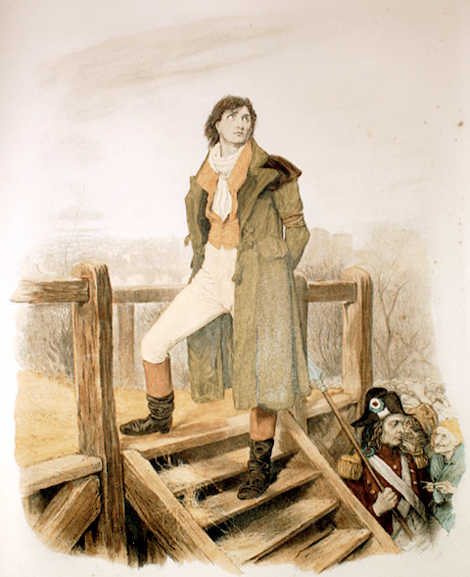
When it was close enough for her to discern the particulars of its dress � which consisted of a long trench coat concealing a formal suit, leather boots, and a stiff wide-brimmed hat, all in uncompromising black � it � he, because she now saw it was a male � stopped.
Sydney had registered the figure�s approach, in some small corner of his mind, but gave no sign that he had noticed anything. Defarge gradually was roused from his inner musings and stopped fidgeting to wait for the man, who had not made a sound, to speak. The knitters continued their work.
The Vengeance, taking charge of the situation, stood and said in her most imperious high-pitched tone, �Who are you, citizen, and what is your business here?�
A pause, in which the man seemed to be working out in his head the language being used.
Finally, he echoed, �Citizen?�, and lifted his head for the first time. His voice was deep, cultured, and the accent unmistakably British. He was around fifty, by his face, but had aged very well. His features would go against him, surely, if ever he were to be charged with actions against the Republic, for he looked of higher birth than the richest of the former aristocrats of France, who now hung about Tellson�s in a cloud. The most unusual of these damming witnesses who bore silent testimony against him were his eyes, which were distinctly of two different hues.
He continued speaking slowly, as if he were thinking about each word before he said it, and seemed to take in and comprehend the entirety of the scene he had walked in upon in an instant. �I am not a citizen of this land, Madame. I do not know of any country here that I may call my own, or that would claim me in return.�
�Then what brings you here, emigrant?� The Vengeance demanded of him harshly. �Never mind; do not answer. It matters not. We will hold you in custody until our fellow citizens return to try you.�
�Try me as what?�
�As an emigrant, and enemy of the Republic. Monsieur Defarge,� She called, indicating that he was to tie the stranger and place him in the tumbril with the others.
Monsieur Defarge advanced with a confident step, having picked up rope and happy to oblige The Vengeance in this small matter.
He tied the stranger�s wrists together behind his back with good, strong knots, but neglected to tie his upper arms as well. The man submitted to the bonds without persuasion or coercion necessary, and allowed himself to be put in the tumbril, where he made his way to a back corner before turning to mention, �By the way, your friend�s quarry escapes her. Madame is even now going in completely the wrong direction as quickly as she can, and soon all hope of apprehending the persons sought will be vanished.�
At this, Sydney was finally roused from his stupor and took an active interest in the proceedings once more.
�What do you mean?� asked The Vengeance sharply. �How could you know this?�
�I know it. The question is, will you risk it, this woman�s escape?�
The Vengeance considered. She could not logically give credence to the stranger�s claim, but still doubt gnawed at her. How long now had Th�r�se been gone? But it didn�t matter even if it was true. She couldn�t just leave the prisoners on their own while she rode after Th�r�se.
�Your friend needs you. Will you not go to her?�
The stranger�s voice, though obviously unaccustomed to the French language, had uncanny persuasive qualities. The Vengeance felt herself agreeing with him. Th�r�se had given everything she had for the Republic; would The Vengeance abandon her now, in her hour of need? No, for how could she? The prisoners were, after all, tied, and altogether a wretched, timid lot, surely quite incapable of any kind of an escape. She would leave Defarge behind, just in case, but her knitters she would need with her, to help hunt the last of the Evr�mondes.
�It is true,� The Vengeance proclaimed to the other women. �Th�r�se needs us; therefore, we shall come.� Then to the stranger, �Only tell us where they have gone, stranger, and we will soon render Th�r�se aid.�
�Oh�they went south,� he advised, gesturing in the direction opposite from that taken by Madame on her way toward Calais.
�Monsieur Defarge, you will remain and watch over the prisoners. Come, citizenesses! Find horses! We ride south!�
They exited the square in a hurry, eagerly headed the wrong way.
The stranger now turned his attentions to Defarge. �Oh, good sir, I see you are weary from a life of long toil. Why do you not rest?�
�I will rest when the Republic is safe,� returned Defarge.
�Is it not safe already, and in capable hands? Who would dare to challenge you, now that you have abolished tyranny in France?�
Defarge considered. �You are tired,� the stranger insisted. �Why not sleep?�
Defarge rocked on his feet, suddenly feeling each of his many years as a terrible burden upon his spirit. All he desired was sleep, but it could not come. He was guarding the prisoners, and could not neglect this duty.
�Look at us,� the stranger urged. �Can we escape? And where would we go? There is nowhere safe for us, the Republic is too strong. Sleep, you must.�
Five minutes later, Defarge was snoozing soundly in one of the chairs vacated by the women.
�Funny how I have that affect on people,� the stranger commented offhandedly to Carton.
Carton didn�t reply. He didn�t like the implications of what he had just witnessed, and felt himself to be not entirely safe with this mysterious man. But then, what did it matter? Lucie was in danger, in all likelihood dead already.
He became aware of the fact that the stranger was moving his arms behind his back. �What are you doing?�
�Cutting myself free,� the stranger replied nonchalantly.
�Can I persuade you to free me also?� Sydney asked hopefully. Maybe it wasn�t too late for him to help Lucie somehow. Then it occurred to him that this man had claimed to have knowledge of her whereabouts. �Do you truly know where she is?�
�I do, or at least I know where she is not.� The stranger finished cutting himself loose, then moved to render the others the same service.
�Where?�
�She has left the road and the carriage behind. She does not travel alone, and does not know where she goes.� The stranger said no more until he had freed all the other prisoners, who thanked him and left the square in various directions, though the Lord knows where they thought they would go next, in a city hostile to them and gone mad with bloodlust. The seamstress, for one who had a plan, was leaving at once to her cousin.
Carton was unbound last. �You cannot save her. But her child is not beyond your reach. The child is going to England, and will need someone to care for her younger than her current nanny.�
�How could you know this?� Carton asked, incredulous.
�I know it,� the stranger replied with a smile. He hopped out of the tumbril and continued leisurely on his way as if nothing had happened.
�Wait!� Carton called after him. The stranger stopped. �Who are you?� Carton asked.
The stranger hesitated, considering his answer. �I was a duke,� he said at last, and began walking again, quickly vanishing from sight.
Carton never saw the stranger again, but traveled back to England, where he found little Lucie in Miss Pross� care and learned from Mr. Lorry that the stranger had been right about Lucie. And so, Carton took over raising little Lucie when Miss Pross became too infirm to continue as she had, as per the stranger�s advice. He found that little Lucie�s dependence on him saved him from his old depression and bad habits, as he was motivated to for her sake prosper and clean himself up, as it were. So, though he never heard from Lucie again, the rest of his life he lived in peace and happiness, his spirit maintained by her child.
And he never forgot the stranger who had saved him from La Guillotine. He could discover nothing that rationally could explain the stranger�s easy manipulation of the French revolutionaries, or how he had come by his mysterious knowledge of Lucie�s fate, and never could determine just who � or what � the stranger had been. But privately, he suspected he was an angel.
So, what'd you think? Email me. Probably no one got who the stranger was, but it was David Bowie (the Thin White Duke). Yeah. I may change it, the ending seems a little forced, but I had to put something because it was due the next day. Okay, story update: I was thinking about the ending the morning before I turned it in, and really, what the hell is David Bowie doing in the French Revolution?!? So, I came up with the following explanation in the shower, wrote it down and turned it in with the story. In my defense, my teacher liked it. You see, David Bowie, being the extremely hot, talented, and overflowing-with-integrity guy he is, has made several enemies among the unprincipled and sucky dredges of Hollywood/the music industry, the most notable of which is none other than that low-down, Pepsi-drinking, 75% silicon Barbie doll slut Britney Spears. So, the Arch-Enemy Britney, finding herself unable to live in a world where she can compare herself to someone with a talent verging on the divine, and being too rich to commit suicide, seeks the help of an Extremely Enlightened and Just Slightly Insane scientist. Said Extremely Enlightened and Just Slightly Insane scientist has recently developed a One-Way Time Machine which is capable of catapulting random unsuspecting victims into the past. Britney pays the EEJSIS an absolutely ungodly amount of money to use his One-Way Time Machine on our dear beloved hero, Bowie. Of course, the EEJSIS takes the money and rids Britney of our beloved. Bowie is sent far into the past, never to return...or so Britney thought! What Britney didn't count on was that this particular EEJSIS happens to know a beautiful voice when he hears one, and so he used the money Britney payed him to finish his next enlightened invention: the Two-Way Time Machine. Using this new device, he finds our beloved in time and restores him to his rightful place as Most Perfect Singer...in the present. And as for the remarkably effective powers of persuasion he uses to free Sydney and himself from the crazy revolutionaries, the EEJSIS is responsible for that too. You see, before sending our beloved back in time, the EEJSIS blasted him with his Experimental Superman Ray, endowing our beloved with special powers to help him survive his sojourn in the past. Thus Britney the Arch-Enemy's evil plot was foiled and humanity saved from the anti-Bowie sluts of Hollywood/the music industry. Based on a true story.