
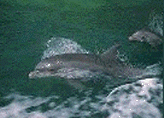
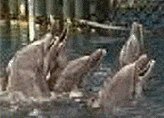
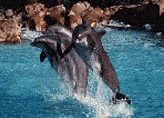
The Bottlenose dolphin's coloring can vary from a pure white underbelly to a deep, rich, charcoal gray. The pod's genetics and the dolphin's genes are resposible for the varying coloration rather then the regions of inhabitance contributing to color variations as with other species. Adult Bottlenose dolphins can reach lengths of 14 to 14.5 feet, and can weigh over 600 pounds. Males tend to be larger then females, but there are a few females who have tipped the scales of 606 and 612 pounds.
Bottlenose dolphins have been observed regularly feeding as a group. The dolphins will work together to "herd" a school of fish to a central location. Different members will take turns to feed while others work to keep the fish in position
Bottlenose dolphins are famous for their "songs". These noises are both the way a Bottlenose dolphins comunicates and locates things such as his pod and food. Their languge is a series of clicks, squeeks, chirps and squels. Although throughly documented, the language of the Bottlenose dolphin is not completely understood.
Bottlenose dolphins live worldwide with the exception of Polar Regions. It is not unusual to see Bottlenose dolphins bowriding along side boats, swimming into harbors, or even approaching a scuba or skin diver. These dolphins are just as curious about humans as humans are about them.
The Bottlenose dolphins has four enemies, two natural and two artificial ones, which are responsible for thousands of unnatural deaths of the Bottlenose dolphins each year. The natural enimies of the Bottlenose dolphins are Killer Whales aka Orcas, and Sharks. The killer Whales and Sharks are responsible for only eight percent of all unnatural Bottlenose dolphin deaths. Usually is it only the young, very old, or the weak that will fall prey to these predaors. Occasionally, an adult will be the victim. The artificial enemies of the Bottlenose dolphins are "Bycatch" and environmental threats. Bycatch is the name given to various sea animals or creatures that are caught and killed in nets meant to catch fish. Dolphins unfortunately fall victim to Bycatch much too often. While attempting to catch the same fish that the fishermen hope to trap in their nets, the Bottlenose dolphin wil chase these fish into the nets and become thrapped themselves. There are new nets that have "dolphin hatches" which allow the dolphins to release themselves if they are ever caught in the net. However, these nets are expensive so not all fishermen are using them due to the cost of them. Environmental threats include things such as habitat loss from development, toxins, water pollution, and depletion of food supply. Each of these factors will not only add to the demise of the Bottlenose dolphin, but also to other foms of life, such as humans.