
Volume 2, Issue 2, New Series Dear Member/Associate, The main reason for writing again so soon is to get approximate numbers for the Annual Dinner on May 12th. ( details were in the last letter.) I would be grateful if you could let me know as soon as possible - by return would be ideal! [email protected] or on 01579 34.20.26 or Lowena, Looedown, Liskeard PL14 6RD. My phone does not have an answerphone facility but takes messages of the 1571 variety. The Chairman of Restormel has already accepted, which is pleasing. I have to report that there will be a change to the advertised speaker. The Turkish Ambassador has been called abroad and cannot find an alternative speaker for the date. I think that he would like to speak himself, actually, and would rather come on a different date than send a substitute. That is what I glean by reading between the lines anyway. This being so I am currently seeking an alternative. The suggestion has been made that one of our MEPs might be invited. Of the seven who represent the 'SW' Giles Chichester is the Conservative with a brief for Cornwall and Devon. Otherwise it would be Glyn Ford (Labour) from Bristol or Graham Watson (L-D) from Somerset. The parliamentary timetable appears to be free then but the published table may not include events arranged since it was issued on the Net. To be fair and random, I put each name on a piece of paper, put these in a hat and drew them out in turn. Graham Watson was first, so I should invite him first. If he cannot oblige I should try Giles Chichester next, and then Glyn Ford. However, I also have a sort of an arrangement with the Romanian Embassy, so the next two days are going to be busy! Romania is one of the two countries, with Bulgaria, which have now signed treaties of application. There have been links between Cornwall and Romania for some years. Those of you who came to the dinner in Charlestown may recall that one of our two speakers that evening was Canon Robson, of the White Cross Mission, which is a Cornish charity which helps Romanian orphans. She remarked at the time that the people they dealt with had a special affection for two flags - the black and white of Cornwall and the blue and gold of Europe. Some years previously, in 1988, I think, the last communist president, the infamous Nicolae Ceausescu, was destroying traditional villages and replacing them with huge urban tower blocks as part of his 'systematisation programme. Our town council had been invited to join with its Breton twin, Quimperl�, to offer moral and, if possible, more tangible support to a village near Cluj ( near Timisoara.) The two towns working together would not only have helped meet some of the logistical problems that might have arisen but would have further cemented our twinning. One of our members was very outspoken about getting involved with communists and nothing was done. In fact, the following year saw their revolution and the end of that particular problem. John de Courcy Ireland and Roy Denman. Some people think I am a bit odd because when I open a newspaper I frequently turn first to the obituary pages. As an historian I find them irresistible. I was particularly sad recently to see entries for the above two men. Ireland (was anyone ever better named?) was a patriotic Irishman and a strong internationalist who felt that war is not only immoral but an inefficient way to sort out international problems. His left-wing views led to a flirtation with Communism but of a human rather than authoritarian kind.
He first came to my attention a few years ago when I saw a copy of his Ireland's Sea Fisheries: a History; a classic of its genre. I have long been researching the history of our industry and there is much in his book of more than peripheral interest to our story. A 15th century Cornish entrepreneur claimed that he would rather have lost his tin mines than the right it fish off the Irish coast. St Ives men used a net they called Dungarvan, presumably made in that port. Some time later, perhaps during the troubles of the 17th century, the custom came to an end and restarted in the early 19th century. From Dun Laoghaire, where they founded the Methodist church, and Howth they chased herring whilst later Kinsale, in the far south, became a base for mackerel ( our canners preferred the fatter fish from that coast to our own product.) The book has a photo of the Ovoca, the first motor trawler to be built in the British isles ( Arklow, 1907.) Perhaps coincidentally, in that same year, some London investors had a project to build one for Padstow, but I don't think anything materialised ( though that year did see the first motor ferry from Padstow to Rock.) I read an article the other day criticising Cornish fishermen for being slow to adopt motors. It was not due to undue conservatism but a lack of cash that caused them to hold back. It is a strange paradox that people who were prepared to sink money in mining ventures of doubtful wisdom were very reluctant to invest in fishing. One honourable exception was Mr Behrens of Prussia Cove who offered to fit out six of the best Mounts Bay boats. Unfortunately he died before his offer could be taken up. de Courcy Ireland campaigned continuously and, ultimately successfully, for a better appreciation of the value of Ireland's sea fisheries to the national economy. With the building of Veronica and the even more huge Atlantic Dawn one could think he had succeeded too much. However, 2002 also saw the first compulsory sea safety training in Ireland. He was an idealist but left a very solid legacy to his country. I had the pleasure to meet him to discuss aspects of the Cornish in the Irish Sea fisheries and he was very helpful. In the back of the book I found an article I had cut out from Fishing News exactly 4 years ago. One Brendan O'Donnell was writing of Spanish fishermen working off the Irish coast 50 years ago. He describes one scene in which some Spanish, French and a few British vessels had sought shelter from bad weather in the tee of Valentia Island. An ancient British steam trawler arrived and, noticing a couple of Spanish pair trawlers at anchor, deliberately bashed first one, then the other hard in the stern. The Spanish preferred to risk the weather, weighed anchor and headed for the open sea! Apparently the French and British trawlers used on occasion to extinguish their lights and then tear up the Spaniards' gear with heavy weighted steel hooks.
|
April 2006 One of my early memories was of about this time. We had been camping down at Sennen and one day visited the coastguard station on Cape Cornwall. Through their powerful binoculars we watched a French and a Spanish trawler heaving lumps of coat at each other - fighting for the 'right' to steal our fish! ( The Sevenstones had been officially part of Cornwall, Sennen parish, since 1903) I never had the pleasure of meeting Sir Roy Denman but his book, Missed Chances Britain and Europe in the 20th century, should be compulsory reading for the very understanding insights it gives into the history we have been living through; giving substance all too often to Adlai Stevenson's gibe about Britain having lost an empire but not yet finding a rôle. Denman was under no doubt that Britain's rôle was (and is) in Europe. Although he was intimately involved in many of the events he explains his account seems to me very fair and balanced. If schools are to place a greater emphasis on British history I wonder how much of this period will find its way in? Precious little, is my guess; it will be deemed too controversial and, despite the bulk of it having taken place before the children concerned were born, too recent to be history. How can democracy work without an informed populace? In the last letter I promised to summarise Peter Maass' conclusions from his reporting of the Bosnian war. They are a little bleak,
UKIP, in seeking to belittle the achievements and worth of the EU, say the same about Europe as a whole. Of course there is no danger of war - nobody wants it and our countries are too intertwined. How, with the lessons of Bosnia behind us and unknown but threatening pressures ahead of us, economic, environmental, racial, can any but the congenitally stupid be so smug? There are those idealists who ask 'as all people are the same so why try and make anything out of the differences?' In one sense they are right - biologically we are all the same within tight limits; we are all the same number of generations evolved from our common ancestors. But in a sense they are also wrong. Human society is amazingly diverse and in this diversity lies the beauty as well as the ugliness of the human condition; the creativity as well as the destructiveness. Diversity is a fact of life and if we cannot appreciate it as we should then at least we must learn to live with it. There is always the danger of the manipulators who use our weakness in accepting difference to create Bosnian-style conflict which they can then exploit to their own advantage. This is not always done quite as unsubtly as by a Milosevich or a Hitler. Maass would 'not dare to predict that It could happen in America which is so different from Europe.' Humm. During four decades America learned not just to survive but to exploit the Cold War to gain a near global hegemony. With the capitulation of the opponent they seemed temporarily to lose momentum. Is Islam the new opposition? Or has belligerence become such a deeply ingrained habit that its administrations can conceive of no other way of relating to those who do not kow-tow to them? Cornwall - a European Region of Culture I expect that by now you will have heard or read about this imaginative project by Cornwall Arts Marketing. I have on CoBER's behalf signified an interest. It is too recent to have been discussed by your board yet; I am still awaiting details from Miranda Bird who seems to be the,contact organiser. We have some experience to lend and our extensive library which is still being catalogued. I have sent then some copies of our Cornwall- a brief introduction in each of the languages in which it is currently available. If some funding could come our way we could produce a more exciting presentation, with maps and pictures and so on. I also sent copies to the publicity department of the World Heritage Bid office. We had quite an interesting meeting with them down at Trevarno the other day ( we being museums and similar bodies associated with the bid.) Multilingual Guide to European Cultural Communities I still have a few left of these interesting books which CoBER helped to produce. They were selling for �10 but I can let members have them for �5 each. They have 364 pages of text in three languages each, and maps. Good value, I think. I shall bring some to the dinner. |
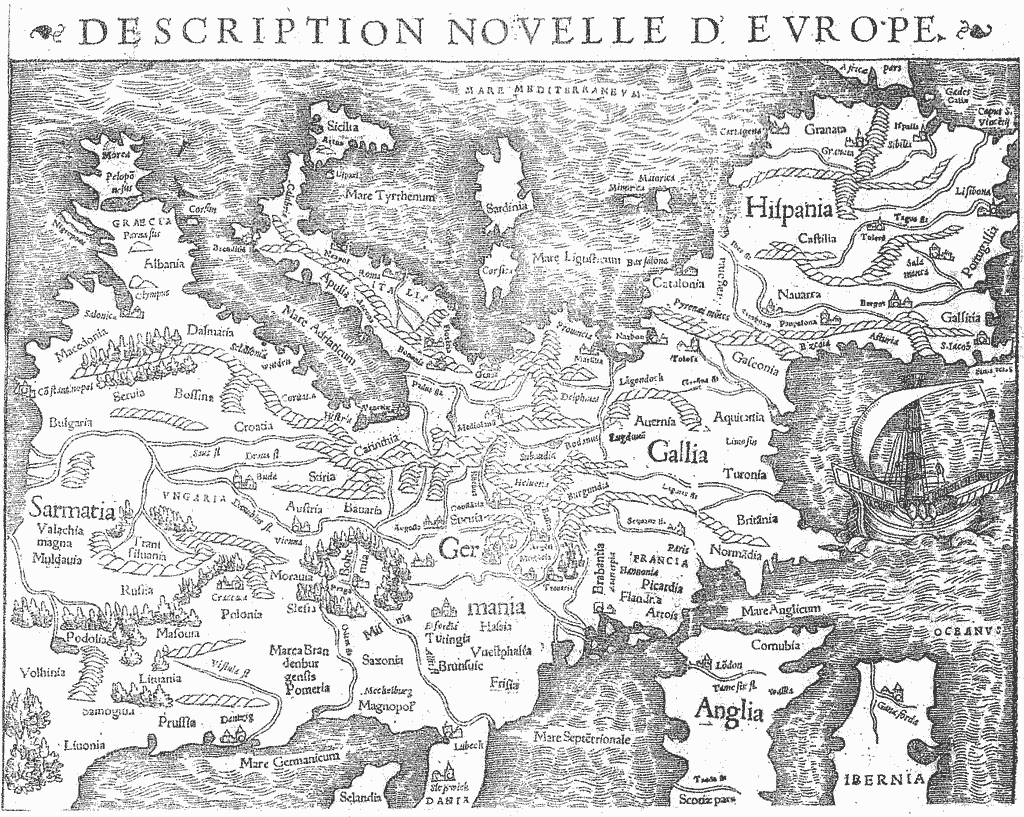
An interesting view of Europe by Sebastian Munster c1546
CoBER is a limited Company Registered in England & Wales No 3083136, Registered Office, 7,West Street, Liskeard, Cornwall, GB
CoBER can be contacted by email: [email protected]
 Index
Index